

P0740 on 2005-2009 Hyundai Tucson: Torque Converter Clutch Circuit Causes and Fixes
On a 2005-2009 Tucson, P0740 is most often caused by a failed internal transmission wiring harness or a faulty Torque Converter Clutch (TCC) solenoid. The repair involves dropping the transmission pan to replace these parts and should include a new filter and fresh Hyundai SP-III fluid.
- P0740 on a 2005-2009 Tucson is an electrical code, not a death sentence for your transmission.
- The most likely cause is a failed internal wiring harness (Part #46307-39050) or a bad TCC solenoid.
- Always check transmission fluid level and condition first.
- The repair requires dropping the transmission pan, so plan to replace the fluid (SP-III spec), filter, and pan gasket at the same time.
- If you see other solenoid codes like P0750 or P0755, the internal wiring harness is almost certainly the problem.
What's Unique About the 2005-2009 Hyundai Tucson
For this generation of Hyundai Tucson, which uses an F4A42-family automatic transmission, code P0740 is very frequently linked to the degradation of the internal transmission wiring harness over time. The plastic insulation on the wires becomes brittle from constant heat cycles, leading to cracks and electrical shorts. Hyundai issued a Technical Service Bulletin (TSB 09-AT-018) that specifically covers this and other solenoid codes, advising technicians to diagnose the electrical components rather than immediately condemning the entire transmission. The bulletin emphasizes that if multiple solenoid codes are present, the harness is the likely culprit.
Symptoms You May Notice
- Check Engine Light is on
- Engine RPMs are higher than usual at highway speeds
- Noticeable decrease in fuel economy
- Transmission may feel like it's slipping
- Harsh or delayed gear shifts
- Vehicle may enter 'limp mode' and get stuck in 3rd gear
- Shuddering or vibration at steady cruising speeds
- Transmission overheating
- Replacing the entire transmission. Hyundai TSB 09-AT-018 specifically advises against replacing the transaxle for this code until proper electrical diagnosis of the solenoids and wiring has been completed.
Most Likely Causes
- Failed Internal Transmission Wiring Harness 🔴 High Probability → Shop Transmission Assembly The internal harness on this era of Hyundai transmissions is a known failure point. The wiring insulation becomes brittle from years of exposure to hot transmission fluid, causing it to crack and short circuit. This is a well-documented issue in owner forums.
How to confirm: Visually inspect the harness for cracked or flaking insulation once the transmission pan is removed. Often, multiple solenoid codes (like P0750, P0755) will be present along with P0740, strongly indicating a harness failure. TSB 09-AT-018 also points to this diagnostic path.
Typical fix: Replace the internal wiring harness. This is done with the transmission pan removed.
Est. part cost: $80-$160 - Failed Torque Converter Clutch (TCC) Solenoid 🔴 High Probability → Shop Automatic Transmission Torque Converter The TCC solenoid is an electro-mechanical part that is in constant use and can fail electrically (coil burns out) or mechanically (valve sticks).
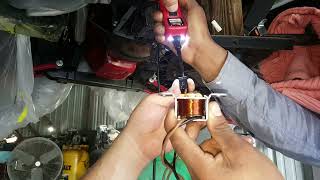
How to confirm: After removing the transmission pan, the solenoid can be tested with a multimeter for proper resistance. For the F4A42 transmission, the TCC solenoid (also called Damper Clutch Control solenoid) should have a resistance of 2.7 to 3.4 ohms. An out-of-spec reading or an open circuit confirms failure.
Typical fix: Replace the TCC solenoid. It is located on the valve body inside the transmission.
Est. part cost: $50-$120 - Low or Dirty Transmission Fluid 🟡 Medium Probability → Shop Transmission Assembly
How to confirm: Check the transmission fluid dipstick for level and condition. The fluid should be at the correct level, pink/red in color, and not smell burnt. Dark, burnt fluid or a low level can cause shifting issues and trigger codes.
Typical fix: Perform a transmission fluid drain-and-fill or a full fluid flush. Ensure only Hyundai Diamond SP-III or a compatible equivalent fluid is used, as specified in Hyundai TSBs.
Est. part cost: $60-$120 for fluid - Damaged External Wiring or Connectors ⚪ Low Probability
How to confirm: Visually inspect the wiring harness leading to the transmission for any signs of damage, corrosion, or loose connections at the main plug.
Typical fix: Repair the damaged section of the wiring harness or clean/replace the connector.
Est. part cost: $10-$50 for repair materials
Rare But Worth Checking
- Faulty Transmission Control Module (TCM): → Shop Transmission Assembly This is rare. The TCM should only be considered after all other possibilities, especially solenoids and wiring, have been thoroughly tested and ruled out.
- Internal Mechanical Failure of Torque Converter: → Shop Automatic Transmission Torque Converter While the code points to an electrical circuit, a severe internal failure of the torque converter itself can sometimes trigger it. This is usually accompanied by significant metal shavings in the transmission pan and other drivability symptoms.
Diagnosis Steps
- Check the transmission fluid level and condition. Top off or change if necessary, using only Hyundai SP-III fluid or a compatible equivalent.
- Scan for other transmission-related codes. The presence of multiple solenoid codes (P0750, P0755, etc.) makes the internal harness the primary suspect.
- Inspect the external transmission wiring harness and main connector for any visible damage or corrosion.
- If external wiring is okay, drain the transmission fluid and drop the oil pan.
- Visually inspect the internal wiring harness (Part #46307-39050) for brittle 🎬 Watch: DIY guide to removing F4A42 automatic transmission solenoids, cracked, or flaking wire insulation.
- Test the resistance of the TCC solenoid with a multimeter. It should be between 2.7 and 3.4 ohms. An open (infinite resistance) or shorted (zero resistance) reading indicates a bad solenoid.
- If the harness and solenoid test good, the issue may be with the valve body or, in rare cases, the TCM.
Parts You'll Likely Need
- Internal Transmission Wiring Harness
(OEM #46307-39050)— This is the most common point of failure for this code on this vehicle due to heat-related degradation of the wire insulation. Multiple parts suppliers confirm this part number for the 2005-2009 Tucson.
Trusted brands: Hyundai (Genuine)
OEM price range: $100-$160
Aftermarket price range: $80-$120 - Torque Converter Clutch (TCC) Solenoid
(OEM #46313-39051)— This solenoid is the component directly referenced by the P0740 code and is a frequent failure item. It is also referred to as the Damper Clutch Control Solenoid.
Trusted brands: Hyundai (Genuine), Rostra, Standard Motor Products (TCS289)
OEM price range: $80-$150
Aftermarket price range: $50-$100 - Automatic Transmission Fluid (Hyundai SP-III)
(OEM #00232-19012)— The fluid must be drained to access the internal components and must be refilled with the correct specification fluid to ensure proper transmission function, as per Hyundai TSB 20-AT-010H.
Trusted brands: Hyundai/Kia (Genuine), Valvoline MaxLife ATF, Castrol Transmax Multi-Vehicle
OEM price range: $15-$25 per quart
Aftermarket price range: $8-$15 per quart - Automatic Transmission Filter and Pan Gasket
(OEM #46321-39010 (Filter), 45285-39010 (Gasket))— These should always be replaced whenever the transmission pan is removed to ensure proper filtration and prevent leaks.
Trusted brands: Wix, Fram, Fel-Pro
OEM price range: $40-$70 (kit)
Aftermarket price range: $20-$40 (kit)
Related Codes That Often Appear With This One
- P0750 — Shift Solenoid 'A' Malfunction. If this code appears with P0740, it strongly suggests the internal wiring harness is faulty, as the harness serves multiple solenoids.
- P0755 — Shift Solenoid 'B' Malfunction. Similar to P0750, its presence points towards a common failure point in the internal wiring harness.
- P0741 — Torque Converter Clutch Circuit Performance or Stuck Off. This is a related code that indicates a performance problem rather than a pure electrical circuit fault, but the root causes are often the same. A video of an F4A42 teardown for a P0741 code pointed to a torque converter problem.
- P0700 — Transmission Control System Malfunction. This is a generic code indicating that the TCM has stored a fault. It will almost always be present alongside a more specific code like P0740.
Technical Service Bulletins (TSBs) & Recalls
- TSB 09-AT-018: Addresses diagnostic procedures for P0740 and other solenoid codes, advising against unnecessary transmission replacement. It guides technicians to perform electrical checks on solenoids and the internal harness.
- TSB 20-AT-010H: Specifies the correct Automatic Transmission Fluid (ATF) for Hyundai vehicles, confirming SP-III (Part No. 00232-19012) for the 2005-2009 Tucson.
- TSB 04-40-015: Referenced in other diagnostic guides, this TSB provides instructions for replacing the internal harness when multiple solenoid DTCs are found.
Platform-Specific Known Issues
- source — An owner of a 2005 Tucson with codes P0700 and P0742 (a related TCC code) noted the issue seemed to happen at highway speeds and that a fluid change temporarily helped. They also mentioned that Hyundai forums suggested the issue was typical and not worth a full transmission replacement, pointing towards a solenoid replacement instead.
- source — A 2007 Tucson owner with 122k miles reported getting codes P0700 and P0741 (TCC Stuck Off). They noted the transmission seemed to shift normally in the city but were hesitant to go to a dealer, asking about DIY-friendly checks. This highlights the common owner experience of seeing the code without severe initial symptoms.
Mechanic-Grade Diagnostic Values
- Torque Converter Clutch (Damper Clutch Control) Solenoid Resistance — expected: 2.7 - 3.4 Ohms at room temperature. Failure: A reading of infinite resistance (open) or near-zero resistance (short) indicates a failed solenoid.
- TCC Solenoid Circuit Voltage Drop — expected: The TCM/PCM expects to see a specific voltage drop across the solenoid when it is commanded on.. Failure: If the module commands the solenoid on but does not see the expected voltage drop, it flags the P0740 code, indicating an open or shorted circuit.
Scan Tool Commands That Help
- Hyundai GDS / Hi-Scan Pro: Actuation Test for DCC (Damper Clutch Control) Solenoid — This bidirectional test is used to confirm if the wiring and solenoid are electrically capable of functioning. The technician commands the solenoid on and listens for an audible click from the transmission. If the scan tool shows 'TEST FAILURE' and no click is heard, it points to an open/short in the circuit or a failed solenoid. If it shows 'COMPLETED' and a click is heard, the external wiring to the TCM is likely intact.
Wiring & Ground Locations
- Transmission Main Connector — On the top or side of the transaxle case, where the main vehicle harness connects to the transmission.. This is the primary connection point for all transmission electronics. A visual inspection for corrosion, moisture, or bent/pushed-out pins is a critical first step before assuming an internal failure.
- Transmission Ground Strap — Typically a braided metal strap bolted from the transmission case to the vehicle's chassis or engine block. While a specific diagram for the 2005-2009 Tucson is elusive, look for a ground cable near the starter or on the bell housing.. A poor ground connection can cause a variety of electrical issues, including erratic solenoid behavior and incorrect sensor readings, potentially leading to a P0740 code.
Real Owner Repair Stories
- Hyundai-Forums.com / Go-Parts research summary (2000-2006 Hyundai Elantra (with same F4A42 family transmission and harness P/N)) — Multiple solenoid codes stored at once (P0740, P0750, P0755, P0760, P0765, P0770).
❌ Tried (didn't work) Diagnosing each solenoid individually.
✅ What actually fixed it Replacing the single internal transmission wiring harness (P/N 46307-39050) resolved all six codes simultaneously. This pattern is a classic indicator of harness failure rather than multiple solenoids failing at once. - YouTube video by 'YepThatsIt' (Hyundai with F4A42 Transmission) — P0740 - TCC Torque converter clutch circuit malfunction.
✅ What actually fixed it The video identifies the TCC solenoid as the direct cause of the P0740 code. It is physically located on the valve body on the lower, left-hand side (on a RHD vehicle). The video demonstrates how to remove the retaining bracket to access and replace the solenoid without removing the entire valve body.
OEM Part Supersession History
46313-39050→46313-39051— Part revision or manufacturer change.
Heads up: The parts are interchangeable; 46313-39051 is the direct replacement for the older part number.46307-39050→No supersession found— N/A
Heads up: This part number remains the correct and current one for the specified vehicle range.
Diagnostic Flowchart
Other Known Issues on This Vehicle
Issues unrelated to this code that are worth knowing about as an owner of this generation:
- Subframe and Control Arm Rust 🔴 High — Very common in 'Salt Belt' regions, can occur at any mileage. Can lead to component failure. (Ref: Recall 113 (NHTSA 13V-354) and a related class-action lawsuit addressed this. Owners report failures even after recall service.)
- Crankshaft Position Sensor (CKP) Failure 🟠 Medium — Common failure item, often after 80,000 miles. Symptoms include engine cranking but not starting, sudden stalling (especially when warm), and rough idling. (Ref: No specific recall, but a widely documented failure. Associated with codes like P0335.)
- Faulty Brake Light Switch 🟡 Low — Extremely common across many Hyundai models of this era. Can cause brake lights to fail, cruise control to not work, and ESC/TCS warning lights to illuminate. (Ref: Recall R/2013/056 was issued to replace the switch.)
- Sluggish Acceleration 🟠 Medium — Reported in older, higher-mileage models. Can be caused by various issues including clogged fuel injectors or failing sensors.
Used vs. New Parts: Buying Guide for This Vehicle
When a used part is the smart pick: For this specific repair, using used parts is generally not recommended. The primary failure items (wiring harness, solenoids) fail due to age and heat cycles. A used part from a junkyard will have similar age and wear, offering little to no long-term reliability.
Donor-vehicle mileage cap: roughly under 50000 miles for the part to have meaningful remaining life.
What to inspect on the donor part:
- If considering a used valve body assembly, look for a donor vehicle with the lowest possible mileage.
- Avoid parts from vehicles that show signs of transmission overheating (dark, burnt fluid).
- Inspect the wiring on a used harness for any signs of brittleness or cracking; if it's not pliable, it's not a viable part.
OEM-only on this vehicle (don't cheap out):
- Internal Transmission Wiring Harness: Aftermarket versions exist, but the OEM part is the most reliable choice for this known failure point. The cost difference is often minimal compared to the labor of doing the job twice.
Aftermarket brands forum-validated for this vehicle:
- Gaskets: Fel-Pro, Mahle, Victor Reinz
- Filters: Wix, Fram, Beck/Arnley, ATP
Brands owners have reported issues with on this vehicle:
- Unbranded, 'white box' solenoids and wiring harnesses from online marketplaces are a significant gamble. Sticking to Genuine Hyundai or well-known transmission parts brands like Rostra or Standard Motor Products is safer.
Real Owner Stories
Aggregated from forums and TSBs cited above. Mileages and costs reflect what owners reported in those sources.
2005 Hyundai Tucson
Symptoms: The issue occurred at highway speeds; the owner observed codes P0700 and P0742. A fluid change provided only a temporary fix.
What fixed it: The owner was advised by forums to replace the solenoid rather than the entire transmission.
Source hint: 2CarPros thread titled '2005 Hyundai Tucson Codes P0700 and P0742 Torque Converter Clutch Solenoid'
2007 Hyundai Tucson — 122000 miles
Symptoms: Codes P0700 and P0741 (TCC Stuck Off) appeared. The transmission shifted normally in city driving, but the owner was hesitant to visit a dealer due to the code appearing without severe initial symptoms.
What fixed it: The discussion highlighted DIY-friendly checks for the TCC system to avoid dealer costs.
Source hint: Reddit Discussion on P0741 in r/Hyundai
Related OBD-II Codes
Frequently Asked Questions
Which specific transmission fluid should I use for my 2005-2009 Tucson to avoid P0740 issues?
My Tucson has P0740 along with P0750 and P0755. Does this mean I need a new transmission?
Is there a specific resistance check for the TCC solenoid on the F4A42 transmission?
Why is the internal wiring harness a common failure point on this era of Hyundai?
Can a faulty brake light switch cause transmission-related issues on my Tucson?
What are the symptoms of the 'limp mode' mentioned for the 2005-2009 Tucson?
Helpful Videos
We Have This Part in Stock




The information in this article is provided for general reference and educational purposes only. Vehicle specifications, procedures, and part compatibility can vary by production date, trim level, and region. Always consult your vehicle's factory service manual and verify part numbers before purchasing or performing repairs. Safety-critical components such as airbags, seat belts, and braking systems should be installed by a qualified professional.
- Hyundai Tucson:
- 🧭 Diagnostic Flowchart
- 🎬 Helpful Videos
- 🛍️ Shop This Part
- What's Unique About the 2005-2009 Hyundai Tucson
- Symptoms You May Notice
- Most Likely Causes
- Rare But Worth Checking
- Diagnosis Steps
- Parts You'll Likely Need
- Related Codes That Often Appear With This One
- Technical Service Bulletins (TSBs) & Recalls
- Platform-Specific Known Issues
- Mechanic-Grade Diagnostic Values
- Scan Tool Commands That Help
- Wiring & Ground Locations
- Real Owner Repair Stories
- OEM Part Supersession History
- Other Known Issues on This Vehicle
- Used vs. New Parts: Buying Guide for This Vehicle
- Real Owner Stories
- 2005 Hyundai Tucson
- 2007 Hyundai Tucson — 122000 miles
- Related OBD-II Codes
- Frequently Asked Questions
- 🎟️ Get 5% Off