

P0756 on 1998-2002 Honda Accord: Shift Solenoid 'B' Causes and Fixes
This code indicates a problem with Shift Solenoid 'B', often due to low or dirty transmission fluid. The first step is always to check the fluid level and condition. If the fluid is fine, the solenoid itself is the next most likely culprit. On this model, Solenoids B and C are a single unit.
- Always check the transmission fluid level and condition first; it's the most common and cheapest fix.
- Use only Honda Genuine ATF-DW1 fluid. These transmissions are very sensitive to fluid type.
- The P0756 code refers to Shift Solenoid 'B', which is located on the front of the transmission, usually under the battery.
- If the solenoid needs replacement, it's a moderately difficult DIY job due to the need to remove the battery and its tray for access.
- If you find significant metal debris when checking the fluid or solenoid, it likely indicates a more severe internal transmission problem requiring professional service.
What's Unique About the 1998-2002 Honda Accord
The 4-speed automatic transmissions in the 1998-2002 Honda Accord are notoriously prone to failure, a fact that led to class-action lawsuits and warranty extensions. Many shifting issues, including P0756, can often be traced back to using non-Honda ATF or extending fluid change intervals. Owners often find that a simple '3x drain-and-fill' of the transmission fluid can resolve intermittent solenoid performance issues. However, this code can also be an early warning of the well-documented internal clutch pack failures common to this transmission.
Symptoms You May Notice
- Check Engine Light is on
- Flashing 'D4' or 'D' indicator light on the instrument cluster
- Harsh, erratic, or delayed shifting, especially a clunk when shifting from N to D
- Transmission slipping between gears
- Vehicle gets stuck in one gear (limp mode)
- Inability to shift into a specific gear
- Increased fuel consumption
- Transmission overheating
- Replacing the solenoid without first performing a 3x drain-and-fill with genuine Honda ATF.
- Assuming the entire transmission needs to be rebuilt before testing the individual solenoids and checking the fluid for excessive debris.
- Replacing only a single solenoid when they are sold and serviced as a dual assembly on this model.
Most Likely Causes
- Low or Dirty Automatic Transmission Fluid (ATF) 🔴 High Probability → Shop Transmission Assembly These transmissions are known to be sensitive to fluid quality and level. Old, contaminated fluid can clog the fine passages within the solenoid body, causing it to stick. Using anything other than genuine Honda ATF is a common cause of issues.
How to confirm: Check the transmission fluid dipstick (yellow handle) for level and color with the engine off and warm. The fluid should be red and clear, not brown, black, or smell burnt. A small amount of gray material on the dipstick is normal wear, but excessive material indicates a problem.
Typical fix: Perform a series of three drain-and-fills (a '3x drain and fill') using Honda Genuine ATF-DW1 (which superseded the original ATF-Z1). This replaces a majority of the old fluid. 🎬 Watch: How to perform a transmission fluid and solenoid service. A single drain-and-fill only replaces about 3 quarts of the total volume.
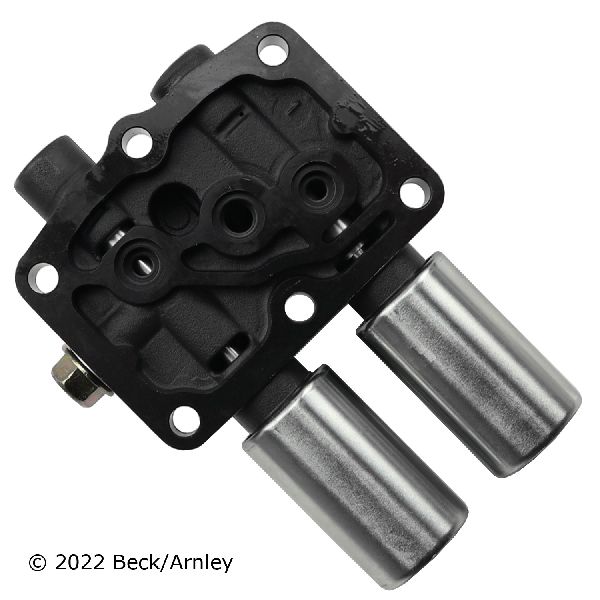
Est. part cost: $30-$90 - Failed Shift Solenoid 'B'/'C' Assembly 🟡 Medium Probability → Shop Transmission Valve Body Solenoids are electro-mechanical parts that can fail over time from heat and wear. Debris in the fluid can also cause them to stick internally. On this model, Solenoids B and C are integrated into a single 'dual-linear' assembly that is replaced as one unit.
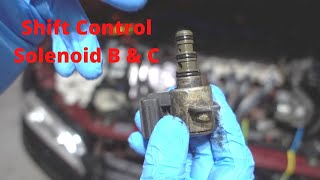
How to confirm: After confirming fluid is good, test the solenoid assembly. Disconnect the electrical connector and measure the resistance of Solenoid 'B' with a multimeter. The specification is 12-25 ohms. You can also apply 12V power to the solenoid terminals 🎬 See how to test and replace the B and C solenoids. to listen for an audible 'click', which indicates it is actuating mechanically.
Typical fix: Replace the faulty dual-linear shift solenoid assembly. It is located on the front of the transmission, typically requiring removal of the battery and battery tray for access. Always use new gaskets.
Est. part cost: $100-$250 - Clogged Transmission Filter or Passages ⚪ Low Probability → Shop Transmission Assembly If the transmission fluid has not been changed regularly, sludge and clutch material can accumulate and block the small screens on the solenoids or internal fluid passages. This was a known issue addressed in Honda TSB 00-033.
How to confirm: When the solenoid assembly is removed, inspect its screens for metal shavings or other debris. If significant debris is found, it points to a larger internal transmission problem, which is very common on this model.
Typical fix: Clean the solenoid screens. If the screens are heavily clogged with metallic debris, it often indicates serious internal transmission wear (e.g., failing clutch packs), and a transmission rebuild or replacement is likely necessary.
Est. part cost: $0 for cleaning, $2500+ for rebuild
Rare But Worth Checking
- Wiring or Connector Issue: The wiring harness leading to the transmission can become damaged from heat, oil, or chafing, causing an intermittent connection to the solenoid. Check the connector for corrosion or loose pins.
- Faulty Powertrain Control Module (PCM): This is very rare. The PCM is the computer that controls the transmission. It should only be considered after all other possibilities, including fluid, solenoids, and wiring, have been thoroughly ruled out.
Diagnosis Steps
- Read the code with an OBD-II scanner. Note any other transmission-related codes like P0700, P0761, or P0780.
- Check the level and condition of the automatic transmission fluid. The engine should be warm and turned OFF for an accurate reading. The dipstick has a yellow handle.
- If the fluid is low, top it off with Honda ATF-DW1 and check for leaks.
- If the fluid is dark, burnt, or contains debris, perform a 3x drain-and-fill. Clear the codes and test drive to see if the issue is resolved.
- If the code returns, locate the dual-linear Shift Solenoid B/C assembly on the front of the transmission. You will need to remove the battery and battery tray for access.
- Inspect the wiring and connector for any damage or corrosion.
- Disconnect the solenoid connector and test the resistance of Solenoid 'B' with a multimeter. Compare the reading to the factory specification of 12-25 ohms.
- Carefully apply 12V power to the solenoid's terminals to listen for a distinct click, confirming mechanical operation.
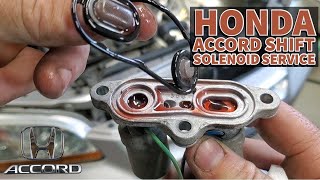
- If the solenoid fails the resistance test or does not click, replace the entire assembly (28250-P6H-024) along with its three gaskets. 🎬 Watch this step-by-step walkthrough for removing and replacing the solenoid.
- When removing the old solenoid, inspect the screens for metal debris. A clogged screen indicates a more severe internal transmission problem is likely imminent.
Parts You'll Likely Need
- Dual-Linear Shift Solenoid Assembly (B and C)
(OEM #28250-P6H-024)— This is the electro-mechanical valve assembly that fails, either electrically or by getting stuck. It contains both Shift Solenoid B and C and is replaced as a single unit.
Trusted brands: Honda (OEM), Rostra, Sonnax
OEM price range: $200-$280
Aftermarket price range: $80-$150 - Honda Genuine Automatic Transmission Fluid (ATF-DW1)
(OEM #08200-9008)— Correct fluid is critical. Low or dirty fluid is the most common cause of this code. A 3x drain-and-fill requires approximately 9 quarts.
Trusted brands: Honda (OEM)
OEM price range: $10-$15 per quart
Aftermarket price range: N/A - Shift Solenoid Gasket Set
(OEM #28252-P6H-000 (x2) and 28252-P6H-010 (x1))— The three gaskets for the dual-solenoid assembly must be replaced to prevent leaks. Two are filter gaskets and one is the main body gasket.
Trusted brands: Honda (OEM)
OEM price range: $15-$30 for the set
Aftermarket price range: $10-$20
Related Codes That Often Appear With This One
- P0761 — This code is for Shift Solenoid 'C' Performance/Stuck Off. On the 1998-2002 Accord, solenoids B and C are housed in the same assembly (part #28250-P6H-024). A failure of the assembly, its connector, or a shared fluid blockage will often trigger codes for both solenoids.
- P0780 — This code indicates a general 'Shift Malfunction'. It's a common companion code when a specific solenoid fails, as the PCM recognizes the resulting incorrect gear ratio or shift timing.
- P0700 — This is a general Transmission Control System Malfunction code. It simply means the Transmission Control Module (TCM) has stored a fault code, which in this case is P0756. It is an umbrella code that is almost always present with other transmission codes.
- P0730 — Incorrect Gear Ratio. This code often points towards internal transmission slip, a common failure mode for this generation Accord, and can be triggered alongside a solenoid code if the solenoid issue is causing slippage.
Technical Service Bulletins (TSBs) & Recalls
- Honda TSB 00-033: Discusses issues with debris in the A/T linear solenoid, which is relevant to a P0756 caused by contamination.
- Honda TSB 02-062: Related to the warranty extension for automatic transmission failures.
- Honda Service News Article: "Hard or Delayed Shifting with A/T DTCs P0756 and P0847" provides specific diagnostic guidance for these performance codes, as noted in NHTSA ODI #10836670.
Platform-Specific Known Issues
- The automatic transmissions used in this generation of Accord are widely known for having a higher-than-average failure rate, specifically related to the 2nd and 3rd gear clutch packs burning out. While P0756 is often a fixable solenoid issue, it can also be an early warning of more significant internal transmission problems, especially if metal debris is found in the fluid or on the solenoid screens. Honda issued TSB 02-062 extending the warranty on some of these transmissions due to the high number of failures.
Mechanic-Grade Diagnostic Values
- Shift Solenoid B/C Assembly Resistance — expected: 12-25 Ohms between the respective pin and ground.. Failure: A reading outside this range (open or shorted) indicates a failed solenoid coil.
- Shift Solenoid B Voltage (at connector) — expected: 12V (battery voltage) when commanded ON by the PCM.. Failure: No voltage when the shift should be occurring points to a wiring or PCM driver issue.
- Shift Solenoid B Wire Color — expected: The wire for Shift Solenoid B is typically Orange (ORN) at the solenoid connector.. Failure: N/A - this is for identification.
Scan Tool Commands That Help
- Honda Diagnostic System (HDS): Solenoid Active Test (or similar function) — This bidirectional command allows the technician to manually activate each shift solenoid while the vehicle is stationary. A distinct 'click' should be heard from the transmission when the command is sent to Solenoid B, confirming the solenoid's mechanical and electrical function without having to remove it.
Wiring & Ground Locations
- G101 — On the thermostat housing, a common grounding point for multiple engine and transmission components.. A corroded or loose G101 ground can cause a variety of intermittent electrical issues for the transmission, including erratic solenoid behavior that may trigger a P0756 code even if the solenoid itself is good. It's a critical point to check for clean, tight connections.
- Transmission Solenoid Connector — On the front of the transmission housing, near the top, for the dual-linear solenoid assembly.. This is the primary point for electrical testing (resistance, voltage). The pins for Solenoid 'B' (Orange wire) and 'C' (Green wire) are located here. Damage or corrosion at this connector is a common point of failure.
Real Owner Repair Stories
- 2CarPros Forum User (2004 Honda Accord (Note: This is a 7th gen, but the principle applies as the transmission design is similar)) — Car throws P0756. While driving, the car would randomly act as if it were in neutral and wouldn't accelerate. Sometimes it would resolve itself, other times it required restarting the car.
❌ Tried (didn't work) The solenoids were tested and passed all bench tests (resistance and click test).
✅ What actually fixed it Despite the solenoid passing the bench tests, the advice from the certified mechanic was to replace the solenoid anyway because the internal resistance could be off just enough under load/heat to cause the code. The user proceeded with replacing the solenoid to resolve the issue. - Honda-Tech Forum User (2000 Honda Accord EX 2.3L, 186k miles) — Flashing 'D4' light and P0780 (Shift Malfunction) code, specifically when coasting downhill on cold mornings. The transmission would hang in 3rd gear instead of shifting to 4th.
❌ Tried (didn't work) A transmission shop rebuilt the transmission 20k miles prior but could not replicate the specific shifting issue., The user replaced Shift Solenoid 'C' based on a guess, but the problem persisted.
✅ What actually fixed it The thread did not have a final confirmed fix, but the user was diagnosing a very specific, intermittent issue related to shift timing that points toward a solenoid or hydraulic control issue that only manifests under specific temperature and load conditions, a classic symptom pattern for this vehicle. - NHTSA ODI #11533512 — An owner reported intermittent harsh or jerky upshifts during steady acceleration accompanied by DTC P0756. The failure eventually resulted in the vehicle being unable to shift into reverse, creating a safety risk by stalling on the road.
- NHTSA ODI #10836670 — A report describes the transmission "D" light illuminating while shifting roughly while the car was in motion on city streets. Diagnostics confirmed codes P0756 and P0847 were present.
OEM Part Supersession History
28250-P6H-004→28250-P6H-024— Standard part revision by Honda, likely for improved reliability or manufacturing process changes.
Heads up: The parts are interchangeable. 28250-P6H-024 is the correct service replacement for the original part.
Diagnostic Flowchart
Other Known Issues on This Vehicle
Issues unrelated to this code that are worth knowing about as an owner of this generation:
- Catastrophic Automatic Transmission Failure 🔴 High → Shop Transmission Assembly — Extremely common, often occurring between 60,000 and 120,000 miles. Affects both 4-cylinder and V6 models. This led to class-action lawsuits and warranty extensions. (Ref: TSB 02-062 (Warranty Extension))
- Faulty Ignition Switch 🔴 High — Widespread issue where the switch fails, causing the engine to stall while driving. Also could allow the key to be removed when not in Park. (Ref: NHTSA 02V120000, 05V-025)
- Clogged EGR Ports 🟠 Medium — Very common on both 4-cylinder and V6 models, leading to rough idle, hesitation, and failed emissions tests. Typically triggers code P0401.
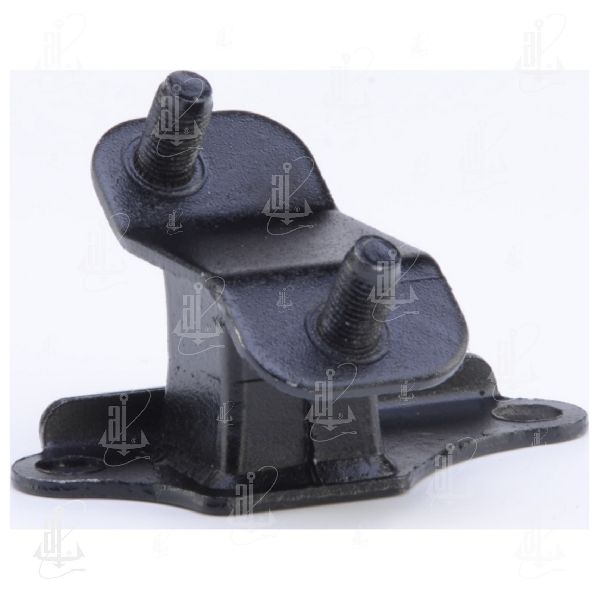
- Failing Motor Mounts 🟠 Medium — The hydraulic-filled motor mounts are prone to leaking and collapsing, causing excessive engine vibration and clunking noises.
Used vs. New Parts: Buying Guide for This Vehicle
When a used part is the smart pick: A used OEM dual-linear solenoid assembly from a junkyard can be a very cost-effective and reliable repair, especially compared to a new OEM part which can be expensive. Given the external accessibility, it's a reasonable DIY or shop repair.
Donor-vehicle mileage cap: roughly under 120000 miles for the part to have meaningful remaining life.
What to inspect on the donor part:
- Prioritize a donor vehicle that appears to have been taken off the road due to collision damage, not powertrain failure.
- If possible, check the transmission fluid from the donor car. Red, clear fluid is a good sign; black or burnt-smelling fluid is a major red flag.
- Inspect the solenoid's electrical connector for any signs of corrosion, melting, or broken clips.
- Check the small filter screens on the solenoid for excessive metallic debris. A light coating of fine grey material is normal, but large flakes indicate the donor transmission was failing internally.
OEM-only on this vehicle (don't cheap out):
- Automatic Transmission Fluid (ATF): Strictly use Honda Genuine ATF-DW1. Using universal or other brands is a well-documented cause of shifting problems and premature failure in these transmissions.
Aftermarket brands forum-validated for this vehicle:
- Rostra: Frequently cited in forums as a reliable and more affordable alternative to OEM.
- Sonnax: Known for producing transmission repair kits and upgraded components, often considered a quality choice.
Brands owners have reported issues with on this vehicle:
- Unbranded, generic parts from online marketplaces (e.g., eBay, Amazon) should be treated with caution. While some may work, many have high failure rates, incorrect resistance values, or are counterfeit parts.
Real Owner Stories
Aggregated from forums and TSBs cited above. Mileages and costs reflect what owners reported in those sources.
1998-2002 Honda Accord — ~95000 miles
Symptoms: The Check Engine Light and flashing 'D4' light came on. The transmission was slipping between gears and shifting very harshly, with a noticeable clunk when shifting from Neutral to Drive.
What fixed it: Initial checks of the fluid and solenoid revealed significant metallic debris on the solenoid screens. This pointed to the common internal failure of the 2nd and 3rd gear clutch packs, which required a complete transmission rebuild.
Cost: $2500+
Source hint: Vehicle Specific Issues and Known Issues sections regarding Catastrophic Automatic Transmission Failure (related to TSB 02-062).
Related OBD-II Codes
Frequently Asked Questions
My D4 light is flashing and the transmission is shifting hard. Is this a common problem on my 2000 Accord?
I found metal shavings on my transmission solenoid screen. What does this mean for my Accord?
What kind of transmission fluid should I use for a drain-and-fill on my 2001 Accord?
The mechanic says I need to replace Shift Solenoid 'B'. Is that a single part on my 1999 Accord?
I heard Honda extended the warranty on these transmissions. Does TSB 02-062 apply to my P0756 code?
My mechanic mentioned TSB 00-033. What is that about?
Helpful Videos
We Have This Part in Stock

The information in this article is provided for general reference and educational purposes only. Vehicle specifications, procedures, and part compatibility can vary by production date, trim level, and region. Always consult your vehicle's factory service manual and verify part numbers before purchasing or performing repairs. Safety-critical components such as airbags, seat belts, and braking systems should be installed by a qualified professional.
- Honda Accord:
- 🧭 Diagnostic Flowchart
- 🎬 Helpful Videos
- 🛍️ Shop This Part
- What's Unique About the 1998-2002 Honda Accord
- Symptoms You May Notice
- Most Likely Causes
- Rare But Worth Checking
- Diagnosis Steps
- Parts You'll Likely Need
- Related Codes That Often Appear With This One
- Technical Service Bulletins (TSBs) & Recalls
- Platform-Specific Known Issues
- Mechanic-Grade Diagnostic Values
- Scan Tool Commands That Help
- Wiring & Ground Locations
- Real Owner Repair Stories
- OEM Part Supersession History
- Other Known Issues on This Vehicle
- Used vs. New Parts: Buying Guide for This Vehicle
- Real Owner Stories
- 1998-2002 Honda Accord — ~95000 miles
- Related OBD-II Codes
- Frequently Asked Questions
- 🎟️ Get 5% Off