

P0843 on 2002-2003 Chevrolet Silverado 1500 HD: Transmission Pressure Sensor Faults and Fixes
P0843 on a 2002-2003 Silverado 1500 HD indicates an electrical fault with the transmission fluid pressure sensor 'A'. The most common cause is a failed Transmission Fluid Pressure Switch Manifold (PSM) inside the transmission oil pan, often part number ACDelco 24222077. This is an internal repair that typically costs a shop between $450 and $900, and it is highly recommended to replace the internal wiring harness at the same time.
- P0843 is an electrical fault code, not a sign of major mechanical transmission failure.
- The most likely cause on a 2002-2003 Silverado 1500 HD is a failed Pressure Switch Manifold (PSM) inside the transmission.
- Driving with this code can cause harsh shifting and may lead to further transmission damage; it should be addressed promptly.
- Diagnosis should always include checking the wiring and fluid before condemning internal parts.
- Repair requires dropping the transmission pan, so a fluid and filter change is a mandatory part of the job.
What's Unique About the 2002-2003 Chevrolet SILVERADO 1500 HD
The 2002-2003 Silverado 1500 HD typically uses the robust 4L80-E heavy-duty automatic transmission. For this specific transmission, the pressure sensors are integrated into a single component called the Pressure Switch Manifold (PSM), which is located on the valve body inside the oil pan. This part is a known failure point due to constant exposure to hot transmission fluid, making it the primary suspect for a P0843 code on these trucks.
Diagnostic Flowchart
Tap your situation to follow the diagnostic path that matches what you're seeing on this vehicle.
Symptoms You May Notice
- Check Engine Light is on
- Harsh, erratic, or delayed shifting
- Transmission stuck in one gear (limp mode)
- "Shift Range Inhibited" message on the instrument cluster [TSB #PIP4379M]
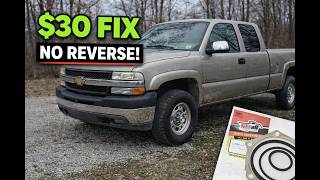
- Inability to shift into reverse [TSB #PIP4379M] 🎬 See this walkthrough on fixing common reverse gear issues.
- Increased fuel consumption
- Vehicle may feel like the brakes are engaged or will not move when first put into Drive
- Replacing the entire transmission. This code points to a specific electrical fault, not a major mechanical failure, 🎬 Watch: 3 common 4L80E problems and easy DIY fixes. and often does not require a full rebuild or replacement.
- Replacing the pressure switch without checking the wiring first. A simple wiring short or a bad engine ground can mimic a failed sensor, leading to unnecessary parts replacement.
Most Likely Causes
- Failed Transmission Fluid Pressure Switch Manifold (PSM) 🔴 High Probability → Shop Transmission Assembly The PSM is an electronic component constantly submerged in hot transmission fluid. Over many heat cycles, its internal circuits and plastic components can fail, causing electrical shorts or opens. In one documented case, a faulty internal harness, which is subject to the same conditions, left an owner stranded with no forward or reverse gears.
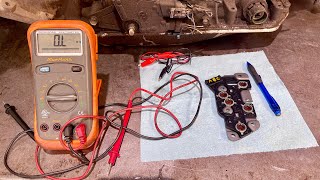
How to confirm: After verifying the external wiring is intact, a technician will use a scan tool to monitor voltage from the pressure switches while shifting. If switch 'A' voltage remains high regardless of gear, the PSM is faulty. An advanced DIY step is to test the circuit at the external transmission connector (see Diagnosis Steps). A continuity test on the individual switches of a removed PSM should show very low resistance (near 0 ohms) when pressed. 🎬 Watch: How to test the pressure switch and solenoids.
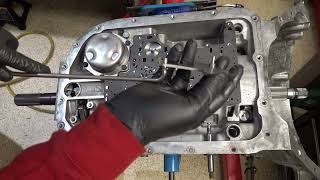
Typical fix: Replace the Pressure Switch Manifold. This involves draining the fluid, dropping the transmission pan, and accessing the part on the valve body. The internal wiring harness is often replaced at the same time as a preventative measure.
Est. part cost: $100-$250 - Wiring Harness or Connector Issue 🟡 Medium Probability The wiring harness, both internal to the transmission and external, can be damaged by heat, vibration, or corrosion over time, leading to shorts or open circuits. The main external connector can lose its seal, allowing moisture in, and the internal harness is especially prone to becoming brittle.
How to confirm: Visually inspect the external transmission wiring harness for any signs of damage. Test for continuity and shorts between the TCM connector and the transmission case connector for the TFP sensor 'A' circuit (Pin N on the 4L80-E connector). Check engine grounds like G103 and G104 on the engine block for corrosion or looseness, as bad grounds can cause myriad electrical issues.
Typical fix: Repair the damaged section of the external wiring harness or replace the faulty connector. If the damage is to the internal harness, it is typically replaced along with the PSM.
Est. part cost: $20-$150 - Low or Contaminated Transmission Fluid ⚪ Low Probability → Shop Transmission Assembly While P0843 is an electrical code, extremely low or dirty fluid can cause erratic hydraulic behavior and overheating, which can accelerate the failure of electronic components like the PSM.
How to confirm: Check the transmission fluid level and condition using the dipstick. The fluid should be at the correct level and appear bright red, not brown, black, or burnt-smelling.
Typical fix: Perform a transmission fluid and filter change. This is a required step when replacing internal components anyway.
Est. part cost: $50-$120
Rare But Worth Checking
- Faulty Transmission Control Module (TCM) or Powertrain Control Module (PCM): → Shop Transmission Assembly This is rare and should only be considered after all other possibilities (sensor, wiring, fluid) have been exhaustively ruled out. A faulty module can misinterpret a correct signal from the sensor.
Diagnosis Steps
- Check and verify the transmission fluid level and condition. Ensure it is clean and at the proper level.
- Use a professional scan tool to check for any other transmission-related codes. If P0701 is present, diagnose it first per TSB PIP4379M.
- Monitor the live data stream for the Transmission Fluid Pressure Sensor 'A' with the scan tool. The voltage should change as the transmission is commanded to shift through gears.
- If the voltage for sensor 'A' is stuck high (typically near 5 volts), inspect the external transmission wiring harness and connector for damage, corrosion, or loose connections. Pay close attention to engine grounds G103 (right rear of engine block) and G104 (left rear of engine block).
- Perform a pinout test at the external transmission case connector. Using a multimeter and a wiring diagram, check the signal from Pin N (Pressure Switch A). A constant high voltage when it should be changing with commanded gears points to an internal issue (PSM or internal harness).
- If the external wiring tests good, the fault is internal to the transmission. The next step is to drain the fluid, remove the oil pan, and inspect the internal wiring harness and the Pressure Switch Manifold.
- Test the resistance of the solenoids while the pan is off. Shift solenoids A and B should read 20-22 ohms.
- Replace the Pressure Switch Manifold, and it is highly recommended to replace the internal wiring harness at the same time.
- Reassemble the transmission with a new pan gasket and filter, and refill with the correct specification of transmission fluid (DEXRON-VI is the current GM recommendation for 4L80-E service fills).
- Clear the codes and perform a test drive to confirm the repair.
Parts You'll Likely Need
- Transmission Fluid Pressure Switch Manifold
(OEM #ACDelco: 24222077 or 24200695)— This is the most common component to fail and cause a P0843 code on this vehicle, as it contains the pressure switch 'A'.
Trusted brands: ACDelco, Rostra, Duralast
OEM price range: $150-$250
Aftermarket price range: $40-$120 - Transmission Fluid and Filter Kit — Replacing the internal pressure switch manifold requires dropping the pan, making a fluid and filter change a necessary part of the service.
Trusted brands: ACDelco
OEM price range: $60-$100
Aftermarket price range: $40-$70 - Internal Transmission Wiring Harness
(OEM #ACDelco: 24232327 (verify application))— The internal harness becomes brittle from heat and fluid exposure. It is best practice to replace it along with the pressure switch manifold to prevent a repeat failure.
Trusted brands: ACDelco, Rostra
OEM price range: $50-$90
Aftermarket price range: $30-$60
Related Codes That Often Appear With This One
- P0700 — P0700 is a general code that means the Transmission Control Module (TCM) has stored a fault and requested the Check Engine Light to be turned on. It will almost always be present with a specific transmission code like P0843.
- P0701 — As noted in GM Technical Service Bulletin PIP4379M, this code may appear with P0843. The TSB advises diagnosing P0701 first if it is present. [TSB #PIP4379M]
- P0842, P0872, P0877 — These are codes for other pressure switches (A-Low, C-High, C-Low) within the same Pressure Switch Manifold. It is common for multiple switches to fail around the same time, triggering several of these codes together.
Technical Service Bulletins (TSBs) & Recalls
- PIP4379M: Mentions P0843 in a list of codes related to symptoms like no reverse or range inhibit, and advises diagnosing P0701 first if present.
Mechanic-Grade Diagnostic Values
- Shift Solenoid A/B Resistance — expected: 20 to 22 Ohms. Failure: A reading significantly outside this range indicates a failed solenoid.
- Pressure Control (PC) Solenoid / Force Motor Resistance — expected: 3.5 to 5.5 Ohms. Failure: Readings outside this range suggest a faulty PC solenoid.
- Pressure Switch Manifold (PSM) Switch Continuity — expected: Near 0 Ohms when a switch is manually depressed. Failure: An open circuit (OL) or high resistance when a switch is pressed indicates a failure within the manifold.
- Line Pressure at Idle (PC Solenoid disconnected) — expected: 180 to 230 PSI. Failure: Significantly lower pressure (e.g., under 150 PSI) points to a pump or pressure control issue, not just a sensor fault.
Scan Tool Commands That Help
- Tech2 / GDS2 or equivalent professional scanner: Transmission Output Controls — A technician can use this function to command individual solenoids on and off to verify their mechanical operation and see the corresponding change (or lack thereof) on the pressure switch data PID. This helps isolate a failed solenoid from a wiring or PSM issue.
- Tech2 / GDS2 or equivalent professional scanner: Line Pressure Control — This bidirectional command allows a technician to manually increase or decrease line pressure. It is used to test the functionality of the Pressure Control (PC) solenoid (force motor) independently of the PCM's commands.
Wiring & Ground Locations
- Main Transmission Connector — On the driver's side of the 4L80-E transmission case, roughly 8 inches back from the bellhousing.. This is the main interface for all electronic signals. Pin N is the specific circuit for Pressure Switch 'A'. Testing for voltage here can quickly determine if the fault is internal or external to the transmission.
- G103 — On the right rear of the engine block.. This is a primary engine ground. A poor connection here can cause erratic voltage readings and phantom electrical faults in various systems, including the transmission controls, mimicking a sensor failure.
- G104 — On the left rear of the engine block.. This is another critical engine ground. Like G103, corrosion or a loose connection can lead to unstable sensor readings and trigger fault codes like P0843.
Real Owner Repair Stories
- PerformanceTrucks.net Forums (2006 GM Truck with 4L80-E (12k miles on transmission)) — No reverse gear. No forward gears in D4 (Overdrive), but manual shifting through 1, 2, and 3 worked.
❌ Tried (didn't work) Initial research pointed to various potential electronic or hydraulic issues.
✅ What actually fixed it The root cause was a mechanical failure. The overdrive (OD) sprag had blown apart. Replacing the OD sprag and reassembling the transmission resolved all symptoms. - LS1TECH Forums (2002 GMC with high mileage and a 4L80-E) — No reverse gear, and felt like it was not in 1st gear when put in Drive (takeoff felt sluggish).
❌ Tried (didn't work) The owner initially suspected a VSS or other electronic issue based on research.
✅ What actually fixed it Forum experts clarified that on a 4L80-E, loss of reverse is almost always a purely hydraulic or mechanical issue, not electronic. The common causes identified were a worn rear band (fixable with an extended apply pin) or a broken band servo piston, both requiring internal repairs.
OEM Part Supersession History
24200695→24222077— Part has been updated by the manufacturer.
Heads up: The new part number (24222077) is the correct service replacement for the original. Some sources note that this part may require programming or special setup procedures, though this is less common for a simple pressure switch manifold on this platform.
Model Year Variations Within This Range
- 1991-1993 vs 1994+: The main external electrical connector on the 4L80-E changed around 1993/1994 from a bolt-on style to a snap-on plug. The 2002-2003 Silverado HD uses the later snap-on style. This is important if sourcing a used transmission or harness.
- Pre-1997 vs Post-1997: The cooling line locations on the case changed. Early models had both lines near the front, while later models (including the 2002-2003) have one line at the front and the return line further back for improved cooling. This is critical for transmission swaps.
- 2003+: The electronics within the GM truck platform were updated starting in the 2003 model year. While the transmission itself is largely the same, the PCM and vehicle wiring can differ, which is a consideration for swaps between a 2002 and a 2003+ truck.
Helpful Videos
We Have This Part in Stock

The information in this article is provided for general reference and educational purposes only. Vehicle specifications, procedures, and part compatibility can vary by production date, trim level, and region. Always consult your vehicle's factory service manual and verify part numbers before purchasing or performing repairs. Safety-critical components such as airbags, seat belts, and braking systems should be installed by a qualified professional.
- Chevrolet SILVERADO 1500 HD:
- 🧭 Diagnostic Flowchart
- 🎬 Helpful Videos
- 🛍️ Shop This Part
- What's Unique About the 2002-2003 Chevrolet SILVERADO 1500 HD
- Symptoms You May Notice
- Most Likely Causes
- Rare But Worth Checking
- Diagnosis Steps
- Parts You'll Likely Need
- Related Codes That Often Appear With This One
- Technical Service Bulletins (TSBs) & Recalls
- Mechanic-Grade Diagnostic Values
- Scan Tool Commands That Help
- Wiring & Ground Locations
- Real Owner Repair Stories
- OEM Part Supersession History
- Model Year Variations Within This Range
- 🎟️ Get 5% Off