

P0880 on 2010-2017 Hyundai Santa Fe: TCM Power Signal Error Causes and Fixes
For a 2010-2017 Hyundai Santa Fe, code P0880 usually indicates a power supply problem to the Transmission Control Module (TCM), often caused by a faulty internal transmission wiring harness, a bad TCM power relay, or a blown fuse. This will cause the vehicle to enter a 'limp mode,' stuck in 4th gear with harsh shifting into Drive and Reverse.
- P0880 on a 2010-2017 Santa Fe is a serious electrical fault that puts the transmission into a protective 'limp mode' (stuck in 4th gear).
- Do not immediately assume the transmission is bad. Hyundai has a TSB (#20-AT-017H) that points to an electrical issue, most often the internal wiring harness.
- Diagnosis should start with the easiest and cheapest parts: check the transmission-related fuses and swap the TCM power relay.
- The most probable fix, if fuses and relays are good, is replacing the internal transmission wiring harness, which is a labor-intensive job.
- Due to the safety implications of a malfunctioning transmission and the complexity of the repair, professional service is highly recommended.
What's Unique About the 2010-2017 Hyundai SANTA FE
The 2010-2017 Santa Fe spans two generations (CM and DM), both of which are covered under Hyundai Technical Service Bulletin (TSB) #20-AT-017H for this code. The TSB explicitly warns technicians not to replace the entire transmission for P0880, as the cause is almost always electrical. A very common point of failure identified in the TSB and by numerous owner and technician reports is the internal transmission wiring harness (part number 46307-3B650 for many models), which can develop an internal short or open circuit, leading to this power-related code.
Diagnostic Flowchart
Tap your situation to follow the diagnostic path that matches what you're seeing on this vehicle.
Generation note: This range covers the end of the second generation (CM, 2010-2012) and the third generation (DM, 2013-2017), specifically the Santa Fe Sport models. Both generations are explicitly mentioned in Hyundai's Technical Service Bulletin #20-AT-017H for this exact issue, indicating a shared vulnerability in the transmission's electrical power supply circuit, particularly the internal harness.
Symptoms You May Notice
- Check Engine Light is on
- Transmission is stuck in 4th gear (fail-safe or 'limp' mode)
- Harsh or clunking shift when moving into Reverse or Drive
- Transmission may not shift at all
- Sluggish or slow acceleration from a stop
- Transmission warning light may be illuminated
- ABS or traction control warning lights may be illuminated in some cases
- Replacing the entire transmission. TSB #20-AT-017H specifically warns against this, as the problem is almost always electrical and external to the core mechanical components.
- Replacing the Transmission Control Module (TCM) first. Many owners and shops have replaced the expensive TCM only to find the problem persists because the root cause was the cheaper internal wiring harness.
- Replacing shift solenoids. While solenoids can cause shifting problems, P0880 points specifically to a power supply issue for the entire TCM/solenoid group, not an individual solenoid circuit.
Most Likely Causes
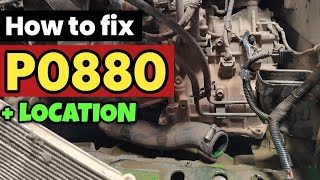
- Faulty Internal Transmission Wiring Harness 🔴 High Probability → Shop Transmission Assembly Hyundai TSB #20-AT-017H and numerous real-world repairs point to this as the primary fix. The harness, often part number 46307-3B650, is located inside the transmission and is prone to developing an intermittent short or open circuit over time due to heat and fluid exposure. This causes the PCM to detect an invalid voltage and cut power 🎬 See this breakdown of the P0880 TCM input signal code to the circuit.
How to confirm: After confirming external wiring, fuses, and relays are good, a technician will test for a short to ground at the transmission connector pins. If a short is detected, they will need to drop the transmission pan and valve body to access and replace the harness.
Typical fix: Replace the internal transmission wiring harness. This requires draining the transmission fluid, removing the oil pan, and removing the valve body to access the part.
Est. part cost: $80-$150 - Faulty TCM Power Relay or Blown Fuse 🟡 Medium Probability → Shop Wiring Relay Relays and fuses are common failure points. A short in the circuit, often from the failing internal harness, can cause the fuse to blow or the relay to fail. The TCM relay is typically located in the under-hood fuse box.
How to confirm: Locate the fuse box in the engine compartment. Inspect the fuses labeled 'TCM' or 'ATM'. Swap the TCM relay with an identical, known-good relay (like the horn relay) to see if the symptoms change.
Typical fix: Replace the blown fuse or faulty relay.
Est. part cost: $5-$30 - Damaged External Wiring or Poor Connection 🟡 Medium Probability The wiring harness between the PCM and the transmission can become damaged from rubbing, heat, or corrosion, especially at the main connector on the transmission case. A poor connection at the Body Control Module (BCM) has also been reported as a rare cause.
How to confirm: Visually inspect the wiring harness for any signs of chafing, melting, or corrosion. Unplug the main connector at the transmission and check for corroded, bent, or pushed-out pins. Check for stable voltage at the appropriate pins.
Typical fix: Repair the damaged section of wire or clean/replace the connector.
Est. part cost: $10-$100 - Faulty Transmission Control Module (TCM) ⚪ Low Probability → Shop Transmission Assembly While possible, the TCM itself is rarely the point of failure. The TSB and extensive forum discussions strongly suggest ruling out all other power, ground, and wiring issues first. Replacing the TCM is an expensive step that often fails to fix the root cause.
How to confirm: This is a last resort after verifying all wiring (internal and external), fuses, relays, and grounds are perfect. Requires specialized equipment to test the module.
Typical fix: Replace the Transmission Control Module, which is often integrated with the Engine Control Module (ECM/PCM) in these models, and may require programming.
Est. part cost: $500-$1000+
Rare But Worth Checking
- Loose or corroded Body Control Module (BCM) connector. One owner reported that the power supply for the TCM originates from the BCM, and a loose camlock connector under the dash was the ultimate cause after replacing the harness and TCM.
Diagnosis Steps
- Read the codes with an OBD-II scanner to confirm P0880 is present. Note any other codes.
- Check the 'ATM' or 'TCM' fuses in the engine bay fuse box. Replace if blown.
- Inspect the TCM power relay. Swap it with an identical relay (e.g., horn relay) to quickly test for a fault.
- Inspect the battery terminals and main ground connections for tightness and corrosion. Ensure system voltage is stable (approx. 12.6V key off, 13.5V+ engine running).
- Visually inspect the external wiring harness leading from the PCM/BCM to the transmission for any obvious damage, chafing, or corrosion, paying close attention to the main connector on the transmission case.
- Disconnect the transmission connector and test the power supply pins for a short to ground using a multimeter in continuity mode. A short here strongly indicates a faulty internal harness.
- If external checks are inconclusive and a short is suspected, follow the procedure in TSB #20-AT-017H. This involves draining the transmission fluid, removing the oil pan and valve body to access and replace the internal transmission wiring harness.
- If the internal harness replacement does not resolve the issue, a deeper diagnosis of the external harness continuity back to the PCM/BCM and the module itself may be required by a professional.
Parts You'll Likely Need
- Internal Transmission Wiring Harness
(OEM #46307-3B650)— This is the most common fix according to Hyundai's TSB and numerous technician reports for an intermittent short circuit causing the P0880 code. This part fits a wide range of Hyundai/Kia vehicles with the 6-speed automatic transmission.
Trusted brands: Hyundai (OEM)
OEM price range: $80-$150
Aftermarket price range: $60-$120 - TCM Power Relay — A faulty relay can fail to supply power to the TCM circuit, directly causing this code. It's an easy and inexpensive part to check and replace as a primary diagnostic step.
Trusted brands: Hyundai (OEM), Bosch
OEM price range: $20-$40
Aftermarket price range: $10-$25
Technical Service Bulletins (TSBs) & Recalls
- 20-AT-017H: Addresses DTC P0880/P088000, noting symptoms like being stuck in 4th gear fail-safe and harsh shifting. It outlines the diagnostic procedure, which points toward checking wiring and replacing the internal valve body harness. It covers a wide range of Hyundai models with the 6-speed automatic transmission.
- SA499: While for a newer 2023 Sportage, this TSB shows a similar issue where an external transmission harness can rub against a bracket, causing a short and triggering P0880, highlighting the sensitivity of this circuit to wiring faults.
Platform-Specific Known Issues
- Hyundai issued Technical Service Bulletin (TSB) #20-AT-017H in May 2020, directly addressing DTC P0880/P088000 on 2010-2012 Santa Fe (CM) and 2013-2018 Santa Fe Sport (AN) models, among many others. The bulletin provides a detailed service procedure that points to replacing the internal transmission wiring harness and explicitly states not to replace the transmission for this code.
Mechanic-Grade Diagnostic Values
- Voltage at Pins 11 & 13 of the main transmission connector (harness side) — expected: Battery voltage (approx. 12V) with Key On, Engine Off.. Failure: 0V or significantly less than battery voltage indicates an open circuit in the external harness, a bad relay, or a blown fuse.
- Resistance between Pins 11 & 13 (transmission side) and chassis ground — expected: Open Line (OL) or very high resistance (Mega-ohms).. Failure: Low resistance or continuity (a beep on a multimeter) indicates a short to ground, strongly suggesting a faulty internal transmission wiring harness.
- Alternator AC Ripple Voltage — expected: Less than 0.1 Volts AC (100mV) with the engine running.. Failure: Voltage greater than 0.5 Volts AC (500mV) can indicate a failing alternator diode, introducing electrical noise that disrupts the TCM and can trigger P0880.
- Live Data PID: 'Solenoid Power Supply Voltage' on GDS Scan Tool — expected: Stable battery/system voltage (approx. 13.5-14.5V with engine running).. Failure: The value dropping below 7V or exceeding 22V will set the code. Monitoring this while performing a 'wiggle test' on the harness can pinpoint intermittent connections.
Scan Tool Commands That Help
- Hyundai GDS (Global Diagnostic System): TCM Relay Activation Test — Use this bidirectional command to force the TCM power relay on and off. This helps verify if the relay itself is functional and if the wiring from the fuse box to the relay is intact.
- Hyundai GDS (Global Diagnostic System): View Live Data - 'Solenoid Power Supply' — This is the most critical PID to monitor during diagnosis. Graphing this data while test driving or wiggling harnesses can reveal intermittent voltage drops that are too fast to see with a standard multimeter.
Wiring & Ground Locations
- Transmission Connector — On the front of the transmission case, typically a large 20-pin connector.. This is the primary test point. Pins 11 and 13 are the power feeds to the internal harness, and pins 1 and 4 are grounds. Testing here separates the external harness from the internal harness.
- Main Chassis Ground (e.g., G12) — Typically located on the driver's side inner fender or strut tower, near the battery and fuse box.. A loose or corroded main ground can cause a floating voltage reference for the entire power distribution system, leading to incorrect voltage readings by the PCM/TCM and triggering P0880.
- Transmission Case Ground — A strap or wire connecting the transmission housing directly to the vehicle's chassis or subframe.. Ensures the transmission and its internal components have a solid ground path. A poor connection here can cause erratic behavior and power-related codes.
Real Owner Repair Stories
- Hyundai-Forums user (2011 Hyundai Santa Fe 3.5L) — Check engine light with P0880, transmission in limp mode (stuck in 4th gear).
❌ Tried (didn't work) Dealer initially suggested replacing the entire transmission.
✅ What actually fixed it The owner insisted on following the TSB. The shop dropped the pan and replaced the internal transmission wiring harness (part # 46307-3B650), which resolved all issues. - iATN (International Automotive Technicians Network) Member (2012 Hyundai Santa Fe) — P0880, intermittent limp mode.
❌ Tried (didn't work) Checking external wiring, which appeared fine visually.
✅ What actually fixed it The technician found that wiggling the external harness near the transmission could sometimes trigger the fault. Despite this, the fault was an internal short in the valve body harness. The external movement was just enough to cause the internal short to make contact. Replacing the internal harness fixed the problem. - JustAnswer technician response (2013 Hyundai Santa Fe Sport 2.0T) — P0880 code present.
❌ Tried (didn't work) Initial diagnosis focused only on the transmission and its direct connector.
✅ What actually fixed it After extensive diagnosis, the cause was found to be corrosion inside the main engine harness-to-chassis harness connector, which is a large multi-pin connector separate from the transmission itself. Cleaning the corroded pins in this connector restored proper voltage to the TCM circuit and cleared the code.
OEM Part Supersession History
Varies by VIN→Varies by VIN— While 46307-3B650 is a very common internal harness part number for this issue, Hyundai used several variations of the 6-speed automatic transmission. Differences between FWD/AWD, engine size, and model year can require a different harness part number.
Heads up: Always confirm the correct part number using the vehicle's VIN before ordering. Installing a harness that physically fits but is electrically different (e.g., for a different set of solenoids) will not fix the issue and may cause new codes.
Model Year Variations Within This Range
- 2010-2012 (CM) vs 2013-2017 (DM): While both generations are covered by the same TSB and suffer from the same primary failure (internal harness), the physical routing of the external wiring harnesses and the locations of some connectors and ground points may differ slightly between the second (CM) and third (DM) generation chassis.
Helpful Videos

We Have This Part in Stock


The information in this article is provided for general reference and educational purposes only. Vehicle specifications, procedures, and part compatibility can vary by production date, trim level, and region. Always consult your vehicle's factory service manual and verify part numbers before purchasing or performing repairs. Safety-critical components such as airbags, seat belts, and braking systems should be installed by a qualified professional.
- Hyundai SANTA FE:
- 🧭 Diagnostic Flowchart
- 🎬 Helpful Videos
- 🛍️ Shop This Part
- What's Unique About the 2010-2017 Hyundai SANTA FE
- Symptoms You May Notice
- Most Likely Causes
- Rare But Worth Checking
- Diagnosis Steps
- Parts You'll Likely Need
- Technical Service Bulletins (TSBs) & Recalls
- Platform-Specific Known Issues
- Mechanic-Grade Diagnostic Values
- Scan Tool Commands That Help
- Wiring & Ground Locations
- Real Owner Repair Stories
- OEM Part Supersession History
- Model Year Variations Within This Range
- 🎟️ Get 5% Off