

P0965 on 2021-2022 Nissan Versa: CVT Pressure Solenoid 'B' Causes and Fixes
On a 2021-2022 Nissan Versa, P0965 almost always indicates a problem within the CVT, typically a faulty valve body. This is a known issue covered by Nissan Technical Service Bulletins (TSBs). Expect a professional repair involving valve body or full CVT replacement, costing from $1,200 to over $5,000.
- P0965 on a 2021-2022 Versa is a serious transmission code that should be addressed immediately to prevent further damage.
- This is a known issue. Always check for and follow the diagnostic procedures in Nissan's Technical Service Bulletins (TSBs) like NTB22-021A.
- The most probable cause is a faulty CVT control valve body, which is an expensive, professional-level repair.
- Do not attempt this repair at home unless you are an experienced technician with access to a dealer-level scan tool for reprogramming.
- Always use genuine Nissan NS-3 CVT fluid; using the wrong fluid can quickly destroy the transmission.
What's Unique About the 2021-2022 Nissan VERSA
The 2021-2022 Nissan Versa uses a specific Jatco-made CVT (the RE0F11B) that is highly sensitive to fluid condition and internal pressure. Nissan has issued multiple Technical Service Bulletins (TSBs), specifically NTB22-021A, for this exact code alongside others, indicating a known pattern of failure. Unlike a generic vehicle where P0965 could be a simple wiring issue, on this Versa it is frequently a symptom of a more complex internal problem. The TSB provides a direct diagnostic flowchart for technicians, which often leads to replacing the entire valve body or, if significant metal debris is found, the complete CVT assembly.
Diagnostic Flowchart
Tap your situation to follow the diagnostic path that matches what you're seeing on this vehicle.
Symptoms You May Notice
- Hesitation or juddering during acceleration.
- Reduced engine power as the vehicle enters 'limp mode'.
- Harsh, delayed, or erratic shifting sensations.
- Transmission slipping.
- Transmission overheating.
- Illuminated Check Engine Light.
- Increased fuel consumption.
- Replacing only the transmission fluid when the valve body has already failed.
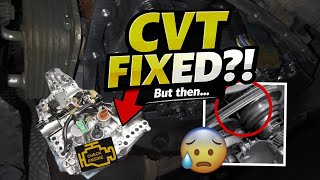
- Replacing an individual solenoid 🎬 Watch: Why replacing just the solenoid often isn't enough. when the failure is systemic to the valve body, as indicated by Nissan's TSBs.
- Assuming it's an engine misfire due to the hesitation and juddering symptoms.
- Replacing the valve body without performing the mandatory TCM reprogramming, leading to continued issues.
Most Likely Causes
- Faulty CVT Control Valve Body 🔴 High Probability → Shop Transmission Valve Body This is a well-documented failure point in the Jatco-made CVTs used by Nissan. The pressure control solenoids are integrated into the valve body, and failure of the solenoid or passages within the body is common. Nissan's TSBs (NTB22-021A, NTB19-040H) point directly to this as a primary issue when P0965 is present with other specific codes.
How to confirm: Diagnosis must follow the steps in Nissan TSB NTB22-021A. This involves checking for specific co-occurring codes, inspecting the fluid for debris, and dropping the pan to check the magnets for metal shavings. The TSB specifies that if only fine metallic paste or sludge is found, the valve body is the indicated repair.
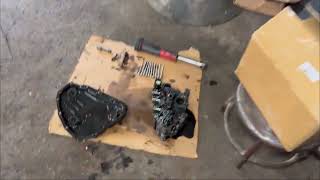
Typical fix: Replacement of the entire CVT control valve body assembly 🎬 See a step-by-step walkthrough of a CVT valve body replacement., followed by a mandatory reprogramming and calibration procedure with a Nissan-specific scan tool.
Est. part cost: $800-$1500 - Internal CVT Assembly Failure 🟡 Medium Probability If the valve body issue is not addressed, or if significant metal debris is found, it indicates wider internal damage, such as to the CVT belt or pulleys. The TSBs specify that if excessive debris (chunks of metal, bearing cages, etc.) is found on the oil pan magnets, the entire CVT assembly must be replaced.
How to confirm: Following the TSB diagnostic path, if a large amount of metallic debris (described as 'broken parts' like bearing cages, clutch material, or belt elements) is found on the oil pan magnets, CVT replacement is required and must be authorized by Nissan's Powertrain Call Center (PCC) for warranty claims.
Typical fix: Complete replacement of the CVT transmission assembly. A remanufactured unit from Nissan for a 2021 Versa costs approximately $2,400 for the part alone.
Est. part cost: $3500-$6000 - Low or Contaminated CVT Fluid 🟡 Medium Probability CVTs are extremely sensitive to fluid quality and level. Using incorrect fluid or running the fluid for too long (beyond the recommended 30,000-50,000 mile interval) can cause premature wear, overheating, and pressure control problems.
How to confirm: Check the level and condition of the CVT fluid. It should be at the correct level and not smell burnt or appear dark and gritty. A fluid change is often the first diagnostic step but is unlikely to solve the P0965 code if a hardware fault already exists.
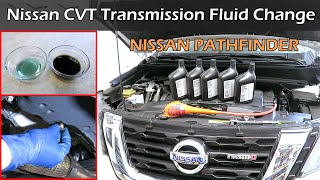
Typical fix: Perform a CVT fluid drain and fill using only the specified Nissan CVT fluid (NS-3). 🎬 Watch: How to properly drain and fill Nissan CVT fluid. This may be attempted as a first step but often will not solve an existing hardware problem that has already logged a code.
Est. part cost: $150-$300 - Wiring or Connector Issue ⚪ Low Probability
How to confirm: Visually inspect the main transmission wiring harness and the connector at the CVT case for damage, corrosion, or loose pins. A multimeter can be used to check for continuity and resistance in the solenoid circuit, which should be around 5-7 ohms depending on temperature.
Typical fix: Repair the damaged wire or clean/replace the corroded connector.
Est. part cost: $20-$100
Diagnosis Steps
- Scan the TCM for all stored DTCs. Note if P0965 appears with other codes listed in Nissan TSB NTB22-021A.
- Check for applicable TSBs using your vehicle's VIN. This is the most critical step, as NTB22-021A provides the exact repair flowchart.
- Carefully check the CVT fluid level and condition. Look for a burnt smell or metallic particles.
- Inspect the main transmission wiring harness and connector for any visible damage, corrosion, or looseness.
- Follow the diagnostic procedure outlined in TSB NTB22-021A. This will guide the decision between replacing the valve body (if debris is minimal) or the entire CVT assembly (if large metal chunks are found in the oil pan).
- If a new valve body or CVT is installed, perform the mandatory computer reprogramming and calibration with a compatible scan tool like the Nissan CONSULT-III plus.
Parts You'll Likely Need
- CVT Control Valve Body
(OEM #31705-3JX5D)— This is the most common cause of P0965 on this vehicle, as identified in multiple Nissan TSBs. The solenoids are integrated into this assembly.
Trusted brands: Nissan Genuine Parts
OEM price range: $1000-$1500
Aftermarket price range: $700-$1200 - CVT Assembly
(OEM #31020-50X5A (supersedes 31020-50X1A))— Required if significant metal debris is found in the transmission pan, indicating widespread internal damage beyond just the valve body.
Trusted brands: Nissan Genuine Parts, TD Reman
OEM price range: $3100-$4200
Aftermarket price range: $2400-$3500 - Nissan NS-3 CVT Fluid
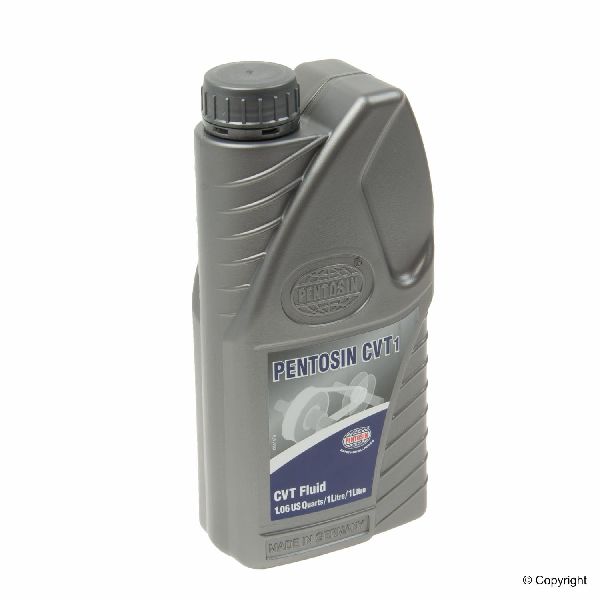
(OEM #999MP-NS300P)— The correct fluid is mandatory for any repair involving the CVT. Using any other type of fluid can cause damage.
Trusted brands: Nissan Genuine Parts
OEM price range: $20-$25 per quart
Related Codes That Often Appear With This One
- P0746 — Pressure Control Solenoid 'A' - TSB NTB22-021A groups this code with P0965, indicating a common failure pattern within the valve body.
- P0776 — Pressure Control Solenoid 'B' Performance - A performance-related code for the same solenoid, often seen with P0965 and pointing to the same TSB-guided repair.
- P0841 — Transmission Fluid Pressure Sensor/Switch 'A' - Indicates a general pressure regulation problem within the transmission and is also listed in TSB NTB22-021A.
- P17F0 — CVT Judder (T/M Inspection) - A Nissan-specific code that directly points to a mechanical issue (judder) that is a common symptom of valve body failure. It is a key code in the diagnostic flowchart of TSB NTB22-021A.
- P17F1 — CVT Judder (C/V Inspection) - Another Nissan-specific code related to judder, often seen with P0965 as per TSB NTB22-021A.
Technical Service Bulletins (TSBs) & Recalls
- NTB22-021A: 'DTC P0746, P0776, P0841, P0965, P17F0 AND/OR P17F1 STORED IN THE TCM'
- NTB19-040H: 'DTC P0741/4/6, P0776, P0841, P0875, P0965, P2857/8/9, P17F0/1/2/4 AND/OR P285A STORED IN THE TCM, AND MAY HAVE HESITATION AND/OR REDUCED POWER'
Platform-Specific Known Issues
- Nissan has issued multiple TSBs (NTB22-021A, NTB19-040H, etc.) that group P0965 with other transmission codes. These bulletins provide a specific diagnostic flowchart for technicians to follow, often leading to the replacement of the valve body or the entire CVT unit. This indicates a known pattern failure acknowledged by the manufacturer.
- The diagnostic flowchart in TSB NTB22-021A is crucial: if codes like P0965 are present, the technician must inspect the CVT oil pan magnets. If only fine, paste-like metallic debris is found, the procedure calls for replacing the valve body. If larger, solid metal chunks are found, the entire CVT assembly must be replaced.
Mechanic-Grade Diagnostic Values
- Pressure Control Solenoid 'B' Resistance — expected: 2.4 - 3.2 Ohms at 68°F (20°C). Failure: A reading of infinite resistance (open circuit) or significantly outside the expected range indicates a faulty solenoid coil.
- Pressure Control Solenoid 'B' Circuit Voltage — expected: Pulse-Width Modulated (PWM) signal, not a steady voltage.. Failure: Testing with a standard voltmeter is not effective. Diagnosis relies on resistance checks and scan tool data/commands.
Scan Tool Commands That Help
- Nissan CONSULT-III plus (or compatible advanced scan tool): Write IP Characteristic / Erase/Write Calibration Data — This function is mandatory after replacing the CVT valve body or the entire CVT assembly. It writes the unique calibration data from a QR code on the new part to the Transmission Control Module (TCM). Failure to perform this step will result in harsh shifting, drivability problems, and will void the warranty on the new part.
- Nissan CONSULT-III plus (or compatible advanced scan tool): Conform CVTF Deterioration — This procedure should be performed after changing the CVT fluid or replacing major components. It resets the TCM's internal counter that estimates the fluid's degradation level, ensuring the system applies the correct pressures for the new fluid's condition.
- Nissan CONSULT-III plus (or compatible advanced scan tool): Clutch Point Learning — Required after a valve body replacement to allow the TCM to learn the engagement points of the clutches with the new hardware. Not performing this can lead to harsh engagement when shifting into Drive or Reverse.
Wiring & Ground Locations
- F142 (Transmission Harness Connector) — Located on the top or side of the CVT case, where the main engine room wiring harness connects to the transmission's internal harness.. This is the primary connector for all transmission solenoids and sensors. Corrosion or a loose pin in the cavities corresponding to Pressure Control Solenoid 'B' can directly cause a P0965 code. A visual inspection and pin-drag test are key diagnostic steps.
- Engine Compartment Grounds (e.g., F10) — There are multiple key ground points bolted to the chassis frame rail and engine block in the engine compartment, often near the battery or on the transaxle housing itself.. A poor ground connection for the TCM or the main engine harness can cause erratic voltage and resistance readings, potentially triggering false solenoid performance codes like P0965.
Real Owner Repair Stories
- Forum user reports on platforms like NissanVersaForums.com (Nissan Versa Note with RE0F11A CVT (similar to the Versa's RE0F11B)) — Hesitation, juddering on acceleration, and codes P0965 and P0846 stored.
❌ Tried (didn't work) Performing a CVT fluid drain and fill.
✅ What actually fixed it The final resolution was the replacement of the entire CVT valve body assembly, followed by the required TCM reprogramming. - Dealer technician accounts and TSB-guided repairs (Nissan Sentra/Versa with P0965 and other related codes (e.g., P0776, P17F0)) — Harsh shifting, judder, and lack of power.
❌ Tried (didn't work) Clearing codes and hoping the issue resolves on its own.
✅ What actually fixed it During the TSB-mandated inspection, the technician dropped the oil pan and found significant metal chunks on the magnets. This indicated widespread internal failure. The repair required the replacement of the entire CVT assembly, as a new valve body alone would be quickly destroyed by the circulating debris.
OEM Part Supersession History
31020-50X1A→31020-50X5A— Updated part from the manufacturer, likely containing revisions to improve durability or address known failure points.
Heads up: The new part number (31020-50X5A) is the correct replacement for the 2021-2022 Versa.N/A→N/A— N/A
Heads up: When replacing the valve body, a QR code containing unique calibration data is supplied with the new part. This data MUST be written to the TCM using a Nissan CONSULT tool or equivalent. Attempting to install a new valve body without performing this programming will lead to severe shifting problems and likely damage the new component.
Model Year Variations Within This Range
- 2021-2022: There are no significant mechanical differences in the CVT or its control system between the 2021 and 2022 model year Nissan Versa. The primary differences were in trim levels and available convenience features. The TSBs related to code P0965 cover both model years, indicating the cause and repair procedures are identical.
Helpful Videos
We Have This Part in Stock



The information in this article is provided for general reference and educational purposes only. Vehicle specifications, procedures, and part compatibility can vary by production date, trim level, and region. Always consult your vehicle's factory service manual and verify part numbers before purchasing or performing repairs. Safety-critical components such as airbags, seat belts, and braking systems should be installed by a qualified professional.
- Nissan VERSA:
- 🧭 Diagnostic Flowchart
- 🎬 Helpful Videos
- 🛍️ Shop This Part
- What's Unique About the 2021-2022 Nissan VERSA
- Symptoms You May Notice
- Most Likely Causes
- Diagnosis Steps
- Parts You'll Likely Need
- Related Codes That Often Appear With This One
- Technical Service Bulletins (TSBs) & Recalls
- Platform-Specific Known Issues
- Mechanic-Grade Diagnostic Values
- Scan Tool Commands That Help
- Wiring & Ground Locations
- Real Owner Repair Stories
- OEM Part Supersession History
- Model Year Variations Within This Range
- 🎟️ Get 5% Off