

P1101 on 2013-2016 Dodge Dart 1.4L Turbo: Intake Airflow Performance Causes and Fixes
On a 2013-2016 Dodge Dart with the 1.4L Turbo, code P1101 is almost always caused by an unmetered air leak in the intake or PCV system. The most common fixes are repairing cracked vacuum hoses or replacing the entire valve cover assembly due to a failed internal PCV diaphragm, which is often caused by a failed check valve in the intake manifold. A smoke test is the best way to find the leak.
- P1101 on this car means there is an air leak; it is NOT a MAF sensor problem because the car doesn't have one.
- The most likely cause is a failed PCV system, specifically the diaphragm in the valve cover. A whistling noise at idle is a key symptom.
- Before buying any parts, perform a thorough visual inspection and a smoke test to find the source of the unmetered air.
- Check for related codes like P0171 (lean) or P0299 (underboost), as they strongly support the diagnosis of an air leak.
- If you replace the valve cover, consider adding an aftermarket PCV fix-kit to prevent the new one from failing in the same way.
What's Unique About the 2013-2016 Dodge Dart
The 1.4L MultiAir Turbo engine in the Dart is a speed-density system, meaning it calculates airflow instead of measuring it directly with a MAF sensor. This makes the P1101 code's common definition of 'MAF Sensor Out of Self Test Range' incorrect and misleading for this car. The engine is part of the Fiat FIRE family, but it shares a nearly identical PCV system 🎬 Watch: Understanding the shared PCV failure on 1.4L engines failure mode with the GM 1.4L engine found in the Chevy Cruze. This failure involves a check valve in the intake manifold and a diaphragm in the valve cover, which is a primary cause of this code.
Symptoms You May Notice
- Check Engine Light is on
- Reduced engine power or sluggish acceleration
- Rough or unstable idle
- Hesitation when accelerating
- Whistling, hissing, or chirping noise from the engine bay at idle
- Poor fuel economy
- Strong suction when trying to remove the oil filler cap while the engine is running
- Replacing the throttle body when the issue is a simple vacuum leak.
- Assuming the turbocharger is bad when the problem is a leak in a control hose or a faulty PCV system.
- Replacing only the valve cover without addressing the failed check valve in the intake manifold, leading to a repeat failure of the new valve cover diaphragm.
Most Likely Causes
- Failed PCV System (Valve Cover Diaphragm) 🔴 High Probability This engine family has a known weakness where a check valve in the intake manifold fails, allowing boost pressure into the crankcase. This pressure then ruptures a diaphragm located in the valve cover, creating a large, unmetered air leak. This is the most common cause for P1101 on this engine.
How to confirm: With the engine running at idle, a loud whistling or chirping sound from the valve cover area is a strong indicator. You can also try to remove the oil cap; if there is strong suction holding it down and the engine stumbles or stalls when the cap is removed, the diaphragm is ruptured. A smoke test will show smoke billowing from the oil cap opening or the dipstick tube.
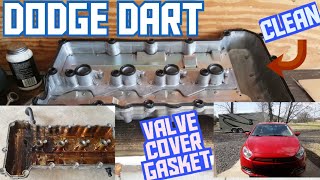
Typical fix: The diaphragm is not sold separately. The entire valve cover assembly must be replaced. 🎬 See this walkthrough on how to replace the valve cover To prevent recurrence, many owners also replace the intake manifold (which contains the faulty check valve) or install an aftermarket external PCV check valve kit (like those from CruzeKits.com) to bypass the failed internal check valve.
Est. part cost: $150-$350 - Intake Air Leak (Vacuum or Boost Leak) 🔴 High Probability The plastic and rubber components of the intake and vacuum system become brittle over time from heat and vibration, leading to cracks. The hoses connected to the turbocharger wastegate solenoid are particularly susceptible.
How to confirm: Perform a smoke test on the intake system. This is the most reliable method. Visually inspect all accessible hoses between the air filter box, turbo, and intake manifold for cracks, loose connections, or deterioration. Pay close attention to the small vacuum lines near the turbo.
Typical fix: Replace the cracked or disconnected hose. Ensure the air filter housing is properly sealed.
Est. part cost: $15-$100 - Faulty Manifold Absolute Pressure (MAP) Sensor 🟡 Medium Probability Sensors can fail or become contaminated with oil or carbon over time, leading to inaccurate readings without setting a specific sensor fault code. This can cause the PCM's airflow calculations to be incorrect.
How to confirm: Use a scan tool to monitor the MAP sensor reading with the key on, engine off. It should read close to the current barometric pressure. Compare its readings to a known good sensor or vacuum gauge while the engine is running. A failing sensor may provide erratic or biased readings.
Typical fix: Replace the MAP sensor. There are two on this engine (one pre-throttle body, one on the intake manifold); the one on the intake manifold is the primary sensor for this calculation and the most likely culprit.
Est. part cost: $40-$80 - Improperly Installed or Poorly Sealing Engine Air Filter ⚪ Low Probability → Shop Air Cleaner Assembly If the air filter or its housing is not perfectly sealed, it can allow turbulent, unmetered air to enter the intake tract, causing the PCM's calculations to be incorrect. This is more common with cheap, ill-fitting aftermarket filters.
How to confirm: Open the air filter box and inspect the filter. Ensure it is seated correctly and that the housing is closed and sealed on all sides with no gaps. Check for warping or damage to the filter seal.
Typical fix: Reinstall the air filter correctly or replace it with a quality OEM or equivalent filter that fits properly.
Est. part cost: $20-$40
Rare But Worth Checking
- Internal Engine Mechanical Issue: On the similar GM 1.4L engine, this code has been linked to cracked pistons or worn piston rings, which alter crankcase pressure and engine breathing. This should only be considered after all other causes, especially air leaks, have been ruled out. A compression and leak-down test would be required for diagnosis.
Diagnosis Steps
- Scan for any other fault codes. Codes like P0171 or P0299 strongly point towards a vacuum/boost leak.
- Visually inspect the entire air intake system, from the air filter box to the throttle body. Look for any obvious cracks, loose clamps, or disconnected hoses.
- Perform the 'Oil Cap Test': With the engine idling, listen for hissing or whistling sounds that would indicate a vacuum leak. Pay close attention to the valve cover area. Carefully try to remove the oil filler cap. If it's held on by strong vacuum and the engine note changes drastically or stalls when it's removed, the valve cover diaphragm has failed.
- Perform a smoke test. This is the most effective way to find small, hard-to-see leaks in the intake manifold, vacuum lines, and PCV system. Introduce smoke into the intake system and look for smoke escaping from the valve cover, hoses, or gaskets.
- Inspect the air filter to ensure it is clean and properly seated in its housing, with no gaps around the seal.
- If no leaks are found, use a scan tool to monitor the MAP sensor's live data to ensure it is reading correctly at idle and under load. Compare the reading to barometric pressure with the key on, engine off.
- If all else fails, consider a mechanical issue. Perform an engine compression test and a crankcase pressure test to rule out internal engine problems.
Parts You'll Likely Need
- Valve Cover Assembly
(OEM #55268951 / 68210283AA)— The PCV diaphragm inside the original valve cover is a common failure point that creates a large vacuum leak. The diaphragm is not serviceable; the entire cover must be replaced.
Trusted brands: Mopar, Dorman (p/n 264-968), Standard Motor Products
OEM price range: $200-$300
Aftermarket price range: $120-$200 - Manifold Absolute Pressure (MAP) Sensor
(OEM #0261230282 / 55573248)— A faulty MAP sensor can provide the PCM with incorrect data, leading to a P1101 code. It's a potential cause if no air leaks are found.
Trusted brands: Bosch, Mopar, Standard Motor Products
OEM price range: $60-$90
Aftermarket price range: $30-$60 - Intake Manifold
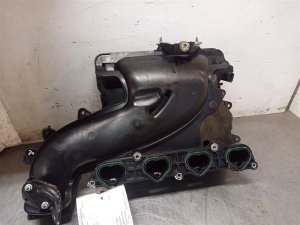
(OEM #68105583AF)— Often replaced proactively when the valve cover fails. The integrated non-return check valve fails, allowing boost to enter the crankcase and rupture the valve cover diaphragm. Replacing the manifold or installing an external check valve kit is the permanent fix.
Trusted brands: Mopar, Dorman (p/n 615-380)
OEM price range: $250-$400
Aftermarket price range: $150-$250 - Vacuum Hoses / Intake Ducts — Cracked rubber or plastic hoses are a very common source of unmetered air leaks that trigger this code.
Trusted brands: Mopar, Gates
OEM price range: $30-$100
Aftermarket price range: $15-$50
Related Codes That Often Appear With This One
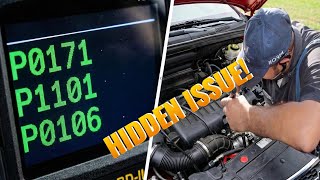
- P0171 — System Too Lean (Bank 1). This code is frequently triggered alongside P1101 because an unmetered air leak (vacuum leak) from the PCV system or intake hoses is a common cause for both.
- P0299 — Turbocharger Underboost. A leak in the charge pipes (after the turbo) or a failed PCV system can cause a loss of boost pressure, triggering both codes.
- P0106 — Manifold Absolute Pressure/Barometric Pressure Circuit Range/Performance. If the MAP sensor itself is failing or providing erratic data due to a large vacuum leak, it can trigger both a specific sensor performance code and the P1101 airflow calculation code.
Technical Service Bulletins (TSBs) & Recalls
- Mopar TSB 25-001-15: While not directly for P1101, this TSB addresses a rough idle, MIL illumination, and DTC P0507 (Idle Air Control System RPM Higher Than Expected). The cause is a ruptured PCV valve diaphragm in the valve cover, the exact same failure that causes P1101. The fix is to replace the valve cover assembly. This corroborates the common failure mode.
Platform-Specific Known Issues
- The PCV system design, with a check valve in the intake manifold and a diaphragm in the valve cover, is a known weak point on this engine platform, making it the most likely cause of code P1101.
- The failure cascade is well-documented: the intake manifold's internal check valve fails, allowing boost pressure into the crankcase, which then ruptures the PCV diaphragm in the valve cover, creating a massive vacuum leak.
Mechanic-Grade Diagnostic Values
- MAP Sensor Voltage (Key On, Engine Off) — expected: ~4.5 Volts (Should correspond to Barometric Pressure). Failure: Voltage is significantly different from the Barometric Pressure sensor reading or outside the 4.0-4.9V range.
- MAP Sensor Voltage (Engine at Idle) — expected: 1.0 - 2.0 Volts. Failure: Voltage is significantly higher, which can indicate a large vacuum leak or a faulty sensor.
- Spark Plug Gap (1.4L Turbo) — expected: ~0.028 inches. Failure: Incorrect gap can affect combustion efficiency and engine breathing, potentially contributing to airflow calculation errors over time.
Scan Tool Commands That Help
- wiTECH or equivalent professional scan tool: PCM Flash / Reprogramming — If a Technical Service Bulletin (TSB), like #18-033-15 for the 1.4L engine, applies to the vehicle. An outdated PCM software version may be overly sensitive in setting the P1101 code or have incorrect parameters for airflow calculation.
- Manual Procedure or Scan Tool: Throttle Relearn / Reset — After cleaning the throttle body, replacing it, or after the battery has been disconnected for an extended period. The PCM 'forgets' the learned idle throttle position, which can cause an unstable idle and contribute to airflow-related codes until it relearns.
Wiring & Ground Locations
- Main Engine/Transmission Ground — On the driver's side frame rail, behind the splash guard. A cable runs from the battery negative post to a stud on the frame, and another cable runs from that stud to the transmission case.. This is a critical ground path for the entire powertrain. Corrosion on this stud is a very common Dodge Dart issue, causing a wide range of electrical problems, including erratic sensor readings that could lead the PCM to miscalculate airflow and set a P1101.
- G108 — Rear center of the top of the engine for the 1.4L.. This is a primary engine ground. A loose or corroded connection here can affect the reference ground for multiple sensors used in the airflow calculation, such as the MAP and temperature sensors.
- G104 / G105 — Located on the left (driver's) side of the engine compartment, near the front.. These are chassis and engine compartment grounds. While not directly on the engine, they provide the ground path for the PCM and other modules. Poor connections can cause intermittent and hard-to-diagnose electrical faults.
Real Owner Repair Stories
- DadsGarage Diagnostic Specialist YouTube Channel (2016 Chevy Cruze 1.8L (demonstrating a principle applicable to the Dart's speed-density system)) — Check Engine Light with code P1101, engine runs funny at times.
❌ Tried (didn't work) Initial visual inspection of ducts showed no obvious leaks.
✅ What actually fixed it The air filter housing was not properly seated on the intake tube, creating a small gap. This allowed turbulent air to enter past the seal, causing inaccurate airflow calculations by the PCM. Properly reinstalling the air filter and sealing the housing resolved the code. - Commenter on DadsGarage Diagnostic Specialist YouTube Video (Opel Meriva B 1.4L Turbo (same engine family as Dart/Cruze)) — Check Engine Light with only code P1101.
❌ Tried (didn't work) Replacing the Mass Airflow (MAF) sensor four times.
✅ What actually fixed it The actual cause was a faulty throttle body. After replacing the throttle body, the P1101 code was resolved using the original MAF sensor.
Model Year Variations Within This Range
- 2013-2015: Earlier models may have outdated Powertrain Control Module (PCM) software. TSB #18-033-15 was released for the 1.4L engine to address diagnostic and system improvements. A vehicle that has never had this update applied may be more prone to setting a P1101 code under certain conditions compared to a vehicle with the updated software.
Diagnostic Flowchart
Real Owner Stories
Aggregated from forums and TSBs cited above. Mileages and costs reflect what owners reported in those sources.
Dodge Dart 1.4L MultiAir Turbo
Symptoms: Experienced codes P1101, P0171, and P0106. Noticed that taking the oil cap off while the engine was running caused the car to run rough or stall.
What fixed it: Replacing the valve cover.
Source hint: Dodge-Dart.org Forum Thread: 'P1101 code'
Dodge Dart 1.4L MultiAir Turbo
Symptoms: Reported an underboost condition alongside the airflow performance code, accompanied by a noticeable hissing sound from the engine.
What fixed it: Diagnosing and addressing a boost leak in the PCV/valve cover system.
Source hint: Dodge-Dart.org Forum Thread: 'P0299 and P1101'
Chevrolet Cruze 1.4L Turbo
Symptoms: Experienced the identical PCV failure cascade where the intake manifold check valve fails, leading to a ruptured valve cover diaphragm.
What fixed it: Addressing the failure cascade detailed in a GM TSB regarding the intake manifold check valve and valve cover diaphragm.
Source hint: Reddit r/Cruze: 'Check engine light p1101'
Related OBD-II Codes
Frequently Asked Questions
Does Mopar TSB 25-001-15 apply to my Dodge Dart with code P1101?
Why is there a loud whistling sound coming from my 1.4L MultiAir engine when P1101 is triggered?
Can I just replace the PCV valve on my Dart instead of the whole valve cover?
What is the 'Oil Cap Test' for diagnosing P1101 on the Dodge Dart?
How do I prevent the PCV diaphragm from blowing out again after replacing the valve cover?
Are there other codes that commonly appear with P1101 on this engine?
Helpful Videos
Used OEM Parts in Stock
New Aftermarket Parts Available




The information in this article is provided for general reference and educational purposes only. Vehicle specifications, procedures, and part compatibility can vary by production date, trim level, and region. Always consult your vehicle's factory service manual and verify part numbers before purchasing or performing repairs. Safety-critical components such as airbags, seat belts, and braking systems should be installed by a qualified professional.
- Dodge Dart:
- 🧭 Diagnostic Flowchart
- 🎬 Helpful Videos
- 🛍️ Shop This Part
- What's Unique About the 2013-2016 Dodge Dart
- Symptoms You May Notice
- Most Likely Causes
- Rare But Worth Checking
- Diagnosis Steps
- Parts You'll Likely Need
- Related Codes That Often Appear With This One
- Technical Service Bulletins (TSBs) & Recalls
- Platform-Specific Known Issues
- Mechanic-Grade Diagnostic Values
- Scan Tool Commands That Help
- Wiring & Ground Locations
- Real Owner Repair Stories
- Model Year Variations Within This Range
- Real Owner Stories
- Dodge Dart 1.4L MultiAir Turbo
- Dodge Dart 1.4L MultiAir Turbo
- Chevrolet Cruze 1.4L Turbo
- Related OBD-II Codes
- Frequently Asked Questions
- 🎟️ Get 5% Off