

P1289 on 2003-2006 Ford Expedition 5.4L: CHT Sensor Circuit High Explained
This code almost always means the Cylinder Head Temperature (CHT) sensor has failed or its wiring is damaged. The truck may enter a 'limp mode' with cooling fans running constantly. Replacing the sensor, which is located in a difficult-to-reach spot on the driver's side cylinder head under the intake, is the most common fix. Many owners successfully replace it by only removing the alternator.
- P1289 on your Expedition means the computer sees a fault in the Cylinder Head Temperature (CHT) sensor circuit, usually an open wire or failed sensor.
- Expect symptoms like the cooling fans running constantly, the A/C not working, and a dead temperature gauge.
- The CHT sensor (Motorcraft DY1144) is the most likely culprit, but if the code returns instantly after replacement, the wiring harness or connector pigtail (Motorcraft WPT-115) is faulty.
- The sensor is very hard to reach, but removing the alternator can provide enough access to replace it without removing the entire intake manifold, especially with a 19mm flex-head wrench.
What's Unique About the 2003-2006 Ford Expedition
Unlike many vehicles that use a traditional Engine Coolant Temperature (ECT) sensor submerged in coolant, the Ford 5.4L V8 engine uses a Cylinder Head Temperature (CHT) sensor threaded directly into the cylinder head's metal. This design means it measures metal temperature, not coolant temperature. A failure triggers aggressive fail-safe strategies, like running the cooling fans on high and disabling the A/C, to prevent potential engine damage, even if the engine isn't actually overheating.
Symptoms You May Notice
- Check Engine Light is on
- Temperature gauge on the instrument cluster is inoperative or reads cold.
- Cooling fans run constantly at high speed, even on a cold engine.
- A/C compressor will not engage.
- Engine may enter a reduced power "limp mode".
- An engine overheat warning message or "engine temp data error" may appear on the dash, even if the engine is cold.
- Hesitation or lack of power during acceleration.
- Replacing the thermostat. While a faulty thermostat can cause overheating, it will not cause the P1289 'circuit high' code.
- Replacing the Engine Coolant Temperature (ECT) sensor. This engine uses a CHT sensor for its primary temperature reading; some models may have an ECT for other purposes, but P1289 specifically refers to the CHT circuit.
- Replacing the PCM without thoroughly testing the CHT sensor circuit first.
Most Likely Causes
- Faulty Cylinder Head Temperature (CHT) Sensor 🔴 High Probability → Shop Engine Cylinder Head The sensor is subjected to extreme heat cycles, which can lead to internal failure over time. It's the most common point of failure for this code.
How to confirm: With a scan tool, observe the CHT sensor voltage (CHT_V). A reading over 4.6V or a temperature reading of -40°F/°C on a warm engine points to a failed sensor or open circuit. You can also measure the sensor's resistance when cold and hot to see if it changes according to specification.
Typical fix: Replace the CHT sensor. Due to the difficult access, it is highly recommended to use a high-quality OEM (Motorcraft) or premium aftermarket part to avoid repeat repairs. The Motorcraft part number is typically DY1144 (supercedes 3L7Z-12A648-AA).
Est. part cost: $25-$60 - Damaged CHT Sensor Wiring or Connector 🟡 Medium Probability The wiring harness is routed in a hot, tight area at the back of the engine, making it susceptible to heat damage, brittleness, and chafing against other components. If the code returns immediately after sensor replacement, the wiring is the likely culprit.
How to confirm: Visually inspect the wiring harness leading to the CHT sensor for any signs of fraying, melting, or breaks. The damage is often found where the harness passes over the bell housing or near the back of the intake manifold. Perform a "wiggle test" on the harness while monitoring the sensor data on a scan tool. Check for 5V reference and a good ground at the connector.
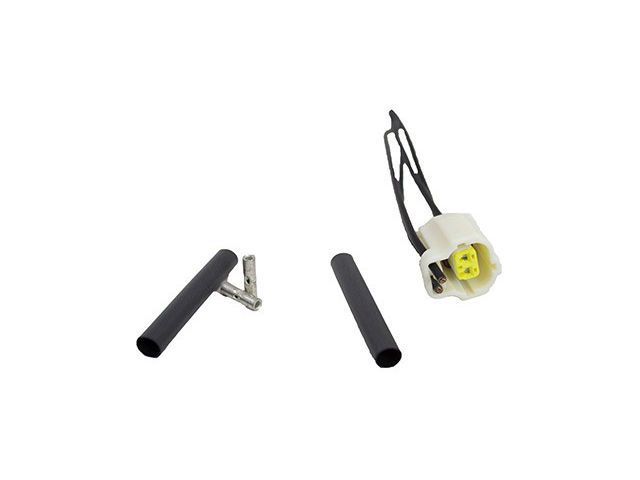
Typical fix: Repair the damaged section of the wire or replace the connector pigtail. The Motorcraft pigtail connector is part number WPT-115.
Est. part cost: $15-$35 for a pigtail connector - Low Engine Coolant ⚪ Low Probability While the CHT measures metal temp, a severe loss of coolant can cause hot spots in the cylinder head that might trigger temperature-related codes, although P1299 (overheat condition) is more common in this scenario.
How to confirm: Check the engine coolant level in the reservoir and radiator (when the engine is cool).
Typical fix: Top off the coolant and inspect the cooling system for leaks.
Est. part cost: $20-$40 for coolant
Rare But Worth Checking
- Rodent Damage to Wiring: Squirrels and other rodents have been known to chew through the CHT sensor wiring harness where it sits in the valley of the engine, causing an open circuit and triggering P1289.
- Faulty Powertrain Control Module (PCM): → Shop Engine Control Module (ECM) This is extremely rare. Before condemning the PCM, all other possibilities, especially the CHT sensor and its entire wiring circuit, must be exhaustively tested and ruled out. Some users report that clearing the code makes the gauge work for a few seconds before failing again, which can sometimes point to an internal PCM driver issue, but a wiring fault is still more likely.
Diagnosis Steps
- Verify the P1289 code is present using an OBD-II scanner.
- Check the engine coolant level to rule out any basic cooling system issues.
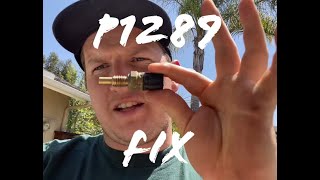
- Using a scan tool with live data, monitor the CHT sensor reading. If it shows -40°F or a similarly extreme cold temperature, this indicates an open circuit, which is consistent with P1289. 🎬 See how to diagnose and fix the P1289 code
- Visually inspect the CHT sensor wiring harness, which is located on the driver's side cylinder head, under the intake manifold, near the firewall. A borescope can be helpful for this. Look for any visible damage, such as melted wires, corrosion, or rodent damage.
- If wiring appears intact, the next step is to test the circuit. Disconnect the sensor and check for a 5-volt reference signal from the PCM at the connector.
- If the reference voltage and ground are good, the CHT sensor itself is the most likely cause of the failure.
- If the code persists immediately after replacing the sensor, the fault lies within the wiring harness between the sensor and the PCM. A continuity test from the sensor connector to the PCM connector pins is required.
Parts You'll Likely Need
- Cylinder Head Temperature (CHT) Sensor
(OEM #Motorcraft DY1144 (replaces 3L7Z-12A648-AA))— This sensor is the most common failure point for code P1289. It fails internally from constant heat cycles.
Trusted brands: Motorcraft, NTK, Standard Motor Products (SMP)
OEM price range: $40-$75
Aftermarket price range: $25-$50 - CHT Sensor Connector Pigtail
(OEM #Motorcraft WPT-115)— The connector and nearby wiring can become brittle and break from engine heat, causing an open circuit. This is the next most likely culprit if a new sensor doesn't fix the issue.
Trusted brands: Motorcraft, Dorman
OEM price range: $25-$40
Aftermarket price range: $15-$25
Related Codes That Often Appear With This One
- P1299 — P1299 indicates the CHT sensor has detected an actual overheat condition. It can sometimes appear with P1289 if the sensor is failing erratically, sending both out-of-range and overheat signals.
- P0119 — This code indicates an intermittent fault in the coolant temperature sensor circuit. It can appear alongside P1289 if the sensor or wiring is failing intermittently before failing completely open.
Platform-Specific Known Issues
- Difficult Sensor Location: The location of the CHT sensor on the 5.4L V8 is notoriously difficult to access. It is situated on the driver's side cylinder head, underneath the intake manifold, near the firewall. The factory service procedure often calls for removing the entire intake manifold, which significantly increases labor time and cost.
- Alternator Removal Method (DIY Fix): Many owners and mechanics have successfully replaced the sensor without removing the intake manifold. This popular method involves removing the air intake tube and the alternator to create access from the front. 🎬 Watch: How to remove the alternator for easier sensor access A 19mm flex-head ratcheting wrench is considered an essential tool for this job, allowing you to reach the sensor from the newly created opening. While still tight, this method can save hours of labor.
Mechanic-Grade Diagnostic Values
- CHT Sensor Resistance — expected: ~37 kΩ @ 68°F (20°C), ~2.4 kΩ @ 176°F (80°C), ~1.1 kΩ @ 212°F (100°C). Failure: An infinite resistance (Open Loop) reading indicates an internally failed sensor, which causes P1289.
- CHT Sensor Circuit Voltage (Key On, Engine Off) — expected: ~3.0V - 4.0V on a cold engine. The voltage should decrease as the engine warms up.. Failure: Voltage is greater than 4.6V, indicating an open circuit.
- CHT Reference Voltage (VREF) at Harness Connector — expected: 5 Volts DC on one wire (sensor unplugged, key on).. Failure: Absence of 5V reference points to a problem with the PCM or the wiring between the PCM and the sensor.
- PCM Fail-Safe Temperature Thresholds — expected: At ~258°F (126°C), the PCM disables four fuel injectors. At ~310°F (154°C), the PCM disables all fuel injectors.. Failure: These are not failure indicators, but the programmed responses to a perceived overheat condition, which can be triggered by a faulty sensor reading.
- PCM Dual-Resistor Circuit Voltage Overlap — expected: At certain temperatures, two different voltage readings can be correct. For example, at 194°F (90°C), the voltage could be either ~0.60V or ~3.71V as the PCM switches between its 'cold' and 'hot' resistor circuits.. Failure: This is an advanced diagnostic note; a technician unaware of this might misdiagnose a good sensor. The key failure for P1289 remains a voltage stuck high (>4.6V).
Wiring & Ground Locations
- PCM Connector Pin 41 — At the main Powertrain Control Module (PCM) connector, located in the right rear of the engine compartment.. This is the pin for the CHT signal wire (Light Green/Yellow). It's a critical point for testing continuity from the sensor to the PCM if a wiring break is suspected.
- PCM Connector Pin 58 — At the main Powertrain Control Module (PCM) connector.. This is the pin for the Signal Return (SIGRTN) wire (Grey/Red). This wire is shared with other sensors via splices, so a fault here can sometimes cause other codes.
- Harness Chafe Point over EGR Pipe — Where the main engine wiring harness crosses over the hot EGR tube near the back of the engine.. The heat shield can fail, allowing the EGR tube to melt through the harness loom and burn the CHT sensor wires, causing an open or short. This is a known failure point that is difficult to see without removing the harness.
- Ground G103 — On the engine block in the right rear of the engine compartment.. This is a primary engine ground. While not directly for the CHT's signal return, a poor main engine ground can cause a variety of strange sensor reading issues.
Real Owner Repair Stories
- Ford Truck Enthusiasts forum user (2006 Ford E-250 with 5.4L V8) — Temperature gauge would spike to hot for no reason, then eventually dropped to cold and stayed there, triggering a code.
❌ Tried (didn't work) Replacing the CHT sensor.
✅ What actually fixed it The wiring harness had melted where it crossed over the EGR pipe. The CHT sensor's 5V supply wire was burnt in half. Splicing the wire and adding a heat shield permanently fixed the problem. - Reddit user /u/Tyler_From_Canada (2007 Ford F-150 Lariat with 5.4L 3V) — P1289 code returned immediately after sensor replacement.
❌ Tried (didn't work) Replacing the CHT sensor with a new part from NAPA.
✅ What actually fixed it The user located the CHT sub-harness connector behind the engine, performed a continuity test, and found a broken wire at pin 1. Repairing the single broken wire in the harness resolved the code. - Ford F150 Forum user (2007 Ford Expedition with 5.4L V8 at 160,000 miles) — Persistent P1289 code, no A/C, dead temp gauge.
❌ Tried (didn't work) Replacing the CHT sensor., Replacing the CHT sensor connector pigtail.
✅ What actually fixed it The owner gave up on finding the break in the factory wiring. They ran two new, separate wires directly from the CHT sensor connector all the way to the PCM, splicing them in at pins 41 and 58. This bypass of the factory harness permanently fixed the issue.
OEM Part Supersession History
3L7Z-12A648-AA→Motorcraft DY1144— Standard part number update and consolidation.
Diagnostic Flowchart
Other Known Issues on This Vehicle
Issues unrelated to this code that are worth knowing about as an owner of this generation:
- Spark Plug Breakage During Removal 🔴 High — Extremely common on engines built before 10/9/07. The two-piece spark plug design allows carbon to build up on the ground electrode shield, causing it to seize in the cylinder head. Attempting removal, especially on a warm engine or without proper technique, often breaks the plug, leaving the lower portion stuck. (Ref: TSB 08-7-6)
- Cam Phaser Knocking / Engine Ticking 🟠 Medium — Very common, especially at hot idle. Caused by failing Variable Cam Timing (VCT) phasers, low oil pressure to the phasers (due to worn tensioner seals or clogged passages), or faulty VCT solenoids. Often sounds like a diesel engine at idle. (Ref: TSB 06-19-8)
- Fuel Pump Driver Module (FPDM) Failure 🔴 High — Extremely common, especially in regions with road salt. The aluminum module is mounted directly to the steel frame above the spare tire, causing galvanic corrosion that destroys the module's housing and electronics. This leads to a crank-no-start or stalling condition that is often misdiagnosed as a bad fuel pump.
- Cracked Plastic Intake Manifold 🟠 Medium — The composite intake manifold, particularly the coolant crossover passage at the front, can develop cracks over time, leading to coolant leaks. Vacuum leaks can also occur from cracked fittings on the rear of the manifold.
Used vs. New Parts: Buying Guide for This Vehicle
When a used part is the smart pick: For this repair, a used part is almost never a smart choice. The CHT sensor is an inexpensive electronic component, and the primary cost of the repair is the high labor required for access. The risk of a used sensor failing prematurely far outweighs the small cost savings. A used wiring pigtail from a junkyard could be considered if it is in excellent, non-brittle condition.
Donor-vehicle mileage cap: roughly under 80000 miles for the part to have meaningful remaining life.
What to inspect on the donor part:
- For a wiring pigtail, check for any signs of cracking, brittleness, or heat damage on the plastic connector and wire insulation.
- Ensure the connector's weather seal is intact and pliable.
- Verify the locking tab on the connector is not broken.
- Avoid any pigtail that shows signs of a previous, shoddy splice repair.
OEM-only on this vehicle (don't cheap out):
- Cylinder Head Temperature (CHT) Sensor
Aftermarket brands forum-validated for this vehicle:
- NTK
- Delphi
- Standard Motor Products (SMP)
Brands owners have reported issues with on this vehicle:
- Unbranded 'economy' or store-brand sensors are generally not recommended for this repair due to the high labor cost of a potential repeat failure.
Real Owner Stories
Aggregated from forums and TSBs cited above. Mileages and costs reflect what owners reported in those sources.
2005 Ford Expedition 5.4L 3V V8
Symptoms: The vehicle had a rough idle and a P1289 code.
What fixed it: The problem was traced to a corroded wire splice in the CHT sensor pigtail, which was located over the transmission bell housing.
Source hint: expeditionforum.com thread titled '2005 Expedition rough idle with a P1289 code CHT'
2004-2008 Ford F-150 5.4L 3V V8
Symptoms: A persistent P1289 code that would not go away even after replacing both the CHT sensor and the pigtail connector.
What fixed it: The ultimate fix required a thorough wiring check all the way back to the PCM to find the fault in the harness.
Source hint: f150forum.com thread titled 'p1289 code wont go away'
2005 Ford Expedition 5.4L 3V V8
Symptoms: Check Engine Light with code P1289 and a dead temperature gauge.
What fixed it: The suggested fix was to replace the CHT sensor. Other owners recommended using the alternator-removal method for access and confirmed a 19mm flex-head wrench was the right tool for the job.
Source hint: ford-trucks.com thread titled 'p1289 code on 05 expedition'
Related OBD-II Codes
Frequently Asked Questions
I replaced the CHT sensor on my Expedition, but the P1289 code came back immediately. What should I check next?
Is there an easier way to replace the CHT sensor on the 5.4L V8 without removing the entire intake manifold?
My temperature gauge is dead and the cooling fans are running constantly. Is this related to the P1289 code?
What are the correct Motorcraft part numbers for the CHT sensor and its electrical connector?
Where exactly is the Cylinder Head Temperature (CHT) sensor located on the 2003-2006 Expedition 5.4L engine?
My A/C stopped working at the same time the check engine light for P1289 came on. Are the two issues connected?
Helpful Videos


We Have This Part in Stock




The information in this article is provided for general reference and educational purposes only. Vehicle specifications, procedures, and part compatibility can vary by production date, trim level, and region. Always consult your vehicle's factory service manual and verify part numbers before purchasing or performing repairs. Safety-critical components such as airbags, seat belts, and braking systems should be installed by a qualified professional.
- Ford Expedition:
- 🧭 Diagnostic Flowchart
- 🎬 Helpful Videos
- 🛍️ Shop This Part
- What's Unique About the 2003-2006 Ford Expedition
- Symptoms You May Notice
- Most Likely Causes
- Rare But Worth Checking
- Diagnosis Steps
- Parts You'll Likely Need
- Related Codes That Often Appear With This One
- Platform-Specific Known Issues
- Mechanic-Grade Diagnostic Values
- Wiring & Ground Locations
- Real Owner Repair Stories
- OEM Part Supersession History
- Other Known Issues on This Vehicle
- Used vs. New Parts: Buying Guide for This Vehicle
- Real Owner Stories
- 2005 Ford Expedition 5.4L 3V V8
- 2004-2008 Ford F-150 5.4L 3V V8
- 2005 Ford Expedition 5.4L 3V V8
- Related OBD-II Codes
- Frequently Asked Questions
- 🎟️ Get 5% Off