

P1441 on 2000-2006 Toyota Tundra: SAIS Valve Stuck Open Causes and Fixes
P1441 means the Secondary Air Injection System (SAIS) valve for Bank 1 is stuck open, a very common issue on 2005-2006 Tundras. The root cause is almost always a failing air pump that ingests moisture, causing its internal filter to disintegrate and send debris downstream. This debris contaminates and seizes the valves. The proper fix involves replacing the pump and both valves, which is expensive ($1,500+). Many owners opt for an aftermarket electronic bypass kit where legally permitted.
- P1441 on a 2005-2006 Tundra points to a stuck-open Secondary Air Injection valve, which will put the truck in a low-power 'limp mode'.
- The root cause is a failing air pump. A complete repair requires replacing the pump AND both air switching valves located under the intake manifold.
- Simply replacing the one faulty valve is not enough; the new part will fail again if the pump is not also replaced.
- This is a labor-intensive and expensive repair, often costing between $1,200 and $2,200 at a shop.
- For those not subject to emissions testing, an aftermarket bypass kit is a much cheaper and permanent solution.
What's Unique About the 2000-2006 Toyota Tundra
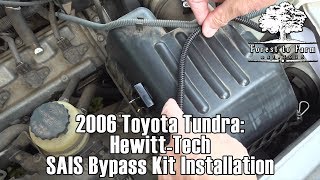
This issue is a widely documented failure point on the 4.7L 2UZ-FE engine, particularly in the 2005-2006 model years which introduced this specific emissions system. The design allows moisture and debris from a deteriorating air pump to travel downstream, seizing the air switching valves located under the intake manifold. Toyota acknowledged this systemic problem in Technical Service Bulletin T-SB-0230-12, which covers multiple vehicles with this engine. Because of the high cost of the OEM repair, a market for aftermarket electronic bypass kits, such as those from Hewitt Technologies, has emerged as a popular, 🎬 See how to install a Hewitt bypass kit. though not emissions-compliant, alternative.
Symptoms You May Notice
- Check Engine Light is on
- VSC and/or TRAC lights are on
- Vehicle enters 'limp mode' with severely reduced engine power and acceleration.
- Loud whining or 'vacuum cleaner' noise from the engine bay for 30-60 seconds on a cold start.
- Flashing '4LO' light on 4WD models (as part of the warning display)
- Replacing only the stuck Air Switching Valve without replacing the Air Pump. The new valve will likely fail again quickly due to continued contamination from the old pump.
- Replacing an oxygen sensor. While emissions-related, a bad O2 sensor will not directly cause a P1441 code.
Most Likely Causes
- Failed Secondary Air Injection Pump 🔴 High Probability → Shop Secondary Air Injection Pump The air pump's internal foam filter can degrade due to moisture ingestion, or the pump motor can fail, sending moisture and black debris into the air switching valves, causing them to seize. This is a well-documented design flaw.
How to confirm: Listen for a loud 'vacuum cleaner' sound from the passenger side fender well during a cold start. NHTSA ODI #10465660 notes an owner report of a loud noise at startup that "sounds like electric vacuum" specifically associated with code P1441. The pump can also be tested for operation with a capable scan tool or by applying direct power. Debris may be visible in the hoses leading from the pump, which is a definitive sign of failure.
Typical fix: Replace the air injection pump. It is critical to replace the switching valves at the same time, as they are almost certainly contaminated. Failure to replace the pump will lead to a repeat failure of new valves.
Est. part cost: $250-$500 - Seized/Stuck Air Switching Valve(s) 🔴 High Probability These valves, located under the intake manifold, are the direct victims of the debris and moisture from the failing air pump. The contamination causes corrosion and binding of the valve mechanism, causing them to get stuck open or closed.
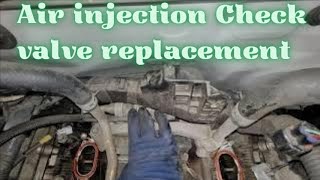
How to confirm: Diagnosis requires removing the intake manifold for inspection and testing. Manufacturer Bulletin #T-SB-0230-12 explicitly identifies P1441 as "Secondary Air Injection System Switching Valve No. 2 Bank 1 Stuck Open." The valves can be manually actuated to check for movement or tested with a vacuum pump. This is typically confirmed during the repair process itself. A user on TundraTalk.net shared a story of diagnosing a bad valve which required pulling the intake manifold. 🎬 Watch this step-by-step air switching valve replacement walkthrough.
Typical fix: Replace both the Bank 1 (P1441) and Bank 2 air switching valves. Since the intake manifold must be removed, replacing both is standard practice to avoid a repeat repair.
Est. part cost: $200-$400 per valve
Rare But Worth Checking
- Cracked or Disconnected Vacuum Lines: The air switching valves are controlled by vacuum switching solenoids (VSVs). A cracked, disconnected, or misrouted vacuum line could prevent a valve from closing properly, triggering the code. This is worth checking after recent engine work. A TundraSolutions forum thread details checking these lines as a primary step.
- Faulty Air Injection Control Driver: The electronic module that controls the air pump and valves can fail, though this is less common than mechanical failure of the pump or valves. TSB T-SB-0230-12 notes this as a possibility, often accompanied by codes P0418 and P2445. The driver is typically located on the driver-side inner fender.
Diagnosis Steps
- Confirm the code with an OBD-II scanner. Note any other accompanying SAIS codes (e.g., P1444, P2440, P2445).
- On a cold start, listen for a loud whining/vacuum noise from the passenger side front fender area lasting about 30-60 seconds. This indicates a failing air pump.
- If possible, use a bidirectional scan tool to command the air pump and switching valves on and off to test for functionality.
- Visually inspect the vacuum lines running to the vacuum switching solenoids (on the passenger side of the intake manifold) for cracks, disconnection, or incorrect routing. A forum member on TundraTalk highlighted a specific vacuum hose under the intake that can cause both P1441 and P1444 if disconnected.
- If the pump is suspected, disconnect the main air hose from it and inspect for black debris or moisture, which confirms internal failure and system contamination.
- The definitive test for the valves requires removing the intake manifold to access and physically inspect them. This is a labor-intensive step and is usually done as part of the repair itself.
Parts You'll Likely Need
- Air Switching Valve, Bank 1
(OEM #25720-50020)— This is the specific valve identified by the P1441 code as being stuck open.
Trusted brands: Toyota (OEM), Dorman
OEM price range: $100-$300
Aftermarket price range: $150-$250 - Air Switching Valve, Bank 2
(OEM #25710-50022)— It is highly recommended to replace the Bank 2 valve at the same time, as it has been exposed to the same contaminants from the failing pump and is located under the same intake manifold.
Trusted brands: Toyota (OEM), Dorman
OEM price range: $200-$400
Aftermarket price range: $150-$250 - Secondary Air Injection Pump
(OEM #17600-0F010)— This is the root cause of the problem. Failure to replace the pump will lead to repeat failure of the new valves.
Trusted brands: Toyota (OEM), Dorman
OEM price range: $470-$600
Aftermarket price range: $250-$400 - Intake Manifold Gasket Set
(OEM #17171-50030)— Required for re-installing the intake manifold after replacing the switching valves. You will need two.
Trusted brands: Toyota (OEM), Fel-Pro, Mahle
OEM price range: $20-$40 each
Aftermarket price range: $10-$25 each - Air Tube Gaskets
(OEM #17377-50010)— Required for sealing the air tubes to the switching valves. You will need four.
Trusted brands: Toyota (OEM)
OEM price range: $5-$10 each
Aftermarket price range: $3-$8 each
Related Codes That Often Appear With This One
- P1444 — This code indicates the switching valve for Bank 2 (driver's side) is stuck open. Since the failing air pump contaminates the entire system, it's very common for both valves to fail around the same time.
- P2440 — This is another code for the Bank 1 switching valve being stuck open. The ECU may use different codes under slightly different conditions, but they point to the same root cause.
- P2442 — This code indicates the switching valve for Bank 1 is stuck closed. This can happen if the debris from the pump causes the valve to seize in the closed position instead of open.
- P2445 — This code indicates the air injection pump itself is stuck off. This often happens after the pump has been failing, making noise, and has finally seized completely.
- P0418 — This code points to a fault in the Secondary Air Injection System Relay 'A' Circuit. A failing pump can draw excessive current, potentially damaging the control relay or its circuit.
Technical Service Bulletins (TSBs) & Recalls
- T-SB-0230-12 Rev1
- Bulletin #T-SB-0230-12 Rev (Dated 2013-10-17) — This update further clarifies the relationship between P1441/P1444 and the Secondary Air Injection System Switching Valve No. 2 Bank 1 / Bank 2 being stuck open.
Platform-Specific Known Issues
- The Secondary Air Injection System on 2005-2006 2UZ-FE engines is a known, high-failure rate component. The issue is so prevalent that Toyota issued a Technical Service Bulletin (T-SB-0230-12) acknowledging that debris from the air pump contaminates the system.
- Due to the extremely high cost of OEM repair, many owners in states without emissions testing opt for an electronic bypass kit from companies like Hewitt Technologies. These kits trick the ECU into thinking the system is functioning correctly, preventing limp mode and clearing the check engine light. Forum posts on TundraTalk.com and TacomaWorld.com have many user reviews of these kits.
- A user on TundraTalk.net shared their experience troubleshooting P1441 and P2440, which led them to a bad switching valve under the intake. They confirmed that these codes trigger the 'fail-safe' limp mode.
Mechanic-Grade Diagnostic Values
- Air Pump Current Draw — expected: 25 to 30 Amps during operation. Failure: Spikes over 50 Amps or significantly lower draw can indicate a failing or seized pump motor.
Scan Tool Commands That Help
- Toyota Techstream: Utility -> Air Injection Check -> Manual Mode — This active test allows a technician to manually command the air pump and air switching valves (ASV) on and off to verify their mechanical and electrical operation independently of a cold start. It's a critical step to confirm if the pump runs and if the valves respond to commands before removing the intake manifold.
- Toyota Techstream: Utility -> Air Injection Check -> Automatic Mode — This function runs a complete system self-test. It is used after a repair to confirm the fix and check for any pending codes without having to perform multiple cold start drive cycles.
Wiring & Ground Locations
- Air Injection Control Driver — Typically located on the driver-side inner fender, near the firewall.. This module controls the air pump and valves. While less common to fail than the mechanical parts, a fault here can mimic a pump or valve failure, often setting codes like P0418. It receives main power from a 50A fuse and ignition power from a 10A fuse.
- Ground Point EA — On the passenger side (right) fender, near the washer fluid reservoir.. This is the main ground point for the Air Injection Control Driver. A corroded or loose ground here can cause intermittent operation or complete failure of the SAIS, leading to various codes including P1441.
Real Owner Repair Stories
- TundraTalk.net forum user 'RobRig' (2006 Tundra V8 Crew Cab 4x4) — Sudden loss of power, unable to exceed 30 mph (limp mode), Check Engine Light with codes P1441 and P2440.
❌ Tried (didn't work) Clearing the codes, which provided a temporary fix before the problem reappeared.
✅ What actually fixed it Troubleshooting with a Factory Service Manual (FSM) pointed to a bad Secondary Air Switching Valve on Bank 1. The user replaced only the single faulty valve (costing ~$90 from Amazon) and the intake gaskets, which resolved the codes and the limp mode condition. This is contrary to the common advice of replacing the pump and both valves simultaneously. - TundraSolutions.com forum user 'wandering_boy' (First Gen Tundra V8) — Check Engine Light, truck went into limp mode (could not exceed 2500 RPM or 30 mph), codes P1441 and P1444.
❌ Tried (didn't work) Initial diagnosis without a clear plan.
✅ What actually fixed it The user performed a full system replacement, including the air pump and all switching valves located under the intake manifold. They noted that the root cause is the valves sticking open, allowing exhaust to flow backward and destroy the pump. The complete replacement fixed the issue. - NHTSA ODI #10730734 — An owner reported that their secondary air injection pump needed replacement after experiencing codes P1441 and P1444. They noted that while a recall existed for newer models, the same problem was occurring on their vehicle.
OEM Part Supersession History
25710-50020, 25710-50021→25710-50022— Standard part revision and improvement by the manufacturer.25720-50010, 25720-50011→25720-50020— Standard part revision and improvement by the manufacturer.
Model Year Variations Within This Range
- 2005-2006: The 2005 model year introduced the updated 2UZ-FE engine with Variable Valve Timing (VVT-i) and the problematic Secondary Air Injection System. Earlier 2000-2004 models with the non-VVT-i 2UZ-FE do not have this system. There were no significant mechanical changes between the 2005 and 2006 models that affect the cause or repair of P1441; a slight change in horsepower rating in 2006 was due to new SAE testing procedures, not an engine change.
Diagnostic Flowchart
Other Known Issues on This Vehicle
Issues unrelated to this code that are worth knowing about as an owner of this generation:
- Premature Frame Corrosion/Rust 🔴 High — Very common, especially in states that use road salt. Led to a major recall and warranty enhancement program from Toyota. (Ref: NHTSA Action Number: PE09049; Toyota Recall Campaign 90D.)
- Lower Ball Joint Failure 🔴 High — A critical and well-documented failure point. Failure can be catastrophic, causing wheel separation. Owners strongly recommend using only OEM parts for replacement. (Ref: Toyota Recall 70B (for 2002-2006 models).)
- Cracked Exhaust Manifolds 🟠 Medium — Common on the 4.7L 2UZ-FE engine. Presents as a ticking noise on a cold start that may disappear as the engine warms up.
- Internal Radiator Failure (Pink Milkshake) 🔴 High — On automatic transmission models, the internal transmission cooler within the radiator can fail, mixing coolant and transmission fluid. This can quickly destroy the transmission.
Used vs. New Parts: Buying Guide for This Vehicle
When a used part is the smart pick: For this specific P1441 repair, using salvaged/used parts is STRONGLY DISCOURAGED. The failure is systemic and caused by contamination. A used air pump or used switching valves from a junkyard vehicle very likely suffer from the same moisture intrusion and debris that caused the original parts to fail. The risk of a repeat failure is exceptionally high.
What to inspect on the donor part:
- Not applicable. Avoid used SAIS components for this repair.
OEM-only on this vehicle (don't cheap out):
- While not strictly 'OEM-only', using new, high-quality parts is critical. The cost and labor involved in accessing the switching valves under the intake manifold make it unwise to use parts with questionable reliability.
Aftermarket brands forum-validated for this vehicle:
- Dorman: Offers replacement air pumps (e.g., 306-010, may require splicing the connector) and switching valves (e.g., 911-643) that are widely used as a more affordable alternative to OEM.
- Hewitt Technologies: This brand is the most recognized provider of electronic SAIS bypass kits, which are a very popular, permanent alternative to mechanical repair in areas without emissions testing.
Brands owners have reported issues with on this vehicle:
- Unbranded, low-cost parts from online marketplaces should be avoided due to the high labor cost of the repair. A premature failure will be very costly in terms of time.
Real Owner Stories
Aggregated from forums and TSBs cited above. Mileages and costs reflect what owners reported in those sources.
2006 Tundra V8 Crew Cab 4x4
Symptoms: Vehicle would not get above 30 mph, had to limp home. When the pedal was put to the floor the RPMs would not go above 4000. The codes put the engine in a fail-safe mode and limited the throttle to limp-mode.
What fixed it: Troubleshot to a bad Secondary Air Switching Valve on Bank 1 (left side). Access required pulling the intake manifold. Replaced the valve and two silicone intake gaskets.
Cost: $110
Source hint: Tundras.com report titled '2006 Tundra, V8, No Acceleration, Fault Codes P0453, P1441, & P2440'
2005 Tundra 4.7L V8
Symptoms: Diagnosed a bad valve which required pulling the intake manifold. Confirmed that P1441 and P2440 trigger the 'fail-safe' limp mode.
What fixed it: Replacement of the switching valve located under the intake manifold.
Source hint: TundraTalk.net user experience troubleshooting P1441 and P2440
Related OBD-II Codes
Frequently Asked Questions
Does Toyota TSB T-SB-0230-12 apply to my 2005-2006 Tundra with the 4.7L V8?
Why is my Tundra in 'limp mode' with P1441 and a flashing 4LO light?
Can I use an electronic bypass kit to fix the P1441 code on my Tundra?
Is the loud 'vacuum cleaner' noise on cold starts related to P1441?
Do I really need to remove the intake manifold to fix P1441?
Are there other major issues I should look out for on my 2000-2006 Tundra?
Helpful Videos
Used OEM Parts in Stock
New Aftermarket Parts Available


The information in this article is provided for general reference and educational purposes only. Vehicle specifications, procedures, and part compatibility can vary by production date, trim level, and region. Always consult your vehicle's factory service manual and verify part numbers before purchasing or performing repairs. Safety-critical components such as airbags, seat belts, and braking systems should be installed by a qualified professional.
- Toyota Tundra:
- 🧭 Diagnostic Flowchart
- 🎬 Helpful Videos
- 🛍️ Shop This Part
- What's Unique About the 2000-2006 Toyota Tundra
- Symptoms You May Notice
- Most Likely Causes
- Rare But Worth Checking
- Diagnosis Steps
- Parts You'll Likely Need
- Related Codes That Often Appear With This One
- Technical Service Bulletins (TSBs) & Recalls
- Platform-Specific Known Issues
- Mechanic-Grade Diagnostic Values
- Scan Tool Commands That Help
- Wiring & Ground Locations
- Real Owner Repair Stories
- OEM Part Supersession History
- Model Year Variations Within This Range
- Other Known Issues on This Vehicle
- Used vs. New Parts: Buying Guide for This Vehicle
- Real Owner Stories
- 2006 Tundra V8 Crew Cab 4x4
- 2005 Tundra 4.7L V8
- Related OBD-II Codes
- Frequently Asked Questions
- 🎟️ Get 5% Off