

P1450 on 2015-2024 Ford Mustang 2.3L EcoBoost: Causes and Fixes for 'Unable to Bleed Up Fuel Tank Vacuum'
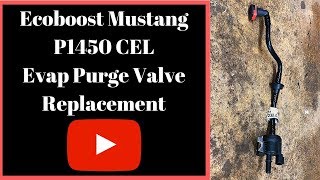
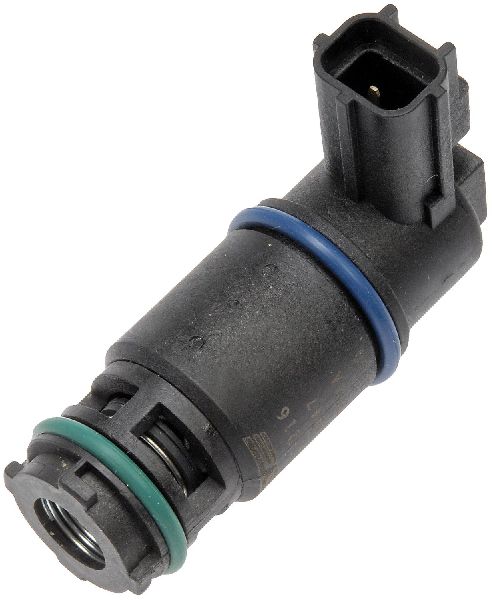
On a 2015-2024 Mustang EcoBoost, P1450 is almost always caused by a faulty canister purge valve (OEM Part No. FR3Z-9G297-H) located on the engine. This is a well-known issue causing hard starts or a rough, stumbling idle after refueling. The fix is a simple 15-minute DIY replacement requiring an 8mm and 10mm socket, with the part costing between $30 for an aftermarket version and $70 for the OEM Motorcraft part.
- P1450 on a 2015-2024 EcoBoost Mustang is almost certainly a failed canister purge valve on the engine.
- The most common symptoms are a Check Engine Light and difficulty starting or a rough idle right after getting gas.
- You can confirm the failure with a simple 'finger test' for vacuum on the valve's outlet port with the engine running and electrical connector unplugged.
- This is a very easy and inexpensive DIY repair, typically taking less than 30 minutes with basic tools like an 8mm and 10mm socket.
- The most current OEM part number is FR3Z-9G297-H. Using this specific revision is recommended.
What's Unique About the 2015-2024 Ford Mustang
The S550 generation Mustang (2015-2023) is exceptionally prone to this specific code across all engine variants. The canister purge valve, mounted on the engine, is a documented high-failure part and is the culprit in over 90% of P1450 cases on this platform. The issue is so common that Ford issued Technical Service Bulletin TSB 19-2323 for 2015-2017 models to address it. Manufacturer Bulletin #TSB 17-0019 also notes that some 2.3L models built on or before January 13, 2017, may exhibit an illuminated MIL with DTCs P1450, P0456, and/or P144C. Owner forums and repair videos overwhelmingly confirm that replacing this valve is the definitive fix, often without needing further diagnosis. Some owners report replacing the valve multiple times, indicating even the replacement parts can have a limited lifespan.
Generation note: The 2015-2024 range covers the S550 generation (2015-2023) and the start of the S650 generation (2024-present). The P1450 issue due to the purge valve is extremely well-documented for the S550 generation. While the S650 uses similar systems, it uses a different purge valve part number, and long-term data is not yet available, but the underlying engine and emissions components are largely carry-overs.
Symptoms You May Notice
- Check Engine Light is on
- Difficulty starting the engine, or a rough, stumbling idle immediately after refueling
- Engine stalling after fill-ups
- Rough idle at other times
- A 'whoosh' sound of air rushing into the tank when opening the fuel filler door (on capless systems)
- Noticeable fuel odor in engine oil, indicating fuel dilution from a stuck-open purge valve.
- Replacing the gas cap or cleaning the capless fuel filler neck. While important for EVAP leak codes (like P0455 or P0456), this is not a common cause for the P1450 'trapped vacuum' code on this vehicle.
Most Likely Causes
- Faulty Canister Purge Valve (Stuck Open) 🔴 High Probability → Shop Vapor Canister This is a well-documented, high-failure part on the S550 Mustang platform across all engines, including the 2.3L EcoBoost. The internal diaphragm of the valve fails, causing it to remain stuck open and constantly apply engine vacuum to the fuel tank. NHTSA ODI #11467127 describes a diagnosis where a sticking canister purge valve was found pulling a constant vacuum, often accompanied by misfire codes. Over-filling the fuel tank can flood the charcoal canister and send fuel/vapors that contaminate and ruin the valve.
How to confirm: Locate the valve on the driver's side of the engine. Start the engine, then disconnect the electrical connector and the outlet hose from the valve. Place your finger over the port on the valve; if you feel any suction, it is stuck open and has failed. This is a definitive test.
Typical fix: Replace the canister purge valve assembly. This is a simple repair requiring an 8mm and 10mm socket to remove the engine cover, and a 10mm socket for the valve itself.
Est. part cost: $30-$85
Rare But Worth Checking
- Blocked EVAP Canister Vent Solenoid or Hose: → Shop Vapor Canister This component is located near the fuel tank and allows fresh air into the system. If it gets stuck closed or its filter is clogged with dirt or spider webs, it can trap vacuum in the tank. Manufacturer Bulletin #TSB 21-2106 notes that on similar Ford platforms, a kinked evaporator emissions fresh air vent line can trigger P1450.
- Kinked or Collapsed EVAP Hose: A physical restriction in one of the EVAP hoses between the tank, charcoal canister, and purge valve can trap vacuum. This requires a visual inspection of the lines, often under the vehicle.
- Faulty Fuel Tank Pressure (FTP) Sensor: → Shop Fuel Tank If the sensor that measures tank pressure fails and incorrectly reports a constant vacuum, it can trigger P1450. This is rare, but one owner on a forum reported this issue was caused by undercoating spray clogging the sensor's atmospheric reference port, which is located above the rear axle. Cleaning the sensor with brake cleaner resolved the code.
Diagnosis Steps
- Read the trouble codes with an OBD-II scanner to confirm P1450 is present.
- Perform the definitive purge valve test: Remove the plastic engine cover held by two 8mm bolts and two 10mm nuts.
- Locate the purge valve on the driver's side of the 2.3L engine.
- Start the engine and let it idle.
- Disconnect the electrical plug from the purge valve.
- Disconnect the EVAP line that runs from the valve towards the back of the car (often has a green or white clip).
- Place your finger over the port on the valve where the hose was just removed. If any suction is felt, the purge valve is faulty and must be replaced.
- If no suction is felt, the purge valve is likely good. The next steps would be to inspect the EVAP vent solenoid and hoses near the fuel tank for blockages or kinks, which may require lifting the vehicle and potentially a smoke test. However, be aware that a smoke test is often not useful for P1450 as it detects leaks, not blockages.
Parts You'll Likely Need
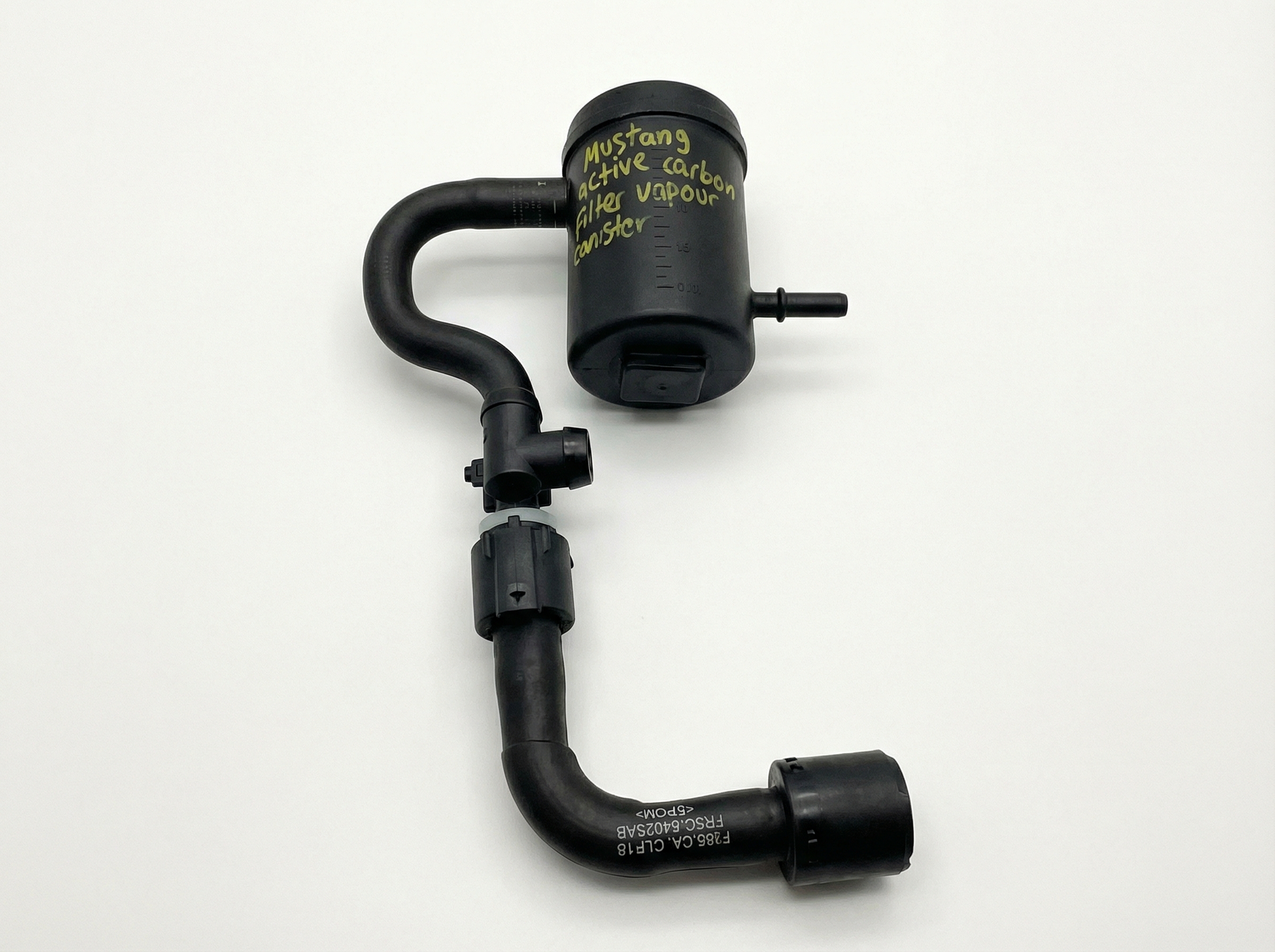
- Canister Purge Valve (Fuel Vapour Hose)
(OEM #FR3Z-9G297-H)— This is the overwhelmingly common failure point for code P1450 on the 2015-2023 Mustang. It gets stuck internally, allowing constant engine vacuum to be pulled on the fuel tank. The 'H' revision is the most current part for this generation.
Trusted brands: Motorcraft (OEM), Bosch, Standard Motor Products (SMP), Dorman
OEM price range: $50-$85
Aftermarket price range: $30-$50
Related Codes That Often Appear With This One
- P144C — This code for 'Evaporative Emission System Purge Check Valve Performance' directly points to the same faulty purge valve. TSB 19-2323 often lists both codes together as being caused by the same part.
- P0456 — This code indicates a 'very small leak'. A purge valve that is not sealing perfectly can sometimes be interpreted by the PCM as a small leak, triggering this code alongside P1450.
- P2196 — This code for 'O2 Sensor Signal Stuck Rich' can occur because the stuck-open purge valve allows un-metered fuel vapors to be constantly drawn into the intake, creating a rich fuel mixture that the oxygen sensor detects. This is frequently seen on other Fords with the same P1450 issue.
- P0316 — This code for 'Misfire Detected on Startup' can be triggered by the same conditions that cause the hard start after refueling, as the rich mixture from the open purge valve causes the engine to stumble immediately after starting. NHTSA ODI #11467127 confirms P0316 and P0300 often appear with P1450 due to a sticking purge valve.
Technical Service Bulletins (TSBs) & Recalls
- TSB 19-2323: Addresses DTCs P1450 and/or P144C on some 2015-2017 models, related to the purge valve and sometimes requiring a PCM update.
- Bulletin #TSB 17-0019: Specifically addresses 2017 Mustang 2.3L models built on or before January 13, 2017, exhibiting MIL with DTCs P0456, P1450, and/or P144C.
- Bulletin #TSB 21-2106: While issued for other Ford platforms, this bulletin notes that P1450 can be caused by a kinked evaporator emissions fresh air vent line.
Platform-Specific Known Issues
- Ford issued TSB 19-2323 (which supersedes TSB 17-0019 and others) for some 2015-2017 models to address DTCs P1450 and P144C. The fix involves replacing the purge valve assembly (part FR3Z-9G297-H) and, in some cases, reprogramming the PCM to the latest calibration.
Mechanic-Grade Diagnostic Values
- Canister Purge Valve Solenoid Coil Resistance — expected: 14 to 38 Ohms. Failure: A reading of infinity (Open Loop) or near-zero Ohms (short circuit) indicates a failed coil.
- Canister Vent Solenoid Coil Resistance — expected: 48 to 65 Ohms. Failure: Readings significantly outside this range indicate a faulty solenoid coil.
- Fuel Tank Pressure (FTP) Sensor Voltage (Key On, Engine Off) — expected: 2.5V to 2.8V at atmospheric pressure.. Failure: A voltage that drops below ~2.4V at idle with the purge valve commanded off indicates the valve is leaking vacuum. A reading biased high or low at rest can indicate a faulty sensor.
- Live Data: EVAP System Vacuum (FTP Sensor) — expected: Near 0 in-H2O at idle with purge valve commanded off.. Failure: If live data shows vacuum (e.g., pressure drops below -8.0 in-H2O) when the purge valve is commanded off, it confirms an un-commanded vacuum source, likely a stuck-open purge valve.
Scan Tool Commands That Help
- FORScan or Ford IDS: EVAP System Test — This is a comprehensive, automated test that cycles the purge and vent solenoids to verify the entire system's integrity. It is the dealership-level method to run after a repair to confirm the fix or during a complex diagnosis where the simple finger test is inconclusive.
- FORScan or Ford IDS: Output State Control (OSC) / Active Commands — Allows a technician to manually command the canister purge valve (PID: EVAPCV) and canister vent solenoid (PID: EVAPV) on and off while monitoring the Fuel Tank Pressure (FTP) sensor. This is used to isolate a specific component. For example, commanding the purge valve to 0% (off) should result in the FTP sensor reading atmospheric pressure; if vacuum is still present, the valve is mechanically stuck open.
Wiring & Ground Locations
- G104 — Located in the engine bay, near the battery on the driver's side.. This is a primary ground point that provides the ground for the Data Link Connector (DLC). While not directly tied to the EVAP system, a poor ground here could affect scan tool communication during diagnosis.
- G400 — Located in the trunk area on the driver's side.. This ground point serves the Fuel Pump Driver Module. While a fault here is unlikely to cause P1450, it is a key part of the overall fuel system's electrical integrity.
- FTP Sensor VREF Circuit — Wiring harness between the Powertrain Control Module (PCM) and the Fuel Tank Pressure (FTP) sensor on top of the fuel tank.. An open or short in the reference voltage (VREF) circuit from the PCM can cause the FTP sensor to send incorrect readings, potentially triggering a P1450 code. This is a rare electrical cause to investigate if all mechanical components check out.
Real Owner Repair Stories
- Fiesta ST Forum (Ford Fiesta ST (similar EVAP system and failure mode)) — P1450 and P219A codes, stuttering after fill-ups, smell of gasoline.
❌ Tried (didn't work) Attempting to replace only the valve and reuse the old nylon lines, which was found to be nearly impossible.
✅ What actually fixed it Replacing the entire purge valve and line assembly. The user strongly recommended an oil change immediately after the repair, as they drained oil that smelled strongly of fuel, indicating significant fuel dilution from the stuck-open valve. - Reddit user on r/Ford (2010 Ford (unspecified model)) — P1450 code.
❌ Tried (didn't work) Clearing the code with a scanner and expecting it to stay off immediately.
✅ What actually fixed it Replacing the purge valve fixed the root cause, but the user noted the Check Engine Light remained on for about a week. Other users confirmed the EVAP readiness monitor can take 100 miles or more of varied driving cycles to complete and turn off the light on its own. - NHTSA ODI #11343783 — An owner reported a stuck canister purge valve that triggered the P1450 code specifically after filling up at a gas station, which could also cause the vehicle to stall.
- NHTSA ODI #11321251 — One owner reported that their vehicle stalls and has trouble starting with code P1450; however, they noted that replacement of the fuel tank pressure solenoid alone did not resolve the issue.
"I Checked Everything" — The Actual Cause
- A smoke test is the wrong diagnostic procedure for an isolated P1450 code. This code indicates an inability to BLEED vacuum (a blockage), not a leak. A smoke test, which pressurizes the system to find leaks, will almost always pass when P1450 is the only code. The actual fault is typically the purge valve leaking engine vacuum *into* the EVAP system or a blockage in the vent path, neither of which a smoke test is designed to identify. Technicians familiar with this code will bypass a smoke test and proceed directly to testing the purge valve's function with a vacuum gauge or by using the 'finger test'.
When the Usual Fixes Don't Work
- While replacing the canister purge valve fixes P1450 in over 90% of cases for this Mustang, there are documented instances where the code returned. In one case, the true cause was a clogged atmospheric reference port on the Fuel Tank Pressure (FTP) sensor, which was obstructed by aftermarket undercoating. Cleaning the sensor resolved the issue where multiple purge valve replacements had failed. In another scenario, a user found that even after replacing the valve, the code persisted until they also performed an oil change, as the old oil was heavily diluted with fuel and potentially affecting engine operation enough to interfere with EVAP self-tests.
OEM Part Supersession History
FR3Z-9G297-A→FR3Z-9G297-H— Part revision to improve reliability and address the common failure mode.FR3Z-9G297-H→PR3Z-9G297-A— New part number for the updated S650 platform.
Heads up: The FR3Z-9G297-H part for the S550 is not specified for the 2024+ S650 Mustang, which uses PR3Z-9G297-A.
Model Year Variations Within This Range
- 2015-2017: These earlier model years are specifically called out in TSB 19-2323, which recommends replacing the purge valve and, in some cases, reprogramming the PCM to the latest calibration. Later models may have already received the updated calibration from the factory.
- 2015-2023 vs 2024+: The S550 generation (2015-2023) uses purge valve part number FR3Z-9G297-H. The S650 generation (2024+) uses a different part number, PR3Z-9G297-A. The parts are not listed as interchangeable.
Diagnostic Flowchart
Other Known Issues on This Vehicle
Issues unrelated to this code that are worth knowing about as an owner of this generation:
- Head Gasket Failure / Coolant Intrusion ('Ecoboom') 🔴 High — More common on pre-2020 models with the 'open-deck' block design. Can occur at any mileage, especially on tuned vehicles, but stock vehicles are also affected. Subject of a class-action lawsuit.
- A/C Evaporator Leak 🟠 Medium — A very common failure on 2015-2017 models where the A/C system stops blowing cold air due to a refrigerant leak from the evaporator core. The part is cheap, but labor is extensive (5+ hours) as it requires removing the entire dashboard. (Ref: TSB 18-2256 (supersedes 18-2166))
- Faulty Low-Pressure Fuel Sensor (LPFS) 🟠 Medium — The original sensor is prone to failure, sending incorrect data to the ECU. This can cause poor performance, stumbling, and lean conditions that may contribute to engine damage. It is a widely recommended preventative upgrade to the revised part (BU5Z-9F972-B).
- Intake Valve Carbon Buildup 🟡 Low — A long-term consequence of all direct-injection engines. Over 50,000-80,000 miles, carbon can build up on intake valves, leading to rough idle, misfires, and reduced performance. Requires manual cleaning (e.g., walnut blasting).
- Cracked Exhaust Manifold 🟡 Low — The stock exhaust manifold can be prone to cracking due to high exhaust temperatures, particularly on tuned or aggressively driven vehicles.
Used vs. New Parts: Buying Guide for This Vehicle
When a used part is the smart pick: For the canister purge valve causing P1450, a used part is NEVER recommended. The part has a very high failure rate, is inexpensive to buy new, and the labor to access it is minimal. The risk of getting a used part that has already failed or is near failure is extremely high.
What to inspect on the donor part:
- Not applicable, do not buy this part used.
OEM-only on this vehicle (don't cheap out):
- Canister Purge Valve: While not strictly 'OEM-only', forum consensus strongly advises using the OEM Motorcraft (FR3Z-9G297-H) part. It provides the highest likelihood of a long-term fix.
Aftermarket brands forum-validated for this vehicle:
- Bosch is a reputable OEM supplier and is often considered a safe alternative to Motorcraft.
Brands owners have reported issues with on this vehicle:
- Cheap, unbranded purge valves from online marketplaces like Amazon or eBay should be avoided. Owners report these parts often fail within a few months, leading to the code returning.
Real Owner Stories
Aggregated from forums and TSBs cited above. Mileages and costs reflect what owners reported in those sources.
2015 Ford Mustang EcoBoost
Symptoms: Check engine light with code P1450, trouble staying on or turning on after filling up the fuel tank; sometimes requires accelerating the car on the first startup after pumping gas.
What fixed it: Replaced the fuel vapor return valve (canister purge valve).
Source hint: owner_reports: Los Meros Vera
2019 Ford Mustang 5.0L (S550 Platform)
Symptoms: P1450 code present; confirmed to be the same failure mode as the EcoBoost models.
What fixed it: Replaced the purge valve at the dealership in about 15 minutes.
Cost: $32-$32
Source hint: Mustang6G.com: P1450 Code - Purge valve
2015 Ford Mustang EcoBoost Performance Package
Symptoms: Stalling after fill-up and power loss.
What fixed it: Replacement of the purge valve; discussion of the interplay between the vent valve and charcoal canister.
Source hint: StangNet Forums: P1450 issue 2015 ecoboost pp
2017 Ford Mustang (S550 Platform)
Symptoms: Recurring P1450 code even after the purge valve was replaced.
What fixed it: Cleaning the atmospheric reference port on the Fuel Tank Pressure (FTP) sensor with brake cleaner, as it had been clogged by oily undercoating.
Source hint: Mustang6G.com: P1450 CEL, even after Solenoid replacement
Related OBD-II Codes
Frequently Asked Questions
Does TSB 19-2323 apply to my 2015-2017 Mustang EcoBoost?
I replaced my purge valve but the P1450 code returned on my S550. What else could it be?
Is there a specific part number I should use for the purge valve on my 2.3L EcoBoost?
Why does my Mustang struggle to start only after I fill up the gas tank?
Can I test the purge valve myself before buying a new one?
Is the P1450 issue related to the 'Ecoboom' head gasket problem?
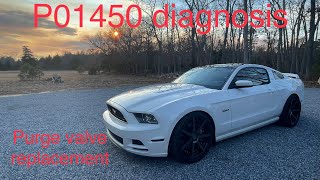
Helpful Videos

Used OEM Parts in Stock
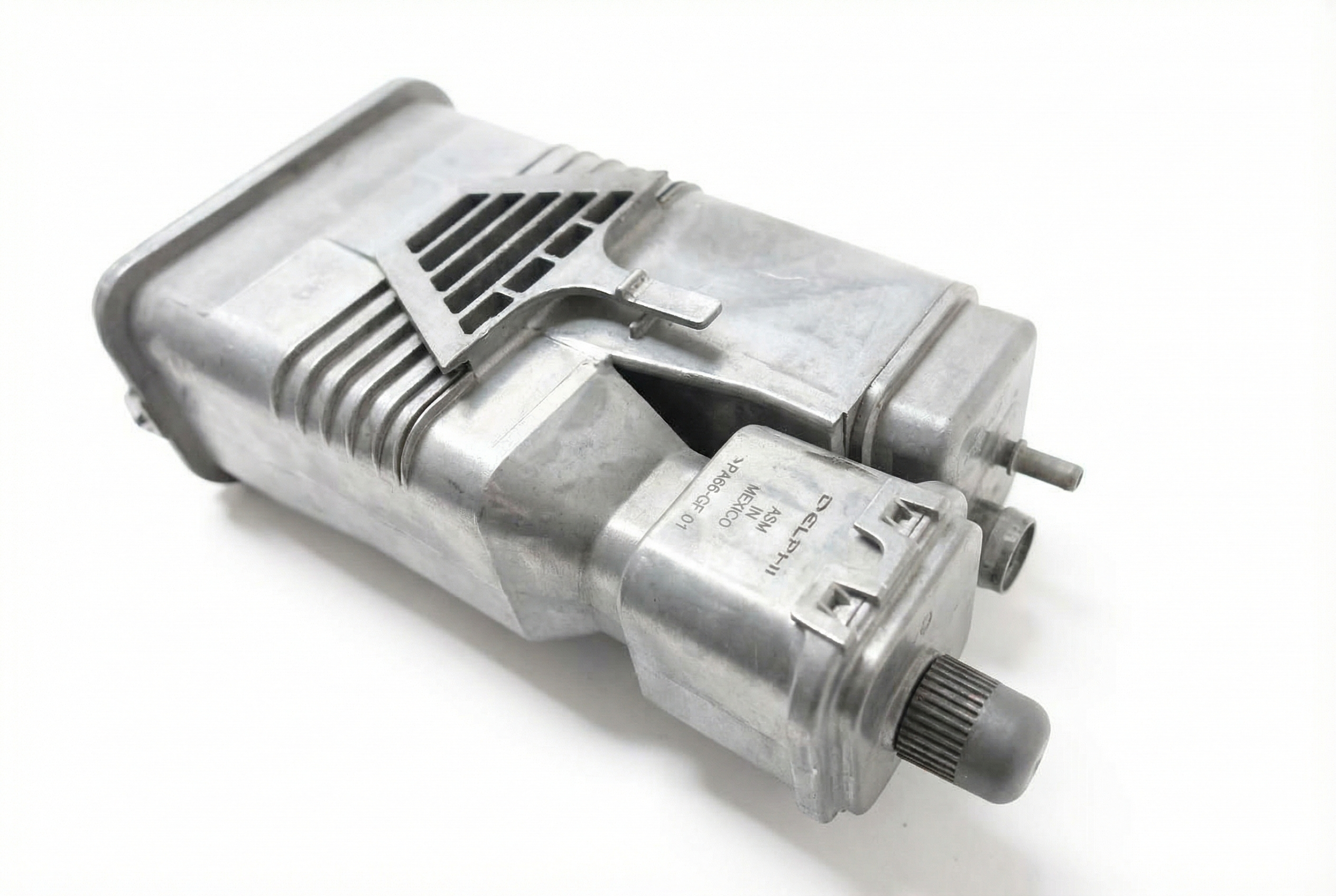
New Aftermarket Parts Available


The information in this article is provided for general reference and educational purposes only. Vehicle specifications, procedures, and part compatibility can vary by production date, trim level, and region. Always consult your vehicle's factory service manual and verify part numbers before purchasing or performing repairs. Safety-critical components such as airbags, seat belts, and braking systems should be installed by a qualified professional.
- Ford Mustang:
- 🧭 Diagnostic Flowchart
- 🎬 Helpful Videos
- 🛍️ Shop This Part
- What's Unique About the 2015-2024 Ford Mustang
- Symptoms You May Notice
- Most Likely Causes
- Rare But Worth Checking
- Diagnosis Steps
- Parts You'll Likely Need
- Related Codes That Often Appear With This One
- Technical Service Bulletins (TSBs) & Recalls
- Platform-Specific Known Issues
- Mechanic-Grade Diagnostic Values
- Scan Tool Commands That Help
- Wiring & Ground Locations
- Real Owner Repair Stories
- "I Checked Everything" — The Actual Cause
- When the Usual Fixes Don't Work
- OEM Part Supersession History
- Model Year Variations Within This Range
- Other Known Issues on This Vehicle
- Used vs. New Parts: Buying Guide for This Vehicle
- Real Owner Stories
- 2015 Ford Mustang EcoBoost
- 2019 Ford Mustang 5.0L (S550 Platform)
- 2015 Ford Mustang EcoBoost Performance Package
- 2017 Ford Mustang (S550 Platform)
- Related OBD-II Codes
- Frequently Asked Questions
- 🎟️ Get 5% Off