

P1450 on 2007-2015 Mazda CX-9: Unable to Bleed Fuel Tank Vacuum Causes and Fixes
On a 2007-2015 Mazda CX-9, code P1450 is almost always a faulty canister purge solenoid valve stuck open. A loud 'whoosh' from the gas cap upon opening is a key symptom. Replacing the purge valve is a common, DIY-friendly fix costing around $50-$100 for the part. This is a well-known issue on the Ford/Mazda 3.7L engine family.
- P1450 on your CX-9 means the fuel tank is holding too much vacuum, not that there is a leak.
- The most likely cause is a faulty purge solenoid valve in the engine bay, which is a DIY-friendly fix.
- A loud 'whoosh' from the gas cap when you open it and/or hard starting after refueling are the clearest symptoms of this specific problem.
- Do not replace the gas cap to fix this code; it is almost never the cause.
- If a new purge valve doesn't solve the issue, the next step is to inspect the vent valve and hoses at the rear of the vehicle for blockages.
What's Unique About the 2007-2015 Mazda CX-9
The 3.7L V6 engine in the CX-9, a Ford Cyclone engine, is also used in the Mazda6, Ford Edge, and Lincoln MKX, all of which suffer from the exact same P1450 issue. Mazda issued a Technical Service Bulletin (TSB 01-012/14) for this code on the Mazda6 3.7L, identifying a faulty purge solenoid valve as the cause and providing a modified part number. This indicates a known design weakness with this component that extends to the CX-9. Forum discussions from CX-9 owners confirm they experience the same issue and follow the same diagnostic path, with the purge valve being the primary suspect.
Symptoms You May Notice
- Check Engine Light is on.
- A loud 'whoosh' or suction sound when opening the gas cap to refuel.
- Difficulty starting the engine immediately after refueling; may require extended cranking or pressing the accelerator.
- Slightly rough or unstable idle.
- Stalling when coming to a stop shortly after starting the engine.
- Replacing the gas cap. A bad gas cap typically causes a large leak code (e.g., P0455), not a code for excessive vacuum. P1450 means the system is sealed too well, which is the opposite problem. A forum user confirmed replacing the cap did not fix their P1450.
Most Likely Causes
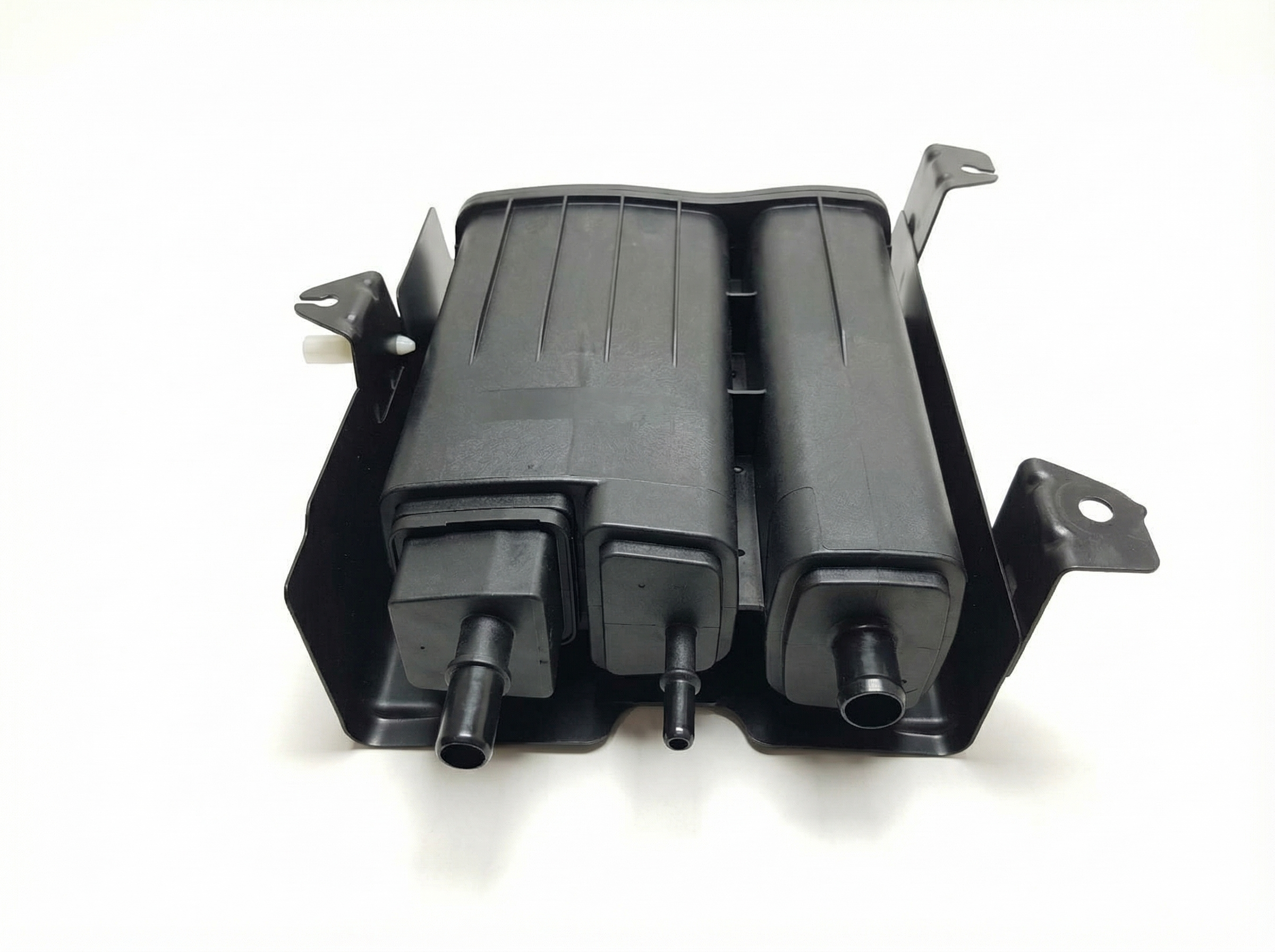
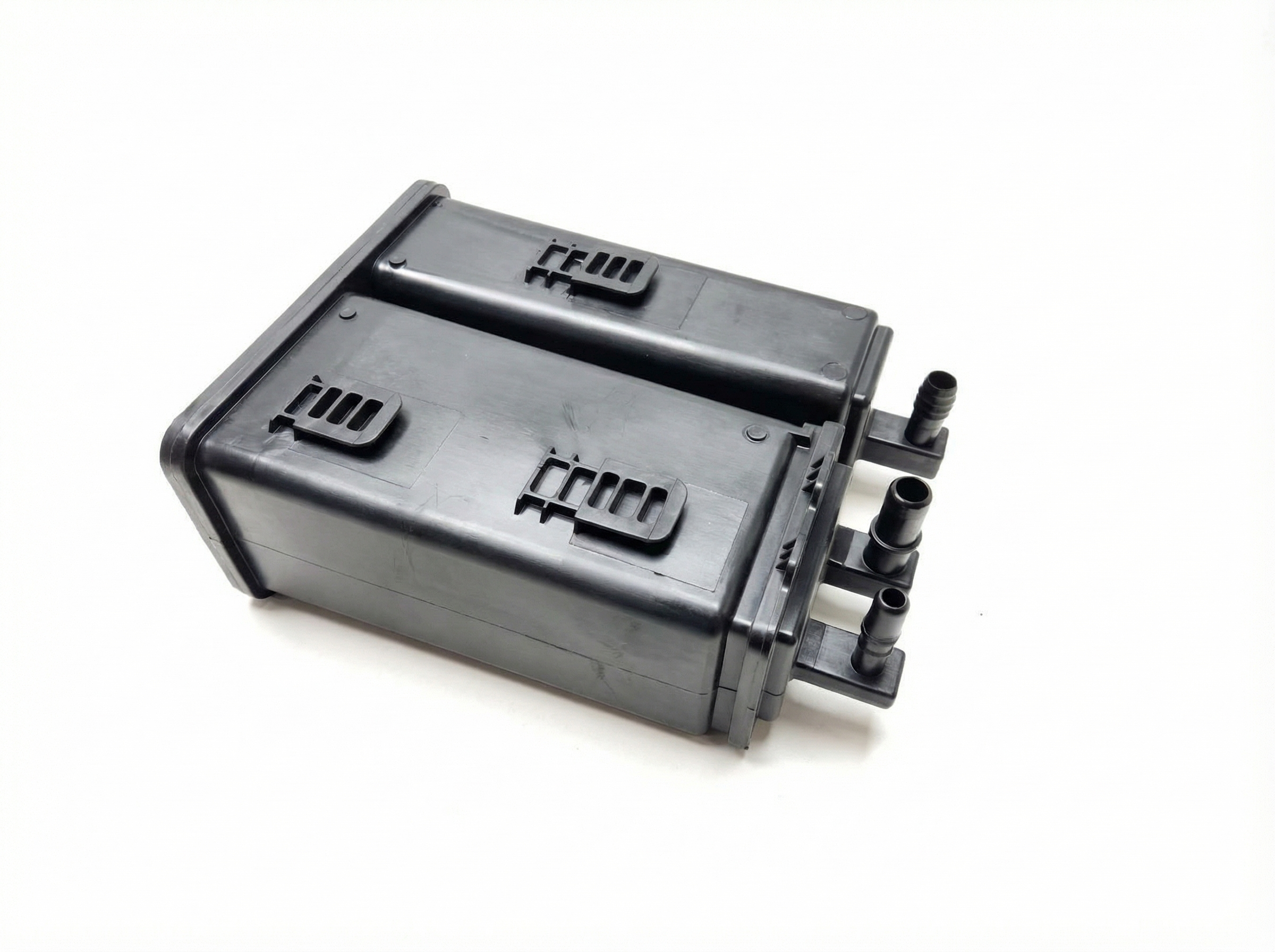
- Faulty Canister Purge Solenoid Valve 🔴 High Probability → Shop Vapor Canister A known issue across multiple Mazda and Ford models with this engine, as confirmed by TSB 01-012/14 for the Mazda6 3.7L. The valve, located in the engine bay, fails and gets stuck open, constantly pulling engine vacuum on the fuel tank.
How to confirm: With the engine idling, locate the purge valve in the engine bay. Disconnect the hose coming from the charcoal canister and place your finger over the port on the valve. If you feel any suction at all, the valve is stuck open and must be replaced. You can also remove the valve and try to blow through it; if air passes, it's bad.
Typical fix: Replace the canister purge solenoid valve. On some CX-9s, this is sold as an assembly with hoses.
Est. part cost: $50-$160 - Blocked EVAP Canister Vent Solenoid or Hose 🟡 Medium Probability → Shop Vapor Canister The vent hose outlet, located at the rear of the vehicle near the charcoal canister, can become clogged with dirt, debris, or spider webs, preventing fresh air from entering the system to relieve vacuum. The solenoid itself can also fail and get stuck closed.
How to confirm: Inspect the vent solenoid and its associated hoses at the rear of the vehicle for any visible blockages or kinks. The solenoid is normally open and can be tested with a scan tool or by applying power and ground to see if it clicks closed.
Typical fix: Clean the blockage from the hose or replace the canister vent solenoid if it is faulty. This is often the next step if a new purge valve doesn't fix the code.
Est. part cost: $40-$80 - Clogged or Saturated Charcoal Canister ⚪ Low Probability → Shop Vapor Canister
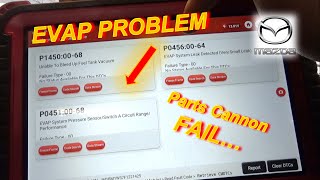
How to confirm: This is usually diagnosed after confirming the purge and vent valves are working correctly. The canister may feel heavy or have traces of raw fuel if it has been saturated by repeatedly overfilling the fuel tank. A user on Mazdas247.com was directed to check this area after replacing the purge valve did not solve the issue. 🎬 Watch: How to avoid a P1450 parts cannon fail
Typical fix: Replace the charcoal canister assembly.
Est. part cost: $200-$350
Rare But Worth Checking
- Faulty Fuel Tank Pressure (FTP) Sensor: → Shop Fuel Tank While less common, a faulty FTP sensor can send incorrect vacuum readings to the PCM, falsely triggering the P1450 code. It often appears with other FTP-related codes like P0451.
- Kinked or Collapsed EVAP Hose: A physically damaged or collapsed hose between the fuel tank, purge valve, and canister can create a restriction that leads to this code. This is worth checking if other work was recently performed under the hood or vehicle.
Diagnosis Steps
- Confirm P1450 is the active code using an OBD-II scanner.
- When refueling, listen for a loud 'whoosh' of air when opening the gas cap. This strongly suggests excessive vacuum is present.
- Test the purge solenoid valve. With the engine idling, disconnect the EVAP hose from the valve and check for suction on the valve's port. Any suction indicates the valve is stuck open and needs replacement. This is the most definitive and common test. 🎬 Watch: How to test for excessive fuel tank vacuum
- If the purge valve is good, inspect the EVAP canister vent solenoid and its hoses at the rear of the vehicle. Check for clogs from dirt, debris, or spider webs, especially at the hose outlet.
- If no blockages are found, test the vent solenoid for proper operation using a scan tool or by applying voltage to see if it actuates (clicks).
- If both valves and their hoses are clear and functional, the issue may be a faulty Fuel Tank Pressure (FTP) sensor or, rarely, a saturated charcoal canister.
Parts You'll Likely Need
- Canister Purge Solenoid Valve
(OEM #Z504-18-741A)— This is the most common failure item for P1450 on this platform. TSB 01-012/14 for the same engine recommends this modified part. Note: Some later models may use a full assembly, part number CA41-20-370.
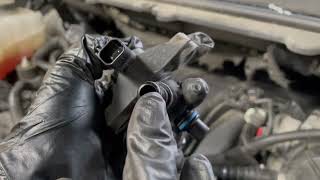
Trusted brands: Mazda OE, Bosch, Standard Motor Products, Dorman (911-708) 🎬 See: How to replace the purge valve solenoid
OEM price range: $70-$160
Aftermarket price range: $40-$75 - Canister Vent Solenoid Valve — This is the second most likely cause if the purge valve is functioning correctly. It can get stuck closed or its vent path can become blocked.
Trusted brands: Mazda OE, Dorman
OEM price range: $60-$90
Aftermarket price range: $30-$60
Related Codes That Often Appear With This One
- P0496 — This code for 'High Purge Flow' is a direct result of the most common cause of P1450: a purge valve stuck open, which allows continuous, uncommanded flow.
- P0451 — This code for 'Fuel Tank Pressure Sensor Range/Performance' can appear if the sensor itself is faulty or if the blockage causing P1450 leads to out-of-range pressure readings.
- P2195 / P2197 — These lean codes for O2 sensors can be triggered when the stuck-open purge valve creates a vacuum leak, introducing unmetered air into the intake manifold.
Technical Service Bulletins (TSBs) & Recalls
- 01-012/14 - While officially for the 2009-2013 Mazda6 3.7L, this TSB addresses the P1450 code by recommending the replacement of the purge solenoid valve with a modified part (Z504-18-741A), which is highly relevant as it's the same engine and a common failure on the CX-9.
- Bulletin #01-012-14-2908A - This manufacturer bulletin notes that some vehicles may experience a MIL illumination with DTC P1450:00 stored in memory, indicating an inability to bleed up fuel tank vacuum. The bulletin confirms this concern may be caused by the purge valve, which has been modified to eliminate the issue.
Mechanic-Grade Diagnostic Values
- Canister Purge Solenoid Valve Coil Resistance — expected: 14 to 38 Ohms. Failure: A reading of infinity (OL) indicates an open circuit, while a reading near zero indicates a short. Either requires replacement.
- Canister Vent Solenoid Coil Resistance — expected: 20 to 65 Ohms. Failure: A reading outside this range, especially infinity (OL), points to a failed solenoid coil.
- Fuel Tank Pressure (FTP) Sensor Voltage (Key On, Engine Off, Gas Cap Off) — expected: Approximately 2.5V - 2.6V. Failure: A reading stuck near 0V or 5V, or a reading that doesn't correspond to atmospheric pressure (e.g., showing vacuum with the cap off), indicates a faulty sensor, wiring issue, or a blocked reference hose.
Scan Tool Commands That Help
- Mazda IDS / FORScan / Professional Scan Tool: EVAP System Test (or similar name) — This function allows the technician to command the purge and vent solenoids to open and close while monitoring the Fuel Tank Pressure (FTP) sensor. It can be used to verify if the vent solenoid is sealing correctly and if the purge solenoid is opening when commanded, helping to isolate a faulty component without manual testing.
- Professional Scan Tool with Bidirectional Control: Purge Valve Duty Cycle / Command — To confirm a stuck-open purge valve. Command the purge valve to 0% (closed) at idle. If the FTP sensor live data still shows a vacuum being pulled, the valve is mechanically failed and leaking, confirming the diagnosis.
Real Owner Repair Stories
- Pine Hollow Auto Diagnostics (YouTube) (2015 Mazda 3 (similar EVAP system design and components)) — Persistent P1450 and P0451 codes, needed to pass state emissions inspection.
❌ Tried (didn't work) Replaced canister purge valve (OEM), Replaced charcoal canister (OEM), Replaced gas cap (OEM)
✅ What actually fixed it The small atmospheric reference hose for the Fuel Tank Pressure (FTP) sensor was clogged with dust and debris at its vent nipple. Cleaning out this tiny hose restored the correct pressure reading (0 PSI / 2.6V with cap off) and fixed the codes.
"I Checked Everything" — The Actual Cause
- In a documented case on a similar Mazda system, the vehicle had P1450 and passed a smoke test because the issue was not a leak, but a blockage. The Fuel Tank Pressure (FTP) sensor's atmospheric reference hose was clogged with dust. This caused the sensor to read a constant slight vacuum even when the tank was open to the air, tricking the PCM into thinking the system was unable to bleed up. The fix was simply cleaning the small, often-overlooked reference hose.
OEM Part Supersession History
CY01-18-740 (for 2007 3.5L V6)→N/A - This part is specific to the 2007 model.— Engine change from 3.5L to 3.7L in 2008.
Heads up: The 3.5L purge valve is not interchangeable with the 3.7L assembly.Unknown→CA41-20-370 (Purge Valve Assembly)— This is the assembly part number for the 3.7L V6 models.
Heads up: Mazda sells this as a complete assembly of the valve and hoses. However, the electrical solenoid itself is a common Ford part (sometimes marked K5T46696 or 9U5A9G866DC) and can be separated from the Mazda-specific hoses for a much cheaper repair if only the solenoid has failed.
Model Year Variations Within This Range
- 2007: The 2007 CX-9 used a 3.5L V6 engine and has a different purge valve (Part No. CY01-18-740) than the 2008-2015 models.
- 2008-2015: These models use the 3.7L V6 engine and are typically serviced with a complete purge valve and hose assembly (Part No. CA41-20-370).
Diagnostic Flowchart
Other Known Issues on This Vehicle
Issues unrelated to this code that are worth knowing about as an owner of this generation:
- Internal Water Pump Failure 🔴 High — Common at higher mileage (80k-120k miles). A significant design flaw of the Ford 3.5L/3.7L engine. (Ref: No recall, but a widely documented failure. Failure allows coolant to leak directly into the engine oil, leading to catastrophic engine damage if not caught early. Early signs include milky engine oil and low coolant levels.)
- AWD Transfer Case (PTU) Failure 🔴 High — Common across all first-gen model years. Often caused by lubricant breakdown from excessive heat due to proximity to the exhaust. (Ref: Mazda issued a warranty extension (SSP 92) for certain 2010-2014 models, extending coverage to 7 years or 90,000 miles. Many failures occur outside this window. Symptoms include a burning gear oil smell and grinding noises.)
- Timing Cover Oil Leak 🟠 Medium — A Mazda technician on Reddit estimated this occurs on ~40% of first-gen CX-9s. (Ref: No TSB. This is a costly repair as it requires removing the engine to reseal the timing cover.)
- Brake Booster Failure 🟠 Medium — Fairly common, especially on 2010-2012 models. (Ref: No recall. Symptoms include a hissing or whistling sound when the brake pedal is pressed and a stiff pedal feel.)
Used vs. New Parts: Buying Guide for This Vehicle
When a used part is the smart pick: A used charcoal canister (OEM Part CY01-13-96ZD) can be a cost-effective choice if the original is confirmed to be saturated or damaged, as new units are expensive. Other electronic components like solenoids are generally not recommended to be purchased used due to their high failure rate and low cost for new aftermarket replacements.
Donor-vehicle mileage cap: roughly under 80000 miles for the part to have meaningful remaining life.
What to inspect on the donor part:
- For a charcoal canister, ensure the donor vehicle was not in a major rear-end collision.
- Check the canister for any physical cracks or damage.
- Avoid parts from vehicles in regions with heavy road salt usage, as corrosion can damage the attached vent solenoid and fittings.
OEM-only on this vehicle (don't cheap out):
- Gas Cap - While aftermarket caps exist, the sensitivity of the Mazda EVAP system makes an OEM cap (GS3L-42-250B) a worthwhile investment to avoid persistent small leak codes.
Aftermarket brands forum-validated for this vehicle:
- Dorman (for purge and vent valves)
- Standard Motor Products (SMP)
- Bosch
Brands owners have reported issues with on this vehicle:
- No-name, unbranded electronic solenoids from online marketplaces can have high defect rates and are best avoided.
Real Owner Stories
Aggregated from forums and TSBs cited above. Mileages and costs reflect what owners reported in those sources.
2015 Mazda CX-9
Symptoms: Persistent P1450 check engine light that lasted for almost a year.
What fixed it: The issue was resolved after inspecting the canister and vent solenoid area at the rear of the vehicle, after replacing the purge valve and gas cap failed to fix it.
Source hint: Mazdas247.com: Thread 'Been dealing with this Check Engine P1450 for almost a year'
Mazda CX-9
Symptoms: Hard to start after fillups and stalling when coming to a stop.
What fixed it: Identified as a likely stuck-open purge valve or a clogged charcoal canister from over-filling the tank.
Source hint: Mazdas247.com: Thread 'CX-9 hard to start after fillups'
2011-2015 Lincoln MKX (3.7L V6)
Symptoms: P1450 code; unable to bleed up fuel tank vacuum.
What fixed it: Replacement of the purge valve as per TSB 14-0213 and 14-0191.
Source hint: FordEdgeForum.com thread 'P1450 - Ford unable to bleed up bleed fuel tank vacuum'
Related OBD-II Codes
Frequently Asked Questions
Does TSB 01-012/14 apply to my Mazda CX-9 with the 3.7L V6?
Why does my CX-9 make a loud whooshing sound when I open the gas cap?
I replaced the purge valve but P1450 is still there. What should I check next on my CX-9?
Can overfilling my gas tank cause the P1450 code on this vehicle?
Is the P1450 issue on the CX-9 shared with the Ford Edge?
What part number should I use to fix the purge valve issue on my 3.7L engine?
Helpful Videos

Used OEM Parts in Stock
New Aftermarket Parts Available


The information in this article is provided for general reference and educational purposes only. Vehicle specifications, procedures, and part compatibility can vary by production date, trim level, and region. Always consult your vehicle's factory service manual and verify part numbers before purchasing or performing repairs. Safety-critical components such as airbags, seat belts, and braking systems should be installed by a qualified professional.
- Mazda CX-9:
- 🧭 Diagnostic Flowchart
- 🎬 Helpful Videos
- 🛍️ Shop This Part
- What's Unique About the 2007-2015 Mazda CX-9
- Symptoms You May Notice
- Most Likely Causes
- Rare But Worth Checking
- Diagnosis Steps
- Parts You'll Likely Need
- Related Codes That Often Appear With This One
- Technical Service Bulletins (TSBs) & Recalls
- Mechanic-Grade Diagnostic Values
- Scan Tool Commands That Help
- Real Owner Repair Stories
- "I Checked Everything" — The Actual Cause
- OEM Part Supersession History
- Model Year Variations Within This Range
- Other Known Issues on This Vehicle
- Used vs. New Parts: Buying Guide for This Vehicle
- Real Owner Stories
- 2015 Mazda CX-9
- Mazda CX-9
- 2011-2015 Lincoln MKX (3.7L V6)
- Related OBD-II Codes
- Frequently Asked Questions
- 🎟️ Get 5% Off