

P2015 on 2010-2018 Audi A5 2.0L TFSI: Intake Manifold Runner Position Fixes
On a 2010-2016 Audi A5 2.0T, code P2015 is almost always caused by a worn plastic stop on the intake manifold actuator, allowing it to over-travel. The most common and affordable fix is an aftermarket metal repair bracket from brands like Dieselgeek or GruvenParts (~$50) that provides a new stop and can be installed by a DIYer. A full manifold replacement can cost over $800, though many vehicles are covered by a 10-year/120,000-mile extended warranty.
- Before starting any repair, call an Audi dealer with your VIN to check if your car is covered by the 10-year/120,000-mile extended warranty for the intake manifold.
- The most likely cause is a simple broken plastic stop on the manifold, which can be fixed cheaply with an aftermarket metal bracket.
- If you are replacing the entire intake manifold, it is highly recommended to perform a carbon cleaning of the intake valves at the same time.
- Always check the simple things first: visually inspect the actuator arm for play and check the associated vacuum hoses for cracks or leaks.
What's Unique About the 2010-2018 Audi A5
This is an extremely common and well-documented failure on the Audi/VW 2.0L TFSI (EA888) engine from this era. The issue is rarely the sensor itself, but rather a small, integrated plastic stop for the actuator arm that wears down or breaks off the manifold. This allows the actuator to over-travel, triggering the 'range/performance' fault. The problem is so prevalent that numerous companies (Dieselgeek, GruvenParts, ECS Tuning) manufacture simple metal repair brackets specifically to fix this single point of failure, often avoiding the need for a costly manifold replacement.
Generation note: The 2010-2018 range covers two generations of the Audi A5: the B8/B8.5 (2010-2016) and the B9 (2017-2018). The P2015 fault caused by the worn actuator stop is overwhelmingly common on the B8/B8.5 generation with the EA888 Gen 2 engine. While the code can appear on B9 models, the specific causes and parts may differ. The extended warranty for this issue is primarily for the earlier generation.
Symptoms You May Notice
- Check Engine Light is on
- Reduced engine performance and sluggish acceleration
- Rough, unstable, or surging idle
- Decreased fuel economy
- In some cases, a clunking or jerky feeling when stopping
- Engine may enter 'limp mode' with severely restricted power
- Replacing only the position sensor (it is not sold separately from the manifold).
- Replacing the actuator motor when the issue is the mechanical stop on the manifold itself.
- Replacing the intake manifold without first checking for extended warranty coverage.
- Assuming a cheap Amazon repair bracket will work as well as a quality one; some require modification to fit correctly.
Most Likely Causes
- Worn or Broken Intake Manifold Actuator Stop 🔴 High Probability → Shop Engine Intake Manifold The original intake manifold (PNs like 06H133201AN) uses a small plastic lever stop that becomes brittle and fails over time from heat and vibration, allowing the actuator arm to move past its intended range, triggering the code.
How to confirm: Visually inspect the actuator motor on the driver's side of the intake manifold. The linkage arm will often have excessive play or you may see it move beyond its normal stopping point when the ignition is cycled. You can often move it by hand and feel the lack of a solid stop.
Typical fix: Install an aftermarket P2015 repair bracket (e.g., from Dieselgeek, GruvenParts). This metal bracket bolts onto the manifold and provides a new, durable stop for the actuator arm. This is the most cost-effective fix. 🎬 See how to install a quick-fix bracket on your manifold. Alternatively, replace the entire intake manifold with an updated version (e.g., 06J133201BH).
Est. part cost: $40-$80 for a repair bracket, $300-$600 for a new manifold. - Carbon Buildup on Intake Flaps 🟡 Medium Probability As a direct-injection (TFSI) engine, the 2.0T is highly susceptible to carbon accumulation on the intake valves and runner flaps, as fuel does not wash over them. This buildup can physically restrict the movement of the flaps, causing them to bind.
How to confirm: This requires removing the intake manifold for visual inspection of the intake ports and the flaps themselves. The flaps will be coated in thick, black carbon deposits and may be difficult to move by hand. Some owners check the MAP/IAT sensor for carbon as a quick (but not definitive) indicator.
Typical fix: Perform a manual carbon cleaning service ('walnut blasting') on the intake ports and valves with the manifold removed. 🎬 Watch: How to perform a walnut blasting carbon cleaning service. Clean the runner flaps within the manifold as well.
Est. part cost: $20-$50 for cleaning supplies and gaskets. - Failed Intake Runner Control Solenoid (N316) ⚪ Low Probability The solenoid that provides vacuum to the actuator can fail electrically or become clogged with debris, preventing it from properly controlling the flaps.
How to confirm: Test the solenoid's operation using a capable scan tool with output tests. Check for power and ground at the connector. Inspect the associated vacuum lines for blockages or leaks. TSB 24 16 53 specifically addresses testing and replacing this part.
Typical fix: Replace the N316 solenoid valve (PN may vary, check with VIN) and ensure vacuum lines are clear.
Est. part cost: $40-$90, though one owner reported a dealer price of $182.
Rare But Worth Checking
- Damaged Vacuum Lines: The vacuum lines that control the actuator can become brittle, cracked, or disconnected, leading to a loss of vacuum and preventing the flaps from moving correctly. A thorough visual and physical check of all lines from the vacuum pump to the solenoid and actuator is a crucial first step.
- Failed Intake Manifold Position Sensor (G336): → Shop Engine Intake Manifold While the sensor itself can fail, it is far less common than the mechanical failure of the manifold stop. The sensor is integrated into the intake manifold and is not sold separately by Audi, so a confirmed failure requires replacing the entire manifold.
- Internally Separated/Broken Flap Linkage: The linkage arm connecting the external actuator to the internal flaps can break or pop off its ball joint. In this case, a repair bracket will not work, and the entire manifold must be replaced.
Diagnosis Steps
- Scan the vehicle with an OBD-II scanner (like VCDS or OBDeleven) to confirm P2015 is present and note any other codes. 🎬 Watch: A step-by-step guide to diagnosing the P2015 fault.
- Contact an Audi dealership with your vehicle's VIN to check for coverage under the extended warranty for the intake manifold (often 10 years/120,000 miles). Do this before paying for any repairs.
- Visually inspect the intake manifold actuator arm on the driver's side of the engine. Observe the arm while a helper cycles the ignition on and off. Look for excessive movement or 'slop' indicating the stop has failed.
- If using VCDS/OBDeleven, monitor measuring block group 142 to see the requested vs. actual flap position. A large discrepancy or failure to adapt points to a mechanical issue.
- If excessive movement is confirmed, the internal stop has failed. The recommended fix is an aftermarket repair bracket or full manifold replacement.
- If the arm movement seems normal, inspect all associated vacuum lines for cracks, leaks, or loose connections.
- If vacuum lines are intact, suspect either heavy carbon buildup restricting the flaps or a faulty control solenoid (N316). Move the runner plates by hand (with engine off) to check for binding.
- If all else fails, removal of the intake manifold is necessary to inspect for carbon buildup or internal mechanical failure, such as a broken flap or linkage.
Parts You'll Likely Need
- Intake Manifold Repair Bracket — This is the most common, cost-effective, and permanent fix for the failed plastic actuator stop on the manifold.
Trusted brands: Dieselgeek, GruvenParts, ECS Tuning
OEM price range: N/A
Aftermarket price range: $40-$80 - Intake Manifold Assembly
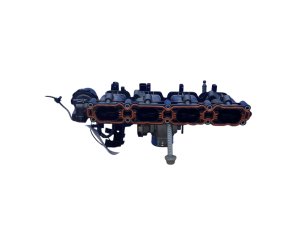
(OEM #06J133201BH (latest revision), 06H133201AN, 06H133201AT (older revisions))— Required if the manifold is cracked, the internal flaps are broken, or if you prefer an OEM repair. The position sensor is integrated into this part. Note: Part number may vary, confirm with VIN. Newer manifolds have redesigned, more robust stops.
Trusted brands: Audi Genuine, Mahle, Vaico
OEM price range: $450-$600
Aftermarket price range: $250-$400 - Intake Manifold Gasket
(OEM #06F129717D (example, confirm with VIN))— Must be replaced any time the intake manifold is removed.
Trusted brands: Victor Reinz, Elring
OEM price range: $20-$40
Aftermarket price range: $10-$25
Related Codes That Often Appear With This One
- P2004 — This code means 'Intake Manifold Runner Control Stuck Open,' which can be triggered by the same underlying mechanical or carbon buildup issues.
- P2006 — This code means 'Intake Manifold Runner Control Stuck Closed,' often caused by heavy carbon buildup or a broken linkage.
- P0300, P0301, P0302, P0303, P0304 — Random or specific cylinder misfire codes can occur because the incorrect flap position leads to an improper air-fuel mixture, causing combustion instability.
Technical Service Bulletins (TSBs) & Recalls
- TSB 24 16 53 (2044003/1) / TSB 2072273/1: Addresses a faulty Changeover valve for intake manifold flap (N316) causing P2015 and advises replacement of the solenoid valve, not the entire manifold.
- TSB 24 15 04 (2038161) / TSB 2030192/1: Mentions P2014/P2015 faults and advises checking for restrictions in vacuum lines and performing an adaptation of the flaps before replacing the manifold.
- Bulletin #A0124312072273_2: Provides information for when the MIL is on due to the electric changeover valve N316, specifically referencing codes P2004, P2006, P2014, and P2015.
Platform-Specific Known Issues
- Audi/VW issued an extended warranty (not a recall) for the 2.0T TSI intake manifold covering many vehicles for up to 10 years or 120,000 miles. The part must fail for the warranty to apply. Always check with a dealer.
- These engines are prone to significant carbon buildup on the intake valves, which should be cleaned (walnut blasting) whenever the intake manifold is removed for service. This is a separate but related maintenance item.
- In states with PZEV emissions standards, the intake manifold may be covered under an even longer 15-year/150,000-mile warranty. Check the emissions label under your hood.
Mechanic-Grade Diagnostic Values
- VCDS Measuring Block 142 - Live Data — expected: Fields for 'Specified Position' and 'Actual Position' should match closely as engine RPM changes.. Failure: A large, persistent mismatch between specified and actual values, or the 'Actual' value being stuck, indicates a mechanical or sensor fault.
- VCDS Runner Flap B1 Position Offset Voltage — expected: Approximately 4.5V at startup (Key On, Engine Off).. Failure: A value significantly different from 4.5V indicates the position sensor (G336) is out of specification, even if the part is brand new.
- Intake Runner Control Solenoid (N316) Resistance — expected: 25 - 35 Ω between terminals 1 and 2 at approx. 20°C.. Failure: Resistance is significantly outside this range, indicating a failed solenoid coil.
- Intake Manifold Position Sensor (G336) Reference Voltage — expected: Approximately 5V between Pin 1 (5V reference) and Pin 3 (ground) at the sensor connector with key on, engine off.. Failure: No voltage or significantly lower voltage points to a wiring issue or a problem with the Engine Control Module (ECM).
- Wiring Harness Continuity (G336/N316 to ECM) — expected: Maximum resistance of 0.5 - 1.5 Ω.. Failure: Higher resistance (or an open circuit) indicates a break or corrosion in the wire between the component and the ECM.
Scan Tool Commands That Help
- VCDS (VAG-COM) / OBDeleven: Engine -> Measuring Value Blocks (MVB) -> Group 142 — This is the primary tool for diagnosing P2015. It provides a live view of the ECU's 'Specified' flap position versus the sensor's reported 'Actual' position, immediately showing if the flaps are not responding as commanded.
- VCDS (VAG-COM) / OBDeleven: Engine -> Basic Settings -> Group 142 -> Activate — This function must be run after replacing the intake manifold to allow the ECM to learn the new sensor's end-stop positions. It is also the fix for cases where an ECU flash desynchronizes the stored values, causing a P2015 code with a mechanically sound manifold. The procedure is run with the engine idling.
Wiring & Ground Locations
- Ground Point 12 — In the engine compartment, on the left side frame rail.. This is a primary engine compartment ground. A poor connection here can cause erratic voltage and sensor readings for multiple engine components, including the intake manifold position sensor system.
- Negative Jump-Start Terminal / Ground Point — A designated metal post on the driver's side strut tower.. This is an easily accessible and critical chassis ground point. Verifying it is clean and tight is a basic but crucial step when diagnosing any electrical fault in the engine bay.
- ECM Connector T60 / G336 Sensor Connector — The T60 connector is one of the main plugs on the Engine Control Module (ECM). The G336 connector is on the intake manifold itself.. Technicians must test for continuity and shorts between specific pins on these two connectors to rule out a wiring harness failure before condemning the entire intake manifold.
Real Owner Repair Stories
- Golfmk6.com forum user (VW GTI with 2.0TSI engine (shared EA888 platform)) — P2015 Check Engine Light appeared immediately after an ECU flash/tune.
❌ Tried (didn't work) Clearing the code (it would return instantly)., Visual inspection and manual cycling of the flapper arm.
✅ What actually fixed it Running the intake manifold flap adaptation using VCDS: Engine -> Basic Settings -> Group 142. This re-calibrated the sensor's voltage range to the newly flashed ECU, and the code was permanently resolved without replacing any parts. - Ross-Tech Forums user (VW 2.0 TSI (CCTA Engine), applicable to Audi EA888) — P2015 code returned immediately after replacing the entire intake manifold with a brand new part.
❌ Tried (didn't work) Replacing the entire intake manifold assembly., Running the VCDS adaptation procedure, which repeatedly resulted in an 'ERROR' message.
✅ What actually fixed it The brand new intake manifold had a faulty, out-of-spec position sensor from the factory. The diagnostic clue was the 'Runner Flap B1 Position Offset' voltage in VCDS, which was incorrect at startup (~2.7V instead of ~4.5V). The problem was solved by replacing the new (but faulty) manifold with another known-good part. - Reddit user on r/Volkswagen (2010 VW CC 2.0 TSI (EA888)) — Persistent P2015 code after major work, plus inconsistent hard brake pedal at low speeds.
❌ Tried (didn't work) Full carbon cleaning service., Replacing the throttle body., Replacing the entire intake manifold.
✅ What actually fixed it The root cause was a clogged internal screen on the engine's main vacuum pump. Cleaning and ultimately removing this small, restrictive screen restored proper and consistent vacuum to all systems, including the intake runner actuator, which cleared the P2015 code. - NHTSA ODI #11542990 — An owner reported receiving an emissions failure report with the CEL code P2015 and noted that a technical service bulletin details the repair and how it should be covered under an extended warranty.
"I Checked Everything" — The Actual Cause
- A user on Reddit reported chasing a P2015 code that persisted after a full manifold replacement. Standard vacuum line tests were clean. The ultimate cause was found to be an intermittent loss of brake boost and a clogged internal screen inside the main engine vacuum pump. The vacuum supply was inconsistent at the source, which was not detectable with a typical smoke test of the intake and vacuum lines.
When the Usual Fixes Don't Work
- While the vast majority of P2015 codes on this platform are fixed with a repair bracket or a new manifold, there are documented edge cases where this does not solve the problem. In one instance, the code appeared after an ECU tune and was only resolved by running a software adaptation via VCDS, indicating a calibration issue, not a mechanical one. In another case, a brand new manifold was faulty out of the box, proven by checking the sensor's startup voltage in VCDS. A third case showed the code was caused by an internal clog in the main vacuum pump, which would not be found by standard vacuum leak tests. These cases highlight the importance of advanced software diagnostics and considering the entire system when the common fix fails.
OEM Part Supersession History
06H133201AN, 06H133201AT→06J133201BH— The original manifolds used a plastic actuator stop that was prone to breaking. The revised part number features a more robust, redesigned stop mechanism to prevent over-travel of the actuator arm.Varies (older N316 solenoids)→06H906283B— According to TSB 24 16 53, the original solenoid was prone to internal corrosion. The updated part is a revised design.
Heads up: The new valve has an additional connection for a fresh air line, and a corresponding connecting hose (PN 06H133583F) may also be required for the retrofit.
Model Year Variations Within This Range
- 2010-2016 (B8/B8.5 Generations): These model years use the EA888 Gen 2 engine (codes like CAEB) and are highly susceptible to the P2015 fault from the worn plastic actuator stop on the manifold. The extended warranty is primarily targeted at these vehicles.
- 2017-2018 (B9 Generation): The B9 A5 uses the updated EA888 Gen 3 engine. While it can still log a P2015 code, the intake manifold is a different design, and the specific, common failure of the actuator stop from the B8/B8.5 generation is not the typical cause. Diagnosis for a B9 would focus more on other potential causes like carbon buildup or sensor failure.
Diagnostic Flowchart
Used vs. New Parts: Buying Guide for This Vehicle
When a used part is the smart pick: It is strongly advised to NEVER use a used intake manifold to fix this issue. The primary failure is due to a plastic component wearing out over time. A used manifold from a salvage yard has an unknown history and is highly likely to have the same wear, leading to a repeat failure in a short time. A forum user reported installing a used manifold only to have the exact same P2015 error return immediately.
What to inspect on the donor part:
- Not applicable, do not purchase a used manifold for this repair.
OEM-only on this vehicle (don't cheap out):
- Intake Manifold Assembly
Aftermarket brands forum-validated for this vehicle:
- For Repair Bracket: Dieselgeek, GruvenParts, ECS Tuning
- For OEM-quality Manifold: Mahle, Vaico
Brands owners have reported issues with on this vehicle:
- Cheap, unbranded intake manifolds or repair brackets from eBay/Amazon. Forum discussions frequently mention these parts having poor fitment, being made of inferior materials, or having out-of-spec sensors that fail to adapt, leading to the code returning.
Real Owner Stories
Aggregated from forums and TSBs cited above. Mileages and costs reflect what owners reported in those sources.
2018 Audi A5 2.0t
Symptoms: Check engine light on with p2015 and p2006.
What fixed it: The repair shop recommended changing the whole intake manifold.
Cost: $600
Source hint: AudiWorld Forums
2014 Audi A5 2.0T
Symptoms: P2015 CEL Code.
What fixed it: Installed an aftermarket repair bracket, which was discussed as an effective solution.
Source hint: Audizine - B8 A5 P2015 fix discussion
2013 Audi A5 2.0T
Symptoms: P2015 intake manifold flap position sensor implausible signal.
What fixed it: Replaced the entire intake manifold after other diagnostic attempts failed to resolve the code.
Source hint: Ross-Tech Forums - P2015 intake manifold flap position sensor implausible signal
Related OBD-II Codes
Frequently Asked Questions
Is the P2015 code on my 2010-2018 Audi A5 covered by a warranty?
What is the cheapest way to fix the P2015 code on my A5 2.0T?
I'm getting my intake manifold replaced for P2015. Is there any other maintenance I should do at the same time?
How can I check if the intake manifold actuator stop is broken on my A5 without special tools?
My mechanic says I need a new manifold, but I read about TSB 24 16 53. Could that apply?
What's the difference between the original intake manifold and the updated replacement?
Helpful Videos
![Carbon Cleaning Audi A5 (2013 B8.5) | Walnut Blasting! [Part 2]](https://img.youtube.com/vi/yIj4oWjfeBY/mqdefault.jpg)
We Have This Part in Stock

The information in this article is provided for general reference and educational purposes only. Vehicle specifications, procedures, and part compatibility can vary by production date, trim level, and region. Always consult your vehicle's factory service manual and verify part numbers before purchasing or performing repairs. Safety-critical components such as airbags, seat belts, and braking systems should be installed by a qualified professional.
- Audi A5:
- 🧭 Diagnostic Flowchart
- 🎬 Helpful Videos
- 🛍️ Shop This Part
- What's Unique About the 2010-2018 Audi A5
- Symptoms You May Notice
- Most Likely Causes
- Rare But Worth Checking
- Diagnosis Steps
- Parts You'll Likely Need
- Related Codes That Often Appear With This One
- Technical Service Bulletins (TSBs) & Recalls
- Platform-Specific Known Issues
- Mechanic-Grade Diagnostic Values
- Scan Tool Commands That Help
- Wiring & Ground Locations
- Real Owner Repair Stories
- "I Checked Everything" — The Actual Cause
- When the Usual Fixes Don't Work
- OEM Part Supersession History
- Model Year Variations Within This Range
- Used vs. New Parts: Buying Guide for This Vehicle
- Real Owner Stories
- 2018 Audi A5 2.0t
- 2014 Audi A5 2.0T
- 2013 Audi A5 2.0T
- Related OBD-II Codes
- Frequently Asked Questions
- 🎟️ Get 5% Off