

P2096 on 2005-2010 Hyundai Sonata: Post-Catalyst Lean Causes & Fixes
On a 2005-2010 Sonata, code P2096 is most often caused by an exhaust leak, especially from a cracked flex pipe, or a faulty downstream oxygen (O2) sensor. Exhaust leaks allow outside air into the pipe, tricking the sensor into a false lean reading. Expect to pay a muffler shop $150-$300 to weld in a new flex pipe or spend $60-$150 on a DIY O2 sensor replacement.
- For a 2005-2010 Sonata, P2096 almost always means you have an exhaust leak before the second O2 sensor (likely a cracked flex pipe) or a bad downstream O2 sensor.
- Always inspect for exhaust leaks before buying any parts. A smoke test is the most reliable method.
- Do not immediately replace the expensive catalytic converter; it is rarely the direct cause of this specific code.
- The platform-mate Kia Optima (2006-2010) suffers from the exact same issues.
What's Unique About the 2005-2010 Hyundai Sonata
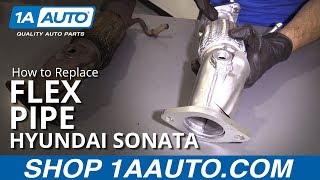
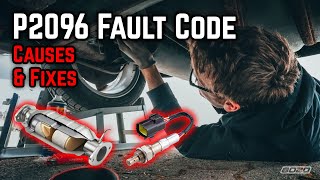
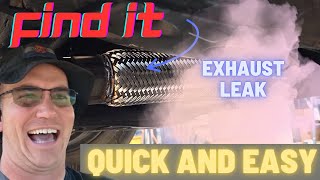
The fifth-generation (NF) Sonata, particularly with the 2.4L Theta II engine, is well-documented for developing exhaust leaks at the flexible pipe section of the exhaust system. This specific failure is a very common trigger for P2096, as the leak draws in outside air between the upstream and downstream sensors, causing the downstream oxygen sensor to report a false lean condition. While O2 sensors can fail on any car, always start by thoroughly inspecting 🎬 Watch: This video explains what P2096 really means and how to fix it. the exhaust flex pipe on a 2005-2010 Sonata before replacing any parts.
Symptoms You May Notice
- Check Engine Light is on
- Reduced fuel economy
- Rough or unstable idle
- Poor acceleration or hesitation
- Audible exhaust leak noise (hissing or ticking, especially when cold)
- Catalytic converter may glow red hot if the lean condition is severe and causing overheating.
- Replacing the upstream (pre-catalyst) oxygen sensor instead of the downstream (post-catalyst) one.
- Replacing the catalytic converter when the actual problem is a small, hard-to-find exhaust leak between the two O2 sensors.
- Replacing the O2 sensor when the true cause is a cracked exhaust flex pipe.
Most Likely Causes
- Exhaust Leak (before the downstream O2 sensor) 🔴 High Probability The exhaust flex pipe on the NF Sonata is a well-documented failure point, often cracking or rusting out due to engine movement and road salt. Leaks can also occur at the exhaust manifold gasket.
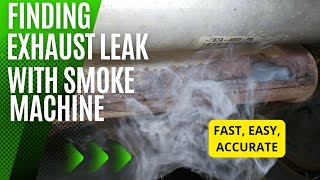
How to confirm: With the engine running (preferably when cold), carefully feel and listen for air escaping from the exhaust system, particularly around the braided flex pipe near the front of the vehicle. You may see black soot marks around the crack. A shop will use a smoke machine to definitively pinpoint the leak's location.
Typical fix: Weld in a new universal flex pipe section or replace the entire front pipe assembly. This is often best done by a muffler shop.
Est. part cost: $30-$80 for a universal flex pipe, plus labor. - Faulty Downstream Oxygen Sensor (Bank 1, Sensor 2) 🟡 Medium Probability → Shop Oxygen Sensor Oxygen sensors are wear-and-tear items that degrade over time, leading to slow or inaccurate readings. On Hyundai vehicles, the downstream sensor is used to cross-check the upstream sensor, so a faulty downstream sensor can trigger this code even if the engine is running perfectly.
How to confirm: Use a scan tool to monitor the live voltage data from the downstream O2 sensor (B1S2). A healthy sensor will show a relatively stable voltage (typically above 0.5V-0.6V). If the voltage is stuck low (e.g., below 0.4V) or fluctuating wildly like the upstream sensor, it is likely faulty.
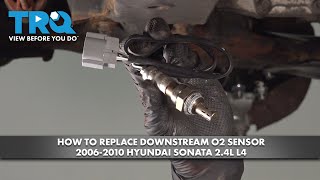
Typical fix: Replace the downstream oxygen sensor. This is a DIY-friendly task for many, requiring a 22mm or specialized O2 sensor socket. 🎬 Watch this walkthrough on replacing the downstream O2 sensor.
Est. part cost: $60-$150 - Failing Catalytic Converter ⚪ Low Probability → Shop Catalytic Converter While not a primary cause, the Theta II engines in some of these Sonatas were prone to oil consumption issues which can contaminate and destroy the catalytic converter over time, leading to various codes including P0420 and sometimes P2096.
How to confirm: If exhaust leaks and O2 sensors are ruled out, a failing converter is possible. A diagnostic sign is when the downstream O2 sensor's readings mirror the upstream sensor's fluctuations. An infrared thermometer can also be used to check for a significant temperature drop across the converter, indicating it's not working. A glowing red converter after a drive is a sign of a major issue.
Typical fix: Replace the catalytic converter assembly. This is an expensive repair.
Est. part cost: $400-$1000+ - Intake Air or Vacuum Leak ⚪ Low Probability Hoses and gaskets can become brittle and crack with age, allowing unmetered air to enter the engine. A leaking intake manifold gasket is a possible, though less common, cause.
How to confirm: Visually inspect all vacuum lines and the air intake boot for cracks. With the engine running, you can spray brake cleaner or a propane torch (unlit) around suspected areas; a change in engine idle indicates a leak. A professional smoke test is the most reliable method.
Typical fix: Replace the cracked hose or faulty gasket.
Est. part cost: $10-$50
Rare But Worth Checking
- Low Fuel Pressure: A weak fuel pump or clogged filter can cause a true lean condition. This would typically be accompanied by other symptoms like hard starting or hesitation under load.
- Dirty or Faulty Mass Airflow (MAF) Sensor: A contaminated MAF sensor can under-report the amount of air entering the engine, causing the computer to command too little fuel.
- Faulty PCV Valve: A stuck-open PCV valve can act as a vacuum leak, allowing unmetered air into the intake and causing a lean condition.
- ECM Software Anomaly: While more common on later models, some vehicles can have overly sensitive diagnostic logic. TSBs have been issued for other Hyundai models to update ECM software to correct false P2096 codes.
Diagnosis Steps
- Check for other stored trouble codes that could provide more clues.
- Perform a thorough visual and audible inspection of the entire exhaust system from the engine to the tailpipe, especially when the engine is cold. Pay extremely close attention to the braided flex pipe section for cracks, soot marks, or audible leaks.
- Inspect the intake system for cracked hoses, loose clamps, or bad gaskets that could cause a vacuum leak.
- Use a scan tool to observe live data for the Bank 1 Sensor 2 (downstream) oxygen sensor. The voltage should be relatively steady (typically above 0.5V). If it's stuck below 0.4V or fluctuating rapidly like the upstream sensor, it points to either an exhaust leak or a faulty sensor.
- If an exhaust leak is suspected but not obvious, a smoke machine test is the most effective way to find it.
- If no leaks are found, and the sensor wiring is intact, the downstream O2 sensor is the next most likely culprit. Test the sensor's response before replacing.
- Check for any applicable Technical Service Bulletins (TSBs) for your vehicle's VIN, as an ECM software update may be available.
- Only after ruling out all exhaust leaks, the O2 sensor, and potential software updates should you investigate the catalytic converter or fuel delivery system.
Parts You'll Likely Need
- Downstream Oxygen Sensor (Bank 1, Sensor 2)
(OEM #39210-2G200 (for 2.4L, verify with VIN))— This sensor is responsible for reporting the lean condition. It can fail with age and provide inaccurate readings.
Trusted brands: Denso, Bosch, NGK/NTK, Spectra Premium (OS5564)
OEM price range: $120-$180
Aftermarket price range: $60-$110 - Exhaust Flex Pipe
(OEM #28610-0A150 (Front Pipe Assembly, verify with VIN))— This is a common failure point on this Sonata generation, and a leak here is a primary cause of P2096.
Trusted brands: Walker, Bosal
OEM price range: N/A (part of a larger assembly)
Aftermarket price range: $30-$80 (for a weld-in universal part)
Related Codes That Often Appear With This One
- P0171 — P0171 indicates 'System Too Lean (Bank 1)' detected by the *upstream* sensor. If you have both codes, it points more strongly to a true engine lean condition like a vacuum leak or fuel delivery issue, rather than just an exhaust leak or bad downstream sensor.
- P0420 — P0420 indicates 'Catalyst System Efficiency Below Threshold'. A failing catalytic converter can cause both codes. Also, an exhaust leak that triggers P2096 can sometimes also trick the computer into setting a P0420.
- P2270 — P2270 stands for 'O2 Sensor Signal Stuck Lean Bank 1 Sensor 2'. This code is highly specific and almost always points directly to a faulty downstream oxygen sensor or its wiring, making diagnosis much simpler.
Technical Service Bulletins (TSBs) & Recalls
- While no TSB is specific to the 2005-2010 Sonata for P2096, Hyundai has issued TSBs for other models like the Elantra (14-FL-006, 14-01-063) to update ECM logic for being too sensitive and falsely triggering P2096. This indicates a history of software-related issues; in fact, NHTSA ODI #10654930 notes that a technician identified P2096 as being related to Service Recall #13-FL-006 on similar Hyundai platforms.
Platform-Specific Known Issues
- The exhaust flex pipe on the 2005-2010 Sonata is prone to cracking and causing leaks that directly lead to a P2096 code.
- The 2.4L Theta II engine in this generation had known issues with oil consumption that could lead to premature catalytic converter failure, which can be a secondary cause of this code. NHTSA ODI #11644778 describes a situation where a powertrain alarm for P2096 occurred after the engine oil level dropped below the "L" mark.
- In some instances, P2096 may be accompanied by severe drivability issues; NHTSA ODI #11566614 reports a check engine light flashing and the car jerking while throwing codes P1326 and P2096.
Mechanic-Grade Diagnostic Values
- Downstream O2 Sensor (B1S2) Voltage at Idle (after warm-up) — expected: Relatively stable voltage above 0.6V.. Failure: Voltage is stuck low (below 0.45V) or fluctuates rapidly like the upstream sensor.
- Upstream O2 Sensor (B1S1) Voltage at Idle (after warm-up) — expected: Signal actively switching from rich (above 0.45V) to lean (below 0.45V) multiple times within 10 seconds.. Failure: A flat or slow-to-respond signal.
- Heated Oxygen Sensor (HO2S) Heater Resistance — expected: 3.3 - 4.1 Ohms at 20°C (68°F).. Failure: Resistance is outside the specified range, indicating a faulty heater circuit within the sensor.
- ECM Fuel Trim Adaptation Threshold — expected: The ECM sets DTC P2096 if the proportional post-catalyst fuel trim adaptation value exceeds 630 msec for a duration of 60 seconds.. Failure: This indicates the ECM has reached its maximum limit trying to add fuel to correct the perceived lean condition.
Wiring & Ground Locations
- Bank 1 Sensor 2 (Downstream) — For the 2.4L I4 engine, this is the only downstream sensor, located in the exhaust pipe after the catalytic converter. For the 3.3L V6 engine, Bank 1 is the rear bank (closer to the firewall). The downstream sensor (Sensor 2) is located after the rear catalytic converter. It is identifiable by its longer wiring harness compared to the other three sensors on the V6.. This is the specific sensor that triggers the P2096 code. Correctly identifying it is crucial to avoid replacing the wrong part.
- O2 Sensor Connector (B1S2) — For the 3.3L V6, the connector for the long-wire downstream sensor (B1S2) is black, while the gray connector is for the upstream sensor. For the 2.4L, the downstream sensor has a 4-pin connector.. Ensuring a clean, secure connection at the correct harness plug is a key diagnostic step. Corrosion or damage here can mimic a sensor failure.
Real Owner Repair Stories
- Hyundai-Forums user post (2008 Hyundai Sonata) — Check Engine Light with code P2096.
❌ Tried (didn't work) Replacing the downstream O2 sensor
✅ What actually fixed it The final fix was identifying and repairing a cracked exhaust flex pipe. The leak was causing the new O2 sensor to read lean. - Hyundai-Forums user post (2006 Hyundai Sonata 3.3L V6) — Check Engine Light with code P2096.
❌ Tried (didn't work) Initial diagnosis pointed towards O2 sensors.
✅ What actually fixed it The problem was resolved by replacing a cracked exhaust flex pipe. The user noted it's a very common issue on this model. - NHTSA ODI #10788066 — An owner reported a recurring check engine light with code P2096, described as "Post Catalyst Fuel Trim System Too Lean Bank 1," which persisted even after multiple shop visits.
OEM Part Supersession History
39210-25110→Not specified, but aftermarket equivalents are widely available.— Standard part lifecycle.
Heads up: The aftermarket part number 234-4439 is a direct-fit replacement for 39210-25110 on 2006-2009 Sonata 2.4L models.39210-2G100→39210-2G200— Part update/revision.
Heads up: Always verify the correct part number with the vehicle's VIN, as there are variations. The 39210-2G200 is specified as the rear/downstream sensor for many 2.4L applications in this era.
Model Year Variations Within This Range
- 2005-2008 vs 2009-2010 (NF Facelift): The facelift in 2009 introduced the revised Theta II engine and may have different part numbers for exhaust components and sensors. For example, O2 sensor part number 39210-2G200 is primarily listed for 2009-onward models, while earlier models may use a different part. It is critical to verify part numbers against the vehicle's VIN.
- 2.4L I4 vs 3.3L V6: The 3.3L V6 has two banks and four oxygen sensors. Bank 1 is the rear bank, closer to the firewall. The downstream sensor for Bank 1 (B1S2) has a distinctly longer wire harness than the other three sensors. The 2.4L I4 has only one bank and two sensors.
Diagnostic Flowchart
Used vs. New Parts: Buying Guide for This Vehicle
When a used part is the smart pick: A used front pipe assembly (including the flex pipe) from a junkyard can be a cost-effective solution if it comes from a low-mileage vehicle that was not in a front-end collision and shows no signs of rust or stress on the flex braid. This is often cheaper than having a muffler shop weld in a new flex section.
Donor-vehicle mileage cap: roughly under 80000 miles for the part to have meaningful remaining life.
What to inspect on the donor part:
- Check the braided steel on the flex pipe for any broken strands, stretching, or black soot marks.
- Inspect the flange welds for cracks or severe rust.
- Ensure the donor vehicle is from a region with minimal road salt use.
- Verify the O2 sensor bung threads are not stripped or damaged.
OEM-only on this vehicle (don't cheap out):
- Catalytic Converter: Aftermarket catalytic converters for this generation are known to be less efficient and may fail to keep the P0420 code away, even if they temporarily resolve the P2096 code. An OEM or high-quality CARB-compliant aftermarket unit is recommended if the converter is the confirmed cause.
Aftermarket brands forum-validated for this vehicle:
- Denso: Often the original equipment (OE) supplier for Hyundai, making them a very safe and reliable choice.
- NGK/NTK: A world-leading OE sensor manufacturer with a strong reputation for quality and reliability.
- Bosch: A high-quality option that meets or exceeds OE specifications.
Brands owners have reported issues with on this vehicle:
- Unbranded or 'white-box' sensors from online marketplaces. These often have high failure rates, inaccurate readings, or incorrect wire lengths, leading to repeat repairs. Quality control is a major issue with non-reputable brands.
Real Owner Stories
Aggregated from forums and TSBs cited above. Mileages and costs reflect what owners reported in those sources.
2007 Hyundai Sonata 2.4L 4-cylinder
Symptoms: Check engine light is the only indicator, does not affect the performance of the vehicle at all.
What fixed it: Replacing the downstream O2 sensor. The owner noted this was the second time in about five years that this fix resolved the code.
Source hint: youtube_comment from 'Mike Reeves' cited in owner_reports ('2007 Hyundai Sonata (2.4 L 4-cylinder) Downstream 02 Sensor Replacement - YouTube')
2006 Hyundai Sonata
Symptoms: Check Engine Light with code P2096.
What fixed it: Diagnosis often starts with checking for exhaust leaks and evaluating O2 sensor data, with these being the most frequent resolutions.
Source hint: Reddit r/Cartalk & r/MechanicAdvice
Hyundai Elantra (Cross-Model Reference)
Symptoms: Check engine light cycling on and off with codes P2096 and P0304.
What fixed it: As reported in NHTSA ODI #11251875, a dealer found the codes were related to cylinder misfires and a noise from the lower end of the engine, requiring significant engine work.
Documented NHTSA Reports
- NHTSA ODI #11644778: An owner reported that after their engine oil level dropped below the "L" mark, the vehicle triggered a P2096 powertrain system alarm.
- NHTSA ODI #11566614: A driver experienced the check engine light flashing accompanied by the car jerking; diagnostic scans revealed codes P1326 and P2096.
- NHTSA ODI #10654930: A technician informed an owner that code P2096 was associated with a specific Hyundai service recall (Service No. 13-FL-006).
- NHTSA ODI #10788066: An owner sought repairs at multiple shops for a P2096 code, which was officially defined as "Post Catalyst Fuel Trim System Too Lean Bank 1."
Related OBD-II Codes
Frequently Asked Questions
What is the most common reason for a P2096 code on a 2005-2010 Hyundai Sonata?
How can I check for the common exhaust flex pipe leak on my Sonata myself?
My Sonata burns oil. Could this be related to my P2096 code?
Is there a software update or TSB from Hyundai to fix the P2096 code on my Sonata?
What should the downstream O2 sensor (Bank 1, Sensor 2) voltage look like on a scan tool?
My mechanic wants to replace the catalytic converter first. Is this the right approach?
Does the Kia Optima from the same era have this same P2096 problem?
Helpful Videos
We Have This Part in Stock



The information in this article is provided for general reference and educational purposes only. Vehicle specifications, procedures, and part compatibility can vary by production date, trim level, and region. Always consult your vehicle's factory service manual and verify part numbers before purchasing or performing repairs. Safety-critical components such as airbags, seat belts, and braking systems should be installed by a qualified professional.
- Hyundai Sonata:
- 🧭 Diagnostic Flowchart
- 🎬 Helpful Videos
- 🛍️ Shop This Part
- What's Unique About the 2005-2010 Hyundai Sonata
- Symptoms You May Notice
- Most Likely Causes
- Rare But Worth Checking
- Diagnosis Steps
- Parts You'll Likely Need
- Related Codes That Often Appear With This One
- Technical Service Bulletins (TSBs) & Recalls
- Platform-Specific Known Issues
- Mechanic-Grade Diagnostic Values
- Wiring & Ground Locations
- Real Owner Repair Stories
- OEM Part Supersession History
- Model Year Variations Within This Range
- Used vs. New Parts: Buying Guide for This Vehicle
- Real Owner Stories
- 2007 Hyundai Sonata 2.4L 4-cylinder
- 2006 Hyundai Sonata
- Hyundai Elantra (Cross-Model Reference)
- Documented NHTSA Reports
- Related OBD-II Codes
- Frequently Asked Questions
- 🎟️ Get 5% Off