

P2099 on 2008-2015 Chevrolet Equinox: Post-Catalyst Fuel Trim Too Rich Bank 2 Causes and Fixes
On a V6 Equinox, P2099 usually indicates a leaking fuel injector on Bank 2 (the cylinder bank near the radiator). A GM service bulletin (PIP4964F) advises checking injectors before replacing O2 sensors. Other causes include exhaust leaks near the converter outlet and, less commonly, a bad O2 sensor. This issue is common across other GM models with the 3.0L and 3.6L V6 engines.
- P2099 on a V6 Equinox means the exhaust is too rich on Bank 2 (the cylinder bank near the radiator).
- The most likely cause is a leaking fuel injector, not a bad oxygen sensor. Test the injectors before replacing other parts.
- Also, carefully check for exhaust leaks between the engine and the downstream O2 sensor.
- This code only applies to models with a V6 engine.
- Ignoring this code can lead to poor fuel mileage and damage to the catalytic converter.
What's Unique About the 2008-2015 Chevrolet EQUINOX
For the V6 engines (3.0L LF1/LFW, 3.6L LFX) in this generation of Equinox and its platform mates, a P2099 code has a very specific history. General Motors has issued a Technical Service Bulletin (PIP4964F) that points directly to leaking fuel injectors as a primary cause. While many technicians might first suspect an oxygen sensor, on this platform, it is critical to investigate the fuel system first to avoid a misdiagnosis and unnecessary parts replacement. The TSB also highlights checking for small exhaust leaks at the converter outlet flange.
Diagnostic Flowchart
Tap your situation to follow the diagnostic path that matches what you're seeing on this vehicle.
Generation note: This range covers the first generation (2008-2009) and the second generation (2010-2015). Both offered V6 engines (3.4L/3.6L in Gen 1, 3.0L/3.6L in Gen 2) where this Bank 2 code applies. The primary causes, especially regarding fuel injectors as noted in TSB PIP4964F, are consistent across these generations for the V6 powerplants.
Symptoms You May Notice
- Check Engine Light is on
- Decreased fuel economy
- Engine may run rough or hesitate on acceleration
- Black smoke from the exhaust, especially on startup
- A smell of raw fuel from the exhaust
- Black soot collecting on the rear bumper of the vehicle
- Immediately replacing the downstream oxygen sensor without first checking for fuel injector leaks or exhaust leaks, as recommended by the manufacturer TSB.
Most Likely Causes
- Leaking Fuel Injector(s) on Bank 2 🔴 High Probability → Shop Fuel Injector A GM Technical Service Bulletin (PIP4964F) specifically identifies leaking fuel injectors as a very common cause for this code on these engines. Carbon buildup can cause the injectors to stick or leak fuel after the engine is shut off.
How to confirm: Perform a fuel injector balance test or use an Active Fuel Injector Tester (AFIT), as recommended by the TSB. This measures pressure drop for each injector to see if one is leaking down. A less precise method is to pull the spark plugs on Bank 2 and check for one that is black and sooty, indicating a rich condition in that cylinder.
Typical fix: Replace the faulty fuel injector(s) on Bank 2. It is often recommended to replace all three injectors on that bank at the same time, along with their seals.
Est. part cost: $50-$150 per injector - Exhaust Leak 🟡 Medium Probability Exhaust gaskets, particularly at the manifold or converter flanges, can degrade over time. The TSB specifically notes to check for small leaks at the converter outlet, which can pull in outside air and trick the downstream O2 sensor. Flex pipes are also a common failure point.
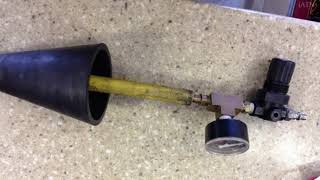
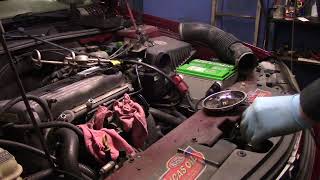
How to confirm: Visually inspect the exhaust system on Bank 2 (front of the vehicle) for soot trails or cracks. A smoke test is the most effective method. TSB PIP4964F recommends applying low pressure (5-8 psi) to the tailpipe and using a soapy water solution on flanges 🎬 Watch: A quick and easy way to find exhaust leaks. and welds to look for bubbles.
Typical fix: Replace the leaking gasket or repair the cracked pipe. This may involve replacing hardware or filing down flange surfaces to ensure a good seal.
Est. part cost: $10-$50 for gaskets and hardware - Faulty Downstream Oxygen Sensor (Bank 2, Sensor 2) ⚪ Low Probability → Shop Oxygen Sensor While O2 sensors do fail, they are often replaced unnecessarily for this code. The TSB guidance suggests this is a less likely cause than injectors or exhaust leaks. However, a sensor can become contaminated by fuel or age, causing it to send a false rich signal.
How to confirm: Use a scan tool to graph the voltage of the Bank 2, Sensor 2. It should show a relatively steady voltage (typically between 0.5V and 0.8V) when the engine is at operating temperature and holding a steady RPM. If it is stuck high (above 0.8V) or fluctuating wildly like the upstream sensor, it may be faulty. Swapping it with the Bank 1 downstream sensor and seeing if the code follows to P2097 is a definitive test.
Typical fix: Replace the Bank 2, Sensor 2 oxygen sensor.
Est. part cost: $40-$120
Rare But Worth Checking
- High Fuel Pressure: A failing fuel pressure regulator can cause a system-wide rich condition. Check this if both banks are running rich (e.g., P2097 is also present).
- Failing Catalytic Converter: → Shop Catalytic Converter A failing converter can sometimes cause erratic readings from the downstream O2 sensor. This is usually accompanied by other codes like P0430 (Catalyst Efficiency Bank 2).
- Mechanical Valvetrain Issue: TSB PIP4964F notes that if no injector or exhaust leak is found, a mechanical issue like a sticking valve could be the cause, which may or may not trigger a misfire code.
Diagnosis Steps
- Confirm the code with an OBD-II scanner and check for any other codes. Note the freeze frame data to see the conditions when the code was set.
- Identify Bank 2. On the transverse V6 Equinox, Bank 2 is the cylinder bank closer to the radiator/front of the vehicle.
- Crucially, follow TSB PIP4964F guidance: Perform a fuel injector balance test to check for leaking injectors on Bank 2 before proceeding. This is the most likely cause.
- If injectors are good, perform an exhaust leak test. Use a smoke machine or apply 5-8 PSI of air pressure at the tailpipe and spray gasket flanges and O2 sensor bungs on Bank 2 with soapy water. Look for bubbles.
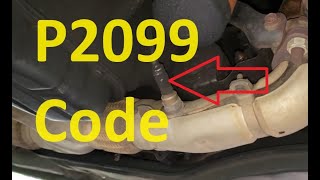
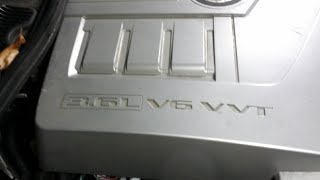
- If injectors and exhaust are confirmed to be good, use a scan tool to monitor the live voltage of the Bank 2, Sensor 2 (downstream) oxygen sensor. It should be relatively stable and above 0.5V. If it's stuck high (>0.8V) or mirroring the rapid fluctuations of the upstream sensor, the sensor 🎬 Watch: How to check your oxygen sensor for a P2099 code. itself may be the issue.
- As a final check, test fuel pressure to rule out a faulty fuel pressure regulator, especially if rich codes are present for both banks.
Parts You'll Likely Need
- Fuel Injector
(OEM #ACDelco 12629927 (for 3.0L LF1 V6 2010-2011), ACDelco 12634126 (for 3.0L LFW / 3.6L LFX V6 2012+))— This is the most common cause of P2099 on this vehicle, as identified in a GM Technical Service Bulletin.
Trusted brands: ACDelco, Hitachi, Standard Motor Products
OEM price range: $100-$180
Aftermarket price range: $50-$120 - Downstream Oxygen Sensor (Bank 2, Sensor 2)
(OEM #ACDelco 213-4229 or 12634061 (Check VIN, fits many 3.0L/3.6L))— This part is replaced if it is proven to be faulty after injectors and exhaust leaks have been ruled out.
Trusted brands: ACDelco, Denso, NTK
OEM price range: $80-$150
Aftermarket price range: $40-$120 - Exhaust Manifold Gasket or Flange Gasket — Required to fix an exhaust leak, which is a possible cause of the code.
Trusted brands: Fel-Pro, ACDelco, Mahle
OEM price range: $20-$50
Aftermarket price range: $10-$30
Related Codes That Often Appear With This One
- P2097 — This is the same 'rich' code but for Bank 1. If both are present, it points to a systemic issue like high fuel pressure affecting the entire engine.
- P0175 — This is 'System Too Rich Bank 2' detected by the *upstream* O2 sensor. Seeing both codes strongly suggests a genuine rich condition, like a leaking injector, rather than just a sensor fault.
- P0300, P0302, P0304, P0306 — These are misfire codes (random or specific to Bank 2 cylinders). A severely leaking injector can foul the spark plug and cause misfires on that cylinder.
Technical Service Bulletins (TSBs) & Recalls
- PIP4964F: Advises technicians to perform a fuel injector balance test when diagnosing P2097 or P2099, as leaking injectors are a primary cause. Also suggests checking for small exhaust leaks at the converter outlet using a low-pressure air test. This TSB covers a wide range of GM vehicles using the 3.0L and 3.6L V6 engines.
Platform-Specific Known Issues
- A known issue with leaking fuel injectors on the 3.0L and 3.6L V6 engines can directly cause a P2099 code. GM TSB PIP4964F specifically instructs technicians to check for this early in the diagnosis.
- Exhaust leaks at the flange between the catalytic converter and the rest of the exhaust are also a known weak point that can cause this code by introducing air into the exhaust stream.
Mechanic-Grade Diagnostic Values
- Low-Side Fuel Pressure (Key On, Engine Off) — expected: 55-60 PSI. Failure: Pressure below this range indicates a weak in-tank fuel pump; pressure above may indicate a regulator issue.
- Downstream O2 Sensor (Bank 2, Sensor 2) Voltage at Idle — expected: Relatively stable voltage between 0.4V and 0.8V.. Failure: A voltage stuck high (above 0.8V) confirms the rich condition seen by the ECM. If it fluctuates rapidly like an upstream sensor, the catalytic converter may be failing.
- Upstream O2 Sensor (Bank 2, Sensor 1) Heater Circuit Resistance — expected: Approximately 5.5–6.2 Ohms.. Failure: A reading significantly higher than this (e.g., 18 Ohms) indicates a failed heater element within the sensor, which can affect fuel trim calculations, although it typically sets a heater circuit code.
- ECM Ground Circuit Resistance — expected: Less than 1.0 Ohm.. Failure: Higher resistance indicates a poor ground connection, which can cause erratic sensor readings and incorrect ECM calculations.
Scan Tool Commands That Help
- GDS2 / Tech2: Injector Balance / Active Fuel Injector Tester (AFIT) — This is the manufacturer-recommended first step (per TSB PIP4964F) to diagnose P2099. It pressurizes the fuel rail and individually fires each injector to measure pressure drop, precisely identifying a leaking injector without disassembly.
- GDS2 / Tech2: Fuel Rail Pressure Sensor Reading — Used to verify that the fuel pressure sensor reading on the scan tool matches the actual pressure measured with a mechanical gauge. An offset can indicate a faulty sensor, tricking the ECM into incorrect fuel calculations.
Wiring & Ground Locations
- G107 (3.6L) / G103 (3.4L) — For the 3.6L LFX, G107 is on the upper left front side of the engine. For the 3.4L, G103 is on the left side of the engine compartment.. These are primary engine and Engine Control Module (ECM) ground points. A corroded or loose connection here can cause incorrect readings from the O2 sensors and fuel pressure sensor, leading to false rich codes.
- G109 (3.6L) — Located on the upper left rear side of the 3.6L engine.. This ground serves various engine components. Ensuring it is clean and tight is a critical step when troubleshooting any electronic engine code, as poor grounding can introduce voltage offsets and signal noise.
- O2 Sensor Fuses (#41 & #43) — In the underhood fuse block. Fuse #41 (15A) is for the post-catalytic converter (downstream) sensor, and Fuse #43 (15A) is for the pre-catalytic converter (upstream) sensor on many 2010-2017 models.. A blown fuse for the downstream O2 sensor's heater circuit can cause the sensor to respond slowly or inaccurately, potentially contributing to fuel trim errors, although this would typically set a specific heater circuit code.
Real Owner Repair Stories
- On the ScannerDanner forum, a user with a 2007 Cadillac SRX with the 3.6L V6 (an engine shared with the Equinox) chased a P2099 code for an extended period. They replaced O2 sensors, injectors, and even the catalytic converter. The discussion highlighted the importance of checking fuel trims (LTFT) between banks and the difficulty in finding small exhaust leaks, which were a prime suspect. The user noted black soot on the rear of the vehicle, confirming a real rich condition.
OEM Part Supersession History
12642128→12634126— Part revision or manufacturer change for the fuel injector used in 3.0L LFW and 3.6L LFX engines.12609457→213-4229— This is a service part number update for the downstream oxygen sensor. Both numbers refer to the same ACDelco part.
Model Year Variations Within This Range
- 2010-2011: These model years primarily used the 3.0L LF1 V6 engine.
- 2012-2015: For 2012, the 3.0L was updated to the E85-capable LFW V6. For 2013, the primary V6 option became the more powerful 3.6L LFX engine, which has a different architecture, including cylinder heads with integrated exhaust manifolds. While the P2099 code applies to both, part numbers for injectors and some sensors differ. The LFX uses injector #12634126.
Helpful Videos

We Have This Part in Stock



The information in this article is provided for general reference and educational purposes only. Vehicle specifications, procedures, and part compatibility can vary by production date, trim level, and region. Always consult your vehicle's factory service manual and verify part numbers before purchasing or performing repairs. Safety-critical components such as airbags, seat belts, and braking systems should be installed by a qualified professional.
- Chevrolet EQUINOX:
- 🧭 Diagnostic Flowchart
- 🎬 Helpful Videos
- 🛍️ Shop This Part
- What's Unique About the 2008-2015 Chevrolet EQUINOX
- Symptoms You May Notice
- Most Likely Causes
- Rare But Worth Checking
- Diagnosis Steps
- Parts You'll Likely Need
- Related Codes That Often Appear With This One
- Technical Service Bulletins (TSBs) & Recalls
- Platform-Specific Known Issues
- Mechanic-Grade Diagnostic Values
- Scan Tool Commands That Help
- Wiring & Ground Locations
- Real Owner Repair Stories
- OEM Part Supersession History
- Model Year Variations Within This Range
- 🎟️ Get 5% Off