

P2120 on 2007-2011 GMC Sierra: Accelerator Pedal Sensor 'D' Circuit Causes and Fixes
On a 2007-2011 GMC Sierra, code P2120 almost always indicates a problem with the accelerator pedal assembly or its wiring, triggering a 'Reduced Engine Power' warning. Before replacing the pedal assembly (around $70-$180), inspect the electrical connector for loose pins, a known issue covered by GM TSB #PIP3783D. Also, check for broken ground wires near the intake manifold and water intrusion in kick panel connectors, which are other common, documented failure points for this platform.
- P2120 on a 2007-2011 Sierra will trigger the 'Reduced Engine Power' mode, making the truck unsafe for normal driving.
- Before buying any parts, ALWAYS inspect the electrical connector at the accelerator pedal for loose-fitting terminals, as this is a known GM issue (TSB #PIP3783D).
- If the wiring connection is secure, the most likely fix is to replace the entire accelerator pedal assembly.
- Do not confuse this pedal-related code with a problem at the throttle body; they are separate components.
What's Unique About the 2007-2011 Gmc SIERRA
For this generation of GMC Sierra and its platform mates (like the Chevy Silverado, Tahoe, and Yukon), wiring issues are a very well-documented cause for APP sensor codes like P2120. A specific GM Technical Service Bulletin (PIP3783D) directs technicians to check for poor terminal tension in the APP sensor's electrical connector before replacing any parts. Furthermore, another TSB (#07-06-04-019F) points to water intrusion in a body harness connector in the driver's kick panel as a cause. Finally, owner forums and repair videos frequently cite a specific broken ground wire on the passenger side of the intake manifold as a culprit for intermittent 'Reduced Power' events over bumps. These multiple, known wiring failure points make a thorough electrical inspection the most critical first step before replacing the pedal.
Diagnostic Flowchart
Tap your situation to follow the diagnostic path that matches what you're seeing on this vehicle.
Generation note: The 2007 model year was a transition. This guide applies to the 'new' GMT900 platform (2007-2013). Some 2007 models were sold as the 'Classic' GMT800 body style. While the APP sensor functions similarly, the specific part numbers and connector locations may differ slightly. The TSBs provided apply to the 2007 model year, indicating the issue is prevalent on the GMT900 platform.
Symptoms You May Notice
- "Reduced Engine Power" message on the driver information center.
- Check Engine Light (Malfunction Indicator Lamp) is on.
- Poor, delayed, or no throttle response.
- Vehicle speed is severely limited (limp mode).
- Hesitation or stumbling during acceleration.
- A "Service Stabilitrak" or "Service Traction Control" message may also appear.
- Engine may stall or die when hitting bumps, followed by gauges and lights acting erratically.
- Replacing the throttle body. P2120 specifically points to a fault in the accelerator pedal circuit, which is the driver's input. Throttle body issues will set different codes, such as P1516 or P2135.
Most Likely Causes
- Poor Terminal Tension at APP Sensor Connector 🔴 High Probability This is a well-documented issue for GM trucks of this era, as cited in TSB #PIP3783D. The female terminals in the 6-pin connector (X115) at the pedal can spread apart over time, causing a weak or intermittent connection.
How to confirm: With the ignition off, disconnect the electrical connector at the accelerator pedal. Visually inspect the pins for corrosion or damage. Use a proper terminal test probe to check the tension of each female pin. A 'wiggle test' is highly effective: with the key on and a scan tool displaying live APP sensor voltage, gently wiggle the connector and harness. If the voltage reading drops out or jumps, a connection fault is present.
Typical fix: If terminals are loose, they can sometimes be carefully re-tensioned with a small pick tool. A more reliable and common repair is to replace the entire connector pigtail. Solder and heat-shrink the new pigtail for a durable connection.
Est. part cost: $25-$45 - Faulty Accelerator Pedal Position (APP) Sensor 🔴 High Probability → Shop Accelerator Pedal Assembly The electronic sensors inside the pedal assembly can fail internally from wear and tear, leading to incorrect voltage signals. It is a high-use component.
How to confirm: If the wiring and connector are confirmed to be good, use a scan tool to monitor the live data from APP Sensor 1 and APP Sensor 2. The voltage should change smoothly as you press and release the pedal. If the voltage is erratic, jumps, or doesn't change, the sensor has failed. Some mechanics on forums recommend using only an OEM/ACDelco replacement part, as they have experienced issues with aftermarket sensors failing prematurely.
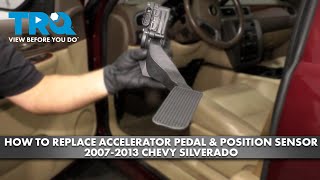
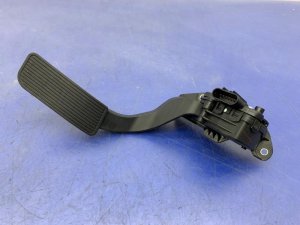
Typical fix: Replace the entire accelerator pedal assembly. The sensors are integrated into the pedal and are not sold separately. It is typically held on by two 10mm nuts. 🎬 Watch: Step-by-step guide to replacing the accelerator pedal assembly.
Est. part cost: $70-$180 - Damaged Wiring Harness or Poor Ground 🟡 Medium Probability A specific, frequently-reported failure is a small black ground wire in the harness on the passenger side of the intake manifold, which can break internally or corrode at its connection point. This often causes intermittent power loss when hitting bumps. Wires can also chafe against brackets or the firewall, and other ground connections (like G103) can corrode.
How to confirm: Visually inspect the wiring harness from the pedal towards the firewall for any signs of chafing, melting, or rodent damage. Specifically locate the small black ground wire on the passenger side intake harness and gently tug on it; if it separates, it has failed. Check and clean main ground points, such as G103 on the cylinder head and G107 on the engine block. 🎬 Watch: A mechanic shows you exactly where to find these ground locations.
Typical fix: Repair the damaged section of wire using solder and heat shrink tubing. For the broken ground wire, cut the wire, crimp on a new ring terminal, and secure it to a clean, solid ground point on the engine. Clean corroded ground connections with a wire brush and ensure they are tight.
Est. part cost: $5-$20
Rare But Worth Checking
- Water Intrusion into Body Harness Connector: Per TSB #07-06-04-019F, water can leak from A-pillar seals, sunroof drains, or the windshield into the instrument panel-to-body harness connector (located in the driver's side kick panel), causing corrosion and setting various APP sensor codes. The TSB explicitly states not to replace the pedal before checking this connector. A professional fix sometimes involves running new, dedicated wires to bypass the compromised connector entirely.
- Backed-out Pins at ECM Connector: In rare cases, after the pedal and pigtail have been replaced, the fault can be traced to the main J1/X1 connector at the Engine Control Module (ECM). Pins for the APP circuit can back out slightly, causing a poor connection. The fix is to disconnect the ECM connector and carefully re-seat each pin.
- Faulty Engine Control Module (ECM): → Shop Engine Control Module (ECM) This is extremely rare and should only be considered after all wiring, connector, and sensor issues have been completely ruled out by thorough testing.
Diagnosis Steps
- Read all stored DTCs with an OBD-II scanner. Note any other codes present, especially P2138.
- Visually inspect the accelerator pedal assembly and its electrical connector for any obvious damage.
- As per TSB PIP3783D, carefully inspect the terminals in the APP sensor connector (X115) for a loose fit (poor tension).
- Perform a 'wiggle test': With the key on and a scan tool displaying live APP sensor voltage, gently wiggle the connector and harness at the pedal. If the voltage reading drops out or jumps, a wiring or connection fault is present.
- Inspect the wiring harness near the passenger side of the intake manifold. Gently tug on the small black ground wire to see if it is broken internally.
- If the connection seems good, use a multimeter to verify that the sensor is receiving the correct 5-volt reference and has a solid ground connection at the pedal connector.
- Check for water intrusion in the driver's side kick panel area, specifically at the large instrument panel-to-body harness connector, as noted in TSB #07-06-04-019F.
- If power and ground are good, but the signal is still faulty on the scan tool, the accelerator pedal assembly is the likely culprit and should be replaced.
- As a final step if all else fails, inspect the wiring and pins at the main J1/X1 connector at the Engine Control Module (ECM) for damage or corrosion.
Parts You'll Likely Need
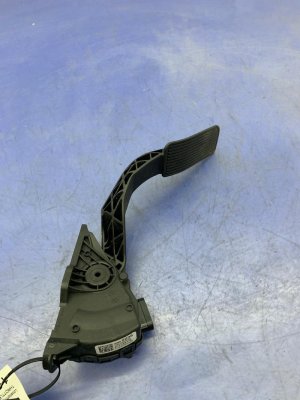
- Accelerator Pedal Assembly
(OEM #25832864)— This is the most common part to fail when wiring is confirmed to be good. The internal position sensors wear out, and the entire assembly must be replaced as a unit. This part number supersedes 15847349 and 15101848.
Trusted brands: ACDelco (GM Genuine), Dorman (699-105), NTK (AD0456), Standard Motor Products (APS265)
OEM price range: $95-$180
Aftermarket price range: $70-$150 - APP Sensor Connector Pigtail
(OEM #13584094)— Needed to fix the common issue of poor terminal tension or damage at the original connector, as cited by TSB PIP3783D. The ACDelco service part number is PT2712.
Trusted brands: ACDelco (GM Genuine), Dorman, Standard Motor Products
OEM price range: $30-$50
Aftermarket price range: $20-$40
Related Codes That Often Appear With This One
- P2122 — Indicates APP Sensor 'D' Circuit Low Voltage.
- P2123 — Indicates APP Sensor 'D' Circuit High Voltage.
- P2125 — Relates to the second internal sensor, APP Sensor 'E' Circuit.
- P2127 — Indicates APP Sensor 'E' Circuit Low Voltage.
- P2128 — Indicates APP Sensor 'E' Circuit High Voltage.
- P2138 — Indicates a correlation fault between the two APP sensors (Sensor D and E). This is very common to see with P2120 as the ECM constantly compares the two signals for safety.
Technical Service Bulletins (TSBs) & Recalls
- PIP3783D: Addresses multiple APP sensor codes, including P2120, and advises technicians to inspect the accelerator pedal position circuits for poor terminal tension before replacing parts.
- 07-06-04-019F: Details how water intrusion into the instrument panel-to-body harness connector can cause intermittent MIL, Reduced Engine Power, and DTC P2138 (often seen with P2120). It explicitly warns against replacing the pedal assembly before inspecting this connector.
- 07-06-04-019G: A later revision of the water intrusion TSB, updated in 2021 to include models up to 2022, confirming this remains a known issue across many GM platforms.
Platform-Specific Known Issues
- A known issue of poor terminal tension in the accelerator pedal position sensor connector is documented in GM Technical Service Bulletin #PIP3783D. This should be the first diagnostic check.
- Broken Ground Wire on Intake Manifold: A YouTube video by 'Pine Hollow Auto Diagnostics' with over 1 million views details a common failure of a small black ground wire on the passenger side of the intake manifold. The wire breaks internally, causing intermittent 'Reduced Engine Power' mode, often triggered by bumps. The fix is to cut the wire and run a new ground to the engine block.
- Water Intrusion in Kick Panel Connector: GM TSB #07-06-04-019F warns that water can leak into the IP-to-body harness connector in the driver's kick panel, causing corrosion and APP sensor codes. Technicians are advised to check this before replacing the pedal.
Mechanic-Grade Diagnostic Values
- 5-Volt Reference at APP Connector (Pins E & B) — expected: 4.8 - 5.2 Volts with key on, engine off.. Failure: Voltage below 4.8V or above 5.2V points to a fault in the ECM or the reference circuit wiring.
- APP Sensor 1 Signal Voltage (Pin F) — expected: Sweeps smoothly from approx. 0.5V - 1.1V (pedal released) to approx. 2.6V - 4.5V (pedal fully depressed).. Failure: Voltage is stuck, jumps erratically, or goes below 0.24V or above 4.49V for more than 0.5 seconds.
- APP Sensor 2 Signal Voltage (Pin C) — expected: Sweeps smoothly from approx. 1.2V - 2.0V (pedal released) to approx. 3.4V - 4.5V (pedal fully depressed).. Failure: Voltage is erratic or outside the expected range, often setting a P2125 or P2138 code alongside P2120.
- Low Reference (Ground) Circuit Resistance (Pins A & D to chassis ground) — expected: Less than 3.0 Ohms.. Failure: Resistance higher than 3.0 Ohms indicates an open or high-resistance in the ground circuit, which is a common problem.
Scan Tool Commands That Help
- GDS2 / Tech2 or high-level scan tool: Throttle/Idle Learn Reset — After replacing the accelerator pedal, throttle body, or ECM, this procedure is required to reset learned values and allow the ECM to calibrate to the new component's baseline readings. Failure to do so can result in an unstable idle or other throttle-related codes.
Wiring & Ground Locations
- X115 — The 6-pin electrical connector located directly on the accelerator pedal assembly.. This is the most common point of failure due to poor terminal tension, as documented in TSB PIP3783D. All diagnostic voltage and resistance tests for the pedal sensor begin at this connector.
- APP Connector Pinout (X115) — Pin A: Low Ref (GND) for APP 2; Pin B: 5V Ref for APP 2; Pin C: Signal for APP 2; Pin D: Low Ref (GND) for APP 1; Pin E: 5V Ref for APP 1; Pin F: Signal for APP 1.. Knowing the specific function of each pin is essential for accurately testing the 5V reference, ground, and signal circuits with a multimeter. P2120 relates to the circuit for APP Sensor 1 (Pins D, E, F).
- G103 — On the front of the passenger side cylinder head.. This is a primary engine sensor ground. Corrosion or a loose connection here can cause erratic voltage readings for multiple sensors, including the APP sensor circuits, leading to intermittent codes.
- G107 — On the front of the engine block, typically on the driver's side.. Another critical engine ground point. A poor connection here can affect ECM operation and sensor readings.
- ECM J1/X1 Connector — The main multi-pin connector at the Engine Control Module (ECM), located on the driver's side of the engine bay.. This is the termination point for the APP sensor wiring. In rare cases, after the pedal and pigtail are confirmed good, a pin can back out of this connector, causing an open circuit.
Real Owner Repair Stories
- SilveradoSierra.com forum user (2008 GMC Sierra) — Intermittent 'Reduced Engine Power' message, codes P2120 and P2138.
❌ Tried (didn't work) Replacing the accelerator pedal assembly (twice), Replacing the APP sensor connector pigtail
✅ What actually fixed it Found a broken ground wire for the engine harness located on the passenger side of the engine. The wire was broken inside the insulation and only made intermittent contact. Cut the wire, crimped on a new ring terminal, and secured it to a clean bolt on the cylinder head, which permanently resolved the issue. - iATN (International Automotive Technicians Network) post (2007 Chevrolet Silverado) — Reduced power, codes P1125 and P2120 returned two weeks after repair.
❌ Tried (didn't work) Replacing the throttle body, Replacing the accelerator pedal assembly
✅ What actually fixed it The technician traced the issue to poor ground connections. Cleaning the main engine and body grounds resolved the recurring codes. - YouTube channel 'South Florida Technical Training' (2007-2011 GM Truck) — Persistent P2138 (APP sensor correlation) and Reduced Engine Power message.
❌ Tried (didn't work) Replacing the accelerator pedal assembly
✅ What actually fixed it The cause was water intrusion into the large instrument panel-to-body harness connector in the driver's kick panel, as described in TSB #07-06-04-019F. The corroded terminals were causing signal faults.
OEM Part Supersession History
15101848, 15847349→25832864— Standard part evolution, possible internal improvements for durability.
Heads up: The new part number (25832864) is the correct service replacement for the entire 2007-2011 GMT900 model range and is fully compatible.N/A (part of harness)→13584094 (GM), PT2712 (ACDelco Service PN)— To provide a service repair for damaged or loose-fitting original connectors without replacing the entire engine harness.
Heads up: This pigtail connector is the correct 6-pin female connector for the APP sensor.
Helpful Videos

We Have This Part in Stock

The information in this article is provided for general reference and educational purposes only. Vehicle specifications, procedures, and part compatibility can vary by production date, trim level, and region. Always consult your vehicle's factory service manual and verify part numbers before purchasing or performing repairs. Safety-critical components such as airbags, seat belts, and braking systems should be installed by a qualified professional.
- Gmc SIERRA:
- 🧭 Diagnostic Flowchart
- 🎬 Helpful Videos
- 🛍️ Shop This Part
- What's Unique About the 2007-2011 Gmc SIERRA
- Symptoms You May Notice
- Most Likely Causes
- Rare But Worth Checking
- Diagnosis Steps
- Parts You'll Likely Need
- Related Codes That Often Appear With This One
- Technical Service Bulletins (TSBs) & Recalls
- Platform-Specific Known Issues
- Mechanic-Grade Diagnostic Values
- Scan Tool Commands That Help
- Wiring & Ground Locations
- Real Owner Repair Stories
- OEM Part Supersession History
- 🎟️ Get 5% Off