

P2122 on 2007-2014 Cadillac Escalade ESV: APP Sensor Circuit Low Causes & Fixes
This code indicates a low voltage signal from Accelerator Pedal Position (APP) Sensor 1. On this Escalade, the most common cause is a poor electrical connection at the pedal assembly, as noted in GM TSB PIP3783D. The fix is often cleaning and securing the connector or replacing the entire accelerator pedal assembly for about $100-$160 in parts. Many owners confirm that replacing the pedal assembly is a straightforward DIY fix.
- P2122 on a 2007-2014 Escalade means the primary accelerator pedal sensor has a low voltage signal.
- Before buying parts, inspect the wiring connector at the accelerator pedal for loose terminals, as this is a known issue covered by GM TSB PIP3783D.
- If the wiring is good, the most common fix is replacing the entire accelerator pedal assembly, a straightforward DIY job.
- This issue is shared across the GMT900 platform, including the Chevrolet Tahoe, Suburban, Silverado and GMC Yukon.
What's Unique About the 2007-2014 Cadillac ESCALADE ESV
For the GMT900 platform, which includes the 2007-2014 Escalade, General Motors issued Technical Service Bulletin #PIP3783D specifically addressing this and related codes. 🎬 See how to fix common Reduced Engine Power codes. The bulletin highlights that intermittent signal loss is often caused by poor terminal tension in the wiring connector at the accelerator pedal. It also advises technicians to check other connectors, including C109/X109 (below the underhood fuse block) and C205/X205 (under the instrument panel), for issues like corrosion or improper seating. This makes a faulty electrical connection a more likely culprit on these trucks than on many other vehicles, where the sensor itself might be the primary point of failure.
Diagnostic Flowchart
Tap your situation to follow the diagnostic path that matches what you're seeing on this vehicle.
Symptoms You May Notice
- "Reduced Engine Power" message on the dashboard.
- Check Engine Light (Service Engine Soon) is on.
- Poor, delayed, or no throttle response.
- Vehicle may not accelerate past a very low speed or may not accelerate at all.
- Engine may idle higher than normal or stall.
- Traction control light may also illuminate.
- Replacing the throttle body. The symptoms of a bad pedal sensor and a bad throttle body can be similar (like 'Reduced Engine Power'), but P2122 specifically points to the pedal sensor circuit ('D' circuit low), not the throttle body. It's crucial to diagnose based on the specific code.
Most Likely Causes
- Poor Terminal Tension at APP Sensor Connector 🔴 High Probability This is a known issue documented by GM in TSB #PIP3783D for this specific platform. The connector terminals can lose their grip over time due to vibration and heat cycles, causing an intermittent and weak signal.
How to confirm: Visually inspect the connector for looseness, corrosion, or backed-out pins. Use proper terminal test probes (not a standard multimeter probe, which can damage the terminal) to check the tension of the female terminals in the connector. Wiggle the harness while monitoring APP sensor voltage on a scan tool to see if the reading fluctuates.
Typical fix: Disconnect the connector, clean the terminals with contact cleaner, and apply a small amount of dielectric grease. If terminal tension is poor, the terminals may need to be re-crimped or the entire connector pigtail replaced. TSB PIP3783D also suggests inspecting other harness connectors like C109/X109 and C205/X205 for similar issues.
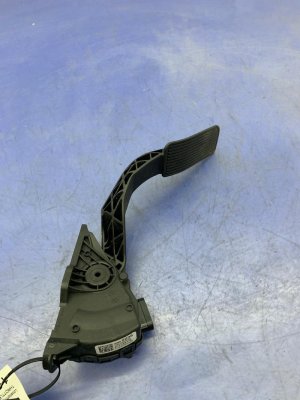
Est. part cost: $0-$35 - Faulty Accelerator Pedal Position (APP) Sensor 🔴 High Probability → Shop Accelerator Pedal Assembly The sensor is an electronic component that wears out over time. It is integrated into the accelerator pedal assembly and is a very common failure point on these trucks, as reported by numerous owners.
How to confirm: Use a scan tool to monitor the live data for APP Sensor 1 Voltage. If the voltage is stuck low (e.g., below 0.5V) and doesn't change smoothly when the pedal is pressed, and the wiring is confirmed to be good, the sensor has failed. The normal range for APP Sensor 1 should be around 0.8V at rest to over 4.0V at full press.
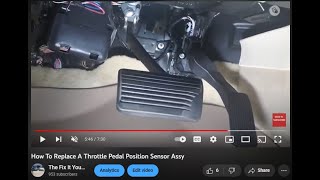
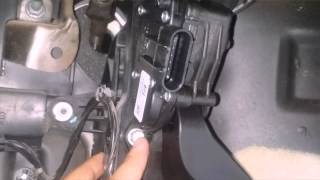
Typical fix: Replace the entire accelerator pedal assembly. This is a simple DIY job for many, typically involving only two or three 10mm bolts. 🎬 Watch this quick walkthrough for replacing the GM pedal sensor.
Est. part cost: $90-$165 - Damaged Wiring Harness 🟡 Medium Probability Wires in the footwell area can be susceptible to damage from kicking, floor mats, or chafing against sharp edges under the dash. One owner on a forum found frayed wires in the harness leading to the pedal, which caused a similar P2138 code. Another owner of a related truck found a broken ground wire near the intake manifold caused similar issues.
How to confirm: Perform a continuity and resistance test on the wires between the APP sensor connector and the ECM. Wiggle the harness while testing to check for intermittent breaks or shorts. A visual inspection may reveal chafed or broken wires.
Typical fix: Repair or splice the damaged section of wire. Ensure the repair is properly soldered and heat-shrunk to prevent future issues.
Est. part cost: $5-$20
Rare But Worth Checking
- Faulty Engine Control Module (ECM): → Shop Engine Control Module (ECM) This is very rare. The ECM should only be considered after all other possibilities, including wiring and the sensor itself, have been exhaustively ruled out. Diagnostic procedures specify testing the ECM circuits last.
Diagnosis Steps
- Read all fault codes with an OBD-II scanner. Note any other codes present, especially other APP sensor codes like P2138.
- Check for Technical Service Bulletins (TSBs). TSB #PIP3783D is directly relevant to this code on this vehicle and its platform mates.
- Using a scan tool, observe the live data for 'APP Sensor 1 Voltage' and 'APP Sensor 2 Voltage'. With the key on and engine off, APP Sensor 1 should read around 0.8V at idle and rise smoothly to over 4.0V at full pedal press. APP Sensor 2 should have a different range.
- If the voltage for Sensor 1 is stuck low (below 0.5V), proceed to inspect the physical components.
- Disconnect the battery. Locate the accelerator pedal assembly under the driver's side dashboard.
- Disconnect the electrical connector from the pedal assembly. Inspect the connector and the sensor pins for any signs of corrosion, moisture, or damage.
- Following the advice of TSB PIP3783D, carefully check the terminal tension in the female side of the connector. A loose connection is a very common cause. Wiggle the harness to see if the connection is intermittent.
- If the connector appears fine, test the circuit. Check for the 5V reference and good ground at the connector with a multimeter. A forum user on a similar vehicle documented testing these wires and finding high resistance, which led him to repair the harness.
- If the wiring, connector, and voltages are correct, the APP sensor itself is the most likely culprit. Replace the accelerator pedal assembly.
- After repair, clear the codes and perform a test drive to ensure the issue is resolved and the 'Reduced Engine Power' message does not return.
Parts You'll Likely Need
- Accelerator Pedal Assembly
(OEM #25832864)— The APP sensor is integrated into the pedal assembly and is the most common part to fail after wiring issues are ruled out. This part number fits the specified Escalade models. 🎬 Watch: Step-by-step guide to replacing the Escalade pedal assembly. OEM parts catalogs show this part number supersedes previous numbers 15847349 and 15101848.
Trusted brands: ACDelco (GM Genuine), Dorman, Standard Motor Products (SMP)
OEM price range: $110-$165
Aftermarket price range: $70-$130 - APP Sensor Connector Pigtail — If the connector itself is damaged or the terminal tension issue described in TSB PIP3783D cannot be resolved by cleaning or re-pinning, replacing the pigtail is the next step. A user on Tahoe Yukon Forum replaced the plug and repinned the wires to solve a related code.
Trusted brands: ACDelco, Dorman
OEM price range: $25-$40
Aftermarket price range: $15-$30
Related Codes That Often Appear With This One
- P2138 — This code indicates a correlation error between APP Sensor 1 and APP Sensor 2. It's very common to see this with P2122 because if Sensor 1's signal is lost or incorrect, it will no longer match the signal from Sensor 2, triggering the correlation fault.
- P2120, P2123, P2125, P2127, P2128 — These are all codes related to the APP sensor circuits (Sensor 1 and Sensor 2, high/low voltage, range/performance). They are often triggered together when there is a fault in the pedal assembly or its wiring, as noted in TSB PIP3783D.
Technical Service Bulletins (TSBs) & Recalls
- PIP3783D: Addresses Service Engine Soon light, reduced engine power, and various APP sensor DTCs (including P2122) caused by poor terminal tension in the sensor's electrical connector. It applies to the 2007-2014 Escalade, Tahoe, Suburban, Yukon, and other GMT900 trucks.
Platform-Specific Known Issues
- A known issue on this platform is poor terminal tension at the APP sensor connector, which can cause intermittent low voltage signals and trigger P2122. This is documented in GM Technical Service Bulletin #PIP3783D.
- The TSB also recommends checking other large inline harness connectors (C109/X109 and C205/X205) for corrosion or poor connections, as the APP sensor circuits pass through them.
Mechanic-Grade Diagnostic Values
- APP Sensor 1 Voltage (Scan Tool) — expected: 0.46V - 4.75V, changes with pedal input.. Failure: Voltage is below 0.46V or does not change with pedal movement.
- APP Sensor 2 Voltage (Scan Tool) — expected: 0.32V - 2.6V, changes with pedal input.. Failure: Voltage is outside the expected range or does not change with pedal movement.
- 5-Volt Reference at APP Connector — expected: 4.5V - 5.2V.. Failure: Voltage is significantly lower or higher, indicating a problem with the ECM or wiring.
- APP Sensor 1 Resistance — expected: Approximately 1,000 - 5,000 ohms, sweeping smoothly.. Failure: Resistance is erratic, out of range, or shows open/short as the pedal is moved.
Scan Tool Commands That Help
- GM Tech2 / GDS2 or compatible high-end scanner: Accelerator Pedal Position Learn / Throttle/Idle Learn — After replacing the accelerator pedal assembly or throttle body, this procedure may be required to recalibrate the system and learn the new component's position values. Some sources suggest manual relearn procedures involving ignition cycles and pedal presses can also be performed.
Wiring & Ground Locations
- G103 — On the front of the passenger side cylinder head.. This ground serves multiple components, and a poor connection here can introduce electrical noise or voltage drops affecting sensor readings. A Reddit user noted that on a similar platform, G103 and G104 ground the VCM, fuel pump relay, and other critical systems.
- G104 — On the left rear corner of the engine, mounted to the left cylinder head.. This ground strap runs from the back of the cylinder head to the firewall. A poor connection can affect various systems controlled by the ECM/BCM, potentially contributing to sensor signal issues.
- C205/X205 — Located under the Instrument Panel Upper Trim Panel (the dashboard top cover near the windshield).. TSB PIP3783D specifically calls out this inline harness connector as a potential point of failure for the APP sensor circuits due to corrosion or poor connection. The APP sensor signals pass through this connector on their way to the ECM.
- C109/X109 — Located in the engine compartment on the left side, below the underhood fuse block.. Similar to X205, this is another major inline connector that the APP sensor circuits pass through. TSB PIP3783D recommends inspecting it for corrosion or pin tension issues if the fault is intermittent.
Real Owner Repair Stories
- YouTube video on a 2006 VW Jetta (2006 Volkswagen Jetta (different vehicle, but same code and diagnostic principle)) — Check Engine Light, EPC light, and vehicle going into limp mode.
❌ Tried (didn't work) Replacing the accelerator pedal assembly ($125 part).
✅ What actually fixed it The owner found a previous, poorly-done wire splice in the harness leading to the pedal. After removing the old splice, soldering the wires correctly, and using heat-shrink tubing, the problem was permanently resolved.
OEM Part Supersession History
15101848, 15847349→25832864— Standard part evolution, integrating design updates and new materials.
Heads up: No programming is required when replacing this pedal assembly. It is a direct fit replacement.
Model Year Variations Within This Range
- 2007-2011: Some aftermarket part suppliers list compatibility for the accelerator pedal assembly (PN 25832864) only up to the 2011 model year, even though the official generation runs to 2014. While the OEM part is listed for the full range, owners of 2012-2014 models should double-check the part number before ordering aftermarket versions.
Helpful Videos
We Have This Part in Stock

The information in this article is provided for general reference and educational purposes only. Vehicle specifications, procedures, and part compatibility can vary by production date, trim level, and region. Always consult your vehicle's factory service manual and verify part numbers before purchasing or performing repairs. Safety-critical components such as airbags, seat belts, and braking systems should be installed by a qualified professional.
- Cadillac ESCALADE ESV:
- 🧭 Diagnostic Flowchart
- 🎬 Helpful Videos
- 🛍️ Shop This Part
- What's Unique About the 2007-2014 Cadillac ESCALADE ESV
- Symptoms You May Notice
- Most Likely Causes
- Rare But Worth Checking
- Diagnosis Steps
- Parts You'll Likely Need
- Related Codes That Often Appear With This One
- Technical Service Bulletins (TSBs) & Recalls
- Platform-Specific Known Issues
- Mechanic-Grade Diagnostic Values
- Scan Tool Commands That Help
- Wiring & Ground Locations
- Real Owner Repair Stories
- OEM Part Supersession History
- Model Year Variations Within This Range
- 🎟️ Get 5% Off