

P2135 on 2010-2015 Hyundai Tucson: Throttle Position Sensor Failure, Causes, and Fixes
On a 2010-2015 Tucson, P2135 almost always means the electronic throttle body assembly is failing. This will put the car in 'limp mode.' The sensors are internal, so the entire assembly must be replaced. Before replacement, a thorough cleaning should be attempted. Expect to pay $180-$350 for an aftermarket part; DIY difficulty is 2/5.
- P2135 on a 2010-2015 Tucson will cause a serious loss of power ('limp mode') and requires immediate attention.
- The most common cause is a failure of the internal, non-serviceable sensors within the electronic throttle body assembly.
- Before replacing the assembly, always perform a thorough cleaning of the throttle plate and bore, as carbon buildup can cause identical symptoms.
- Replacement of the entire throttle body assembly is the standard repair; ensure a throttle relearn procedure is performed afterward.
- Do not misdiagnose this as a faulty accelerator pedal, which typically sets different codes like P2138.
What's Unique About the 2010-2015 Hyundai Tucson
For the second-generation Hyundai Tucson (2010-2015) and its platform mates like the Kia Sportage, the dual throttle position sensors (TPS) are integrated directly into the electronic throttle body assembly. They are not sold as separate, replaceable parts. This design means that a failure of either internal sensor requires the replacement of the entire throttle body unit. While some older vehicles allow for a simple sensor swap, this platform requires a full assembly replacement, which is the most common and confirmed fix for P2135.
Symptoms You May Notice
- Check Engine Light is on
- Vehicle enters 'Limp Mode' (Reduced Engine Power)
- Drastic loss of acceleration
- Hesitation or stumbling when pressing the gas pedal
- Engine may stall, especially at idle or when coming to a stop
- Erratic or high idle speed
- Engine surging without driver input
- Replacing the Accelerator Pedal Position (APP) Sensor. P2135 specifically relates to the sensor correlation at the throttle body on the engine. A faulty accelerator pedal typically sets a different code, such as P2138 or P2122.
Most Likely Causes
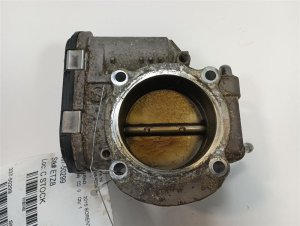
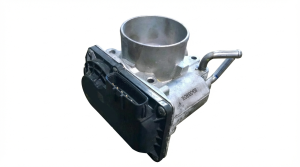
- Faulty Electronic Throttle Body Assembly 🔴 High Probability → Shop Fuel Injection Throttle Body The internal throttle position sensors (TPS) are a common failure point. As these sensors wear out, they send erratic or non-correlating voltage signals, causing the fault. The sensors are not available separately, making assembly replacement necessary.
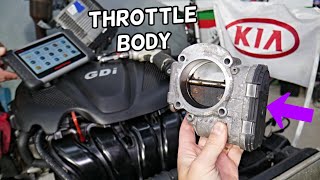
How to confirm: After confirming wiring is intact and cleaning the throttle body doesn't resolve the issue, the most reliable diagnostic step is to replace the throttle body assembly. A scan tool can graph the two TPS voltages; 🎬 See how to test and replace an electronic throttle body a failing sensor will show erratic spikes, dropouts, or a non-linear relationship when the throttle is slowly opened and closed.
Typical fix: Replace the entire electronic throttle body assembly. A throttle relearn procedure must be performed after installation.
Est. part cost: $180-$500 - Dirty Throttle Body 🟡 Medium Probability → Shop Fuel Injection Throttle Body Gasoline Direct Injection (GDI) engines, like the 2.4L available in the Tucson, can be prone to carbon and oil buildup in the intake and on the throttle plate from the PCV system. This buildup can cause the throttle plate to stick or move slowly, creating a mismatch between the expected and actual sensor readings. Hyundai TSB 10-FL-009 for other models specifically advises cleaning the throttle body before replacement for similar issues.
How to confirm: Remove the air intake hose and visually inspect the throttle bore and plate for black, sticky carbon deposits. If the plate doesn't move smoothly by hand (with ignition off), it needs cleaning.
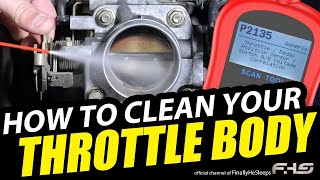
Typical fix: Thoroughly clean the throttle plate and bore using a dedicated throttle body cleaner and a soft brush or cloth. 🎬 Watch: How to clean a throttle body without removing it Do not push the plate open with your fingers; have a helper turn the key to 'ON' (engine off) and press the gas pedal to open the plate electronically.
Est. part cost: $5-$15 - Damaged Wiring or Poor Connection ⚪ Low Probability The wiring harness to the throttle body is located near the front of the engine bay and can be subject to heat and vibration. Technicians pulling on wires instead of the connector body during service can also strain the pins.
How to confirm: Visually inspect the wiring harness and connector going to the throttle body. Check for frayed wires, corrosion on the pins, or a loose connection. Wiggle the connector with the engine running (if it will run stably) to see if it affects idle.
Typical fix: Repair the damaged section of wire or replace the connector pigtail. Apply dielectric grease to the connector to prevent future moisture intrusion.
Est. part cost: $10-$40
Rare But Worth Checking
- Faulty Powertrain Control Module (PCM): → Shop Engine Control Module (ECM) This is very rare. The PCM should only be considered after all other possibilities, including the throttle body and wiring, have been definitively ruled out. Low battery voltage can also cause erratic electronic behavior and should be checked first.
Diagnosis Steps
- Check battery voltage to ensure it's above 12.4 volts. Low voltage can cause various electronic faults.
- Scan for trouble codes. Note any other codes that appear alongside P2135, as they can help confirm the diagnosis.
- Turn the ignition off and disconnect the throttle body electrical connector. Inspect the pins on both the harness and the throttle body for corrosion, moisture, or damage.
- Remove the air intake hose from the throttle body.
- Inspect the throttle bore and plate for heavy carbon buildup. If dirty, clean it thoroughly with throttle body cleaner and a soft cloth. Have a helper turn the ignition to 'ON' (engine off) and press the accelerator to open the plate for cleaning. Do not force it open by hand.
- If the connector is clean and cleaning the throttle body does not fix the issue, the throttle body assembly is the most likely culprit.
- Replace the throttle body assembly, ensuring you also replace the gasket.
- Perform a throttle relearn procedure. A common method is to turn the ignition to 'ON' (engine off) for 15 seconds, then 'OFF' for 10 seconds. Repeat this cycle 3-5 times. Then start the engine and let it idle for several minutes to confirm the fix.
Parts You'll Likely Need
- Electronic Throttle Body Assembly (2.4L)
(OEM #35100-2G700)— This is the primary cause of code P2135, as the internal throttle position sensors fail and are not sold separately. This part number is for the 2.4L Theta II engine. Note: Some listings show 35100-2G710 as a superseding part.
Trusted brands: Hyundai (OEM), Bosch, Cardone (Remanufactured), Dorman
OEM price range: $450-$520
Aftermarket price range: $180-$350 - Electronic Throttle Body Assembly (2.0L)
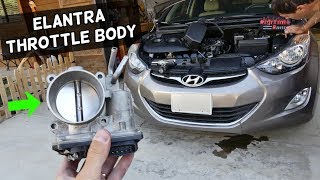
(OEM #35100-2E000)— This is the correct assembly for the 2.0L engine, which has a different part number than the 2.4L. The failure mode is identical. 🎬 Watch: Step-by-step throttle body replacement walkthrough
Trusted brands: Hyundai (OEM), Bosch, Cardone (Remanufactured), Dorman
OEM price range: $350-$500
Aftermarket price range: $180-$350 - Throttle Body Gasket
(OEM #28312-2G010)— It is best practice to replace the gasket anytime the throttle body is removed to prevent vacuum leaks.
Trusted brands: Hyundai (OEM), Fel-Pro, Mahle
OEM price range: $5-$15
Aftermarket price range: $3-$10
Related Codes That Often Appear With This One
- P2106 — This is an informational code that means the PCM has forced the vehicle into 'Limp Mode' as a direct result of the P2135 fault.
- P0121, P0122, P0123 — These codes point to a fault in the TPS 'A' circuit (range, low input, high input). Their presence alongside P2135 strongly suggests the throttle body assembly has failed.
- P0221, P0222, P0223 — These codes point to a fault in the TPS 'B' circuit (range, low input, high input). Seeing them with P2135 reinforces the diagnosis of a failing throttle body assembly.
Technical Service Bulletins (TSBs) & Recalls
- TSB 10-FL-009 / 13-FL-002: While for a different model (Sonata), this TSB is relevant as it shows Hyundai's official procedure for cleaning the throttle body to resolve hesitation and rough idle issues before resorting to replacement, supporting the 'clean first' diagnostic step.
- NHTSA ODI #10633373: A report for the Santa Fe mentions that a malfunction indicator lamp illuminated with Electronic Throttle Control (ETC) system related DTC P2135 (Forced Limited Power) or DTC P0638.
- NHTSA ODI #11019236: An owner of a Santa Fe noted that after running a diagnostic scan, they obtained codes P2106, P1295, and P2135, which they found to be a common problem with a corresponding technical service bulletin.
Platform-Specific Known Issues
- On Hyundai-Forums, multiple owners of 2011-2013 Tucsons confirm that replacing the throttle body assembly resolved their P2135 code and limp mode issues after cleaning failed to work.
- A Reddit user in r/HyundaiTucson described the classic limp mode symptom, which was later diagnosed by the dealer as a throttle body issue, a common occurrence for this generation.
Mechanic-Grade Diagnostic Values
- TPS1 vs. TPS2 Voltage Correlation — expected: TPS1 voltage should increase (e.g., 0.5V to 4.5V) while TPS2 voltage decreases (e.g., 4.5V to 0.5V) as the throttle opens. The difference between the two average values should not exceed 8%.. Failure: On a scan tool graph, any jumps, dropouts, or flat-lining of one sensor's voltage indicates failure. A voltage difference greater than 8% will set the code.
- TPS1 Voltage at Closed Throttle (Key On, Engine Off) — expected: ~0.5V. Failure: Voltage significantly different or unstable.
- TPS2 Voltage at Closed Throttle (Key On, Engine Off) — expected: ~4.5V. Failure: Voltage significantly different or unstable.
- Live Data Throttle Position Angle (Closed Throttle) — expected: Approximately 5.2° - 5.7°. Failure: Reading is 0° or a much higher, erratic value.
Scan Tool Commands That Help
- Hyundai GDS (Global Diagnostic System) or equivalent pro-level scanner: Active Test: ETC Motor — This bidirectional command forces the Electronic Throttle Control (ETC) motor to open and close, typically in 1-second intervals. It is used to visually and audibly confirm if the throttle plate is moving freely and if the motor is functional, which helps distinguish a mechanical jam from an electronic sensor failure.
- Hyundai GDS (Global Diagnostic System) or equivalent pro-level scanner: Special Function: Resetting Adaptive Values — This function must be used after replacing the throttle body to clear the old learned values from the ECM and allow it to calibrate to the new part's closed-throttle position and range of motion.
Wiring & Ground Locations
- Throttle Body Connector — On the electronic throttle body assembly, where the engine wiring harness connects.. This is the primary connection point for both TPS sensors and the throttle motor. Corrosion, moisture, or backed-out pins in this connector are a common cause of P2135 and related low-input codes.
- TPS Signal Wires (2010-2012) — Within the throttle body connector harness.. For the 2.0L and 2.4L engines from 2010-2012, the TPS signal wires are typically PINK/BLUE and BLUE. Knowing these colors helps in performing pin-point voltage and continuity tests.
- Powertrain Control Module (PCM) — Located in the left rear of the engine compartment (for the 2012 Tucson).. The wiring harness from the throttle body runs directly to the PCM, which provides the 5V reference and ground and interprets the sensor signals. A fault here is rare, but the location is critical for advanced diagnostics like checking for continuity from the throttle body connector to the PCM connector.
OEM Part Supersession History
35100-25200→35100-25400— Part revision and consolidation by the manufacturer.
Heads up: 35100-25400 is the direct, fully compatible replacement.35100-25400→35100-2G700— Listed as an interchangeable equivalent across multiple supplier databases for the same applications.
Heads up: These two part numbers are frequently cross-referenced and sold as compatible for the 2010-2015 Tucson 2.4L. However, always confirm fitment with the vehicle's VIN before purchasing to be certain.
Model Year Variations Within This Range
- 2010-2015: The 2.0L and 2.4L engines use different throttle body assemblies. The 2.4L (Theta II) engine typically uses part number 35100-2G700, while the 2.0L engine uses 35100-2E000. The failure mode and diagnostic process are identical.
Diagnostic Flowchart
Other Known Issues on This Vehicle
Issues unrelated to this code that are worth knowing about as an owner of this generation:
- Theta II Engine Seizure/Failure 🔴 High — Widespread across 2.0L and 2.4L engines. Caused by manufacturing debris blocking oil passages, leading to connecting rod bearing failure. Onset can be as early as 70,000 miles. (Ref: Multiple recalls and warranty extensions (e.g., T3G campaign) were issued. TSB 21-EM-004H provides a bearing clearance test procedure.)
- Excessive Oil Consumption 🟠 Medium — Common in both 2.0L and 2.4L engines, often due to issues with piston rings. Owners report needing to add oil between changes.
- ABS Module Fire Risk 🔴 High — The ABS module can internally leak brake fluid, causing an electrical short and potential for an engine compartment fire, even when the vehicle is parked. (Ref: Subject to NHTSA recalls where dealers install a new fuse and/or replace the module.)
- Transmission Shifting Issues 🟡 Low — Some owners report rough or delayed shifting. This is less common than engine issues.
Used vs. New Parts: Buying Guide for This Vehicle
When a used part is the smart pick: A used throttle body is a significant gamble for this repair. The failure is due to internal electronic wear, not mechanical breakage. A used part may work for a short time or fail immediately. It only makes sense if the budget is extremely tight and the donor vehicle is known to have very low mileage.
Donor-vehicle mileage cap: roughly under 50000 miles for the part to have meaningful remaining life.
What to inspect on the donor part:
- Verify the part number on the used unit matches the original exactly.
- Inspect the electrical connector pins for any signs of corrosion, moisture, or damage.
- Look at the throttle plate; excessive carbon buildup may suggest high mileage or a poorly maintained engine.
- Ask for a warranty, even if it's only 30-90 days.
OEM-only on this vehicle (don't cheap out):
- While not strictly OEM-only, using a genuine Hyundai (or OEM supplier like Bosch) throttle body is the highest probability for a long-term fix. Remanufactured units can be hit-or-miss.
Aftermarket brands forum-validated for this vehicle:
- Bosch (often the OEM supplier)
- Hyundai (Genuine OEM)
Brands owners have reported issues with on this vehicle:
- Unbranded, no-name parts from online marketplaces should be avoided, as their internal electronics may not meet the precise specifications required by the ECM, leading to the code returning.
Real Owner Stories
Aggregated from forums and TSBs cited above. Mileages and costs reflect what owners reported in those sources.
2011 Hyundai Tucson
Symptoms: Vehicle suddenly loses all acceleration, the check engine light and ESC light illuminate, and the engine refuses to rev past ~1500 RPM. The issue was intermittent at first but became more frequent.
What fixed it: Replaced the accelerator pedal assembly (part 32700-2S100).
Source hint: Hyundai-Forums.com report cited in owner_reports
2011-2013 Hyundai Tucson
Symptoms: Classic limp mode symptoms and P2135 code; cleaning the throttle body failed to resolve the issue.
What fixed it: Replacing the throttle body assembly.
Source hint: Hyundai-Forums vehicle_specific_issues
2010-2015 Hyundai Tucson
Symptoms: Limp mode symptoms described as a common occurrence for this generation.
What fixed it: Diagnosed by the dealer as a throttle body issue requiring replacement.
Source hint: Reddit r/HyundaiTucson
Documented NHTSA Reports
Symptoms: An owner reported the check engine light and P2135 code occurring for a second time, causing the car to enter limp home mode while driving on a highway (NHTSA ODI #11061416). Another report (NHTSA ODI #10846204) described a situation where acceleration failed, but after restarting the engine, the pedal worked again; diagnostic codes included P2135, P0221, P2106, and P0121. A third report (NHTSA ODI #10626110) noted that the car shut off immediately because it could not respond to the throttle, with codes P2106, P1295, and P2135 present.
Related OBD-II Codes
Frequently Asked Questions
Can I just clean the throttle body on my 2010-2015 Tucson instead of replacing it?
Is there a specific part number I should look for if I need to replace the throttle body on a 2.4L model?
How do I perform the throttle relearn procedure on my Tucson after a repair?
Why does my Tucson enter 'Limp Mode' when this code triggers?
Could the P2135 code be related to the Theta II engine recall?
Helpful Videos

We Have This Part in Stock

The information in this article is provided for general reference and educational purposes only. Vehicle specifications, procedures, and part compatibility can vary by production date, trim level, and region. Always consult your vehicle's factory service manual and verify part numbers before purchasing or performing repairs. Safety-critical components such as airbags, seat belts, and braking systems should be installed by a qualified professional.
- Hyundai Tucson:
- 🧭 Diagnostic Flowchart
- 🎬 Helpful Videos
- 🛍️ Shop This Part
- What's Unique About the 2010-2015 Hyundai Tucson
- Symptoms You May Notice
- Most Likely Causes
- Rare But Worth Checking
- Diagnosis Steps
- Parts You'll Likely Need
- Related Codes That Often Appear With This One
- Technical Service Bulletins (TSBs) & Recalls
- Platform-Specific Known Issues
- Mechanic-Grade Diagnostic Values
- Scan Tool Commands That Help
- Wiring & Ground Locations
- OEM Part Supersession History
- Model Year Variations Within This Range
- Other Known Issues on This Vehicle
- Used vs. New Parts: Buying Guide for This Vehicle
- Real Owner Stories
- 2011 Hyundai Tucson
- 2011-2013 Hyundai Tucson
- 2010-2015 Hyundai Tucson
- Documented NHTSA Reports
- Related OBD-II Codes
- Frequently Asked Questions
- 🎟️ Get 5% Off