

P2635 on 2015-2018 GMC Sierra Denali: Fuel Pump Performance Causes and Fixes
On a 2015-2018 GMC Sierra, code P2635 almost always points to a failing in-tank fuel pump or a faulty Fuel Pump Control Module (FPCM). This is especially common in extreme hot or cold weather. Replacing the in-tank fuel pump module with an updated GM part is the most frequent fix, though the low-pressure fuel sensor on the frame rail is a common, and cheaper, misdiagnosed culprit.
- P2635 on a 2015-2018 Sierra Denali indicates a problem with the low-pressure fuel pump's performance, not the high-pressure pump.
- The most likely cause is a failing in-tank fuel pump module, especially if symptoms worsen in extreme hot or cold weather.
- Always check for the simpler and cheaper potential causes first, such as the Fuel Pump Control Module (FPCM) and its wiring, before committing to replacing the fuel pump.
- When replacing the fuel pump, ensure you are using the updated part number specified by GM to prevent a recurrence of the issue.
What's Unique About the 2015-2018 Gmc SIERRA DENALI
On this generation of GMC Sierra and its K2XX platform mates, the P2635 code is notoriously linked to ambient temperature extremes, a detail confirmed by multiple GM Technical Service Bulletins (TSBs). Owners often experience stalling and hesitation specifically in very hot weather (above 100°F) due to vapor buildup in the fuel feed line that the original pump design cannot overcome. Conversely, they may face no-start, whining pump noises, and power loss issues in very cold weather (below 20°F), which can be related to fuel gelling in diesel models or general pump weakness in gas models. This indicates a sensitivity in the original-spec fuel pump assembly to thermal stress, a well-documented complaint for this vehicle platform.
Diagnostic Flowchart
Tap your situation to follow the diagnostic path that matches what you're seeing on this vehicle.
Symptoms You May Notice
- Hesitation or stumbling during acceleration.
- Engine surging or stalling, especially in very hot weather.
- Loss of engine power, particularly under load.
- Extended cranking time before the engine starts.
- No-start or start-and-stall condition, particularly in cold weather.
- Check Engine Light is on.
- A whining or buzzing noise from the fuel tank area, which may be more noticeable in cold weather.
- Replacing the high-pressure fuel pump (on direct injection engines) when the fault lies with the low-pressure in-tank pump ('Pump A').
- Replacing the fuel pump without first checking the Fuel Pump Control Module (FPCM) and its wiring.
- Replacing the fuel pump when the actual cause is a much cheaper and easier to replace faulty low-pressure fuel sensor on the frame rail.
Most Likely Causes
- Failing In-Tank Fuel Pump Module 🔴 High Probability → Shop Fuel Pump As outlined in GM TSB 17-NA-335, the original fuel pump modules in these trucks are susceptible to performance degradation in extreme heat due to vapor buildup in the fuel line. An updated pump design with a different breather system was released to address this. Cold weather can also cause the pump to weaken or fail, often accompanied by a whining noise.
How to confirm: Use a scan tool to monitor low-side fuel pressure while commanding the pump to run at various speeds. If the pressure doesn't meet specifications (typically fluctuating between 30-65 PSI, varying with demand) or is erratic, the pump is likely failing. A sharp pressure drop coinciding with a stall in hot weather is a strong indicator.
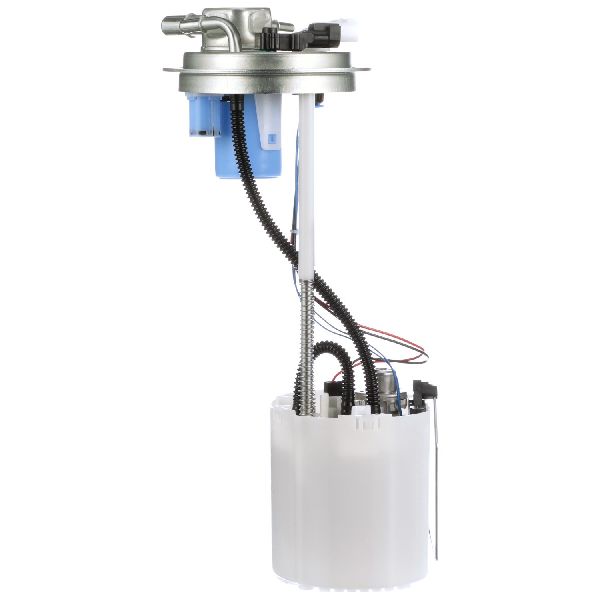
Typical fix: Replace the entire in-tank fuel pump module assembly with the updated part specified by GM. This requires either dropping the fuel tank or lifting the truck bed for access. 🎬 See this walkthrough on how to replace the fuel pump.
Est. part cost: $250-$500 - Faulty Fuel Pressure Sensor 🟡 Medium Probability → Shop Fuel Pressure Sensor A faulty low-pressure fuel sensor can send inaccurate or stuck data to the ECM, making it think there is a flow problem when the pump is fine. TSB #PIP5286B specifically details this scenario, as the sensor reading can get stuck (e.g., at 48.7 PSI) instead of fluctuating.
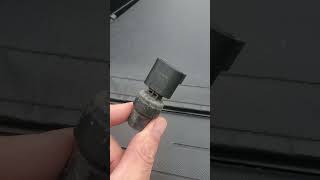
How to confirm: Compare the fuel pressure reading on a scan tool with a reading from a mechanical fuel pressure gauge. If the readings differ significantly, the sensor is likely bad. 🎬 Watch: Diagnostic walkthrough for the low-pressure sensor and P2635 code. Per TSB #PIP5286B, a specific test can be done on a COLD engine: use a scan tool to command fuel system depressurization. The sensor value should drop to zero as the engine stalls. If it remains stuck at a higher reading, the sensor is faulty. This sensor is located on the frame rail under the driver's side.
Typical fix: Replace the low-pressure fuel sensor (e.g., ACDelco P/N: 13516496, which supersedes 13579380). The O-ring seal may need to be ordered separately.
Est. part cost: $40-$100 - Faulty Fuel Pump Control Module (FPCM) 🟡 Medium Probability → Shop Fuel Pump The FPCM, which regulates the voltage to the fuel pump, can fail from heat, vibration, or internal faults, causing it to send incorrect signals or insufficient power to the pump. Its location on the frame rail near the spare tire exposes it to road spray and debris, leading to corrosion on the module or connector pins.
How to confirm: Check for communication with the FPCM using a capable scan tool. Inspect the wiring and connector at the module for green-colored corrosion or damage. A technician can test for power, ground, and the command signal from the ECM at the FPCM connector.
Typical fix: Replace the Fuel Pump Control Module (e.g., ACDelco P/N: 13540015) and program the new module to the vehicle.
Est. part cost: $80-$200 - Clogged Fuel Tank Vent ⚪ Low Probability → Shop Fuel Tank On models with dual fuel tanks, particularly the 6.6L diesel engines, debris can clog the rear tank's vent, creating a vacuum that collapses the tank and restricts fuel flow, triggering P2635. This is less common on the Denali with standard gas engines but is a known platform issue.
How to confirm: Visually inspect the rear fuel tank for signs of collapse or deformation. Check the vent line on top of the tank for blockage from dirt or debris.
Typical fix: Replace the collapsed fuel tank and fuel pump module, and install a modified vent hose to prevent future clogging as per TSB #19-NA-277.
Est. part cost: $1000-$2000+
Rare But Worth Checking
- Wiring Issue: Corrosion or damage to the wiring or connectors for the fuel pump or FPCM can cause intermittent voltage drops, mimicking a failing component. A common failure point is a broken wire inside the harness where it runs through the square tube of the frame rail under the driver's side. This is worth checking before replacing expensive parts.
Diagnosis Steps
- Connect a professional scan tool and check for P2635 and any other accompanying codes like P018B or P0087.
- Observe live data for the low-side fuel pressure sensor. Compare the actual pressure to the desired/commanded pressure. Note if the pressure reading is stuck and not fluctuating.
- Perform the specific fuel pressure sensor test from TSB PIP5286B on a COLD engine: Command 'Fuel System Depressurize' with the scan tool. The pressure reading should drop to zero. If it stays elevated, the sensor is bad.
- Inspect the Fuel Pump Control Module (FPCM), typically located on the driver's side frame rail near the spare tire, for any signs of corrosion (especially green crust) or damage to the module and its connector.
- If possible, command the fuel pump to run at different speeds using the scan tool and monitor the pressure response. A sluggish or non-responsive reading points to a weak pump or FPCM issue.
- Perform a fuel volume test to directly measure the pump's output. A low volume confirms a flow problem originating from the pump or a restriction.
- If sensor readings are suspect, connect a mechanical pressure gauge to the low-pressure fuel line to verify the electronic sensor's accuracy.
- Inspect wiring harnesses leading to the fuel tank and FPCM for any chafing, breaks, or corrosion, paying close attention to the harness section that passes through the frame.
Parts You'll Likely Need
- Fuel Pump and Sender Assembly
(OEM #13513407)— This is the most common failure part for code P2635, especially for the hot weather stalling. The assembly includes the electric pump, sending unit, and filter. TSBs recommend replacing the module with an updated version. Part number varies by wheelbase/cab configuration; 13513407 is for Short Box Crew Cab.
Trusted brands: ACDelco, Delphi
OEM price range: $350-$500
Aftermarket price range: $250-$400 - Fuel Pressure Sensor (Low Pressure)
(OEM #13516496)— This sensor on the frame rail is a very common point of failure, causing P2635 by sending a stuck or incorrect signal. It is often misdiagnosed as a bad fuel pump. The new part number 13516496 supersedes the old 13579380.
Trusted brands: ACDelco, Bosch
OEM price range: $60-$100
Aftermarket price range: $40-$70 - Fuel Pump Control Module (FPCM)
(OEM #13540015)— The FPCM can fail due to heat or corrosion, leading to improper fuel pump operation. It requires programming upon replacement.
Trusted brands: ACDelco, Dorman
OEM price range: $120-$200
Aftermarket price range: $80-$150
Related Codes That Often Appear With This One
- P018B — This code for 'Fuel Pressure Sensor 'B' Circuit Range/Performance' is frequently set alongside P2635, as noted in multiple TSBs. It indicates the system is detecting a problem with the fuel pressure reading, which is directly related to pump flow.
- P0087 — 'Fuel Rail/System Pressure - Too Low' can appear with P2635, especially in cold weather, as a weak in-tank pump fails to supply enough fuel to the high-pressure system.
- P069E — This code, 'Fuel Pump Control Module Requested MIL Illumination', points directly to a fault detected by the FPCM. If seen with P2635, it strongly suggests the issue is with the FPCM, its wiring, or the pump it controls, rather than a sensor.
Technical Service Bulletins (TSBs) & Recalls
- 17-NA-335: Addresses P2635 and P018B in high ambient temperatures, recommending an updated fuel pump module to prevent vapor lock. Supersedes PIP5411F.
- 18-NA-103: Notes P2635 in low ambient temperatures causing no-start, pump whine, or loss of power. For diesels, it points to fuel gelling and advises against replacing the pump.
- PIP5507B: Preliminary information on P2635 and P018B setting in temperatures over 100°F, related to vapor buildup.
- PIP5286B: Provides specific diagnostic steps for a suspected faulty fuel pressure sensor when P2635 and P018B are set, including a cold-engine depressurization test.
- 19-NA-277: For 6.6L diesel models, addresses a collapsed rear fuel tank due to a clogged vent, which triggers P2635.
Platform-Specific Known Issues
- Hot Weather Stalling (TSB 17-NA-335): Per TSB #17-NA-335, vehicles may exhibit hesitation, surging, and stalling with codes P2635 and/or P018B in ambient temperatures of 100°F (37.7°C) or higher due to vapor buildup in the fuel line. The fix is an updated fuel pump module with a one-way breather valve design.
- Cold Weather No-Start/Whine (TSB 18-NA-103): Per TSB #18NA103, vehicles may experience a start-and-stall, no-start, or loss of power with P2635 in ambient temperatures below 20°F (-6°C). This can be accompanied by a loud whining noise from the fuel pump. For diesel engines, this is often due to fuel gelling, but for gasoline engines it indicates a weak pump struggling with the cold.
- Collapsed Rear Fuel Tank (TSB 19-NA-277): → Shop Fuel Tank Primarily affecting 6.6L diesel models with dual tanks, a clogged rear tank vent can create a vacuum, causing the tank to collapse. This restricts fuel flow and triggers P2635. The fix involves replacing the tank, pump, and installing a modified vent hose.
- Owner Experience: Sensor vs. Pump: A Reddit user in r/gmcsierra described replacing the low-pressure sensor under the driver's door, which temporarily fixed the P2635 code. The code returned when the fuel tank was low, leading them to suspect the fuel pump was the ultimate culprit. This highlights the common diagnostic confusion between the two parts.
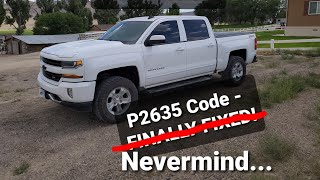
- Owner Experience: Successful Sensor Replacement: A YouTube video for a 2017 Silverado with P2635 showed the owner successfully fixing the code by replacing only the low-pressure fuel sensor on the frame rail (Part #13516496). He noted many people mistakenly replace the entire fuel pump first for this issue, when the sensor was a $40, 5-minute fix.
Mechanic-Grade Diagnostic Values
- Low-Side Fuel Pressure (Scan Tool, Engine On) — expected: Fluctuating between 30-60 PSI depending on engine load and demand.. Failure: The pressure reading is stuck at a fixed value (e.g., 48.7 PSI) and does not change, or it is significantly below the desired pressure.
- Low-Side Fuel Pressure Sensor Signal Voltage (Key On, Engine Off) — expected: Approximately 0.5V.. Failure: Voltage is stuck high, for example at 4.8V, and does not change when the engine starts.
- FPCM Power Supply Voltage at Module Connector — expected: Should be battery voltage (approx. 12V) on the main power wire (Red/Violet).. Failure: Significantly lower voltage (e.g., 1.4V - 2V) indicates a wiring issue, often a break in the harness where it passes through the frame.
Scan Tool Commands That Help
- GDS2 (GM Global Diagnostic System 2): Fuel System Depressurize — Used with a cold engine to test the low-pressure fuel sensor. When commanded, a healthy sensor's PSI reading should drop to zero as the engine stalls. If the reading remains high, the sensor is faulty. This is a specific test outlined in GM Preliminary Information bulletin PIP5286B.
- GDS2 (or capable professional scan tool): Fuel Pump Enable / Fuel Pump Speed Control — Used to manually command the in-tank fuel pump on (with engine off) or vary its speed. This allows a technician to check if the pump responds to commands and to monitor the fuel pressure sensor's reaction, helping to isolate a bad pump, FPCM, or sensor.
- GDS2: Fuel Pump Driver Control Module Configuration — This function is required after replacing the Fuel Pump Control Module (FPCM) to program the new module to the vehicle's specific configuration.
Wiring & Ground Locations
- FPCM Ground — On the body frame mount, under the vehicle near the driver's door area.. A corroded or loose ground for the Fuel Pump Control Module is a common cause of intermittent fuel pump operation and can trigger P2635. This ground should be inspected and cleaned before replacing the module.
- FPCM Harness Chafe Point — Inside the square tube section of the frame rail, directly under the underhood fuse panel on the driver's side where the harness makes a turn.. The main power wire (Red/Violet) to the FPCM is known to break inside the harness at this location, causing a severe voltage drop and leading to P2635 and no-start conditions. This is often missed as the damage is not externally visible.
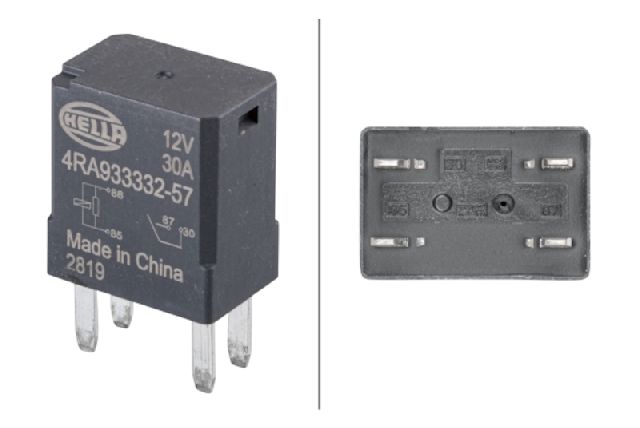
- Underhood Fuse Block — Driver's side of the engine bay, next to the brake fluid reservoir.. This block contains the primary fuses and relays for the fuel pump and FPCM. For 2018 models, this includes fuse #18 (20A), fuse #21, and relay #59. For 2014-2017 models, it includes fuses #18, #21, and relays #60 and #70.
- FPCM Connector (at module) — On the FPCM, located on the frame rail near the spare tire.. Specific pins can be tested for diagnostics. The command signal from the ECM is on the Dark Green/White wire (Pin 13). Battery positive voltage is on the Red/White wire (Pin 32), and the output voltage to the fuel pump is on the Gray wire (Pin 47).
Real Owner Repair Stories
- YouTube channel 'EJmegz Car Vlog' (2017 Chevrolet Silverado 4.3L V6) — Check Engine Light with codes P2635 and P018B. Scan tool showed the low-side fuel pressure was stuck at 48.7 PSI and not fluctuating.
❌ Tried (didn't work) The owner noted that many people mistakenly replace the fuel pump first.
✅ What actually fixed it Replacing the low-pressure fuel sensor located on the frame rail under the driver's side fixed the issue. After replacement, the scan tool showed the pressure correctly fluctuating between 30 and 60 PSI. - 2CarPros Forum User (2016 Chevrolet Silverado 5.3L V8) — Fuel pump control module not communicating. No start. Power at the FPCM fuse was 12V, but the main power wire at the module connector only had 1.4V.
❌ Tried (didn't work) Checking fuses and initial power at the fuse box.
✅ What actually fixed it A broken Red/Violet power wire inside the harness was found. The break was located where the harness runs through the square tube of the frame under the driver's side fuse panel. Running a jumper wire bypassed the break and allowed the truck to start, confirming the diagnosis. The final fix was to repair the broken wire. - Reddit user in r/gmcsierra (GMC Sierra (year not specified)) — P2635 code appeared. The check engine light came on when the fuel tank was under a quarter full.
❌ Tried (didn't work) Replacing the low-pressure fuel sensor under the driver's door did not resolve the issue permanently, as the code returned.
✅ What actually fixed it The user suspected the in-tank fuel pump was the ultimate cause, especially since the issue correlated with low fuel levels, which can cause the pump to work harder or overheat. The thread implies the next step is fuel pump replacement.
OEM Part Supersession History
13579380→13516496— The original low-pressure fuel sensor was prone to failure, often getting stuck at a specific reading. The updated part is more reliable.
Heads up: When ordering the replacement sensor (13516496), the O-ring seal is not included and must be ordered as a separate part.PIP5411F (TSB Number)→17-NA-335 (TSB Number)— The original preliminary bulletin advising replacement of the fuel pump for high-temp stalling was updated and formalized into a full Technical Service Bulletin with more concrete information.
Model Year Variations Within This Range
- 2014-2017 vs 2018: The fuel pump relay locations in the underhood fuse block are different. For 2014-2017 models, check relays #60 and #70. For 2018 models, check relay #59.
Helpful Videos

We Have This Part in Stock


The information in this article is provided for general reference and educational purposes only. Vehicle specifications, procedures, and part compatibility can vary by production date, trim level, and region. Always consult your vehicle's factory service manual and verify part numbers before purchasing or performing repairs. Safety-critical components such as airbags, seat belts, and braking systems should be installed by a qualified professional.
- Gmc SIERRA DENALI:
- 🧭 Diagnostic Flowchart
- 🎬 Helpful Videos
- 🛍️ Shop This Part
- What's Unique About the 2015-2018 Gmc SIERRA DENALI
- Symptoms You May Notice
- Most Likely Causes
- Rare But Worth Checking
- Diagnosis Steps
- Parts You'll Likely Need
- Related Codes That Often Appear With This One
- Technical Service Bulletins (TSBs) & Recalls
- Platform-Specific Known Issues
- Mechanic-Grade Diagnostic Values
- Scan Tool Commands That Help
- Wiring & Ground Locations
- Real Owner Repair Stories
- OEM Part Supersession History
- Model Year Variations Within This Range
- 🎟️ Get 5% Off