

U0101 on 2015-2018 Infiniti QX60: Lost Communication with TCM Causes and Fixes
On a 2015-2018 Infiniti QX60, code U0101 means the Transmission Control Module (TCM) is offline, which is a network communication failure. This commonly causes a no-start condition, limp mode, or harsh shifting. Before suspecting a costly TCM failure, always check for a weak battery, corroded battery terminals, and inspect the main TCM wiring harness and ground connections for damage, as these are the most frequent and cheapest culprits to fix.
- U0101 is a communication error, not a mechanical transmission failure.
- Always start diagnosis by checking the battery, its terminals, and all related ground connections. This is the most common and cheapest fix.
- Do not immediately assume the expensive Transmission Control Module (TCM) has failed. Thoroughly test wiring and power supplies first.
- Due to the complexity of CAN bus diagnostics and the need for potential TCM programming, professional service is highly recommended for this code.
- The TCM is part of the valve body on this vehicle, making replacement a significant job that involves opening the transmission.
What's Unique About the 2015-2018 Infiniti QX60
The Infiniti QX60 from this era uses a Continuously Variable Transmission (CVT) which has been the subject of owner complaints and even a class-action lawsuit for drivability issues like juddering and hesitation. While U0101 is a communication code, it's important to distinguish it from the mechanical CVT issues often discussed, such as those leading to codes like P17F0 or P17F1. For a U0101, the diagnostic focus must remain on the electrical and network integrity first. The TCM on this platform is integrated into the valve body inside the transmission, making a failure a more labor-intensive repair requiring specialized programming.
Symptoms You May Notice
- Check Engine Light is on
- Transmission warning light may be illuminated.
- Vehicle enters 'limp mode,' limiting engine power and speed.
- Harsh, erratic, or delayed shifting.
- Vehicle may not shift out of Park or Neutral.
- The gear selector indicator on the dashboard may be blank or incorrect.
- In some cases, the engine will not start (cranks but no start, or no crank at all).
- Inability for a standard OBD-II scanner to communicate with the transmission module.
- Replacing the entire transmission assembly when only the valve body/TCM is faulty.
- Replacing the TCM when the actual problem is a simple wiring, ground fault, or low battery voltage.
Most Likely Causes
- Low Battery Voltage or Failing Alternator 🔴 High Probability → Shop Alternator All modern vehicles are sensitive to low voltage. The complex network of control modules requires a stable power supply to communicate effectively. A weak battery is a very common cause for various communication codes, including U0101, and should always be the first check.
How to confirm: Test the battery with the engine off; it should read at least 12.4V. With the engine running, check the alternator output, which should be between 13.7V and 14.7V. Many auto parts stores will test your battery and alternator for free. A drop below 12.0V during cranking can be enough to disrupt modules.
Typical fix: Replace the battery and/or alternator if they fail testing.
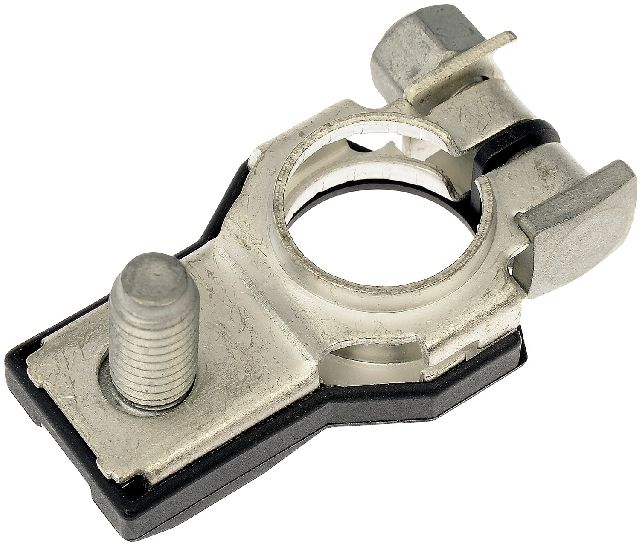
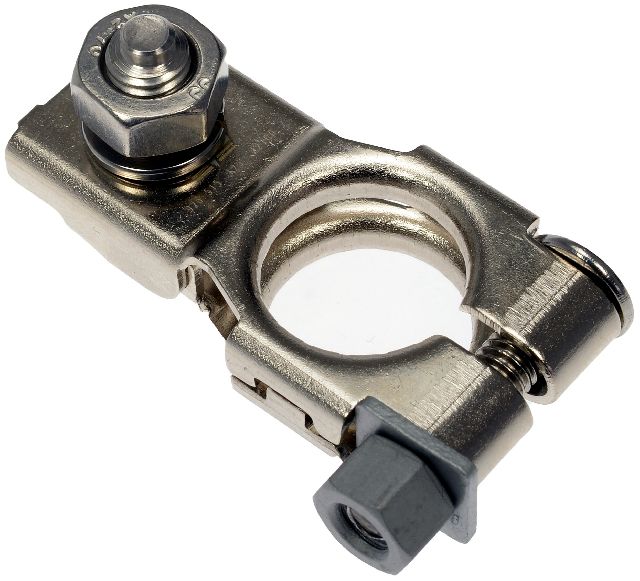
Est. part cost: $150-$400 - Poor Power or Ground Connections 🟡 Medium Probability Corrosion on battery terminals or a loose/corroded ground strap can create high resistance, leading to intermittent voltage drops that disrupt module communication. There are multiple chassis ground points that can become corroded over time.
How to confirm: Visually inspect the battery terminals for white or green corrosion. Clean them thoroughly. Follow the main ground strap from the battery's negative terminal to the chassis and ensure the connection is clean and tight. A common owner story involves a forgotten loose ground bolt causing a no-start and U0101. Use a wiring diagram to locate and check the specific ground points for the TCM.
Typical fix: Clean battery terminals and ground connection points with a wire brush. Apply dielectric grease to prevent future corrosion. Replace corroded terminals or ground straps if necessary.
Est. part cost: $10-$50 - Damaged Wiring Harness or Connectors 🟡 Medium Probability The wiring harness leading to the transmission is exposed to road debris, heat, and moisture. This can cause wires to break, insulation to chafe through, or connector pins to corrode, especially at the main connector on the transmission housing.
How to confirm: Visually inspect the wiring harness going to the Transmission Control Module for any signs of chafing, breaks, or corrosion. Unplug the connector at the TCM and check for bent, corroded, or fluid-contaminated pins. Check for continuity on the CAN bus wires (typically a twisted pair) between the ECM and TCM using a multimeter.
Typical fix: Repair the damaged section of wiring. If a connector is damaged, it may need to be replaced with a new pigtail.
Est. part cost: $50-$300 - Failed Transmission Control Module (TCM) ⚪ Low Probability → Shop Transmission Assembly While less common than wiring or power issues, the TCM can fail internally due to heat, vibration, or age. On this vehicle, the TCM is located inside the transmission as part of the valve body, making it a more involved and expensive repair.
How to confirm: This is typically a process of elimination. If all power, ground, and network wiring tests pass, the TCM itself is the likely culprit. A professional scan tool will be unable to establish communication with the module at all, which is a strong indicator of TCM failure.
Typical fix: Replace the valve body/TCM assembly. This requires draining the transmission fluid and removing the transmission pan. The new TCM must be programmed to the vehicle's VIN using specialized dealer software (Infiniti CONSULT).
Est. part cost: $800-$1500
Rare But Worth Checking
- Blown Fuse: Always check the simple things first. A blown fuse for the TCM will cut its power and cause it to go offline. Check the fuse box in the engine bay (IPDM) and inside the cabin for any fuses labeled TCM, A/T, TRANS, or ECU.
- CAN Bus Network Fault: The U0101 code can sometimes be a symptom of a wider network problem. A short or open in the CAN bus wiring anywhere in the vehicle, or another failing module, can disrupt communication for all modules on the network, including the TCM. This requires advanced diagnostics with an oscilloscope or CAN bus scanner.
Diagnosis Steps
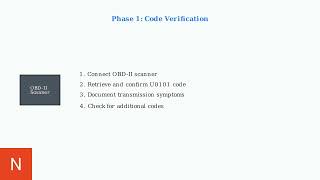
- Scan for Codes: Use an OBD-II scanner to confirm U0101 is present. Note any other codes, especially U1000 or P0700, as they can provide clues.
- Check Battery and Charging System: This is the most critical first step. Test the battery voltage (should be >12.4V off) and alternator output (should be 13.7-14.7V running). Ensure battery terminals are clean and tight. A weak battery is a top cause.
- Inspect Fuses: Check all fuses related to the transmission and engine control modules in the vehicle's fuse boxes (both in the engine bay and passenger cabin).
- Inspect Wiring and Grounds: Visually inspect the wiring harness to the transmission for any obvious damage (chafing, melting, corrosion). Check that the main engine and battery ground straps are secure and free of corrosion. A loose ground is a known cause.
- Verify Power and Ground at the TCM: This is an advanced step. Using a vehicle-specific wiring diagram, unplug the TCM connector and use a multimeter to verify that the module is receiving battery voltage on the correct pins and has a solid ground connection on its ground pins.
- Test CAN Bus: If power and ground are good, the CAN bus network itself needs to be checked. This involves measuring resistance between the CAN High and CAN Low wires (typically should be around 60 ohms with the battery disconnected). This is an advanced step best left to a professional.
- Condemn the TCM: If all other steps pass (power, ground, and CAN network are verified to be good), the Transmission Control Module integrated into the valve body is the most likely point of failure and requires replacement.
Parts You'll Likely Need
- Battery — Low system voltage is a primary and very common cause of communication faults between modules.
Trusted brands: Interstate, DieHard, Duralast
OEM price range: $250-$400
Aftermarket price range: $150-$250 - Transmission Control Module / Valve Body Assembly
(OEM #31705-29X3A (superseded by 31705-29X8A), 31705-1XE3E (superseded by 31705-1XE4E). Part number is VIN dependent, always verify with dealer.)— If power, ground, and wiring are confirmed to be good, the TCM itself has likely failed. On the QX60, it is integrated with the valve body inside the transmission. Replacement requires VIN-specific programming.
Trusted brands: Hitachi (OEM), Rostra, Vertex
OEM price range: $1000-$1500
Aftermarket price range: $650-$1200
Related Codes That Often Appear With This One
- U1000 — This is a general CAN Communication Circuit Failure code common on Nissan/Infiniti vehicles. It often appears alongside U0101 because the root cause (like low voltage or a bad ground) disrupts the entire network, not just the TCM.
- P0700 — This is a generic code set by the ECM when it requests the check engine light for a transmission-related fault. It essentially means 'The TCM has a problem,' and U0101 specifies that the problem is a complete loss of communication.
Technical Service Bulletins (TSBs) & Recalls
- ITB16-035: This TSB from August 2016 provides an update to the TCM software to enhance diagnostic logic for CVT judder. It helps the system to better detect and store codes P17F0/P17F1, but does not directly address U0101.
- ITB15-012h: This is a critical TSB from October 2019 for diagnosing CVT judder with codes P17F0 or P17F1. The procedure may result in the replacement of the control valve (valve body), which contains the TCM. This is a common reason a TCM gets replaced on this platform.
- ITB15-011c: This TSB from May 2022 also deals with reprogramming the TCM to add enhanced diagnostic logic for CVT judder, applying to 2014-2015 models.
Platform-Specific Known Issues
- CVT Judder vs. U0101: Owners frequently discuss CVT judder issues, which are often related to mechanical wear or software logic addressed by TSBs that enable codes like P17F0 and P17F1. It is critical to differentiate these drivability complaints from a U0101 code, which points specifically to a total loss of electrical communication, not a mechanical problem. A U0101 fault will not be fixed by addressing the judder issues.
Mechanic-Grade Diagnostic Values
- CAN Bus Network Resistance — expected: Approximately 60 Ω. Failure: A reading of ~120 Ω indicates one of the two terminating resistors (or the wiring to it) is open. A reading near 0 Ω indicates a short between the CAN High and CAN Low wires.
- TCM Power Supply Pin Voltage — expected: 12.0V - 12.6V (Battery Voltage). Failure: Voltage significantly below 12V or 0V indicates a problem with the fuse, relay (IPDM), or wiring supplying power to the TCM.
- TCM Ground Pin Resistance — expected: Below 1.0 Ω. Failure: Resistance higher than 1.0 Ω indicates a poor ground connection, which can cause intermittent communication issues.
- CAN Bus Voltage (Live) — expected: CAN High: ~2.5V to 3.5V. CAN Low: ~1.5V to 2.5V.. Failure: Voltages that are stuck high, stuck low, or do not mirror each other (in reverse) indicate a short, open, or a faulty module on the bus.
Hidden / Shadow Codes Worth Checking
- P17F0 / P17F1: These are not shadow codes for U0101, but are related technician-level codes for 'CVT Judder' that are enabled after a specific TCM software update (per TSB ITB16-035). Their presence or absence can indicate the software level of the TCM, which is relevant when diagnosing transmission issues on this platform. (see via Infiniti CONSULT-III plus or an advanced professional scan tool after the relevant TSB has been performed.)
Scan Tool Commands That Help
- Infiniti CONSULT-III plus: READ IP CHARA – REPLACEMENT TCM — This function is used before removing a faulty-but-still-communicating TCM. It saves the unique calibration and characterization data from the old module so it can be written to the new one. This is critical for a successful replacement.
- Infiniti CONSULT-III plus: WRITE IP CHARA – REPLACEMENT TCM — After installing a new TCM/valve body, this function is used to write the saved calibration data to the new module, programming it to the vehicle.
- Infiniti CONSULT-III plus: Re/programming, Configuration — This is the main menu path used to perform a full software update on the TCM, such as the one described in TSB ITB16-035 to enhance diagnostic logic for judder. This is necessary to keep module software current and enable newer DTCs.
Wiring & Ground Locations
- Intelligent Power Distribution Module (IPDM) — Located in the engine bay, inside the battery storage area.. The IPDM is a 'smart' fuse and relay box that supplies power to the TCM. An internal failure of the IPDM can cut power to the TCM circuit, causing a U0101 code even if the TCM and its harness are perfectly fine. It's a critical upstream component to check if power is missing at the TCM connector.
- Main Chassis Ground — Underneath the battery and battery tray. Requires battery removal to access and service properly.. This is a primary ground point for multiple engine bay systems. It is highly prone to corrosion from battery fumes and moisture. A high-resistance connection here can cause intermittent voltage drops and communication faults across the entire network, frequently triggering codes like U0101.
- TCM Connector — On the outside of the transmission housing, where the main vehicle harness connects to the internal transmission wiring leading to the valve body/TCM.. This is the single most important connector to inspect. It's the gateway for all power, ground, and communication signals to the TCM. Check for corrosion, moisture intrusion, and loose or backed-out pins.
Real Owner Repair Stories
- Reddit user in r/MechanicAdvice (Chevy (platform generic, but principle applies)) — U0101 Lost Communication with TCM code was present.
❌ Tried (didn't work) Initial diagnosis was unclear.
✅ What actually fixed it A loose wire or terminal at the main connector for the Transmission Control Module (TCM). The mechanic tightened the connection, ensured the wires were secure, and the code was resolved without replacing any parts.
"I Checked Everything" — The Actual Cause
- A technician may perform power, ground, and CAN resistance checks at the TCM harness connector and find no signals, concluding the harness is open. However, the actual cause can be a failed Intelligent Power Distribution Module (IPDM). The IPDM contains internal relays that power the TCM circuit, and when one fails, it creates an open circuit upstream of the harness being tested. The harness itself is fine, but the 'fuse box' that powers it is dead, a detail missed by focusing only on the TCM and its direct wiring.
OEM Part Supersession History
31705-29X3A, 31705-29X5D, 31705-29X2A, 31705-29X7A, 31705-29X5A→31705-29X8A— Part has been updated by the manufacturer for reliability or to consolidate previous versions.
Heads up: Always verify the correct part number with the vehicle's VIN at an Infiniti dealership. While superseded parts should be interchangeable, using the latest revision (31705-29X8A) is always recommended.
Model Year Variations Within This Range
- 2015-2016: A specific TCM software reprogramming was made available under TSB ITB16-035. This update did not directly address U0101 but was designed to enhance diagnostic logic for CVT judder complaints by enabling new DTCs (P17F1, P17F0). The software version on the TCM can therefore differ from later models.
Diagnostic Flowchart
Other Known Issues on This Vehicle
Issues unrelated to this code that are worth knowing about as an owner of this generation:
- CVT Judder / Shudder 🔴 High — Very common, especially on 2014-2017 models. Can occur at various mileages, often starting before 100,000 miles. (Ref: ITB15-012h, ITB16-035)
- Sunroof Drain Clogs & Water Leaks 🟠 Medium — Common issue where the front sunroof drain tubes get clogged, causing water to leak into the cabin, typically onto the A-pillar or floorboards.
- Power Liftgate Malfunction 🟡 Low — Owners report various issues with the rear power liftgate, including not opening, not closing, or closing unexpectedly. Often caused by a deactivated switch in the glove box or needing a reset procedure.
- Excessive Oil Consumption 🟠 Medium — Some owners report the VQ35DE engine consuming oil at a higher than normal rate, requiring frequent top-offs between oil changes.
- AWD System Judder / Noise 🟠 Medium — On AWD models, judder or noise from the rear differential area can occur, sometimes mistaken for a transmission issue. (Ref: ITB12-072H)
- Occupant Classification System (OCS) Failure 🔴 High — Subject of a safety recall, the sensor that detects a passenger in the front seat can fail, potentially disabling the airbag in a crash. (Ref: Recall R1606 / TSB ITB16-018)
Used vs. New Parts: Buying Guide for This Vehicle
When a used part is the smart pick: A used Intelligent Power Distribution Module (IPDM) from a salvage yard can be a cost-effective fix, as it is typically a plug-and-play component on this vehicle, provided the part number matches exactly.
Donor-vehicle mileage cap: roughly under 100000 miles for the part to have meaningful remaining life.
What to inspect on the donor part:
- Verify the part number on the used IPDM is an exact match to the original.
- Inspect all connector pins for any signs of white, green, or blue corrosion from water intrusion.
- Check the plastic housing for any signs of a 'water line' or tide mark, indicating it was submerged.
- Ensure none of the plastic connector housings or locking tabs are broken.
OEM-only on this vehicle (don't cheap out):
- Transmission Control Module / Valve Body Assembly. This part MUST be either a new OEM unit or a professionally remanufactured unit that is specifically programmed to the vehicle's VIN. A standard used part from a junkyard will not work because its internal calibration data will not match the vehicle, leading to immediate communication errors or drivability problems.
Aftermarket brands forum-validated for this vehicle:
- Hitachi (OEM Manufacturer)
- Rostra (Remanufactured)
- Vertex (Remanufactured)
Brands owners have reported issues with on this vehicle:
- Unknown/unbranded sellers on marketplaces offering 'plug-and-play' used TCMs without guaranteeing VIN programming.
Real Owner Stories
Aggregated from forums and TSBs cited above. Mileages and costs reflect what owners reported in those sources.
2010 Nissan Pathfinder (Platform Mate)
Symptoms: The vehicle experienced a no-start condition and a U0101 code immediately after a transmission and radiator flush was performed.
What fixed it: The diagnosis focused on checking for blown fuses and inspecting the CAN wiring for damage or accidental disconnection during the maintenance work.
Source hint: 2CarPros thread titled 'Nissan Pathfinder U0101 No Start after fluid flush'
2015-2018 Infiniti QX60
Symptoms: Vehicle experienced a no-start condition and U0101 code.
What fixed it: The issue was traced back to a forgotten loose ground bolt, which caused an intermittent voltage drop and disrupted the communication network.
Source hint: Common owner story mentioned in 'Poor Power or Ground Connections' section of the article context
Related OBD-II Codes
Frequently Asked Questions
Can a weak battery really cause a U0101 code on my 2015 Infiniti QX60?
Does TSB ITB16-035 or ITB15-011c fix the 'Lost Communication with TCM' issue?
My QX60 has a 'judder' feel and a U0101 code; will the CVT software update fix both?
Where is the TCM located on the 2015-2018 Infiniti QX60?
Why is my gear selector blank on the dashboard along with the Check Engine Light?
Can I replace the QX60 TCM myself?
Helpful Videos
We Have This Part in Stock


The information in this article is provided for general reference and educational purposes only. Vehicle specifications, procedures, and part compatibility can vary by production date, trim level, and region. Always consult your vehicle's factory service manual and verify part numbers before purchasing or performing repairs. Safety-critical components such as airbags, seat belts, and braking systems should be installed by a qualified professional.
- Infiniti QX60:
- 🧭 Diagnostic Flowchart
- 🎬 Helpful Videos
- 🛍️ Shop This Part
- What's Unique About the 2015-2018 Infiniti QX60
- Symptoms You May Notice
- Most Likely Causes
- Rare But Worth Checking
- Diagnosis Steps
- Parts You'll Likely Need
- Related Codes That Often Appear With This One
- Technical Service Bulletins (TSBs) & Recalls
- Platform-Specific Known Issues
- Mechanic-Grade Diagnostic Values
- Hidden / Shadow Codes Worth Checking
- Scan Tool Commands That Help
- Wiring & Ground Locations
- Real Owner Repair Stories
- "I Checked Everything" — The Actual Cause
- OEM Part Supersession History
- Model Year Variations Within This Range
- Other Known Issues on This Vehicle
- Used vs. New Parts: Buying Guide for This Vehicle
- Real Owner Stories
- 2010 Nissan Pathfinder (Platform Mate)
- 2015-2018 Infiniti QX60
- Related OBD-II Codes
- Frequently Asked Questions
- 🎟️ Get 5% Off