

U0415 on 2015-2020 Chevrolet Tahoe: Invalid ABS Data Causes and Fixes
On a 2015-2020 Tahoe, code U0415, often with a 'Service Trailer Brake' message, is most frequently caused by low brake fluid. Before suspecting expensive parts, check and fill the master cylinder reservoir to the max line, as specified in TSB #PIT5490B. This is a simple, often free fix.
- Always check your brake fluid level first when you see code U0415, especially with a 'Service Trailer Brake' message.
- If the fluid is full, the next step is to inspect for a weak battery and check for damaged wiring in known problem areas like under the door sill plates.
- This code affects critical safety systems (ABS, StabiliTrak), so address it promptly.
- If you replace the EBCM, it will likely need to be professionally programmed to your vehicle.
What's Unique About the 2015-2020 Chevrolet TAHOE
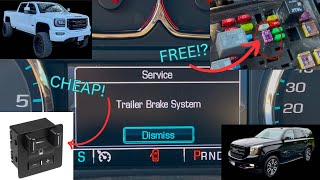
For this generation of Tahoe and its K2XX platform mates (Yukon, Escalade, Silverado, Sierra), the U0415 code is uniquely and strongly tied to several specific, well-documented issues. A 'Service Trailer Brake' message is a very common symptom that points directly to TSB #PIT5490B, which identifies low brake fluid as the primary cause. 🎬 Watch: How to fix the Service Trailer Brake System message. Furthermore, these vehicles have known problem areas for wiring harnesses under the sill plates (TSB #PIT5457D), in the left instrument panel (TSB #PIT5288H), and above the spare tire (TSB #PIT5556A) that can become damaged, leading to this and other communication codes.
Diagnostic Flowchart
Tap your situation to follow the diagnostic path that matches what you're seeing on this vehicle.
Symptoms You May Notice
- ABS warning light illuminated
- Traction Control or StabiliTrak warning light illuminated
- "Service Trailer Brake System" message in the Driver Information Center (DIC)
- Cruise control may be disabled
- In rare cases, erratic speedometer and tachometer behavior or a feeling of being in neutral
- Replacing the ABS wheel speed sensors. While a bad wheel speed sensor can cause ABS issues, it will typically set a specific code for that sensor (e.g., C0035). U0415 alone points to a module-level or communication network problem, not usually a single sensor.
- Replacing the trailer brake control module (TBCM). While the 'Service Trailer Brake' message appears, the problem often originates from an input to the EBCM (like the brake fluid level), which then sends invalid data that the Chassis Control Module interprets as a trailer brake system fault.
Most Likely Causes
- Low Brake Fluid Level 🔴 High Probability → Shop Brake Fluid As per GM Technical Service Bulletin #PIT5490B, the brake fluid level sensor is very sensitive. Fluid sloshing in a low reservoir during turns, braking, or acceleration can cause the sensor to send a momentary 'low' signal to the EBCM. The Chassis Control Module receives this intermittent signal over the network, flags it as invalid data, and sets code U0415, often displaying the 'Service Trailer Brake' message.
How to confirm: Visually inspect the brake fluid level in the master cylinder reservoir. If it is below the 'MAX' line, this is the likely cause. A scan tool (like GDS2) can monitor the 'Brake Fluid Level Sensor' parameter in the EBCM data list, which will read 'OK' or 'Low'.
Typical fix: Fill the master cylinder reservoir to the maximum level with the correct type of brake fluid (e.g., DOT 3). Crucially, inspect for the cause of the low fluid, such as worn brake pads (the most common reason) or a leak in the system. TSB #PIT5490B also advises inspecting the rear of the master cylinder for leaks into the brake booster if no other cause is found.
Est. part cost: $5-$20 for a bottle of brake fluid. - Damaged or Corroded Wiring Harness 🟡 Medium Probability GM has issued multiple TSBs for this platform regarding wiring issues. TSB #PIT5457D points to damaged wires (specifically the Communication Enable circuit 5986) under the driver/passenger sill plates due to water intrusion and corrosion. TSB #PIT5288H identifies a harness pinched by a metal bracket in the left instrument panel near the parking brake pedal. TSB #PIT5556A also identifies a harness chafe point above the spare tire.
How to confirm: Visually inspect the wiring harnesses in the known problem areas. For the sill plates, remove the plastic trim and inspect the harness for any signs of corrosion (green/white powder), chafing, or breaks. For the instrument panel, inspection is more difficult but focus on the harness near the mounting bracket to the left of the dash. For the spare tire area, lower the tire and inspect the harness where it passes between the underbody and frame crossmember.
Typical fix: Repair the damaged section of the wire. This involves cutting out the corroded or broken section, splicing in a new piece of wire with weatherproof connectors (e.g., heat-shrink butt connectors), and wrapping the repair in high-quality electrical tape or loom to prevent recurrence. Reroute harnesses away from sharp metal edges where possible.
Est. part cost: $10-$50 for wiring repair supplies. - Failing Electronic Brake Control Module (EBCM) ⚪ Low Probability → Shop ABS Control Module Like any electronic module, the EBCM can fail internally due to thermal stress, vibration, or internal corrosion from old, moisture-contaminated brake fluid.
How to confirm: This is typically a diagnosis of exclusion. If the brake fluid is full, all wiring (power, ground, communication lines) and power/ground connections to the module are confirmed to be good, and the code persists, the module itself is the likely culprit. A professional-grade scan tool may show a loss of communication with the module or internal fault codes.
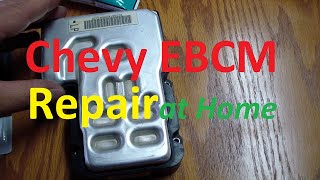
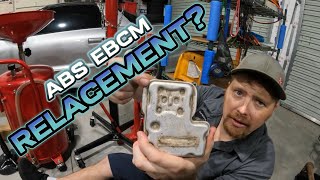
Typical fix: Replace the EBCM. The new module will need to be programmed to the vehicle's VIN, which requires special software (GDS2). 🎬 Watch: Step-by-step guide to replacing the ABS EBCM module. Some companies also offer a service to rebuild your existing module.
Est. part cost: $160-$700 for a new or remanufactured EBCM.
Rare But Worth Checking
- Low System Voltage / Poor Grounds: A weak or failing battery, faulty alternator, or high resistance in battery cables or ground connections can cause various control modules to malfunction and send invalid data. Before diving into complex wiring diagnostics, it's always wise to ensure the battery is fully charged and the charging system is working correctly. GM has a service program for some trucks for corroded body-to-frame ground wires.
Diagnosis Steps
- Read all DTCs from all modules using a capable OBD-II scanner. Note any other codes that are present, especially communication codes (U-codes).
- Check the Brake Fluid: This is the most common and easiest fix. Open the hood and visually inspect the brake fluid level in the master cylinder. If it is not at the 'MAX' line, top it off with DOT 3 fluid. 🎬 See this quick fix for the Service Trailer Brake warning. Clear the codes and test drive, including some sharp turns and stops, to see if the message returns.
- Investigate Low Fluid: If the fluid was low, determine why. Check for worn brake pads or leaks at the calipers, brake lines, or master cylinder. A leak from the master cylinder into the brake booster is also a possibility.
- Check System Voltage: Test the battery and charging system to ensure voltage is stable and within specification (typically above 12.4V with the engine off and 13.7-14.7V with the engine running). Check main battery cables and ground connections for corrosion and tightness.
- Inspect Sill Plate Wiring (TSB #PIT5457D): Remove the driver and passenger side plastic sill plates. Carefully lift and examine the large wiring harness for any signs of corrosion (green/white powder), water intrusion, or physical damage. Pay close attention to the Communication Enable circuit (5986).
- Inspect Instrument Panel Harness (TSB #PIT5288H): Check the wiring around the left side of the instrument panel, near the parking brake pedal assembly. Look for a harness that may be pinched or chafed by a metal dash support bracket.
- Inspect EBCM Connector and Grounds: Locate the EBCM (attached to the ABS hydraulic unit in the engine bay) and inspect its main electrical connector for corrosion, moisture, or bent pins. Trace and check the main ground connections for the module.
- Advanced Diagnostics: If no obvious issues are found, a professional technician will be needed. This may involve using a multimeter and a 194 bulb to load-test the Communication Enable circuit 5986 as described in TSB #PIT5457D, or using a bi-directional scan tool to monitor live data and confirm if the EBCM itself has failed.
Parts You'll Likely Need
- Brake Fluid (DOT 3) — This is the most common fix, as low fluid is a primary trigger for this code on this vehicle, per TSB #PIT5490B.
Trusted brands: ACDelco, Prestone, Bosch
OEM price range: $10-$20
Aftermarket price range: $5-$15 - Electronic Brake Control Module (EBCM)
(OEM #84256781 (replaces 23355954, 84074957, 84074960, 84256789))— If wiring and fluid levels are confirmed to be good, the module itself may have failed internally. This is a last resort after all other causes are ruled out.
Trusted brands: ACDelco (Genuine GM), Dorman (Remanufactured)
OEM price range: $250-$450
Aftermarket price range: $160-$300
Related Codes That Often Appear With This One
- U0077 — This code indicates a loss of communication on the chassis high-speed network. It is often set with U0415 when a wiring issue is present, as noted in TSBs #PIT5288H and #PIT5457D, because the damaged wire is part of the communication bus.
- U0121 — This code means 'Lost Communication With Electronic Brake Control Module'. It can appear alongside U0415 if the wiring issue is severe enough to cause a complete communication loss, not just invalid data. TSB #PIT5457D lists this as a common companion code.
Technical Service Bulletins (TSBs) & Recalls
- PIT5490B: Addresses the 'Service Trailer Brake' message and U0415 caused by low brake fluid. It explains that fluid sloshing during vehicle maneuvers can trigger a momentary 'low' signal, which the Chassis Control Module interprets as invalid data.
- PIT5288H: Points to a pinched wiring harness in the left instrument panel near the dash mounting bracket as a cause for U0415 and a host of other electrical communication DTCs.
- PIT5457D: Identifies corrosion and damage to the wiring harness under the driver and passenger sill plates, specifically affecting the Communication Enable circuit 5986, as a cause for U0415 and loss of communication with various chassis modules.
- PIT5556A: Notes that on short wheelbase utilities like the Tahoe, the chassis harness can be cut or pinched between the body and the spare tire crossmember, leading to intermittent communication issues and multiple DTCs, including U0415.
Platform-Specific Known Issues
- A 'Service Trailer Brake' message appearing with code U0415 is a strong indicator of low brake fluid, as detailed in TSB #PIT5490B. The Chassis Control Module triggers this specific message when it receives the invalid fluid level data from the EBCM.
- Wiring harnesses routed under the sill plates are susceptible to moisture from wet shoes or clogged sunroof drains, leading to corrosion of the communication wires and setting this code along with others like U0077.
- A pinched harness between a metal dash bracket and the body on the driver's side is a known factory assembly issue that can cause a multitude of electrical problems, including U0415, as documented in TSB #PIT5288H.
Mechanic-Grade Diagnostic Values
- Communication Enable Circuit (5986) Voltage — expected: Approx. 12 volts when the BCM is awake (ignition in ACC, ON, or START).. Failure: Low or no voltage present when the concern occurs.
- Communication Enable Circuit (5986) Load Test — expected: A 194 incandescent bulb connected between circuit 5986 at the module and a good ground should light up. Voltage across the lit bulb should be at least 11 volts.. Failure: Bulb does not light, or voltage across the lit bulb is below 11 volts, indicating high resistance in the circuit.
- High Speed CAN Bus Resistance — expected: Approximately 60 Ohms when measured between the CAN High and CAN Low pins at the DLC with the battery disconnected.. Failure: A reading of 120 Ohms indicates an open circuit or a missing terminating resistor. A reading near 0 Ohms indicates a short between the two lines.
Scan Tool Commands That Help
- GDS2 (GM Global Diagnostic System 2): EBCM Antilock Braking Data list > 'Brake Fluid Level Sensor' — To digitally confirm the status of the brake fluid level sensor. The parameter will display 'OK' or 'Low', which is useful for diagnosing the most common cause of U0415 without solely relying on visual inspection, especially if the fault is intermittent.
- GDS2 with SPS (Service Programming System): EBCM Electronic Brake Control Module - Programming / Setup — This function is mandatory after replacing the EBCM. It programs the new module with the vehicle's VIN and specific configuration. Failure to perform this step will result in the new module not functioning and continued ABS/StabiliTrak warnings.
Wiring & Ground Locations
- Circuit 5986 — A communication enable wire that runs from the Body Control Module (BCM) to the EBCM and other chassis modules. It is frequently damaged under the driver's side sill plate.. This circuit 'wakes up' the EBCM. If it's open or has high resistance, the EBCM may not communicate properly, leading to a host of U-codes including U0415. TSB #PIT5457D is dedicated to this circuit failure.
- G103 / G104 — Main engine and chassis grounds located on the engine block or nearby on the frame in the engine compartment.. The EBCM is grounded through one of these primary ground points. A loose or corroded connection here can cause intermittent and difficult-to-diagnose electronic issues, including invalid data codes.
- G218 — A key interior ground point, typically located under the dashboard on the driver's side, often near the A-pillar or kick panel.. This is a primary ground for the Body Control Module (BCM). Since the BCM controls the wake-up signal (Circuit 5986) for the EBCM, a poor ground at G218 can mimic a wiring harness problem.
- Harness above spare tire — The chassis harness is routed along the frame rail, passing over the crossmember for the spare tire.. As noted in TSB #PIT5556A (referenced in PIT5457B), this harness can chafe against the frame crossmember, damaging wires including the communication enable circuit, causing U0415 and other codes.
Real Owner Repair Stories
- tahoeyukonforum.com user report (2015-2020 generation Chevrolet Tahoe) — Recurring "Service Trailer Brake System" message and code U0415.
❌ Tried (didn't work) Dealer diagnosed as a bad EBCM and quoted for replacement.
✅ What actually fixed it Owner checked the brake fluid reservoir and found it was slightly below the MAX line. Topped off the brake fluid with DOT 3 fluid, and the code and message were resolved permanently. This directly confirms TSB #PIT5490B. - gm-trucks.com user report (2016 GMC Sierra (K2XX Platform)) — ABS, Stabilitrak, and other warning lights on the dash, with multiple communication codes including U0415 and U0077.
❌ Tried (didn't work) Checking module connectors and grounds.
✅ What actually fixed it Removed the driver's side sill plate and found several green, corroded wires in the main harness channel. Repaired the broken/corroded wires (specifically on the communication bus). This resolved all codes and warning lights, confirming TSB #PIT5457D. - Forum user report (2017 Chevrolet Silverado (K2XX Platform)) — Intermittent ABS and Stabilitrak warnings with code U0415 after hitting bumps.
❌ Tried (didn't work) Brake fluid was full, sill plate wiring looked okay.
✅ What actually fixed it The negative battery terminal clamp was not fully tightened. Although it felt tight by hand, it could be slightly rotated with a wrench. Cleaning the terminal and tightening the clamp nut securely fixed the voltage fluctuations and cleared the U0415 code.
OEM Part Supersession History
23355954, 84074957, 84074960, 84256789→84256781— Part has been updated by the manufacturer for reliability or to consolidate inventory.
Heads up: A replacement EBCM is NOT plug-and-play. It must be programmed to the vehicle using GM's SPS (Service Programming System) software. Failure to program will result in the module not working.
Model Year Variations Within This Range
- 2015-2020: While the primary causes remain consistent, always check for applicable EBCM software updates via the GM SPS system. A software calibration update may exist to address communication glitches or false triggers for this code. A dealer or shop with an SPS subscription can verify the latest calibration for your specific VIN.
Helpful Videos
We Have This Part in Stock

The information in this article is provided for general reference and educational purposes only. Vehicle specifications, procedures, and part compatibility can vary by production date, trim level, and region. Always consult your vehicle's factory service manual and verify part numbers before purchasing or performing repairs. Safety-critical components such as airbags, seat belts, and braking systems should be installed by a qualified professional.
- Chevrolet TAHOE:
- 🧭 Diagnostic Flowchart
- 🎬 Helpful Videos
- 🛍️ Shop This Part
- What's Unique About the 2015-2020 Chevrolet TAHOE
- Symptoms You May Notice
- Most Likely Causes
- Rare But Worth Checking
- Diagnosis Steps
- Parts You'll Likely Need
- Related Codes That Often Appear With This One
- Technical Service Bulletins (TSBs) & Recalls
- Platform-Specific Known Issues
- Mechanic-Grade Diagnostic Values
- Scan Tool Commands That Help
- Wiring & Ground Locations
- Real Owner Repair Stories
- OEM Part Supersession History
- Model Year Variations Within This Range
- 🎟️ Get 5% Off