

U0418 on 2023-2025 Jeep Wagoneer: Implausible Brake Data Causes & Fixes
On a 2023-2025 Wagoneer, code U0418 is frequently a symptom of a larger network problem, not a brake issue. If seen with codes U0101 or U0402, a known transmission valve body fault is the most likely cause, requiring replacement per a manufacturer TSB. This is a complex repair best left to professionals.
- U0418 on a 2023-2025 Wagoneer indicates a communication problem, not necessarily a brake problem.
- This code is very often accompanied by other codes. Pay close attention to transmission codes U0101 and U0402, as they point to a known TSB-documented issue.
- The most likely cause for U0418 with transmission codes is a faulty transmission valve body, which is a major, professional-level repair.
- Do not replace the ABS module unless all other possibilities, especially the transmission valve body issue and software updates, have been thoroughly investigated.
- Due to the risk of the vehicle entering limp mode or failing to shift, it is unsafe to drive with this active fault.
What's Unique About the 2023-2025 Jeep WAGONEER
On the 2023-2025 Jeep Wagoneer (and its platform mates), U0418 is rarely an isolated fault with the brake module itself. Manufacturer Technical Service Bulletins (TSBs) strongly link this code to significant communication breakdowns originating from other systems. Specifically, TSB #21-016-25 REV. C identifies corroded CAN bus terminals inside the transmission valve body as a root cause for vehicles built on or before October 25, 2024. This corrosion disrupts the entire vehicle network and triggers U0418 along with transmission codes U0101 and U0402, making diagnosis a complex, network-wide investigation rather than a simple brake component check.
Diagnostic Flowchart
Tap your situation to follow the diagnostic path that matches what you're seeing on this vehicle.
Symptoms You May Notice
- Check Engine Light (Malfunction Indicator Lamp) is on
- Vehicle enters 'limp mode' with reduced power.
- After entering limp mode and shifting to Park, the vehicle may not shift into any gear.
- Warning messages related to the 4WD system, ABS, or traction control may appear on the dash.
- 4WD Service light may be displayed in the instrument cluster.
- Replacing the Brake System Control Module (ABS Module). The code indicates the data *from* this module is implausible, but on this platform, the root cause is almost always another module or network issue corrupting the signal, not the brake module itself.
Most Likely Causes
- Corroded Terminals in Transmission Valve Body 🔴 High Probability → Shop Transmission Valve Body A specific TSB (#21-016-25 REV. C) was issued for this platform, indicating that CAN bus terminals inside the transmission valve body are susceptible to corrosion, which disrupts communication across the vehicle network. This applies to Wagoneer models built on or before October 25, 2024.
How to confirm: A technician should use a dealer-level scan tool to check for U0418 in conjunction with U0101 and/or U0402. If present, and the vehicle's build date falls within the range specified in TSB 21-016-25 REV. C, this is the confirmed cause.
Typical fix: The transmission valve body assembly must be replaced, and the TCM must be reprogrammed.
Est. part cost: $800-$1500 - Control Module Software Anomaly 🟡 Medium Probability Modern vehicles rely on complex software, and glitches can cause modules to misinterpret data. Multiple TSBs for Jeep vehicles, including the Wagoneer, address communication DTCs by reprogramming modules with updated software.
How to confirm: A dealer or qualified shop with access to the wiTECH scan tool can check for available software updates for the Powertrain Control Module (PCM), Transmission Control Module (TCM), and Brake System Control Module (BSCM).
Typical fix: Reprogramming (flashing) the affected module(s) with the latest software version.
Est. part cost: $0 - Loose Transfer Case Shift Motor Connector ⚪ Low Probability TSB 0823923 (also released as RSU 23-303) identifies that the transfer case shift motor wire harness connector may not be fully seated from the factory, causing a host of communication codes, including U0418.
How to confirm: If U0418 is present with transfer case codes like C1444-98, a technician should perform the 'push-pull-push' test on the transfer case shift motor wire harness connector to check if it is securely seated.
Typical fix: Securely seat the connector. If the connector is damaged, it will require repair or replacement.
Est. part cost: $0 - $50 - Wiring Harness or Connector Fault ⚪ Low Probability While less common than the documented TSB issues, complex wiring harnesses can be susceptible to damage from road debris, moisture, or chafing against other components.
How to confirm: Visually inspect wiring harnesses connected to the transmission, transfer case, and ABS module. Perform continuity and pin-out tests on the relevant connectors if damage is suspected.
Typical fix: Repairing the damaged section of the wire or replacing the faulty connector.
Est. part cost: $20-$200
Rare But Worth Checking
- Weak or Failing 12V Battery: → Shop Vehicle Battery While a low voltage battery is a very common cause for U0418 on other Jeep models like the Cherokee, the authoritative TSBs for the Wagoneer point to more specific and severe faults. However, a weak battery can cause unpredictable electronic issues on any modern vehicle and should be tested as part of a comprehensive diagnosis.
Diagnosis Steps
- Connect a professional-grade scan tool (like wiTECH) and retrieve codes from ALL vehicle modules.
- If codes U0101 or U0402 are present with U0418, consult TSB #21-016-25 REV. C. Verify if the vehicle's build date (on or before Oct 25, 2024) applies. If so, the likely fix is replacing the transmission valve body.
- If code C1444-98 is present, consult TSB #0823923 and perform the 'push-pull-push' test on the transfer case shift motor connector.
- Check for available software updates for the PCM, TCM, and BSCM using the wiTECH tool. Reprogram any modules with available updates.
- If no specific TSB applies, perform a full battery and charging system test to rule out voltage issues.
- Inspect all related wiring harnesses and connectors, particularly around the transmission, transfer case, and ABS module, for signs of damage, corrosion, or looseness.
- Only after exhausting all other possibilities should the Brake System Control Module itself be considered as the point of failure.
Parts You'll Likely Need
- Transmission Valve Body Assembly
(OEM #68612242AB (for vehicles built up to 02/15/2024) or 68661447AA (for vehicles built on/after 02/15/2024))— Per TSB #21-016-25 REV. C, corroded terminals within this assembly are a documented cause of the network failure that triggers code U0418 on these vehicles.
Trusted brands: Mopar
OEM price range: $800-$1500
Aftermarket price range: N/A
Related Codes That Often Appear With This One
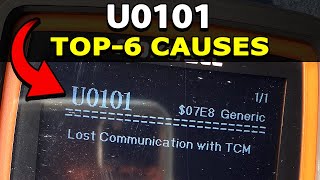
- U0101 — Stands for 'Lost Communication With The Transmission Control Module (TCM)'. Its presence with U0418 strongly points to the transmission valve body issue described in TSB #21-016-25 REV. C. 🎬 Watch: Understanding U0101 and how to fix lost TCM communication.
- U0402 — Stands for 'Implausible Data Received From TCM'. This also points directly to a TCM-related fault, reinforcing the diagnosis of the transmission valve body issue.
- C1444-98 — Stands for 'T-Case Motor Overuse-Component or System Over Temperature'. Its appearance with U0418 is noted in TSBs #08-122-24 and #0823923, indicating a potential network issue related to a loose connector on the 4WD system.
Technical Service Bulletins (TSBs) & Recalls
- 9100437Rev1: Links U0418 with other communication codes related to the gear shifter and transmission.
- 08-122-24: Links U0418 with transfer case motor overuse codes.
- 21-016-25 REV. C: Identifies corroded terminals in the transmission valve body as a cause for U0418, U0101, and U0402, resulting in limp mode.
- 0823923: Links U0418 with transfer case motor overuse codes due to a loose connector.
Platform-Specific Known Issues
- A primary issue for the 2023-2025 Wagoneer is documented in TSB #21-016-25 REV. C, which states that CAN terminals inside the transmission valve body can corrode, leading to a loss of communication. This fault triggers code U0418 along with transmission codes U0101 and U0402, and can cause the vehicle to enter limp mode and fail to shift out of Park.
Mechanic-Grade Diagnostic Values
- CAN Bus Network Resistance — expected: Approximately 60 Ohms. Failure: A reading of 120 Ohms indicates a missing terminating resistor or an open in one of the trunk lines. A reading significantly below 60 Ohms suggests a short between the CAN lines or a third, improper terminating resistor.
- CAN Bus Voltage (High-Speed, e.g., D-PT CAN) — expected: Key On, Engine Off (recessive state): ~2.5V on both CAN High and CAN Low. During communication (dominant state), CAN High should rise to ~3.5V and CAN Low should drop to ~1.5V. A multimeter will show an average of around 2.6V on High and 2.4V on Low.. Failure: Voltages shorted to ground (0V), shorted to power (5V or 12V), or shorted together (both lines showing the same abnormal voltage) indicate a wiring fault.
- Battery Voltage During Module Flashing — expected: Between 13.2V and 13.5V. Failure: Voltage dropping below 13.2V or climbing above 13.5V can cause the reprogramming process to fail and potentially corrupt the module.
Hidden / Shadow Codes Worth Checking
- U0418-00: The '-00' is a standard Failure Type Byte (FTB) meaning 'General Failure Information' or 'No Sub Type Information'. It signifies that the primary code 'U0418' provides the complete fault description and no more specific subtype is available. (see via Visible on professional scan tools like wiTECH.)
Scan Tool Commands That Help
- wiTECH: Module Reprogramming / Flashing — Used to update the software on control modules like the PCM, TCM, or BSCM, which is a common fix for communication codes per multiple TSBs. This should be done after confirming no physical wiring faults exist and before replacing modules.
- wiTECH: Network Communication Test (Bidirectional) — To actively poll a specific module (like the TCM or BSCM) and verify if it is online and responding. If the tool sends a request and gets no response, it confirms that module is offline, helping to isolate the fault.
- wiTECH: View All DTCs / Clear All DTCs — Used after a repair or module flash to ensure all codes are cleared from all modules on the network. The tool automatically presents this option after a successful flash.
Wiring & Ground Locations
- CAN Bus Junction Connector — Underneath the dash panel near the driver's side kick panel.. This connector can be unplugged to isolate large sections of the vehicle's CAN bus. If the communication fault disappears after unplugging it, the problem lies in one of the modules or wiring harnesses located downstream from that connector (e.g., toward the rear of the vehicle). This is a critical step in narrowing down the source of network noise or a short.
- Power Distribution Centers (PDCs) — These vehicles have at least three fuse box locations: 1) Engine compartment, 2) Passenger compartment (under driver's side dashboard), and 3) Rear cargo area.. Since U0418 is often triggered by another module losing power (like the TCM), checking the specific fuses for the TCM and ABS modules in these locations is a fundamental diagnostic step.
OEM Part Supersession History
68612242AB→68661447AA— Change in production for the ZF 8HP75 transmission's valve body assembly.
Heads up: This is not a direct supersession for all vehicles. Per TSB #21-016-25 REV. C, 68612242AB is used for vehicles built up to 02/15/2024, while 68661447AA is used for vehicles built on or after 02/15/2024. They are not interchangeable; the correct part must be used based on the vehicle's build date.
Model Year Variations Within This Range
- 2023-2024: The OEM part number for the transmission valve body, a primary cause of this code, changed on February 15, 2024. Vehicles built on or before this date use part number 68612242AB, while vehicles built after use 68661447AA. This is critical for ordering the correct replacement part.
Helpful Videos
We Have This Part in Stock

The information in this article is provided for general reference and educational purposes only. Vehicle specifications, procedures, and part compatibility can vary by production date, trim level, and region. Always consult your vehicle's factory service manual and verify part numbers before purchasing or performing repairs. Safety-critical components such as airbags, seat belts, and braking systems should be installed by a qualified professional.
- Jeep WAGONEER:
- 🧭 Diagnostic Flowchart
- 🎬 Helpful Videos
- 🛍️ Shop This Part
- What's Unique About the 2023-2025 Jeep WAGONEER
- Symptoms You May Notice
- Most Likely Causes
- Rare But Worth Checking
- Diagnosis Steps
- Parts You'll Likely Need
- Related Codes That Often Appear With This One
- Technical Service Bulletins (TSBs) & Recalls
- Platform-Specific Known Issues
- Mechanic-Grade Diagnostic Values
- Hidden / Shadow Codes Worth Checking
- Scan Tool Commands That Help
- Wiring & Ground Locations
- OEM Part Supersession History
- Model Year Variations Within This Range
- 🎟️ Get 5% Off