

2022-2025 Ford E-Transit A/C Condenser: Diagnosing Failures and the HVAC Software Glitch
This guide covers common failure symptoms, inspection tips for used parts, and a critical software issue that can mimic a failed A/C condenser.
- If your A/C controls are completely dead on a 2022-2023 model, check for the HVAC control module software recall before suspecting a bad condenser.
- The most common signs of a failed condenser are warm air from the vents and/or an oily, grimy residue on the condenser's surface indicating a leak.
- Replacement is not a DIY job. It requires specialized equipment to legally handle refrigerant, making professional installation necessary.
- The primary OEM part number for the 2022-2025 E-Transit is CK4Z-19712-C (Motorcraft YJ-716), which is shared with the gasoline-powered Transit models.
Symptoms of a Failing A/C Condenser
A faulty A/C condenser will almost always result in poor cooling performance. Here are the most common signs that your condenser may be failing:
- Warm Air from Vents: This is the most common symptom. If the condenser is clogged, damaged, or leaking, it cannot effectively cool the refrigerant, and the air coming from your vents will be lukewarm at best.
- Visible Refrigerant Leaks: The condenser contains refrigerant under high pressure. Impacts from road debris can cause small cracks, leading to leaks. You may notice a greasy or oily residue on the condenser's surface, which attracts dirt and grime, making the leak location more obvious.
- Burning Smell: A severe blockage or failure in the condenser can put a heavy strain on the A/C compressor. This can cause the compressor to overheat, sometimes creating a distinct burning smell that travels through the vents. This is a serious issue that requires immediate attention.
- Hissing or Rattling Noises: A large crack or leak in the condenser can produce an audible hissing sound as refrigerant escapes. Rattling could indicate loose mounting hardware or damage to the unit itself.
Important: If your A/C controls are completely unresponsive or the screen is blank, the problem is likely not the condenser. See the 'Known Issues' section below regarding a common software recall.
Known Issues, TSBs, and Recalls
HVAC Control Module Software Recall
For 2022-2023 Ford Transit and E-Transit models, Ford issued a recall for a software error in the remote climate control module. This glitch can cause the entire HVAC system, including the controls for air conditioning, heating, and defrost, to become completely inoperable.
Symptom: The HVAC control panel or touchscreen is unresponsive. You cannot turn the A/C on or off, adjust temperature, or change fan speed. This may also prevent the windshield defroster from working, which is a safety hazard.
Solution: A Ford dealer must update the remote climate control module software. 🎬 See this video for details on the Ford HVAC recall. If you are experiencing these symptoms, it is crucial to check if your vehicle is covered by this recall before assuming a mechanical part like the condenser has failed.
Buying a Used A/C Condenser
A recycled OEM condenser can be a cost-effective alternative to a new part, often providing better fit and quality than cheap aftermarket options. However, careful inspection is key before purchasing.
🎬 Watch: How to properly inspect a condenser for damage.What to Check:
- Fins and Core: Inspect the cooling fins closely. A few bent fins are acceptable and can be carefully straightened with a fin comb, but avoid units with large areas of crushed or flattened fins, as this severely restricts airflow.
- Inlet and Outlet Ports: Check the threaded ports where the A/C lines connect. Ensure they are clean, the threads are undamaged, and there are no cracks in the surrounding welds. The unit should come with caps or plugs to keep moisture and debris out.
- Signs of Leaks: Look for dark, oily patches or areas where dirt has caked onto the surface. This is a telltale sign of a past refrigerant leak, and the part should be rejected.
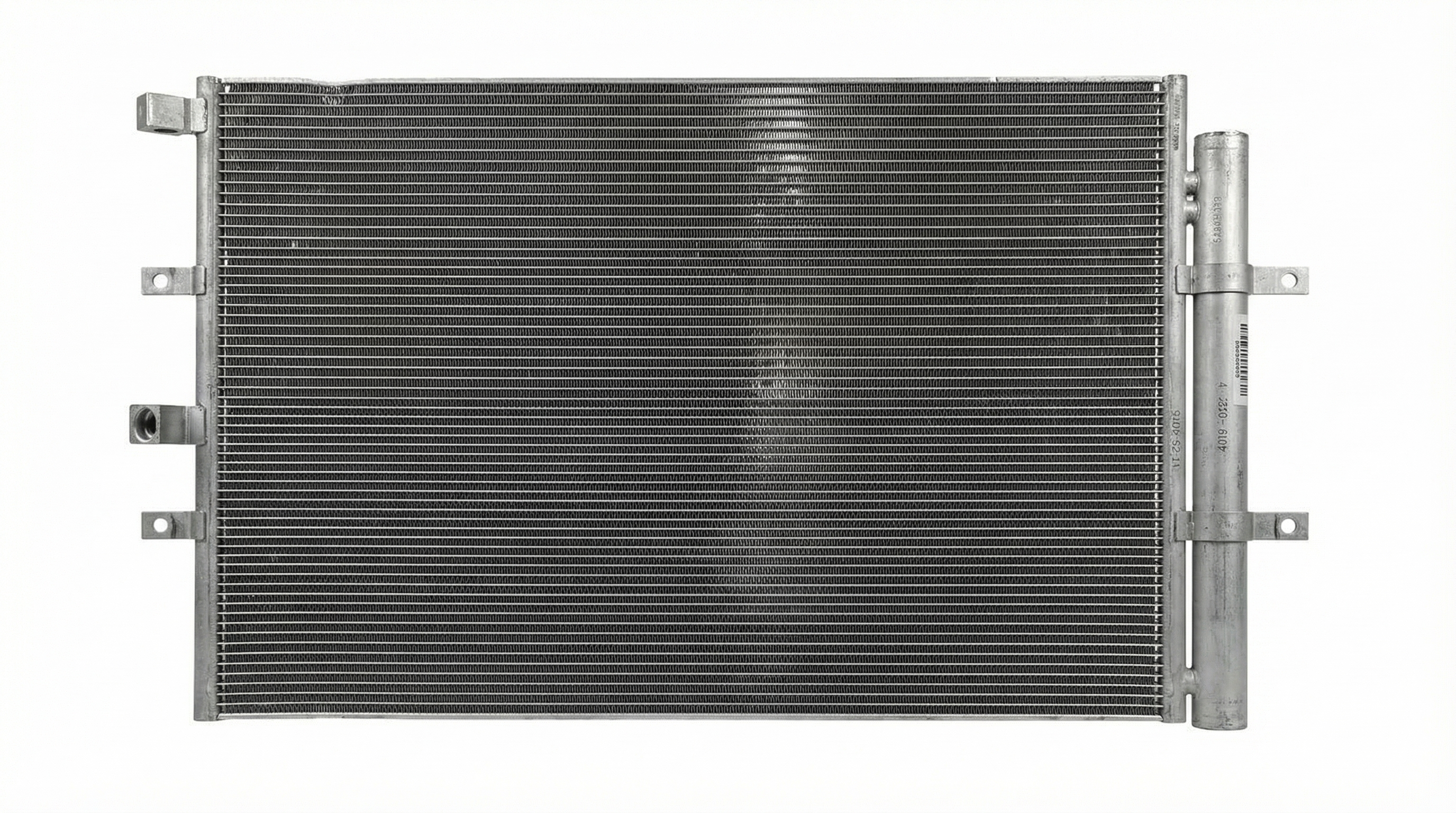
- Physical Damage: Check the entire unit for cracks, deep gouges, or bent mounting tabs. Damage often occurs from front-end collisions. Pay special attention to the integrated receiver/drier (the cylindrical part attached to the side of the condenser), ensuring it is not dented or damaged. The OEM part for the E-Transit includes this drier.
Pro Tip: When installing a used condenser, it is highly recommended to replace the small rubber O-ring seals at the line connections to ensure a leak-free seal. These are inexpensive and can prevent a costly refrigerant leak down the road.
Cost Comparison for A/C Condenser Replacement
The total cost of replacing an A/C condenser includes the part, labor to remove and replace it, and the cost to evacuate and recharge the A/C system with refrigerant. Prices can vary based on your location and the shop's labor rates.
| Item | Estimated Cost |
|---|---|
| New OEM Condenser | $225 - $375 |
| New Aftermarket Condenser | $100 - $250 |
| Used OEM Condenser | $125 - $200 |
| Shop Labor & Refrigerant Service | $330 - $485 |
| Total Professional Replacement | $550 - $1,000+ |
Replacement Information
Replacing the A/C condenser on a Ford E-Transit is a moderately difficult job that is not recommended for the average DIY mechanic.
- Difficulty Rating: 4 out of 5
- DIY Feasible: No. Federal law requires the use of specialized equipment to recover refrigerant from the system before it is opened. The system must also be put under a vacuum to remove moisture before being precisely recharged.
- Procedure: A technician will first recover any remaining refrigerant. The front bumper cover and other components must be removed to access the condenser. After unbolting the A/C lines and mounting brackets, the old condenser is removed. The new unit is installed, and the system is vacuumed down to check for leaks and remove air/moisture before being recharged with the correct amount of refrigerant.
Frequently Asked Questions (FAQ)
Is the A/C condenser for the E-Transit different from the gas-powered Transit?
The primary OEM part number, CK4Z-19712-C, is listed for both the gasoline-powered Transit and the electric E-Transit for these model years. This indicates that the condenser itself is a shared part, which is a common manufacturing practice to save costs.
My A/C is blowing warm, but I don't see any leaks. What could be the problem?
A condenser can fail without visible leaks. The small passages inside can become clogged with debris, preventing refrigerant from flowing properly. This internal blockage will cause poor cooling but won't leave an oily residue on the outside. The only way to diagnose this is by measuring the system's high and low-side pressures 🎬 Watch: Diagnosing a clogged condenser using a manifold gauge set. with a manifold gauge set.
Can I replace the A/C condenser myself to save money?
This is not recommended. It is illegal to release refrigerant into the atmosphere, and specialized, expensive equipment is required to safely recover the refrigerant, vacuum the system, and recharge it. Failure to perform these steps correctly will result in the A/C system not working and can cause damage to new components. The labor cost is for this specialized service, not just unbolting the part.
My A/C system is completely dead and the controls don't work. Is the condenser bad?
It is very unlikely. A bad condenser causes poor cooling but does not affect the electronic controls. If your entire HVAC control system is unresponsive, the issue is almost certainly the software glitch covered by a Ford recall for 2022-2023 models. Contact a Ford dealer with your VIN to see if your vehicle is affected.
Helpful Videos

Technical Specifications
OEM Part Numbers: CK4Z-19712-C YJ-716 BK2Z19712A CK4Z19712A CK4Z19712B
Material: Aluminum. Includes integrated receiver/drier. Dimensions: Approximately 6.0 x 37.4 x 21.4 inches.
We Have This Part in Stock

The information in this article is provided for general reference and educational purposes only. Vehicle specifications, procedures, and part compatibility can vary by production date, trim level, and region. Always consult your vehicle's factory service manual and verify part numbers before purchasing or performing repairs. Safety-critical components such as airbags, seat belts, and braking systems should be installed by a qualified professional.
- Ford E-Transit: