

Subaru Forester & Crosstrek Drive Axle Failures (2014-2025): Clicking, Vibrations, and Recalls
A complete guide to diagnosing and replacing the front and rear drive axle shafts on your 2014-2025 Forester or 2018-2025 Crosstrek, including critical recall information.
- A clicking noise on turns is the most common sign of a bad outer CV joint, while vibration on acceleration points to an inner joint.
- Certain 2023-2024 Foresters and 2024 Crosstreks have a safety recall (NHTSA 23V-754) for front axles that can break suddenly. Check your VIN immediately.
- Cheap new aftermarket axles are known to cause vibrations; a quality, inspected used OEM axle is often a more reliable and cost-effective choice.
- The front axle nut torque is a critical 162 ft-lbs and the nut must be staked (indented) to prevent it from loosening.
Symptoms of a Failing Drive Axle Shaft
A failing CV axle will give you clear warning signs. The front axles, which handle the stress of steering, typically wear out before the rear ones. Ignoring these symptoms can lead to a complete axle failure, which can leave you stranded and cause damage to other components.
Clicking or Popping Noise When Turning
This is the most classic sign of a bad outer CV joint. The sound is most noticeable during slow, tight turns, like in a parking lot. It happens because the ball bearings and cage inside the joint have worn down, creating excessive play that results in a clicking or popping sound with each rotation of the wheel. The noise will typically start on one side (either left or right turns) and get progressively louder and more frequent as the wear worsens.
Vibration During Acceleration
A vibration or shudder that you feel through the car, especially when accelerating at speeds between 40-55 mph, often points to a failing inner CV joint. This vibration may lessen when you're cruising at a steady speed but will return when you get back on the gas. This is different from a tire imbalance, which is usually constant at certain speeds regardless of acceleration. Some owners of the Forester XT have reported significant vibrations at highway speeds related to axle and control arm issues.
Grease on the Inside of Your Wheel or Fender Liner
The CV joints are packed with a thick grease and sealed by a flexible, accordion-like rubber boot. If this boot tears or cracks, it will sling grease outward as the axle spins. You may see a dark, greasy substance splattered on the inside of your wheel, on the suspension components, or in the wheel well. Once the boot is torn, dirt and moisture get into the joint, washing out the remaining grease and quickly destroying the joint. A torn boot requires immediate attention; if caught early, sometimes only the boot needs replacement, but usually, the entire axle is replaced as contamination has already damaged the joint.
Clunking When Shifting or Accelerating
A clunking sound when you shift from Drive to Reverse or when you first accelerate from a stop can indicate excessive play in a worn CV joint. While other issues like worn differential mounts can cause similar noises, it's a common symptom of a severely worn axle.
Safety Recall Notice: Certain 2023-2024 Forester and 2024 Crosstrek models are under a safety recall (NHTSA ID 23V-754) for front drive shafts that can break without warning. See the 'Recalls and TSBs' section below for details.
Known Issues, Recalls, and Technical Service Bulletins (TSBs)
Subaru has issued several official documents related to drive axle and related component issues on these vehicles. Many owners in forums have expressed frustration with premature failures of both CV axles and wheel bearings, sometimes under 60,000 miles.
Safety Recall WRP-23 (NHTSA 23V-754): Front Driveshaft Failure
- Vehicles Affected: Certain 2023-2024 Subaru Forester and 2024 Subaru Crosstrek models.
- The Defect: Due to a manufacturing error in the heat treatment process, the outer race of the front drive shaft can crack and break.
- The Risk: A broken axle will result in a sudden loss of power while driving. If the vehicle is parked without the parking brake engaged, it could roll away. Both scenarios increase the risk of a crash.
- The Fix: Subaru dealers will inspect the front drive shafts and replace them free of charge if they are from the defective batch. You can check if your vehicle is affected by entering your VIN on the NHTSA website.
TSB 03-91-23R: Clicking Sound on Slow Turns
- Vehicles Affected: 2019-2023 Subaru Forester.
- The Issue: A clicking or cracking sound heard when turning the steering wheel to its full lock position at slow speeds.
- The Fix: Subaru released a redesigned, more durable front drive axle shaft to resolve this. The updated part number is 28321SJ010. The bulletin states that axles do not need to be replaced in pairs.
TSB 03-96-25: Rear Wheel Bearing Noise (Related Issue)
- Vehicles Affected: 2019-2024 Subaru Forester and 2024 Subaru Crosstrek.
- The Issue: A harmonic, humming, or grinding noise from the rear of the vehicle caused by water getting into the rear wheel bearings and causing corrosion. This sound can be mistaken for a bad rear axle.
- The Fix: Subaru introduced redesigned rear axle hubs with better seals and more durable bearings. Wheel bearings are covered under the 5-year/60,000-mile powertrain warranty.
Buying a Used Drive Axle Shaft: What to Look For
Given the high cost of new OEM axles, a quality used OEM axle is an excellent value. However, there's a significant difference in quality between used OEM and cheap new aftermarket parts. Many owners report vibrations and premature failures from new aftermarket axles, making a verified, low-mileage OEM part a safer bet.
Physical Inspection Checklist:
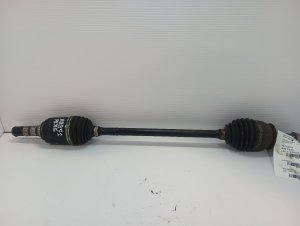
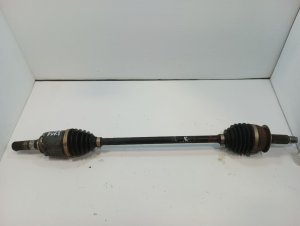
- Inspect the Boots: This is the most critical step. The rubber boots should be pliable, with no cracks, tears, or pinholes. Squeeze the boots to check for hidden splits. Any sign of leaking grease is an immediate red flag.
- Check for Play: Hold the shaft and try to move the inner and outer joints. There should be no significant clicking or clunking. A small amount of rotational play is normal, but excessive in-and-out or up-and-down movement indicates wear.
- Look for Shaft Damage: Inspect the central shaft for any signs of impact damage, deep rust pitting, or being bent. A bent shaft will cause vibrations that can't be balanced.
- Examine the Splines and Threads: Check the splines on both ends and the threads for the axle nut. They should be clean and free of damage. Damaged threads will make installation impossible.
Compatibility Warnings
Subaru uses many different axle shafts that look similar but are not interchangeable. Using the wrong axle can cause damage to your transmission or differential. Always verify the part number or provide your vehicle's VIN to the seller.
Warning: Pay close attention to these specific fitment rules based on your vehicle's configuration:
- Rear Axles (Gasoline, CVT): One common rear axle fits both left and right sides on gasoline models with the CVT automatic transmission. It does NOT fit Hybrid or Wilderness models.
- Rear Axles (2014-2018 Forester): A different rear axle fits all 2014-2018 Foresters with a Manual Transmission. It also fits CVT models from that period, but ONLY if they have the 2.0L Turbo engine.
- Front Axles (2014-2018 Forester): A specific front axle fits 2014-2018 Foresters with the CVT. For the 2014 model year, there was a production change; this part is only for vehicles built from VIN 552206 and later.
Cost to Replace a Drive Axle Shaft
The cost can vary significantly based on the parts you choose and local labor rates. Replacing the axle is almost always a better option than rebuilding the individual joints.
| Part/Service | Estimated Cost (Per Axle) | Notes |
|---|---|---|
| New OEM Axle | $400 - $600 | Highest quality and best fit, but most expensive. |
| New Aftermarket Axle | $70 - $150 | Quality varies widely. Cheaper brands are known to cause vibrations. |
| Used OEM Axle | $50 - $125 | Excellent value if inspected carefully from a low-mileage vehicle. |
| Shop Labor | $150 - $350 | Typically 1-2 hours of labor per side. |
| Total (Shop Installed, New OEM) | $550 - $950 | A single axle replacement at a dealership can approach $1,000. |
Replacement Overview & Torque Specs
Replacing a front CV axle is an intermediate-level DIY job that requires proper tools, including a powerful impact wrench or breaker bar and a torque wrench.
Key Steps & Procedures:
- Unstake the Axle Nut: The large 32mm nut in the center of the wheel hub is staked, or indented, into a notch on the axle to prevent it from loosening. This stake must be bent back out with a punch or chisel before the nut can be removed.
- Separate Suspension: To get enough room to remove the axle, you will typically need to disconnect the lower ball joint from the control arm or detach the strut from the steering knuckle.
- Pop the Inner Joint: The inner joint is held into the transmission or differential by a snap ring. It must be popped out using a pry bar. When installing the new axle, you must push it in firmly until you hear and feel it 'snap' into place.
- Torque and Stake: The axle nut is a critical fastener. It must be torqued to the correct specification with the vehicle's weight on the ground. After torquing, a new stake must be made in the nut with a punch to lock it in place.
Important Torque Specs
| Fastener | Torque Specification | Notes |
|---|---|---|
| Front Axle Nut | 162 ft-lbs (220 Nm) | Applies to Forester and Crosstrek models. |
| Rear Axle Nut | ~140 ft-lbs (190 Nm) | Specification varies slightly. Always confirm with a service manual for your exact year. |
Pro Tip: While you have the axle out, it's a good time to inspect the wheel bearing for any roughness or play. It's also wise to replace the axle seal in the transmission or differential. This is a cheap part that prevents a future fluid leak.
Frequently Asked Questions (FAQ)
Can I drive with a bad CV axle?
You can for a short time, but it's not recommended. A clicking axle will get progressively worse until the joint fails completely, leaving you stranded. If the axle breaks while driving, it can damage other parts and make the vehicle difficult to control.
Do I need to replace axles in pairs?
No, you do not need to replace them in pairs. If the axle on the right side is bad, you only need to replace the right-side axle. However, since they are exposed to the same conditions, it's common for the other side to fail soon after the first one.
Why does my new aftermarket axle vibrate?
This is a common complaint with non-OEM axles. It's often due to lower manufacturing tolerances, improper balance, or a design that isn't perfectly compatible with the vehicle's drivetrain harmonics. This is why a good used OEM axle is often a better choice than a cheap new aftermarket one.
What's the difference between inner and outer CV joint failure?
The outer joint handles the extreme angles of steering, so it typically fails by making a 'clicking' or 'popping' noise on turns. The inner joint operates at a much smaller angle and usually fails by causing a vibration during acceleration.
Technical Specifications
OEM Part Numbers: 28321FN030 28321SG000 28321SG010 28321SJ000 28321SJ010 28421FL020 28421SG000 28421SG020 28321AN030 28321VC020 28321FN000
Front Axle Nut Torque: 162 ft-lbs (220 Nm). Rear Axle Nut Torque: Approx. 140 ft-lbs (190 Nm), verify with service manual. Axle Nut Size: 32mm.
We Have This Part in Stock
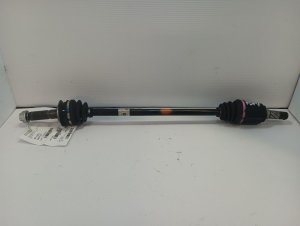
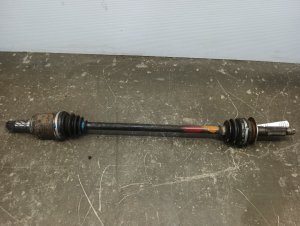
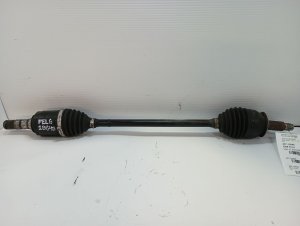
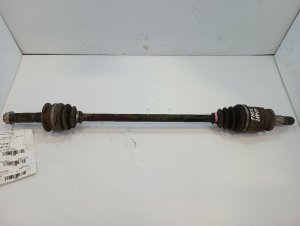

The information in this article is provided for general reference and educational purposes only. Vehicle specifications, procedures, and part compatibility can vary by production date, trim level, and region. Always consult your vehicle's factory service manual and verify part numbers before purchasing or performing repairs. Safety-critical components such as airbags, seat belts, and braking systems should be installed by a qualified professional.
- Subaru Forester:
- Subaru Crosstrek:
- 🛍️ Shop This Part
- Symptoms of a Failing Drive Axle Shaft
- Clicking or Popping Noise When Turning
- Vibration During Acceleration
- Grease on the Inside of Your Wheel or Fender Liner
- Clunking When Shifting or Accelerating
- Known Issues, Recalls, and Technical Service Bulletins (TSBs)
- Safety Recall WRP-23 (NHTSA 23V-754): Front Driveshaft Failure
- TSB 03-91-23R: Clicking Sound on Slow Turns
- TSB 03-96-25: Rear Wheel Bearing Noise (Related Issue)
- Buying a Used Drive Axle Shaft: What to Look For
- Physical Inspection Checklist:
- Compatibility Warnings
- Cost to Replace a Drive Axle Shaft
- Replacement Overview & Torque Specs
- Key Steps & Procedures:
- Important Torque Specs
- Frequently Asked Questions (FAQ)
- 🎟️ Get 5% Off