

Subaru Intake Manifold Guide (2003-2019): Leaks, TGV Faults, and the PZEV Compatibility Trap
This guide covers the common failures, symptoms, and critical compatibility differences for intake manifolds on 2.5L and 3.6L engines in the Legacy, Outback, Forester, Impreza, Baja, and Tribeca.
- There are three main manifold types: 2.5L Non-Turbo, 2.5L Turbo, and 3.0L/3.6L H6. They are not interchangeable.
- For 2.5L non-turbo engines, you MUST verify if your car is a PZEV or Federal emissions model; the manifolds are different and cannot be swapped.
- Plastic manifolds on 2.5L turbo models (GT/XT) are known to crack, causing vacuum leaks and lean codes (P0171).
- Failure of the internal Tumble Generator Valves (TGVs) is common across many models and will set specific check engine light codes (P2004-P2007).
Engine-Specific Failures and Variants
The intake manifold for these Subaru models is not a one-size-fits-all part. Failures and compatibility depend entirely on which engine your vehicle has: a 2.5L non-turbo, a 2.5L turbo, or a 3.0L/3.6L H6. Identifying your engine is the first step in diagnosing a problem or finding the correct replacement part.
1. For 2.5L Non-Turbo Engines (2.5i, Base Models)
Vehicles: Legacy, Outback, Impreza, Forester, and Baja models with the naturally aspirated 2.5L 4-cylinder engine.
The most common issues for these black plastic manifolds are vacuum leaks from hardened gaskets and failures of the integrated Tumble Generator Valves (TGVs). However, the single most important issue is a hidden compatibility trap.
Critical Warning: PZEV vs. Federal Emissions Manifolds
Subaru produced two different, non-interchangeable intake manifolds for these engines: one for Federal emissions vehicles and one for PZEV (Partial Zero Emissions Vehicle) models. PZEV vehicles were sold primarily in California and other states that follow its stricter emissions standards, but can be found anywhere in the US. The two manifold types look nearly identical but have internal differences to accommodate the PZEV system's unique fuel injectors and air intake components. They cannot be swapped. Installing a Federal manifold on a PZEV car (or vice-versa) will cause a persistent Check Engine Light and running issues. You MUST verify which system your vehicle has before ordering a part. The most reliable way is to match the OEM part number from your original manifold or use your vehicle's VIN at a dealership parts counter.
2. For 2.5L Turbo Engines (Legacy GT, Outback XT, Forester XT, Baja Turbo)
Vehicles: Any model with a 'GT' or 'XT' badge, or the Baja 'Turbo' model, using the 2.5L turbocharged 4-cylinder engine (EJ255).
The plastic intake manifolds on these turbocharged models are prone to developing cracks due to years of high heat and pressure fluctuations from the turbo. These cracks often form along the seams or near the mounting points for sensors.
- Cracks and Vacuum Leaks: A crack will allow unmetered air to enter the engine after the mass airflow sensor, leading to a lean condition. This typically causes a rough idle, hesitation, and lean-related trouble codes like P0171.
- Tumble Generator Valve (TGV) Failure: Like the non-turbo models, the TGVs can fail, causing codes like P2004, P2005, P2006, or P2007. On some models, Subaru issued a Technical Service Bulletin (TSB) updating the TGV shaft material to stainless steel to prevent corrosion and binding.
- Modified 'TGV Delete' Manifolds: Some owners modify these manifolds by removing the TGV butterfly plates and internal divider walls to improve airflow for highly tuned engines. A used manifold with this modification will cause a Check Engine Light and limp mode on a stock vehicle unless it is specifically tuned to ignore the missing TGV signals.
3. For 3.0L & 3.6L H6 Engines (Legacy R, Outback R, Tribeca)
Vehicles: Legacy and Outback models with the 3.0L or 3.6L 6-cylinder engine, and all 2008-2014 Tribeca models.
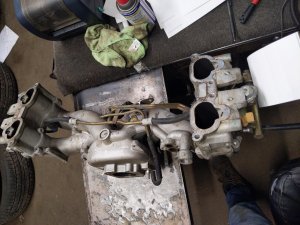
The large plastic manifolds on the H6 engines are generally robust. While gasket leaks can occur with age, a more common issue is a crack developing in the flexible rubber intake tube that connects the air filter box to the throttle body, not the manifold itself. This failure produces the same symptoms as a cracked manifold—a rough idle, lean codes, and poor performance. The EZ30R (post-2003) and EZ36 engines use a plastic intake manifold, while the earliest EZ30D engines used a cast aluminum design. Due to the engine's size, accessing and replacing the manifold or its gaskets is significantly more labor-intensive than on 4-cylinder models.
Symptoms of a Failing Intake Manifold
A bad intake manifold or gasket will disrupt the engine's air-fuel ratio. Here are the most common signs:
- Rough or Unstable Idle: The engine may shake, stumble, or idle higher or lower than usual.
- Check Engine Light: The most common code is P0171 (System Too Lean Bank 1), caused by unmetered air from a vacuum leak. TGV-specific codes like P2004-P2007 point directly to a failure in the manifold's runner control system.
- Hissing or Whistling Sound: A distinct hissing noise from the engine bay at idle is a classic sign of a vacuum leak.
- Poor Engine Performance: You may experience hesitation during acceleration, a lack of power, or poor fuel economy.
- Coolant Leak (Less Common): On some designs with coolant passages, a failed gasket can cause coolant to leak externally onto the engine block or, in severe cases, internally into the oil. This may be accompanied by an engine that runs hot or overheats.
- Faint Ticking or 'Cricket' Noise: Some owners report a faint, high-pitched ticking sound when the internal TGV flaps become loose before they fail completely.
Buying a Used Engine Intake Manifold: What to Check
A used OEM manifold is often a smart, cost-effective alternative to an expensive new part, especially since many aftermarket options don't exist. However, careful inspection is key.
- Verify the Part Number First: This is the most important step. For non-turbo models, confirm if you need a PZEV or Federal part. For all models, matching the part number from your old manifold is the best way to guarantee compatibility. Do not rely on visual identification alone.
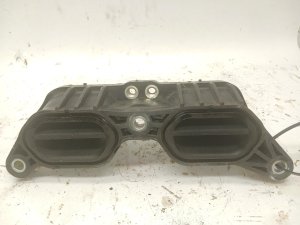
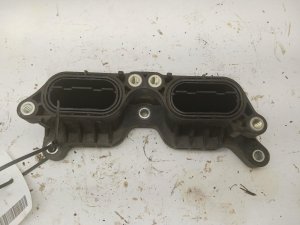
- Inspect for Cracks: Check the entire manifold, especially on plastic turbo models. Pay close attention to the seams where the halves are joined, around sensor mounting bosses, and at the bolt holes. A hairline crack can be hard to see but will cause major problems.
- Check Mating Surfaces: Lay a straightedge across the surfaces where the manifold bolts to the cylinder heads. It should be perfectly flat with no signs of warping. Any warpage will prevent the new gaskets from sealing properly.
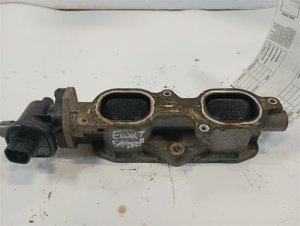
- Look for TGV Modifications: On turbo manifolds, look inside the runners. If you can see straight through without a divider wall or butterfly valve, it has had a 'TGV delete'. This part is only suitable for a car with a custom tune. For a stock vehicle, ensure the TGV valves and linkage are present and move freely.
- Check All Nipples and Ports: Make sure all the small plastic nipples for vacuum hoses are intact and not broken or cracked. A broken nipple can be difficult to repair and will cause a vacuum leak.
- Mileage vs. Condition: For a plastic manifold, one from a lower-mileage vehicle is always preferable, as it has been exposed to fewer heat cycles. However, a high-mileage part that is free of cracks and warping is still a viable option.
Pro Tip: Always use new gaskets when installing a replacement intake manifold. Reusing old, compressed gaskets is a guaranteed way to create a vacuum leak. It's also a good time to replace any brittle-looking vacuum hoses connected to the manifold.
Cost of Replacement
Replacing a Subaru intake manifold can vary widely in cost depending on the engine and the price of the part.
| Part/Service | Estimated Cost |
|---|---|
| New OEM Manifold | $450 - $1,300+ |
| New Aftermarket Manifold | $150 - $400 (Limited availability) |
| Used OEM Manifold | $75 - $250 |
| Shop Labor (Gasket Replacement) | $240 - $450 |
| Shop Labor (Full Manifold Replacement) | $300 - $700+ (Turbo and H6 models are on the higher end) |
Frequently Asked Questions
How do I know if my 2.5L Subaru is a PZEV model?
The surest way is to check the Vehicle Emission Control Information (VECI) label under the hood. It will explicitly state if the vehicle conforms to PZEV, SULEV, or California emissions standards. If you cannot find the label, a Subaru dealer can tell you using your VIN. Do not guess based on where the car was sold.
What are Tumble Generator Valves (TGVs) and why do they fail?
TGVs are small valves inside the intake runners that close on cold starts to increase air velocity, which helps fuel atomize better for cleaner emissions. They can fail when the electronic motor burns out, the position sensor fails, or the valve shaft itself corrodes and gets stuck. This triggers codes like P2004, P2005, P2006, or P2007.
Can I just replace the intake manifold gaskets?
Yes, if the manifold itself is not cracked or warped, simply replacing the gaskets is the correct repair for a gasket leak. The average cost for a professional gasket replacement is around $320. However, if the manifold is plastic and has high mileage, it may be wise to replace it as a preventative measure while everything is apart.
Is an aluminum intake manifold an upgrade for my plastic one?
For some older models, aftermarket or OEM aluminum manifolds may be available. They are more durable and not prone to cracking like plastic. However, they must be specifically designed for your engine and may require other modifications to fit. For most owners, a good condition OEM plastic manifold is the most straightforward and cost-effective solution.
Technical Specifications
OEM Part Numbers: 14001AB48A 14001AB65A 14001AB66A 14001AB880 14001AB91A 14001AC02A 14001AC03A 14001AC33A 14003AC050 14003AC320 14003AC321 14003AC44A 14011AB900 14011AB901 14003AB780 14001AB920 14003AC420 14003AC430
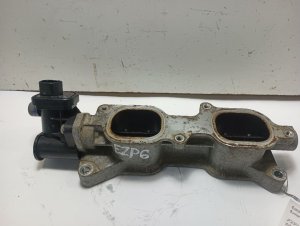
Manifolds are typically made of black composite plastic or cast aluminum, depending on the specific engine and year. They integrate ports for fuel injectors and often house Tumble Generator Valve (TGV) assemblies.
We Have This Part in Stock

The information in this article is provided for general reference and educational purposes only. Vehicle specifications, procedures, and part compatibility can vary by production date, trim level, and region. Always consult your vehicle's factory service manual and verify part numbers before purchasing or performing repairs. Safety-critical components such as airbags, seat belts, and braking systems should be installed by a qualified professional.
- Subaru Legacy:
- Subaru Outback:
- Subaru Baja:
- Subaru Forester:
- Subaru Impreza:
- Subaru Tribeca:
- 🛍️ Shop This Part
- Engine-Specific Failures and Variants
- 1. For 2.5L Non-Turbo Engines (2.5i, Base Models)
- 2. For 2.5L Turbo Engines (Legacy GT, Outback XT, Forester XT, Baja Turbo)
- 3. For 3.0L & 3.6L H6 Engines (Legacy R, Outback R, Tribeca)
- Symptoms of a Failing Intake Manifold
- Buying a Used Engine Intake Manifold: What to Check
- Cost of Replacement
- Frequently Asked Questions
- 🎟️ Get 5% Off