

Ford Mustang Headlight Guide (2010-2022): Halogen, HID, and LED Compatibility
This guide covers the critical differences between S197 and S550 Mustang headlights, including common failures like moisture and flickering, to ensure you buy the right part.
- The 2010-2022 period covers three incompatible generations: 2010-2014, 2015-2017, and 2018-2022. Parts do not swap between them.
- Halogen, HID (Xenon), and LED headlight types are NOT interchangeable without major wiring and computer programming changes.
- Replacement on all 2010-2022 models requires removing the front bumper cover, making it a more involved job than a simple bulb change.
- When buying a used assembly, the most important inspection points are the integrity of all mounting tabs and checking for signs of internal moisture.
Understanding the Three Incompatible Generations (2010-2022)

The 2010-2022 Ford Mustang spans three major design phases, and the headlight assemblies are not interchangeable between them. Installing the wrong generation of headlight will result in mounting issues, incorrect wiring connections, and improper function. It is crucial to identify your vehicle's specific year range before purchasing a replacement.
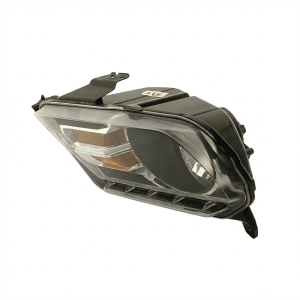
- 2010-2014 (S197): This generation itself has a facelift. 2010-2012 models have a different design than the 2013-2014 models, which feature more prominent LED accent strips.
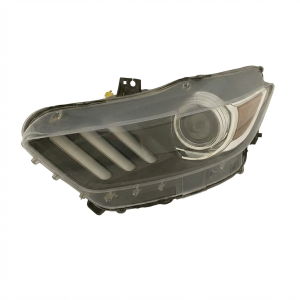
- 2015-2017 (S550): A complete redesign with the signature "tri-bar" LED daytime running lights.
- 2018-2022 (S550 Facelift): The front end was restyled again, with all-LED headlights becoming standard across the lineup.
Warning: Halogen, HID (Xenon), and LED headlight assemblies are not plug-and-play with each other. A vehicle originally equipped with halogen lights cannot use a factory HID or LED assembly without extensive and costly modifications to the vehicle's wiring harness and Body Control Module (BCM).
Generation 1: 2010-2014 (S197) Headlights

Technology Types and Key Identifiers
- Halogen: Standard on base models. These assemblies use a reflector housing to cast light from a halogen bulb. They have a simpler appearance without the complex internal projector lens.
- High-Intensity Discharge (HID/Xenon): Optional on higher trims. These are easily identified by the projector lens (a glass orb) inside the housing that focuses the light. They provide a brighter, whiter light than halogens. These systems use a D3S type HID bulb.
- 2013-2014 Refresh: The updated 2013-2014 models feature a distinct LED strip that functions as a daytime running light, often called a "hockey stick" or C-shape, which was not present on 2010-2012 models. 🎬 Watch: How to install 2013-2014 factory-style HID projector headlights.
Common Issues
- Condensation: Like all modern headlights, the S197 units are vented. A light fog that clears on its own is normal. However, if you see large water droplets or water pooling at the bottom, the main housing seal has likely failed, which can damage the HID ballast.
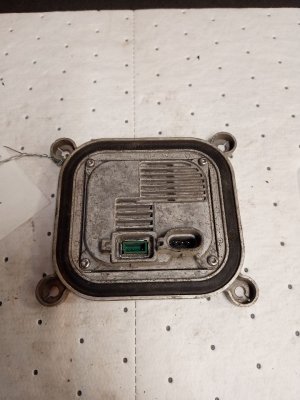
- HID Ballast Failure: The HID ballast is an electronic module, usually mounted to the bottom of the headlight assembly, that provides the high voltage needed to power the HID bulb. Water intrusion is a common cause of failure. Symptoms include a flickering headlight or one that won't turn on at all.
Generation 2: 2015-2017 (S550) Headlights

Technology Types and Key Identifiers
- High-Intensity Discharge (HID/Xenon): Standard on most 2015-2017 models. These headlights are famous for their signature three-bar LED daytime running lights. Even though the DRLs are LED, the main low/high beam is a projector-based HID system that uses a D3S bulb.
- Non-Interchangeability: These assemblies are completely different in shape and mounting from the previous S197 generation and the later 2018+ facelift. 🎬 See this walkthrough on removing stock S550 headlight assemblies.
Common Issues
- DRL Failures: Individual segments of the iconic tri-bar LED DRLs can burn out. Since the LEDs are integrated, this typically requires replacing the entire headlight assembly.
- Moisture Ingress: Like the earlier generation, these headlights can suffer from failed seals, leading to condensation that can damage the internal electronics, including the HID ballast and DRL modules.
Generation 3: 2018-2022 (S550 Facelift) Headlights
Technology Types and Key Identifiers
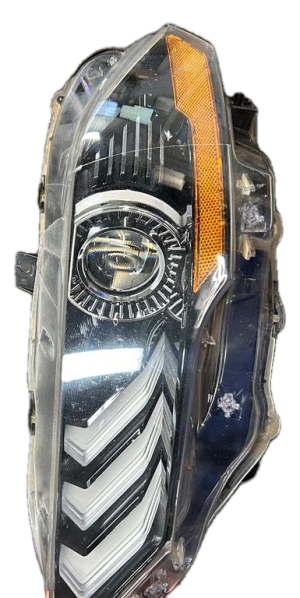
- Full LED: For the 2018 facelift, Ford made full LED headlights standard. The internal design and DRL signature differ from the 2015-2017 models. Higher trim levels may feature unique styling or adaptive capabilities.
- Non-Serviceable Bulbs: The LED light sources are integrated directly into the assembly and are not designed to be replaced individually. A failure of a low beam, high beam, or DRL element requires the replacement of the entire headlight unit.
Common Issues
- LED Driver Module Failure: Similar to an HID ballast, an LED driver module regulates power to the LEDs. Failure of this module can cause the entire headlight or specific functions to stop working. Recalls on other Ford models suggest these modules can be a point of failure.
- Lens Damage: The polycarbonate lenses are durable but can be damaged by road debris, leading to cracks that allow moisture to enter.
Symptoms of a Failing Headlight Assembly

- Dim or Yellowed Light Output: On HID models, bulbs lose brightness and shift color over time. On all models, hazing or yellowing of the outer lens from UV damage can severely reduce light output.
- Flickering Light: This often points to a failing HID ballast, a bad connection, or a failing LED driver module.
- Condensation or Water Inside: A fine mist that disappears after driving is normal, but visible water droplets or pooling indicates a bad seal. This can cause short circuits in ballasts and control modules.
- Burnt-Out DRLs or Turn Signals: If the turn signal bulb is replaceable, it's a simple fix. If an integrated LED DRL fails, the entire assembly often needs to be replaced.
- Warning Lights: A headlight failure may trigger a warning message or symbol on the instrument cluster.
Pro Tip: When an HID bulb is nearing the end of its life, it will often turn a pink or purplish color. If you notice this, it's best to replace both the left and right bulbs at the same time to ensure their color and brightness match.
Buying a Used Headlight Assembly: What to Inspect

A used OEM headlight is often a better choice than a cheap aftermarket alternative due to superior optics, fit, and durability. However, careful inspection is key.
- Verify Generation and Technology: First, confirm it matches your car's year range (2010-12, 2013-14, 2015-17, or 2018-22). Second, verify the technology. Look for a large, round projector lens for HID models. Halogen models will have a simpler, open reflector bowl. LED models (2018+) have unique, complex internal structures. Check the part number on the housing against known OEM numbers.
- Inspect All Mounting Tabs: This is the most critical inspection point. There are several plastic tabs used to bolt the assembly to the car. These are brittle and frequently break during vehicle disassembly. A single broken tab might be repairable with a kit, but an assembly with multiple broken or missing tabs should be avoided.
- Check the Lens Condition: Look for deep scratches, stress cracks, or spiderwebbing within the plastic. Minor surface pitting from normal road use is acceptable, but heavy hazing or yellow UV damage will reduce light output and require a restoration kit.
- Look for Signs of Moisture: Check the inside of the lens for a "water line," mineral deposits, or dried droplet marks. This is a clear sign the assembly has a bad seal and should be avoided, as the internal electronics could be compromised.
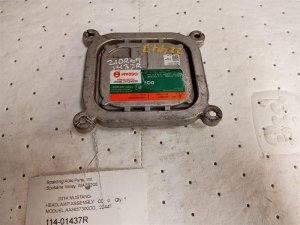
- Confirm Included Components: Ask if the assembly is being sold "bare" or "complete." A complete HID assembly should include the ballast, igniter, and all bulbs. A complete LED assembly must include its driver module. A bare housing will require you to transfer these expensive components from your old light, assuming they are still functional.
Known Issues, Recalls, and TSBs
Recall 15S39 / NHTSA 15V861: While this recall primarily targeted older vehicles, some early models in the 2010-2014 range could be affected. It relates to a lighting control module (LCM) where internal solder joints could crack, leading to a sudden loss of headlights. The fix involves installing a bypass module. Check with a dealer to see if a specific vehicle is included.
Replacement Overview and Headlight Aiming
Warning: On all 2010-2022 Ford Mustangs, the front bumper cover must be removed to access all the bolts securing the headlight assembly. This is not a simple bulb change and requires trim removal tools, sockets, and careful handling to avoid scratching the paint.
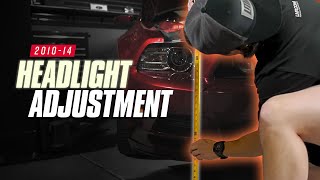
🎬 Learn how to properly aim your 2010-2014 Mustang headlights.After installing a replacement headlight assembly, it is legally required and essential for safety to aim the headlights properly. Misaligned headlights can blind oncoming drivers or fail to illuminate the road adequately.
Basic Aiming Procedure:
- Park the car on a level surface, 25 feet away from a flat, vertical wall.
- Measure the height from the ground to the center of your headlight projector/bulb.
- On the wall, mark a horizontal line at that same height.
- Turn on the low beams. The top of the beam's cutoff line should be at or slightly below your marked horizontal line.
- Use the adjustment screws on the back of the headlight assembly (typically for vertical and sometimes horizontal aim) to align the beam correctly. Cover one headlight while adjusting the other to avoid confusion.
Cost Comparison
| Part Type | Estimated Cost Range |
|---|---|
| New OEM | $800 - $2,000+ per side (especially for newer LED units) |
| New Aftermarket | $200 - $700 per side |
| Used OEM | $150 - $900 per side (highly dependent on generation, type, and condition) |
| Shop Labor | $200 - $400 (for one side, due to bumper removal) |
Frequently Asked Questions (FAQ)
Can I upgrade my Mustang's halogen headlights to factory HIDs or LEDs?
This is not a simple plug-and-play swap. It requires the correct headlight assembly, plus the corresponding wiring harness, ballasts (for HID) or driver modules (for LED), and may require reprogramming the car's Body Control Module (BCM) to recognize the new lights. For most owners, this is a complex and expensive conversion.
My headlight has moisture inside. Do I need to replace the whole thing?
If it's a light fog that clears up, it's likely normal condensation from the vents. If there are large drops or standing water, the seal has failed. You can attempt to remove the assembly, dry it out completely, and apply a new bead of silicone sealant around the seam where the lens meets the housing. However, if the moisture has already damaged the ballast or other electronics, the assembly will likely need to be replaced.
What HID bulb do my 2014 or 2016 Mustang headlights use?
Factory-equipped HID headlights on both the 2013-2014 S197 and 2015-2017 S550 Mustangs use a D3S bulb.
Why is one of my HID headlights a different color than the other?
As HID bulbs age, their color temperature changes, often shifting towards a pink or purple hue just before they fail. This is a clear sign the bulb needs to be replaced. It is highly recommended to replace them in pairs to ensure both headlights have the same color and brightness.
Helpful Videos
Technical Specifications
OEM Part Numbers: AR33-13006-BD AR3Z-13008-A DR33-13006-A DR3Z-13008-C DR3Z-13008-CCP DR3Z13008C DR3Z13008D FR3Z-13008-K FR3Z-13008-KCP JR3Z13008B JR3Z13008A
HID Bulb Type (2010-2017 Factory HID): D3S
We Have This Part in Stock

The information in this article is provided for general reference and educational purposes only. Vehicle specifications, procedures, and part compatibility can vary by production date, trim level, and region. Always consult your vehicle's factory service manual and verify part numbers before purchasing or performing repairs. Safety-critical components such as airbags, seat belts, and braking systems should be installed by a qualified professional.
- Ford Mustang:
- 🎬 Helpful Videos
- 🛍️ Shop This Part
- Understanding the Three Incompatible Generations (2010-2022)
- Generation 1: 2010-2014 (S197) Headlights
- Technology Types and Key Identifiers
- Common Issues
- Generation 2: 2015-2017 (S550) Headlights
- Technology Types and Key Identifiers
- Common Issues
- Generation 3: 2018-2022 (S550 Facelift) Headlights
- Technology Types and Key Identifiers
- Common Issues
- Symptoms of a Failing Headlight Assembly
- Buying a Used Headlight Assembly: What to Inspect
- Known Issues, Recalls, and TSBs
- Replacement Overview and Headlight Aiming
- Cost Comparison
- Frequently Asked Questions (FAQ)
- 🎟️ Get 5% Off