

B0028 on 2013-2016 Dodge DART: Right Side Seat Airbag Circuit Fault Explained
This code indicates an open circuit in the passenger-side seat-mounted airbag. The most common cause is a damaged or loose wiring connector under the passenger seat. This is a critical safety fault that disables the airbag, and professional diagnosis is strongly recommended.
- B0028 on a Dodge Dart means the passenger-side seat airbag has an electrical circuit fault and is disabled.
- The most likely cause is a loose or damaged connector under the passenger seat due to seat movement or debris.
- This is a critical safety issue; the airbag will not deploy in an accident.
- Do not attempt to diagnose or repair this yourself unless you are trained in SRS procedures. Accidental deployment can cause severe injury.
- A professional repair often involves securing the connector or installing a relatively inexpensive wiring repair harness.
What's Unique About the 2013-2016 Dodge DART
The Dodge Dart is built on the Fiat-Chrysler CUSW (Compact U.S. Wide) platform, which it shares with the 2015-2017 Chrysler 200 and 2014-2017 Jeep Cherokee. All three vehicles are known for issues with the wiring harness under the front seats. The movement of the seat can stress, pinch, or loosen the connectors over time, causing poor terminal tension. The problem is common enough that Dodge and Chrysler issued Technical Service Bulletins (TSBs) for the platform mates that group this code with other seat-related circuit faults, pointing towards a common wiring harness problem 🎬 Watch: Fixing common airbag wiring harness issues on this platform. rather than frequent failure of the airbag itself.
Diagnostic Flowchart
Tap your situation to follow the diagnostic path that matches what you're seeing on this vehicle.
Symptoms You May Notice
- Airbag warning light illuminated on the instrument cluster.
- Passenger-side airbag is disabled.
- "Service Airbag System" message on the instrument cluster display.
- Replacing the entire passenger seat when only a wiring repair is needed.
- Replacing the ORC module before thoroughly checking the wiring and connectors under the seat.
- Replacing the seat airbag module when the fault is in the connector.
Most Likely Causes
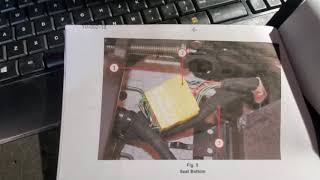
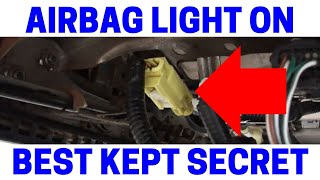
- Damaged or Disconnected Wiring Under Passenger Seat 🔴 High Probability The wiring harness and its main yellow connector are located under the seat, where they are susceptible to damage from debris, items stored under the seat, or stress from seat movement. Poor terminal tension within the connector is a known design flaw on this platform.
How to confirm: With the battery disconnected and the SRS system properly depowered, visually inspect the large yellow connector block under the passenger seat for loose connections, pushed-out pins, or damaged wires. A simple, real-world fix reported by owners is to unplug the connector, slightly bend the male pins to create a tighter fit ('improve terminal drag'), and securely reconnect it. A multimeter can be used to check for continuity on the seat side of the harness, but a more advanced test involves shorting the two pins on the body-side harness and checking if the scan tool code changes from 'open' to 'shorted', which confirms the wiring to the ORC is intact.
Typical fix: Securely reconnecting the connector often resolves the issue. If the connection remains poor, the official fix for platform mates is to install a jumper harness (pigtail) that bypasses the faulty connector pins. This involves cutting the old connector off the seat harness and splicing the new jumper in its place. In some cases, simply cleaning the connector and bending the pins slightly is sufficient.
Est. part cost: $20-$150 for a repair harness, though some OEM kits can be more expensive. - Faulty Right Side Seat Airbag Module (Squib) ⚪ Low Probability → Shop Air Bag
How to confirm: If the wiring is confirmed to be good (both from the connector to the ORC and from the connector to the squib), the fault lies within the airbag module itself. This is diagnosed by substitution or by measuring the squib's resistance with a specialized tool (Ohm meter designed for SRS work). Standard multimeters should not be used as their test current can deploy the airbag.
Typical fix: The seat-mounted airbag module must be replaced. This requires partial disassembly of the seat upholstery to access the airbag unit inside the seatback.
Est. part cost: $200-$500
Rare But Worth Checking
- Faulty Occupant Restraint Controller (ORC): This is the least likely cause. The ORC is the computer for the airbag system. It should only be suspected after all wiring and the airbag squib itself have been ruled out as the cause of the problem. TSBs advise technicians to contact engineering before replacing the ORC for this code. [TSB 9003579]
Diagnosis Steps
- Read the code with a scan tool capable of accessing the SRS/ORC module. Confirm the code is B0028-13.
- Perform a visual inspection of the area under the passenger seat. Look for any debris, stretched wires, or damage. Check the security of the main yellow airbag connector.
- SAFETY FIRST: Disconnect the vehicle's negative battery terminal and wait at least 10-15 minutes to allow the system capacitors to depower before touching any SRS components.
- Disconnect the yellow connector under the seat. Inspect the terminals for corrosion, damage, or pins that may have backed out.
- As a simple first attempt, try slightly bending the male pins in the connector to ensure a tighter fit, then reconnect firmly. Clear codes and see if the fault returns.
- If the fault persists, test the wiring. On the body-side of the disconnected harness, use a jumper wire to short the two pins (typically Violet/Light Blue and Grey/Light Green). Reconnect the battery, turn the ignition on, and re-scan for codes. If the code changes to a 'short circuit' fault (e.g., B0028-12), the wiring from the connector to the ORC is good. This isolates the problem to the seat side of the harness.
- If the wiring to the ORC is good, the next step is to test for continuity on the two wires within the seat harness, from the yellow connector up to the airbag squib connector inside the seatback.
- If all wiring is confirmed to be good, the fault is with the airbag squib itself, which requires replacement of the seat airbag module.
- If replacing the airbag does not fix the issue, the final step is to diagnose the ORC module itself, though this is highly unlikely.
Parts You'll Likely Need
- Seat Wiring Jumper Harness / Pigtail
(OEM #No single number is widely cited for the Dart. However, platform mates use Mopar P/N 68395045AA (Chrysler 200) or 68365479AA, and 68395046AA (Jeep Cherokee) for the identical repair.)— This is the most common official fix, as the wires and terminals in the under-seat connector are the typical failure point. A jumper harness allows a technician to replace the faulty connector and a small section of wire without replacing the entire seat or body harness.
Trusted brands: Mopar
OEM price range: $50-$150
Aftermarket price range: $20-$60 - Right Side Seat Airbag Module — If the wiring is intact, the airbag squib itself has failed and the module must be replaced.
Trusted brands: Mopar
OEM price range: $200-$500
Related Codes That Often Appear With This One
- B0020-13 — This is the equivalent code for the 'Left Side Seat Deployment Squib 1-Circuit Open'. The TSBs often list both codes together, as the underlying cause (under-seat wiring harness design) is the same for both driver and passenger sides.
- B00C5-13 — This code for the 'Passenger Seat Track Position Restraints Sensor-Circuit Open' is also listed in the same TSBs. It indicates another fault within the same under-seat wiring harness, making it a strong indicator that the harness or its main connector is the root problem. [TSB 68264880A$]
Technical Service Bulletins (TSBs) & Recalls
- 10-001-20: While officially for the Jeep Cherokee (KL) and Chrysler 200 (UF), this TSB is highly relevant. It supersedes TSB 10-002-18 and details the procedure for installing a jumper harness to fix the B0028-13 and B0020-13 open circuit codes, confirming the repair strategy for the shared platform.
- 68264880A$: Groups B0028-13 with other seat-related circuit open DTCs, indicating a common wiring issue.
- 9003579: Also groups B0028-13 with other seat-related circuit open DTCs, advising technicians to contact engineering before replacing the ORC module.
Platform-Specific Known Issues
- Real-World Owner Experience: The Pin Bending Fix: A common fix shared by owners on forums involves disconnecting the yellow under-seat connector and using a small tool to slightly bend the male terminal pins. This increases the tension ('terminal drag') when the connector is re-seated, often creating a solid enough connection to resolve the open circuit fault without replacing any parts.
- Early Life Failures: Forum posts from as early as late 2012, when the Dodge Dart was brand new, reported intermittent airbag lights. Technicians at the time identified the under-seat connector as the culprit, indicating this was a problem from the very beginning of the vehicle's production run.
Mechanic-Grade Diagnostic Values
- Right Side Seat Airbag Squib Resistance — expected: Approx. 2.0 - 3.0 Ohms. Failure: A reading of OL (Open Loop / infinite resistance) or significantly outside the expected range. A reading near zero indicates a short.
- Battery Voltage During ORC Programming — expected: 13.0 - 13.5 Volts. Failure: Voltage outside this range can cause the programming (flash) to fail.
Hidden / Shadow Codes Worth Checking
- B2722: ORC LOCKED-ALL DEPLOYMENT DISABLED. This code is set when a new Occupant Restraint Controller (ORC) is installed. (see via This code appears on a capable scan tool (like wiTECH) after installing a new ORC module. It indicates the module is in a 'locked out' state and must be initialized before it will function.)
- B0028-11 / B0028-12: Right Side Seat Deployment Squib 1 - Circuit Short to Ground / Short to Voltage. While the common code is -13 (Open), these suffixes indicate a short circuit. (see via These codes are typically generated during advanced diagnostics. For example, intentionally shorting the pins on the body-side harness connector will cause the code to change from B0028-13 (Open) to a shorted code, confirming the integrity of the wiring to the ORC module.)
Scan Tool Commands That Help
- wiTECH: Initialize ORC — After installing a new Occupant Restraint Controller (ORC) module. This function is found in the ORC's 'Miscellaneous Functions' tab and is required to clear the B2722 'locked' status and make the module operational.
- wiTECH: Data Logger / Live Data — To view the live resistance value (in Ohms) of the airbag squib circuits as seen by the ORC. This helps identify intermittent high resistance that may not be present during a static continuity test.
Wiring & Ground Locations
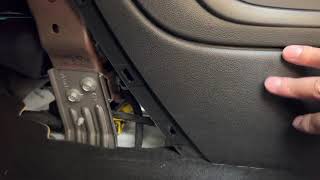
- Occupant Restraint Controller (ORC) — Under the center console, mounted to the vehicle floor. It can be accessed by removing the side trim panels of the center console.. This is the control module that monitors the seat airbag circuit and stores the B0028 fault code. All circuit tests ultimately lead back to this module's connector.
- Right Seat Airbag Circuit Wires — Within the main yellow connector block under the front passenger seat.. These are the two specific wires for the circuit that sets code B0028. The wire colors are Violet/Light Blue and Grey/Light Green. All continuity and resistance tests for this fault are performed on these wires.
- G211 — Left side of the front passenger footwell.. This is a major body ground point for the passenger side of the vehicle. While not directly part of the floating airbag circuit, a poor ground in this area can cause electrical interference or issues with other modules that could be misdiagnosed.
Real Owner Repair Stories
- YouTube channel 'Flat Rate Mechanic' (Chrysler 200 (platform mate)) — Airbag light on with codes B0020-13 (Left side) and B0028-13 (Right side).
❌ Tried (didn't work) No parts were replaced unnecessarily.
✅ What actually fixed it The mechanic performed a diagnostic test by shorting the pins on the body-side harness connector under the seat. This changed the scan tool code from 'open' to 'shorted', proving the wiring to the ORC module was good. The root cause was a poor connection at the connector itself. Cleaning the connector pins and ensuring a secure connection resolved the fault without replacing any parts.
Model Year Variations Within This Range
- 2013: A specific recall (NHTSA #13V-480, Mopar #N61) was issued for certain 2013 Dodge Darts with the 'Mopar 13' package for improperly installed front seat-mounted side airbags. While this defect is an installation error rather than the B0028 wiring fault, it affects the same component and could be a related safety concern for these specific vehicles.
Helpful Videos

The information in this article is provided for general reference and educational purposes only. Vehicle specifications, procedures, and part compatibility can vary by production date, trim level, and region. Always consult your vehicle's factory service manual and verify part numbers before purchasing or performing repairs. Safety-critical components such as airbags, seat belts, and braking systems should be installed by a qualified professional.
- Dodge DART:
- 🧭 Diagnostic Flowchart
- 🎬 Helpful Videos
- What's Unique About the 2013-2016 Dodge DART
- Symptoms You May Notice
- Most Likely Causes
- Rare But Worth Checking
- Diagnosis Steps
- Parts You'll Likely Need
- Related Codes That Often Appear With This One
- Technical Service Bulletins (TSBs) & Recalls
- Platform-Specific Known Issues
- Mechanic-Grade Diagnostic Values
- Hidden / Shadow Codes Worth Checking
- Scan Tool Commands That Help
- Wiring & Ground Locations
- Real Owner Repair Stories
- Model Year Variations Within This Range
- 🎟️ Get 5% Off