

B0043 Guide: Driver/Third Row Airbag Circuit Voltage Fault
The ultimate expert guide to diagnosing and fixing OBD-II code B0043, a critical SRS system failure.
- Code B0043 disables your vehicle's Supplemental Restraint System, guaranteeing the affected airbags will not deploy in a crash.
- Over 80% of B0043 faults stem from simple electrical interruptions, such as a loose under-seat connector, a broken clock spring, or corroded GM kick panel pins.
- A standard $20 OBD-II engine reader cannot see or clear B0043; you must use a bidirectional or SRS-capable scan tool priced at $100 or more.
- An active B0043 code triggers an automatic failure during mandatory state safety inspections and reduces vehicle resale value by up to 40%.
What Does B0043 Mean?
B0043 indicates the airbag control module (SRS module) detected voltage in a specific airbag deployment circuit outside its normal operating range. It often points to a specific location, such as 'Third Row Left Frontal Stage 3' or 'Driver Frontal Deployment Circuit (Stage 2)'. The computer cannot guarantee correct airbag deployment, so it disables the system and illuminates the warning light.
Technical definition: The SAE/OBD-II definition for B0043 is commonly 'Third Row Left Frontal Stage 3 Deployment Control' or 'Driver Frontal Deployment Circuit (Stage 2), Voltage Out of Range'. The SRS module registered a voltage or resistance value in the specified airbag's deployment loop outside predefined thresholds. For example, on a SAAB 9-5, this code sets if the module sees voltage above 4.1V or below 1.0V for more than 2 seconds.
Can I Drive With B0043?
No — Do Not Drive. No, it is not safe to drive with an active B0043 code. The illuminated airbag warning light signifies the Supplemental Restraint System (SRS) is disabled. In a crash, your airbags and seatbelt pretensioners will not activate, increasing the risk of serious injury or death. Driving with this light on guarantees a failed vehicle safety inspection in jurisdictions that require them.
Common Causes
- Loose or Faulty Connectors (Very Common) — Yellow airbag system connectors are the most frequent culprit. Connectors under the front seats or behind kick panels become loose or develop pin corrosion, interrupting the circuit.
- Damaged or Corroded Wiring (Very Common) — Wires in the airbag circuit, often located under seats or in the steering column, fray, pinch, or corrode. This alters electrical resistance, pushing voltage out of range.
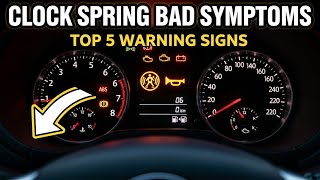
- Faulty Clock Spring (Spiral Cable) (Common) — The clock spring is a coiled ribbon of wires in the steering column maintaining connection to the driver's airbag. It breaks from normal wear, causing an open circuit and often disabling the horn and steering wheel controls.
- Recent Interior Work or Disassembly (Common) — If the light appears after detailing or audio installation, a connector was left unplugged or wiring was damaged. Disconnecting SRS components without disconnecting the battery sets a persistent fault code.
- Defective Airbag Inflator Module (Less Common) — The initiator coil inside the airbag, which triggers deployment, develops high resistance over time, leading to this fault.
- Water Intrusion and Corrosion (Uncommon) — Moisture from a clogged sunroof drain or bad window seal seeps into the cabin and corrodes floor-mounted airbag connectors or the SRS control module.
- Failed SRS Airbag Control Module (Rare) — The main airbag computer fails due to internal faults, software corruption, or water damage. This is a last-resort diagnosis after verifying all circuit components.
- Low Vehicle Battery Voltage (Rare) — A dying vehicle battery causes low system voltage during startup. The sensitive SRS module misinterprets this as a circuit fault, erroneously setting a code.
Symptoms
- Airbag Warning Light On — A solid red or yellow light showing a person with a deployed airbag illuminates on the instrument cluster.
- Horn Not Working — If the fault is in the driver's airbag circuit, a failed clock spring disables the horn.
- Steering Wheel Controls Inoperative — Buttons for cruise control, radio volume, or phone functions on the steering wheel fail if the clock spring breaks.
- Service Airbag System Message — The vehicle's driver information center displays a text warning such as 'Service Airbag System' or 'SRS Fault'.
- Airbag System 'Not Ready' Message — Advanced displays explicitly state that a specific airbag (e.g., 'Third Row Left') is 'Not Ready'.
Diagnostic Flowchart
Tap your situation to follow the diagnostic path that matches what you're seeing on this code.
Common Fixes & Costs
- Repair Wiring or Clean/Reseat Connectors — Parts: $5-$20, Labor: $100-$250, ~1.5 hr book time (Intermediate)
- Replace Clock Spring (Spiral Cable) — Parts: $50-$350, Labor: $125-$300, ~1.5 hr book time (Intermediate)
- Replace Airbag Module (Inflator) — Parts: $200-$800, Labor: $100-$200, ~1 hr book time (Professional)
- Replace SRS Airbag Control Module — Parts: $500-$1200, Labor: $150-$300, ~2 hr book time (Professional)
- Reset 'Crash Data' from SRS Module — Parts: $50-$150, Labor: $100-$200, ~1.5 hr book time (Professional)
Used vs. New Parts: Buying Guide
When a used part is worth it: For a clock spring, a used OEM part from a low-mileage vehicle is a cost-effective option. NEVER purchase used airbag inflator modules from uncertified sources due to extreme safety risks.
Donor-vehicle mileage cap: roughly under 60000 miles for the part to have meaningful remaining life.
Donor quality checklist:
- Verify the part number matches exactly.
- Ensure donor vehicle was not involved in a flood or front-end collision.
- Check that all connectors are intact with no cut wires or broken tabs.
- Purchase from a certified automotive recycler guaranteeing a non-deployed, genuine OEM component.
Decision logic:
- If The required part is an airbag inflator module. → Buy new from the dealer or a certified OEM supplier ONLY. Check for recalls first.
- If The required part is a clock spring and the vehicle is over 10 years old. → A used OEM part from a reputable recycler saves money, but a new aftermarket part offers a longer warranty.
- If The required part is the SRS Control Module. → Buy new. Used modules contain crash data or are incompatible. A new module must be programmed to your VIN.
Warranty tradeoff: Used clock springs typically have a 30-90 day warranty. New aftermarket parts offer a 1-year to limited lifetime warranty. New OEM parts have a 1-year warranty.
Worst-case if a used part fails: $250-$500 if a used clock spring fails early, requiring repeat labor costs.
What Happens If You Wait — Timeline
- Immediate (Ignition On): SRS module detects the fault during its self-test. The airbag warning light illuminates, and the entire SRS system is disabled. (MPG impact: 0%% · Added cost: $0 (Immediate safety risk is the primary cost))
- 0-12 Months: The vehicle fails its mandatory state safety inspection, resulting in fines and an inability to renew registration. (MPG impact: 0%% · Added cost: $50-$200 in failed inspection fees and potential fines.)
- 12+ Months / Resale Attempt: The vehicle's resale or trade-in value is drastically reduced. An active airbag light is a major red flag for buyers. (MPG impact: 0%% · Added cost: A 20-40% reduction in vehicle trade-in value ($1,000-$2,000 loss).)
- In the event of a collision: The airbags and seatbelt pretensioners will NOT deploy, leading to a much higher risk of serious injury or death. (MPG impact: 0%% · Added cost: N/A (Total realization of the safety risk))
Cost of Not Fixing It
- Immediate: Total failure of the airbag system. Airbags and seatbelt pretensioners will not deploy in an accident, increasing the risk of serious injury or death. (Added cost: N/A (Safety Risk))
- 0-12 months: Guaranteed failure of state safety inspection in most jurisdictions. The vehicle cannot be legally registered or sold until repaired. (Added cost: $50-$200 in failed inspection fees and potential fines.)
- Long-term: Significant reduction in vehicle resale value. A car with a persistent airbag light receives a substantially lower trade-in offer, often reduced by more than the cost of the repair itself. (Added cost: $1000-$2000 reduction in vehicle value.)
Diagnosis Steps
- Read Codes with an SRS-Capable Scanner
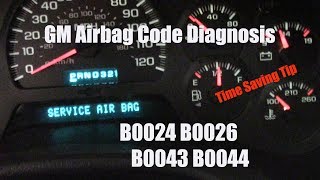
A standard OBD-II reader cannot access the SRS module. Use a professional-grade scan tool to read the B-series code, confirm B0043, and check for related fault codes (e.g., B0026, B0044). Note the specific circuit identified.
Tools: SRS-Capable OBD-II Scan Tool (Beginner) - Perform a Thorough Visual Inspection
Look for bright yellow airbag wiring harnesses and connectors under the front seats and in the footwells near the kick panels. Check for obvious damage, loose connections, chafed wires, or corrosion.
Tools: Flashlight (Beginner) - Test Horn and Steering Wheel Controls
If the code points to a driver-side airbag, test the horn and all steering wheel buttons. If they are inoperative, a failed clock spring is the definitive cause.
Tools: None (Beginner) - Inspect Specific TSB-Related Connectors
For GM trucks and SUVs, TSB #05-09-41-001B points to high resistance in connectors C221 or C222 behind the kick panels. Disconnect the battery, then inspect these specific connectors for corrosion or pushed-out pins.
Tools: Trim removal tools, socket wrench (Intermediate) - Isolate the Fault with a Resistor Tool (Pro Tip)
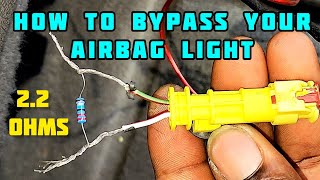
Disconnect the battery for 15 minutes. Disconnect the airbag circuit at a midpoint (e.g., base of the steering column). Plug a 2.0-2.5 ohm airbag simulator resistor into the vehicle harness side. Clear codes. If B0043 returns, the fault is downstream (wiring/module). If it does not, the fault is upstream (clock spring/airbag).
Tools: 2.0-2.5 Ohm Airbag Simulator/Resistor, SRS Scan Tool (Advanced) - Check Live Data for Resistance Fluctuations
Using an advanced scan tool, monitor the live data PID for the resistance of the specific airbag circuit. Wiggle the wiring harness and connectors related to that circuit. A resistance spike or drop pinpoints the exact location of an intermittent connection.
Tools: Advanced Diagnostic Scan Tool (Advanced) - Measure Circuit Resistance with a Multimeter
Disconnect battery and airbag module. A typical airbag deployment loop has a resistance between 1.5 and 4.5 ohms. Measure resistance through the disconnected component's pins. 'OL' indicates an open circuit; near zero indicates a short.
Tools: Digital Multimeter, vehicle-specific wiring diagram (Advanced) - Check Circuit Continuity
With battery and SRS components disconnected, check for continuity in the wiring between the SRS module connector and the component connector. Resistance must be less than 5 ohms from end to end.
Tools: Digital Multimeter, vehicle-specific wiring diagram (Advanced) - Verify Circuit Voltage Thresholds
Using manufacturer-specific data (e.g., SAAB 9-5 sets B0043 if voltage is >4.1V or <1.0V), back-probe the signal wire at the SRS module to measure voltage and confirm a wiring issue.
Tools: Digital Multimeter, Back-probe pins, Service Manual (Professional) - Test the SRS Control Module
Perform a module communication test with a high-end scan tool. If the module fails to communicate, shows water damage, or sets the code after proving the circuit wiring is good, replace the module.
Tools: Advanced Diagnostic Scan Tool (Professional)
When This Code Triggers (Freeze-Frame Conditions)
- SRS System Voltage: 11.5V - 14.5V (The SRS module constantly monitors its operating voltage. A B-code sets during the initial key-on self-test if voltage is outside the acceptable range.)
- Ignition Cycle Counter: Varies (Includes a count of how many times the vehicle has been started since the fault was first detected.)
- Fault Occurrence Counter: Varies (Shows how many times the specific fault condition has been met during self-checks, distinguishing between a hard fault and an intermittent one.)
- Fault Status: Present / Active (Indicates if the fault was active when data was captured. SRS codes are typically set at startup, not during specific driving conditions.)
Related Codes
- B0044 — Indicates 'Deployment Loop Open'. B0043 is for voltage out of range, while B0044 is for resistance out of range. They often appear together pointing to the same physical fault.
- B0026 — Indicates an 'Open' circuit in the Stage 1 deployment loop. Seeing B0026 and B0043 (Stage 2) together strongly suggests a single component failure affecting both circuits, like the clock spring.
- B0042 — Indicates 'Deployment Loop Resistance Low' (short circuit). All three codes point to an electrical problem in the same airbag circuit, just different types of failure.
- B0012 / B0013 — These codes are for the passenger-side airbag deployment loops. They share root causes (faulty connectors like C221/C222) mentioned in GM Technical Service Bulletins.
Climate & Environmental Factors
- High Humidity / Water Intrusion: Moisture promotes corrosion on the sensitive pins of airbag connectors and damages the floor-mounted SRS control module. This corrosion increases circuit resistance, triggering B0043.
- Extreme Cold: In very cold weather, plastic and metal components contract. This causes electrical connectors to lose contact, creating an intermittent high-resistance circuit.
- Coastal or Salty Environments: Vehicles in areas using road salt or near the coast suffer from accelerated corrosion-related faults due to salt-laden air and moisture.
How to Talk to a Mechanic About This Code
Say this: "I have an airbag warning light on, and my scanner shows a B0043 code. I'd like to schedule a diagnostic to pinpoint the electrical fault in the circuit. I've already checked for obvious issues like loose connectors under the seat."
This signals you are an informed customer, directs the technician to the specific system (SRS), and focuses their effort on circuit testing rather than guessing.
Avoid saying:
- 'My airbag light is on, can you fix it?'
- 'I think I need a new airbag.'
- 'Just do whatever it takes to turn the light off.'
Questions to ask before authorizing the repair:
- What were the results of the resistance and voltage tests on the circuit?
- Can you confirm the fault is the clock spring or connector and not just a wiring issue?
- If a new module is needed, does the price include the required VIN programming?
- What is the warranty on the parts and labor for this specific repair?
Where to Take It: Dealer vs Independent vs Chain
- Dealer:
Recommended if the issue is a known TSB, a recall, or requires module replacement. Otherwise, very expensive for a simple wiring fix.
Best for: Vehicles under warranty or with a recall/extended warranty., Complex diagnostics requiring manufacturer-specific tools., Repairs requiring module replacement and VIN programming.
Downsides: Highest labor rates and parts costs., May recommend replacing an entire module when a wiring repair suffices. (Typical cost: +50% vs. baseline) - Independent Shop:
Best fit for most common B0043 repairs. Ensure the shop is experienced with SRS systems.
Best for: Out-of-warranty vehicles where the cause is a common failure (e.g., clock spring, damaged connector)., Cost-conscious owners seeking a diagnosis from an ASE-certified technician.
Downsides: Shop must have an SRS-capable scan tool., May not have access to the latest manufacturer TSBs. (Typical cost: +0% vs. baseline) - Chain Shop:
AVOID. Airbag system repair is a safety-critical task beyond the scope of most chain shops.
Best for: Simple, unrelated maintenance like oil changes and tires.
Downsides: Technician skill varies widely; often lack specialized tools for SRS diagnostics., Many chains explicitly state they do not perform airbag system repairs. (Typical cost: -10% vs. baseline)
When to Walk Away From the Repair
If the estimated repair cost for the airbag system exceeds 30-40% of the car's private-party value, and the car has other pending issues, consider selling it as-is.
- Car worth $5000, fix is $2000: Walk away. The repair cost is 40% of the car's value. Sell the car 'as-is' with full disclosure.
- Car worth $12000, fix is $750: Fix it. The repair cost is only 6% of the vehicle's value and is essential for safety and passing inspection.
- Car worth $2500, fix is $1200: Walk away. The repair cost is nearly 50% of the car's value. The car is at the end of its economic life.
What Scan Tool You Need for This Code
Minimum: An OBD-II scanner that reads and clears Supplemental Restraint System (SRS) codes. A basic engine code reader will NOT work.
A standard $20 OBD-II scanner only accesses the Powertrain Control Module. It cannot communicate with the SRS module to see or clear B-series codes.
Budget: BlueDriver Pro (~$100) — Reads and clears SRS codes on most major brands, provides freeze-frame data, and allows live data monitoring to spot intermittent connections.
Mid-range: Foxwell NT510 Elite / Autel AutoLink AL619 (~$150) — Provides dedicated SRS diagnostics, reads and clears codes, shows live data streams, and performs system-specific functions.
Professional: Autel MaxiCOM MK808 / Launch CRP129E (~$450-600) — Offers OE-level diagnostics for all vehicle systems. Features bidirectional control to test components and is essential for programming new modules.
Rent vs buy: Auto parts store loaner tools are typically basic engine code readers that CANNOT read SRS codes. For a one-time fix, paying a shop's diagnostic fee (~$120) is more cost-effective than buying a high-end scanner.
How to Clear the Code After You Fix It
- Ensure the physical fault (e.g., bad wiring, faulty clock spring) is corrected.
- Reconnect the vehicle battery.
- Use an SRS-capable OBD-II scan tool to connect to the Airbag Control Module.
- Select 'Clear DTCs' or 'Erase Fault Codes'.
- Cycle the ignition off, then on, and wait for the SRS light to perform its self-check (light on for ~6 seconds, then off). If the light stays off, the code is cleared.
Drive cycle: No specific drive cycle is required. The system performs a complete self-test each time the ignition is turned on. If the fault is fixed and cleared, the light stays off on the next startup.
Watch out for:
- Using a standard engine code reader, which cannot access or clear SRS module faults.
- Disconnecting the battery, which does not clear 'hard codes' stored in the SRS module's memory.
- Failing to fix the underlying electrical problem, causing the code to return immediately.
Will This Fail Emissions / State Inspection?
Yes — this code typically fails an OBD-II emissions inspection.
- California: An illuminated airbag light is an automatic failure of the state's Vehicle Safety Systems Inspection (VSSI), required for revived salvage vehicles.
- New York: An illuminated airbag warning lamp is checked during the annual safety inspection. It is currently listed as an advisory and is NOT cause for rejection, but policies change.
- Texas: An illuminated airbag light is a cause for rejection during the annual safety inspection. The light must illuminate during the bulb check and then go out.
Most Commonly Affected Vehicles
- Chevrolet Silverado, Suburban, Tahoe (2003-2013) — Per TSB #05-09-41-001B, codes B0043/B0044 are frequently caused by high resistance in harness connectors C221/C222 behind the kick panels, not the clock spring.
- GMC Sierra, Yukon, Envoy (2003-2013) — Shares platforms with Chevrolet models and is subject to the same issues outlined in TSB #05-09-41-001B regarding kick panel connectors.
- Chevrolet Trailblazer (2002-2012) — Commonly experiences codes B0026 and B0043/B0044 together, strongly indicating a failed clock spring.
- Hyundai Sonata, Elantra, Veloster, Santa Fe (2011-2014) — Clock spring failure is extremely common. Hyundai issued an extended warranty (Campaign T3G) for 15 years/unlimited miles for this part.
- Kia Forte, Sorento, Rio, Soul (2011-2019) — Kia extended the warranty on the clock spring to 15 years/unlimited miles for many affected models due to high failure rates.
- Toyota RAV4, Camry, Corolla, Tacoma (2005-2015) — The 'spiral cable' (Toyota's term for the clock spring) is a frequent failure point causing the airbag light.
- Nissan Titan, Armada, Frontier (2004-2015) — Clock spring failure is a primary cause. Disconnecting components puts the SRS system into a 'Diagnostic Mode' requiring a manual key sequence to reset.
- SAAB 9-5 (2008-2009) — B0043 sets if circuit voltage is > 4.1V or < 1.0V. B0044 sets if resistance is > 4.5 ohms, and B0042 sets if resistance is < 1.5 ohms.
Manufacturer-Specific Notes
- General Motors (Chevrolet, GMC, Cadillac): Per TSB #05-09-41-001B, technicians must inspect the IP harness connectors (C221/C222) behind the kick panels for high resistance before replacing expensive SRS components.
- Hyundai and Kia: Both manufacturers extended the warranty on the clock spring to 15 years with unlimited mileage for many 2011-2019 models (Campaign T3G). Check with a dealer before paying for a repair.
- Nissan: If an SRS component is disconnected with the battery connected, the system enters 'Diagnostic Mode' and flashes the airbag light continuously. It must be reset using a specific ignition key sequence.
- SAAB: Provides extremely precise diagnostic parameters. The SRS module sets B0043 if it measures voltage greater than 4.1 volts or less than 1.0 volt for at least 2 seconds.
Real Owner Stories
2012 Hyundai Elantra at 190k kms
Airbag light came on spontaneously. Research indicated a common clock spring failure.
Outcome: The clock spring was replaced at no cost to the owner as a warranty claim.
Lesson: For Hyundai/Kia vehicles, always check for extended warranties (like campaign T3G) related to clock springs before paying for a repair.
2004 GMC Yukon with 'Service Airbag' message
Airbag light came on after driving. Owner lived in a dry climate, making corrosion less likely.
Outcome: The owner soldered the wire back securely. The airbag light turned off.
Lesson: Perform a thorough visual inspection of accessible connectors, especially under seats, before assuming a complex component failed.
2002 Chevy Trailblazer with codes B0026, B0043, B0044
Airbag light was on, and a scan revealed multiple codes pointing to the driver's side deployment loops.
Outcome: Cleaning the corroded pin resolved the issue and cleared all codes.
Lesson: A combination of Stage 1 and Stage 2 codes strongly points to a single failure point common to both circuits. A diagnostic resistor quickly isolates the fault location.
2006 GMC Sierra with code B0026 (related to B0043)
Airbag light turned on after making a left-hand turn. The owner misdiagnosed the issue and replaced the front impact sensor.
Outcome: Cleaning the pins and re-seating the connector firmly addressed the high resistance and resolved the code.
Lesson: On 2003-2013 GM trucks and SUVs, always check the kick panel connectors per the TSB before replacing expensive parts.
How to Prevent This Code From Triggering
- Apply Dielectric Grease to At-Risk Connectors (Once, or during any related repair) — Applying non-conductive dielectric grease to connector seals prevents moisture intrusion and corrosion, primary causes of high-resistance faults.
- Address All Water Leaks Promptly (As needed) — Fixing water leaks prevents moisture from reaching floor-mounted connectors and the SRS control module, avoiding costly corrosion damage.
- Secure the Clock Spring During Steering Repairs (During relevant service) — If the clock spring is not secured in its centered position when the steering wheel is removed, the internal ribbon cable snaps on the first full turn.
- Be Careful with Under-Seat Cleaning and Storage (Always) — Forcefully shoving items under the front seats snags and damages the sensitive airbag wiring harness, causing an immediate fault.
Frequently Asked Questions
What does 'Stage 2' or 'Stage 3' in the code definition mean?
This refers to a multi-stage airbag, which deploys with varying force based on crash severity, seat position, and occupant weight. Each 'stage' is a separate inflator charge with its own electrical circuit. This code indicates a fault in one of those specific circuits.
Is it safe to test an airbag with a multimeter?
While official service procedures warn against it, many professional technicians do it safely. A modern digital multimeter uses microamps of current for resistance tests, which is not enough to deploy an airbag requiring several amps. ONLY test resistance on a component fully disconnected from the vehicle's power and the SRS module.
What is the 2-ohm resistor test for airbag codes?
This is a professional diagnostic technique where a special 2.0 to 2.5-ohm resistor simulates a good airbag. By plugging the resistor into the harness leading to the SRS module, a technician determines if the fault is in the module/wiring or in the clock spring/airbag itself. This saves significant diagnostic time.
My airbag light came on after my car was detailed. What happened?
Detailers often move seats forcefully or disconnect them to clean underneath. If the battery isn't disconnected first, the SRS module instantly detects the open circuit and stores a permanent fault. The light stays on until cleared with an SRS-capable scan tool.
Will my car pass a safety inspection with the airbag light on?
No. In virtually all regions with mandatory vehicle safety inspections, an illuminated airbag warning light is an automatic failure. The vehicle cannot be legally registered or sold until the fault is repaired and the light is off.
Why did my horn and radio buttons stop working when the airbag light came on?
This is a classic symptom of a failed clock spring. The clock spring is a coiled bundle of wires connecting everything on the steering wheel to the car. When it breaks, all these components lose their connection simultaneously.
Can I just clear the code without fixing the problem?
You can, but the SRS module performs a self-check every time you start the car. The code reappears within seconds because the underlying electrical fault still exists. Clearing the code does not fix the problem, and your airbag system remains disabled.
Key Takeaways
- Code B0043 disables your vehicle's Supplemental Restraint System, guaranteeing the affected airbags will not deploy in a crash.
- Over 80% of B0043 faults stem from simple electrical interruptions, such as a loose under-seat connector, a broken clock spring, or corroded GM kick panel pins.
- A standard $20 OBD-II engine reader cannot see or clear B0043; you must use a bidirectional or SRS-capable scan tool priced at $100 or more.
- An active B0043 code triggers an automatic failure during mandatory state safety inspections and reduces vehicle resale value by up to 40%.
Helpful Videos
Shop the Parts Behind B0043
Below are the parts most often responsible for code B0043, ranked by how frequently each one is the actual culprit (per the diagnosis above). Tap any to see what we have for your vehicle.



The information in this article is provided for general reference and educational purposes only. Vehicle specifications, procedures, and part compatibility can vary by production date, trim level, and region. Always consult your vehicle's factory service manual and verify part numbers before purchasing or performing repairs. Safety-critical components such as airbags, seat belts, and braking systems should be installed by a qualified professional.
- 🧭 Diagnostic Flowchart
- 🎬 Helpful Videos
- 🛍️ Shop This Part
- What Does B0043 Mean?
- Can I Drive With B0043?
- Common Causes
- Symptoms
- Common Fixes & Costs
- Used vs. New Parts: Buying Guide
- What Happens If You Wait — Timeline
- Cost of Not Fixing It
- Diagnosis Steps
- When This Code Triggers (Freeze-Frame Conditions)
- Related Codes
- Climate & Environmental Factors
- How to Talk to a Mechanic About This Code
- Where to Take It: Dealer vs Independent vs Chain
- When to Walk Away From the Repair
- What Scan Tool You Need for This Code
- How to Clear the Code After You Fix It
- Will This Fail Emissions / State Inspection?
- Most Commonly Affected Vehicles
- Manufacturer-Specific Notes
- Real Owner Stories
- 2012 Hyundai Elantra at 190k kms
- 2004 GMC Yukon with 'Service Airbag' message
- 2002 Chevy Trailblazer with codes B0026, B0043, B0044
- 2006 GMC Sierra with code B0026 (related to B0043)
- How to Prevent This Code From Triggering
- Frequently Asked Questions
- What does 'Stage 2' or 'Stage 3' in the code definition mean?
- Is it safe to test an airbag with a multimeter?
- What is the 2-ohm resistor test for airbag codes?
- My airbag light came on after my car was detailed. What happened?
- Will my car pass a safety inspection with the airbag light on?
- Why did my horn and radio buttons stop working when the airbag light came on?
- Can I just clear the code without fixing the problem?
- Key Takeaways
- 🎟️ Get 5% Off