

OBD-II Code B0044: Driver Airbag Circuit (Stage 2) Open
The Ultimate Guide to Diagnosing and Fixing B0044
- Code B0044 completely disables your vehicle's airbag system, meaning no airbags will deploy in an accident.
- The most common cause on GM vehicles (2005-2014) is a loose connection at a yellow airbag plug, specifically connector C221 or a broken CPA retainer clip.
- Never begin diagnosis without disconnecting the negative battery terminal and waiting 15 minutes to prevent accidental, lethal airbag deployment.
- Use a professional scan tool to monitor 'Driver Deployment Loop Resistance' live data; a reading above 4.8 ohms confirms the fault and helps pinpoint the exact loose wire.
What Does B0044 Mean?
B0044 is a manufacturer-specific diagnostic trouble code used primarily by General Motors. It indicates the Sensing and Diagnostic Module (SDM) detects an open circuit or excessive electrical resistance in the driver's steering wheel airbag wiring. This fault instantly disables the SRS and illuminates the airbag warning light.
Technical definition: The SAE/ISO definition is 'Driver Frontal Deployment Loop (Stage 2) Open'. The Sensing and Diagnostic Module (SDM) sets this code when it detects circuit resistance greater than 4.8 ohms for more than 500 milliseconds in the secondary deployment circuit of the driver's airbag. 'Stage 2' refers to the high-force deployment charge in a dual-stage airbag.
Can I Drive With B0044?
No — Do Not Drive. While the vehicle operates mechanically, do not drive it. A B0044 code disables the entire Supplemental Restraint System (SRS) as a safety precaution. In a collision, the airbags will not deploy, dramatically increasing the risk of fatal injury. This critical safety failure requires immediate repair.
Common Causes
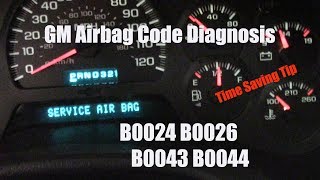
- Loose Airbag Connectors or Broken CPA Clips (Very Common) — Yellow airbag connectors frequently vibrate loose. On GM trucks and SUVs, connector C221 behind the driver's kick panel is a notorious failure point. 🎬 Watch: Diagnostic steps for B0044 on a GM truck Additionally, the plastic Connector Position Assurance (CPA) retainer clip often becomes brittle and breaks, causing poor terminal contact (documented in GM TSB #08-09-41-002H).
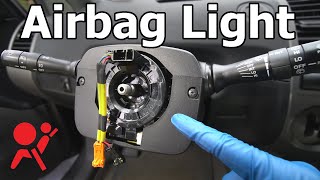
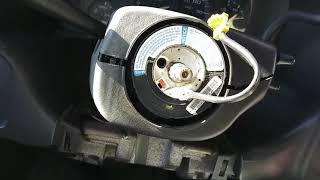
- Faulty Clock Spring (SIR Coil) (Common) — The clock spring is a coiled ribbon cable behind the steering wheel that maintains electrical contact while the wheel turns. Constant friction bends and breaks these thin internal wires over time, creating a hard open circuit. 🎬 See this walkthrough on how to replace a clock spring
- Wiring Chafing or Damage (Less Common) — Wires leading to the airbag connectors fray, pinch, or break. This happens frequently under the driver's seat due to seat track movement (a known issue on C6 Corvettes) or under the dashboard where the harness rubs against metal brackets.
- Water Intrusion and Corrosion (Less Common) — Water leaking from clogged sunroof drains or failing windshield seals drips directly onto inline connectors (like C221) or the SDM module on the floorboard. This moisture corrodes the metal connector pins, spiking electrical resistance above the 4.8-ohm threshold.
- Aftermarket Equipment Installation (Rare) — Installing aftermarket stereos, alarms, or remote starters disturbs under-dash wiring. Installers frequently disconnect yellow airbag plugs for access and fail to seat them fully upon reassembly.
- Failed Driver Airbag Module (Very Rare) — The airbag inflator module rarely fails electrically. Its internal resistance remains stable between 2.5 and 3.0 ohms. Mechanics only suspect this component after proving the wiring, connectors, and clock spring are fully functional.
- Failed Sensing and Diagnostic Module (SDM) (Very Rare) — The airbag control computer (SDM) is highly robust. You must eliminate all wiring and component faults before condemning the SDM.
Symptoms
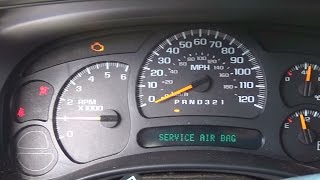
- Airbag Warning Light & 'Service Airbag' Message — The red airbag/SRS indicator on the instrument cluster stays illuminated permanently, often accompanied by a 'Service Airbag' text warning on the Driver Information Center.
- Horn or Steering Wheel Controls Inoperative — If a broken clock spring causes the code, the horn, radio controls, and cruise control buttons on the steering wheel also fail, as they share the same severed ribbon cable. 🎬 Watch: Troubleshooting common GM service airbag message codes
- Clicking or Grinding Noise from Steering Column — A scraping or grinding sound when turning the steering wheel confirms the internal ribbon of the clock spring has snapped and is catching inside its plastic housing.
- Airbags Will Not Deploy (scan-tool only — no driver-felt sign) — The entire Supplemental Restraint System (SRS) shuts down when code B0044 is active. No airbags will deploy in a crash.
Diagnostic Flowchart
Tap your situation to follow the diagnostic path that matches what you're seeing on this code.
Common Fixes & Costs
- Repair or Secure Airbag Connector (CPA Clip/Reseating) — Parts: $5-$20, Labor: $100-$180, ~1.0 hr book time (Intermediate)
- Replace Clock Spring
— Parts: $100-$250, Labor: $150-$350, ~2.0 hr book time
(Professional)
: OEM
: OEM - Replace Airbag Harness Connector Pigtail (e.g., C221)
— Parts: $30-$60, Labor: $150-$300, ~1.5 hr book time
(Professional)
: OEM - Replace Driver's Airbag Module — Parts: $500-$1,500, Labor: $100-$250, ~1.0 hr book time (Professional)
- Replace Sensing and Diagnostic Module (SDM) — Parts: $300-$800, Labor: $150-$400, ~1.5 hr book time (Professional)
Used vs. New Parts: Buying Guide
When a used part is worth it: Never buy a used airbag module. For a clock spring, a used OEM part from a low-mileage donor vehicle is acceptable if budget is tight, but carries the risk of internal wear. Avoid cheap, unbranded aftermarket clock springs.
Donor-vehicle mileage cap: roughly under 60000 miles for the part to have meaningful remaining life.
Donor quality checklist:
- Verify the donor vehicle was not in a front-end collision.
- Ensure the part number matches your VIN exactly.
- Confirm the recycler locked the clock spring dead-center before shipping.
Decision logic:
- If The part is an airbag module or SDM computer → Always buy new OEM. Never install salvaged explosive components.
- If The part is a clock spring and budget is strict → A used OEM part from a reputable recycler is safer than a $30 unbranded aftermarket part.
- If The vehicle is a high-value or newer model → Buy new OEM to guarantee reliability. The labor cost to replace a failed used clock spring negates any savings.
Warranty tradeoff: Used parts carry a 30-day warranty. New aftermarket parts offer 1-year warranties. New OEM parts carry the manufacturer's standard parts warranty.
Worst-case if a used part fails: $300-$600 (If a used clock spring fails, you pay full labor costs again plus the price of a new part).
What Happens If You Wait — Timeline
- Immediate (First 0.5 seconds): The SDM detects resistance over 4.8 ohms, sets B0044, and instantly disables the entire SRS system. The primary safety failure occurs immediately. (MPG impact: 0%% · Added cost: $0 (Safety risk is the immediate cost))
- 1 week - 3 months: If caused by a loose connector, the light flickers over bumps. The airbag system remains unreliable and non-functional. Vibration degrades the loose pins further. (MPG impact: 0%% · Added cost: $100-$180 (A simple zip-tie fix is missed, leading to a paid diagnostic visit later))
- 3 - 12 months: An intermittent clock spring fault becomes a hard failure. The horn and cruise control fail as more wires in the ribbon snap. (MPG impact: 0%% · Added cost: $200-$500 (The clock spring is now definitively destroyed and requires replacement))
- Ongoing: The vehicle fails state safety inspections. If the root cause is a water leak, corrosion spreads to adjacent body control modules. (MPG impact: 0%% · Added cost: $500-$2000 (Cost of repairing secondary water-damaged modules))
Cost of Not Fixing It
- Immediate: Complete failure of the Supplemental Restraint System (SRS). No airbags will deploy in a collision, dramatically increasing the risk of fatal injury. (Added cost: N/A (Severe Safety Risk))
- Ongoing: Guaranteed failure of state safety inspections in states that check for illuminated dashboard warning lights (e.g., New York, Virginia). (Added cost: $50-$100 (Cost of failed inspection and re-test fees))
- Long-term: If caused by a water leak, ignored moisture corrodes adjacent wiring harnesses and destroys other expensive electronic modules under the dashboard. (Added cost: $500-$2000 (Cost of repairing secondary water damage))
Diagnosis Steps
- Read SRS Codes & Symptom Bytes
Use an SRS-capable OBD-II scanner to confirm B0044. Look for symptom bytes: 'B0044 0D' (Resistance Above Threshold) points to a corroded or loose connection. 'B0044 04' (Open Circuit) points to a completely disconnected plug or severed clock spring wire.
Tools: SRS-capable OBD-II Scanner (Beginner) - Disconnect Battery & Perform Visual Inspection
Disconnect the negative battery terminal and wait exactly 15 minutes for the SRS backup capacitors to discharge. Visually inspect the yellow airbag connectors under the driver's dash, behind the kick panel (C221), and under the seat. Look for broken plastic CPA locking clips or backed-out pins.
Tools: 10mm Wrench, Flashlight, Trim removal tools (Beginner) - Reseat and Secure Connectors
With the battery disconnected, unplug the main yellow connectors, inspect for green corrosion, and plug them back in firmly until they click. Cycling the connection 2-3 times scrapes oxidation off the terminals. If the CPA lock is broken, secure the connector tightly with a zip tie.
Tools: Zip Ties, Dielectric Grease (Intermediate) - Check Live Data for Exact Resistance
Reconnect the battery. Using a professional scan tool, monitor the 'Driver Deployment Loop Resistance' live data PID. It should read 1.3 to 4.8 ohms. While watching the screen, wiggle the wiring harnesses at the kick panel and under the seat. A sudden resistance spike pinpoints the exact location of the loose connection.
Tools: Professional SRS Scan Tool (e.g., GM Tech2, Autel) (Advanced) - Isolate the Fault with a Diagnostic Resistor
Disconnect the battery again. Unplug the clock spring at the steering column base. Insert a 2.2-ohm airbag diagnostic resistor into the harness-side connector leading to the SDM. Reconnect the battery and scan. If B0044 changes to B0042 (Low Resistance), the wiring and SDM are perfect. The fault is definitively the clock spring or airbag module.
Tools: 2.2-ohm Airbag Diagnostic Resistor, SRS Scanner (Advanced) - Test Clock Spring Continuity
With the battery disconnected and the airbag removed, use a multimeter to measure resistance through the clock spring pins while slowly turning the steering wheel. Readings must remain under 1.0 ohm. An infinite reading (OL) confirms a broken internal ribbon.
Tools: Digital Multimeter, Steering Wheel Puller (if removing) (Advanced) - Clear Codes and Verify Repair
After repairs, reconnect the battery and use your SRS scanner to clear the B0044 code from the SDM memory. The airbag light will not turn off automatically. Cycle the ignition; if the light illuminates for 7 seconds and turns off, the repair is successful.
Tools: SRS-capable OBD-II Scanner (Beginner)
When This Code Triggers (Freeze-Frame Conditions)
- Ignition Cycle Status: Key-On, Engine-Off or Running (The SDM performs a resistance self-test every time the ignition is turned on.)
- System Voltage: 11-14 Volts (The SDM requires stable battery voltage to perform its self-checks; low voltage triggers false codes.)
- Time Since Ignition On: < 1 second (The resistance check of the deployment loops is the first test performed by the SDM at startup.)
- Fault Status: Present for > 500ms (The high resistance condition must be detected continuously for a half-second to set the code.)
Related Codes
- B0026 — Indicates the 'Stage 1' driver's airbag circuit is open. If B0026 and B0044 appear together, the fault is definitively in a shared component, such as the clock spring or the main steering column connector.
- B0042 — The exact opposite of B0044. It means 'Resistance Low' (a short circuit under 1.3 ohms). Technicians intentionally trigger B0042 using a diagnostic resistor to prove the wiring harness is intact.
- B0043 — Means 'Voltage Out of Range' for the Stage 2 circuit. It appears alongside B0044 if a technician unplugs a connector while the battery is connected, causing the SDM to read both an open circuit and zero voltage simultaneously.
Climate & Environmental Factors
- High Humidity / Water Leaks: Clogged sunroof drains overflow into the cabin, dripping water onto the SDM or kick panel connectors (C221). This corrodes the pins, spiking electrical resistance and triggering B0044.
- Coastal or 'Salt Belt' Regions: Road salt and coastal air accelerate the corrosion of electrical connectors and ground straps. This degrades the sensitive 4.8-ohm threshold of the airbag circuits.
- Extreme Temperature Cycles: Rapid swings between hot and cold cause metal pins and plastic connector housings to expand and contract. Over time, this destroys pin tension, creating an intermittent open circuit.
How to Talk to a Mechanic About This Code
Say this: "I have an airbag light on and a B0044 code on my [Vehicle Year/Make/Model]. I've read this is frequently a loose connection at connector C221 or a broken CPA clip, per GM's TSBs. I want to book a diagnostic appointment to inspect and test these known wiring issues before quoting a clock spring or airbag module."
This proves you are an informed customer. It directs the mechanic to the cheapest, most likely fix first, preventing them from immediately upselling a $500 clock spring replacement.
Avoid saying:
- 'My airbag light is on, can you just fix it?'
- 'I think I need a new clock spring.'
- 'Just do whatever it takes to get the light off.'
Questions to ask before authorizing the repair:
- What was the exact resistance reading from the driver's deployment loop on the scan tool?
- Did you physically inspect connector C221 and the CPA clips for looseness or corrosion?
- If you recommend a clock spring, did you use a diagnostic resistor to prove the wiring harness is intact first?
- What is the warranty on this repair if the B0044 code returns next week?
Where to Take It: Dealer vs Independent vs Chain
- Dealer:
A safe but expensive option. Best reserved for warranty work or SDM programming.
Best for: Vehicles under warranty or covered by Special Coverage #15643., Complex cases requiring a new SDM module to be programmed to the VIN.
Downsides: Highest labor rates., Dealerships frequently replace entire wiring harnesses rather than repairing a single connector. (Typical cost: +50% vs. baseline) - Independent Shop:
Best fit for most owners. An experienced independent mechanic repairs common connector faults much more affordably than a dealer.
Best for: Out-of-warranty vehicles., Diagnosing common connector faults like B0044., Shops with ASE-certified technicians experienced in GM electrical systems.
Downsides: Diagnostic tool capability varies; ensure they have an SRS-capable scanner. (Typical cost: +0% vs. baseline) - Chain Shop:
AVOID. Airbag repair is safety-critical. Do not trust a generalist chain shop with SRS diagnostics.
Best for: Oil changes and tires.
Downsides: Technicians lack specialized SRS diagnostic training., High pressure to upsell expensive parts leads to misdiagnosis. (Typical cost: -10% vs. baseline)
When to Walk Away From the Repair
If the estimated repair cost exceeds 40% of the car's private-party value, consider selling the car as-is. Because B0044 is a severe safety defect, you cannot legally sell it to a private party without full written disclosure.
- Car worth $3500, fix is $1800: Walk away. The repair cost is over 50% of the car's value.
- Car worth $10000, fix is $450: Fix it. The cost is well below the threshold and restores a critical safety feature.
- Car worth $6000, fix is $2500: Borderline. Get a second opinion from an independent specialist to confirm you actually need a $2500 module and not a $5 connector repair.
What Scan Tool You Need for This Code
Minimum: An OBD-II scanner explicitly advertised to read and clear Supplemental Restraint System (SRS) or Airbag codes.
A standard $20 code reader only communicates with the engine computer. B0044 is stored in the separate Sensing and Diagnostic Module (SDM). Basic readers cannot see or clear it.
Budget: Autel AutoLink AL619 / FOXWELL NT630 Plus (~$70-120) — Reads and clears SRS codes. This is the absolute minimum tool required to confirm B0044 and turn the light off after a repair.
Mid-range: BlueDriver Pro / Launch CRP123X (~$100-250) — Provides live data streaming. You can view the 'Driver Deployment Loop Resistance' in real-time while wiggling wires to pinpoint the exact loose connection without replacing parts.
Professional: Autel MaxiCOM MK808 / Launch X431 Series (~$450-900) — Offers OEM-level bidirectional controls and module programming. Required if you must install and program a brand new SDM computer.
Rent vs buy: Auto parts stores read engine codes for free, but their loaner tools rarely read SRS codes. Buying a $100 midrange scanner is mandatory for DIY airbag diagnosis.
How to Clear the Code After You Fix It
- Ensure all yellow connectors are firmly seated and locked.
- Reconnect the negative battery terminal.
- Use an SRS-capable OBD-II scan tool to access the SDM and clear the fault code.
Drive cycle (~5 minutes): There is no complex drive cycle for the SRS system. After clearing the code, cycle the ignition off, then back on. If the airbag light illuminates for 7 seconds and turns off permanently, the repair is successful.
Readiness monitors affected: None
Watch out for:
- Using a standard $20 engine code reader, which cannot access or clear SRS codes.
- Disconnecting the battery, which does not clear hard faults from the SDM's permanent memory.
- The code returning instantly, proving the root electrical resistance is still above 4.8 ohms.
Will This Fail Emissions / State Inspection?
No — by itself this code doesn't fail OBD inspection (but it can keep readiness monitors from setting, which causes a separate fail).
- California: Will NOT fail the emissions (smog) check. The airbag system is excluded from emissions testing.
- New York: An illuminated airbag warning light triggers an automatic failure of the annual safety inspection.
- Texas: Will NOT fail the safety inspection. Texas does not inspect the airbag system for state compliance.
Most Commonly Affected Vehicles
- Chevrolet Silverado, Suburban, Tahoe, Avalanche (2007-2014) — Extremely common on the GMT900 platform. The primary cause is high resistance in the C221 connector behind the driver's kick panel due to a broken CPA retainer (TSB 08-09-41-002H).
- GMC Sierra, Yukon, Yukon XL (2007-2014) — Shares the exact wiring weaknesses as Chevrolet trucks. Failures at connector C221 are the leading cause.
- Cadillac Escalade, CTS (2007-2014) — Prone to the same connector and CPA retainer failures described in GM TSB #08-09-41-002H.
- Chevrolet Impala, Malibu (2006-2014) — While connector issues occur, a faulty clock spring is the most frequent cause of B0044 on these sedans, often appearing alongside code B0026.
- Chevrolet Corvette (2005-2013) — Suffers from a well-documented issue where seat movement unplugs the yellow airbag connector under the driver's seat. Covered under GM Special Coverage #15643.
- Chevrolet HHR, Cobalt (2006-2011) — Explicitly covered under TSB #08-09-41-002H for faulty CPA retainers causing intermittent open circuits.
- Buick / Saturn / Pontiac Enclave, Acadia, Outlook, G6, Aura (2007-2014) — Highly susceptible to B0044 caused by the connector issues detailed in TSB #08-09-41-002H.
- Ford / Dodge / Toyota / Honda All Models (1996-2024) — These manufacturers do not use the 'B0044' code. They use proprietary codes for the same fault (e.g., Ford uses B2292). Diagnosis requires a manufacturer-specific SRS scanner.
Manufacturer-Specific Notes
- General Motors (All Brands): TSB #08-09-41-002H applies to dozens of 2005-2014 GM models. It explicitly warns mechanics to inspect the plastic Connector Position Assurance (CPA) retainer on airbag plugs before replacing any expensive parts. A broken $5 clip is the leading cause of B0044.
- GM Trucks & SUVs (Chevrolet, GMC): On GMT900 trucks, the yellow 4-way connector C221 behind the driver's kick panel is highly vulnerable to being kicked by the driver's left foot. TSB #05-09-41-001 addresses this specific connector failure.
- Chevrolet / Cadillac: GM issued Special Coverage #15643 (10 years/120,000 miles) for 2005-2013 Corvettes and 2004-2009 XLRs. Power seat movement pulls the under-seat airbag connector apart. The official dealer repair removes the connector entirely and solders the wires together.
Real Owner Stories
2007 Chevy Silverado with B0026 and B0044
The 'Service Airbag' light illuminated. A scan revealed B0026 (Stage 1 Open) and B0044 (Stage 2 Open).
What they tried:
- Reseating the yellow connector under the steering column (C275) cleared B0026, but B0044 remained.
Outcome: The owner located connector C221 behind the driver's kick panel. After cleaning the pins, applying dielectric grease, and reconnecting it securely, B0044 cleared permanently.
Lesson: On GM trucks, check multiple connectors. C221 behind the kick panel is the primary culprit for B0044. Fixing one code doesn't mean the entire harness is secure.
2006 Chevy Avalanche with intermittent B0044
The airbag light flickered over bumps. Wiggling wires near the driver's kick panel temporarily turned the light off.
What they tried:
- The owner initially priced out a $250 clock spring replacement.
Outcome: Instead of buying parts, the owner disconnected the battery, unplugged connector C221, and found the CPA clip broken. They reconnected it firmly and wrapped a zip tie around the housing to prevent vibration. Total cost: $0.10.
Lesson: An intermittent light that responds to wiggling wires is a loose connection, not a failed component. Try a zip tie before buying expensive parts.
2011 Chevy Impala with B0044 and dead horn
Airbag light illuminated with code B0044. Days later, the horn and steering wheel radio controls failed.
What they tried:
- The owner checked all under-dash yellow connectors, but reseating them did nothing.
Outcome: The combination of B0044 and dead steering wheel buttons pointed directly to a severed clock spring ribbon. Replacing the clock spring resolved all three issues instantly.
Lesson: Secondary symptoms dictate the diagnosis. If B0044 appears alongside horn or cruise control failure, the clock spring is definitively broken.
How to Prevent This Code From Triggering
- Clean sunroof drains annually (Once per year) — Prevents water from overflowing into the cabin and corroding sensitive electronics like the SDM and kick panel connectors.
- Apply dielectric grease to key connectors (When servicing under-dash components) — Seals out moisture and prevents pin corrosion, the primary cause of high electrical resistance in airbag circuits.
- Secure hanging under-dash wiring (During interior detailing) — Prevents yellow-loomed wires from being kicked by the driver or pinched by the parking brake mechanism.
Frequently Asked Questions
Can I just clear the B0044 code to turn the light off?
No. If the underlying electrical resistance remains above 4.8 ohms, the SDM detects the fault during its next self-test within seconds. The code and warning light will return immediately.
What is the most common misdiagnosis for B0044?
Mechanics often mistakenly replace the expensive clock spring or airbag module first. The actual fault is usually a loose harness connection or a $5 broken plastic CPA clip.
Is code B0044 related to the Takata airbag recall?
No. B0044 is an electrical circuit failure in your vehicle's wiring. The Takata recall addresses defective chemical inflators that rupture upon deployment.
Why are the airbag connectors and wires always yellow?
Bright yellow connectors and wire looms universally identify the Supplemental Restraint System (SRS). This visual warning alerts technicians to disconnect the battery and wait 15 minutes before handling to prevent accidental deployment.
I adjusted my seat and the airbag light came on. Could that cause B0044?
Yes. Moving the seat pulls on the airbag wiring harness underneath, disturbing the yellow connector. This temporary open circuit instantly triggers code B0044, a known issue on vehicles like the C6 Corvette.
What does the 'Stage 2' in the definition mean?
Modern vehicles use dual-stage airbags. Stage 1 is a lower-force deployment, while Stage 2 is a high-force charge for severe impacts. B0044 specifically indicates an electrical failure in the high-force circuit.
Is it safe to do this repair myself?
You can safely inspect and reseat loose connectors ONLY if you disconnect the battery and wait 15 minutes first. Stop DIY and hire a professional if the fix requires replacing the clock spring or airbag module.
Key Takeaways
- Code B0044 completely disables your vehicle's airbag system, meaning no airbags will deploy in an accident.
- The most common cause on GM vehicles (2005-2014) is a loose connection at a yellow airbag plug, specifically connector C221 or a broken CPA retainer clip.
- Never begin diagnosis without disconnecting the negative battery terminal and waiting 15 minutes to prevent accidental, lethal airbag deployment.
- Use a professional scan tool to monitor 'Driver Deployment Loop Resistance' live data; a reading above 4.8 ohms confirms the fault and helps pinpoint the exact loose wire.
Helpful Videos
Shop the Parts Behind B0044
Below are the parts most often responsible for code B0044, ranked by how frequently each one is the actual culprit (per the diagnosis above). Tap any to see what we have for your vehicle.




The information in this article is provided for general reference and educational purposes only. Vehicle specifications, procedures, and part compatibility can vary by production date, trim level, and region. Always consult your vehicle's factory service manual and verify part numbers before purchasing or performing repairs. Safety-critical components such as airbags, seat belts, and braking systems should be installed by a qualified professional.
- 🧭 Diagnostic Flowchart
- 🎬 Helpful Videos
- 🛍️ Shop This Part
- What Does B0044 Mean?
- Can I Drive With B0044?
- Common Causes
- Symptoms
- Common Fixes & Costs
- Used vs. New Parts: Buying Guide
- What Happens If You Wait — Timeline
- Cost of Not Fixing It
- Diagnosis Steps
- When This Code Triggers (Freeze-Frame Conditions)
- Related Codes
- Climate & Environmental Factors
- How to Talk to a Mechanic About This Code
- Where to Take It: Dealer vs Independent vs Chain
- When to Walk Away From the Repair
- What Scan Tool You Need for This Code
- How to Clear the Code After You Fix It
- Will This Fail Emissions / State Inspection?
- Most Commonly Affected Vehicles
- Manufacturer-Specific Notes
- Real Owner Stories
- 2007 Chevy Silverado with B0026 and B0044
- 2006 Chevy Avalanche with intermittent B0044
- 2011 Chevy Impala with B0044 and dead horn
- How to Prevent This Code From Triggering
- Frequently Asked Questions
- Can I just clear the B0044 code to turn the light off?
- What is the most common misdiagnosis for B0044?
- Is code B0044 related to the Takata airbag recall?
- Why are the airbag connectors and wires always yellow?
- I adjusted my seat and the airbag light came on. Could that cause B0044?
- What does the 'Stage 2' in the definition mean?
- Is it safe to do this repair myself?
- Key Takeaways
- 🎟️ Get 5% Off