

OBD-II Code B0061: Passenger Seat Belt Pretensioner/Tension Sensor Circuit Fault
The Ultimate 2026 Guide: What B0061 means, why it triggers, and how to fix it for good
- Code B0061 indicates a critical electrical fault in the passenger seat belt pretensioner circuit that instantly disables the entire airbag system.
- Inspect the yellow SRS connector under the front passenger seat first, as damaged or corroded wiring accounts for over 70% of B0061 triggers.
- Stop driving the vehicle immediately; a B0061 code guarantees zero airbag deployment and zero seat belt pretensioning during a collision.
- Disconnect the negative battery terminal and wait exactly 15 minutes to discharge the SRS backup capacitors before touching any yellow airbag connectors.
- Save $500 to $1,000 in unnecessary part replacements by checking for manufacturer Technical Service Bulletins (TSBs) and performing a $10 contact-cleaning on the under-seat harness.
What Does B0061 Mean?

B0061 indicates your vehicle's Supplemental Restraint System (SRS) or Restraints Control Module (RCM) detected a critical electrical fault in the passenger seat belt pretensioner circuit. A pretensioner uses a small explosive charge to rapidly tighten the seat belt during a crash. When the computer detects an open circuit, short circuit, or high resistance in this device's wiring, it disables the entire airbag system as a safety precaution.
Technical definition: SAE/ISO defines B0061 as "Passenger Seatbelt Tension Sensor (Subfault)". The Restraints Control Module (RCM) or Occupant Classification System Module (OCSM) detected an unexpected voltage, resistance, or an open/short in the passenger seat belt pretensioner's electrical circuit. The system continuously monitors this circuit for a specific resistance value (typically 2.0-3.0 ohms); any deviation instantly triggers the code.
Can I Drive With B0061?
No — Do Not Drive. Driving with an active B0061 code means the entire Supplemental Restraint System (SRS) is disabled. In a collision, NO airbags deploy and NO seat belt pretensioners activate for any occupant. This dramatically increases the risk of serious injury or death. The safety system is compromised the moment the warning light appears and remains offline until the fault is repaired.
Common Causes

- Damaged, loose, or corroded wiring under the passenger seat (Very Common) — The pretensioner wiring sits under the front passenger seat. Constant seat movement, items shoved underneath, or moisture from winter boots damages wires, loosens connectors, or corrodes pins. Wires frequently break internally while the outer insulation appears intact, requiring a physical 'tug test' to confirm.
- Faulty seat belt pretensioner assembly (Common) — The pretensioner unit itself (part of the buckle or retractor) fails internally. This stems from an internal short, an open circuit in the explosive charge's igniter, or a failed internal tension sensor.
- Faulty Occupant Classification System (OCS) Module (Less Common) — On many vehicles (especially Nissan and Ford), the pretensioner reports to the OCS module inside the seat cushion. This module fails or loses calibration, preventing communication with the main SRS module and triggering B0061.
- Open or short in the main SRS wiring harness (Less Common) — A wire breaks or shorts against the vehicle's frame between the control module and the pretensioner connector due to chafing or improper previous repairs.
- Use of damaged salvage yard parts (Rare) — Installing a salvaged SRS component is extremely risky. The part often suffered electrical spikes or hidden damage during a previous collision, rendering it non-functional and triggering immediate codes.
- Faulty Restraints Control Module (RCM) or Communication Failure (Rare) — The main airbag computer fails, or a damaged wire in the CAN/LIN bus network prevents the RCM from receiving sensor signals. This is the absolute last component to suspect.
Symptoms

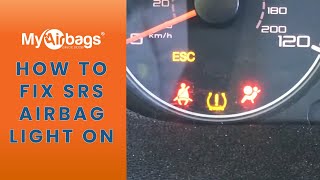
- Airbag or SRS warning light is on — The primary symptom. The light stays illuminated on the dashboard continuously, indicating the entire safety system is disabled.
- Passenger airbag disabled light is on — The system disables the passenger airbag as a precaution because it cannot verify the status of the seat belt or occupant.
- Warning message on the instrument cluster — Many vehicles display a specific text message like "Service Airbag System," "Check Restraint System," or "Passenger Restraint System Malfunction."
- Persistent warning chimes — The car produces a persistent warning chime upon startup, or the 'fasten seat belt' chime continues indefinitely even after the passenger buckles up.
Diagnostic Flowchart
Tap your situation to follow the diagnostic path that matches what you're seeing on this code.
Common Fixes & Costs
- Repairing wiring or cleaning connector under the seat
— Parts: $5-$25, Labor: $100-$250, ~1.5 hr book time
(Intermediate)
: OEM - Replacing the seat belt pretensioner assembly
— Parts: $200-$500, Labor: $150-$300, ~1.5 hr book time
(Professional)
: OEM
: OEM - Mail-in seat belt pretensioner repair service — Parts: $75-$120, Labor: $100-$200, ~1.5 hr book time (DIY)
- OCS/RCM Module Calibration or Reprogramming — Parts: $0, Labor: $120-$250, ~1.0 hr book time (Professional)
Used vs. New Parts: Buying Guide
When a used part is worth it: Buying used SRS components is highly discouraged due to unknown history. A used part was often deployed, exposed to moisture, or carries hidden damage. A mail-in repair service for your original part is a safer, more cost-effective alternative to a questionable salvage part.
Donor-vehicle mileage cap: roughly under 30000 miles for the part to have meaningful remaining life.
Donor quality checklist:
- Must be from a certified recycler with a clear return policy and warranty.
- Verify donor vehicle was not a flood or fire victim.
- Part number must be an exact match; superseded numbers fail to communicate.
- Visually inspect for corrosion, stress marks, or previous deployment.
Decision logic:
- If The original part has only an electrical fault (not deployed) → Use a mail-in repair service. This is the safest, most cost-effective option, retaining the original VIN-matched part.
- If The part is physically destroyed or deployed → Buy a new OEM part. The safety risk of a faulty SRS component is too high to justify salvage yard savings.
Warranty tradeoff: Salvage yard parts offer 30-90 day warranties. New OEM parts carry 1-year warranties. Professional repair services typically offer lifetime warranties on their work.
Worst-case if a used part fails: $300-$600 if the used part is DOA (repeat labor + cost of another part). The ultimate cost is a non-functional safety system in a crash.
What Happens If You Wait — Timeline
- 0 seconds: The SRS module detects an out-of-range resistance reading. The airbag warning light illuminates instantly, disabling the entire SRS system. (MPG impact: 0%% · Added cost: $0)
- Immediate and ongoing: The vehicle operates without functional airbags or pretensioners. The risk of serious injury or death in a collision is dramatically increased. (MPG impact: 0%% · Added cost: Potentially infinite in the event of an accident.)
- At the next state safety inspection: The vehicle automatically fails safety inspection in most states, preventing legal road use until repaired. (MPG impact: 0%% · Added cost: $50-$150 in inspection/re-inspection fees.)
Cost of Not Fixing It
- Immediately: The entire Supplemental Restraint System (SRS) is disabled. No airbags and no seat belt pretensioners deploy in a collision, dramatically increasing the risk of severe injury or death. (Added cost: N/A)
- At next state inspection: Vehicle automatically fails mandatory safety inspections, preventing legal registration renewal until repaired. (Added cost: Cost of re-inspection fee.)
Diagnosis Steps

- Scan for Codes & Suffixes
Use an SRS-capable OBD-II scanner to confirm B0061. Note any manufacturer-specific suffix codes (e.g., Ford's B0061-13 for 'Circuit Open'), as they pinpoint the exact electrical fault type.
Tools: SRS-capable OBD-II Scanner (Beginner) - Check for Technical Service Bulletins (TSBs)
Search online for TSBs related to B0061 for your specific vehicle. Manufacturers frequently release bulletins for known wiring or calibration issues (like Nissan's OCS TSBs or GM's connector corrosion recall), saving hours of diagnostic time.
Tools: Internet access (Beginner) - Visual Inspection & 'Tug Test'
Look under the front passenger seat for the yellow SRS connector. Check for pinched or frayed wires. Gently tug on each wire entering the connector; internal breaks are common, and a light pull reveals broken wires hiding inside intact insulation.
Tools: Flashlight (Beginner) - Disconnect Battery and Reseat Connector
SAFETY FIRST: Disconnect the negative battery terminal and wait exactly 15 minutes for the SRS backup power to discharge. Disconnect the pretensioner's yellow connector, inspect pins for corrosion, spray with electronic contact cleaner, and plug it back in firmly. Apply dielectric grease to prevent future corrosion. Reconnect the battery and check if the code returns.
Tools: Wrench set, Electronic contact cleaner, Dielectric grease (Beginner) - Live Data Stream Analysis
Using an advanced scan tool, view live data for the passenger pretensioner circuit resistance. A healthy circuit shows a stable 2.0 to 3.0 Ohms. While monitoring, wiggle the harness under the seat. If resistance jumps to OL (Open Loop) or fluctuates wildly, you have an intermittent wiring fault.
Tools: Advanced SRS Scan Tool (Intermediate) - Test Pretensioner Resistance
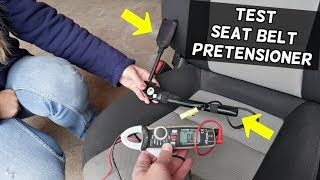
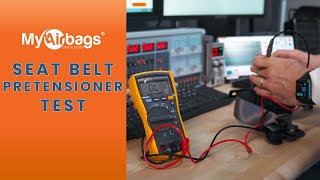
With the battery disconnected, unplug the pretensioner. Use a multimeter to measure resistance across the two pins on the pretensioner assembly. Normal is 2.0-3.0 Ohms. Open loop (OL) indicates a blown/faulty pretensioner. Near zero ohms indicates a short. WARNING: Use proper pin-out tools; never force standard multimeter probes into SRS connectors.
Tools: Multimeter, Terminal pin-out kit (Advanced) - Test Harness Wiring for Continuity and Shorts
With the battery disconnected and both the pretensioner and SRS module unplugged, check for continuity on the two wires between the module and the pretensioner connector (should be <0.5 ohms). Check each wire for a short to ground (should be OL). An open circuit or short to ground requires harness repair.
Tools: Multimeter, Vehicle-specific wiring diagram (Advanced) - Harness Load Testing (Pro Tip)
A standard continuity test is often misleading if corrosion exists. With the harness disconnected at both ends, use a fused jumper wire with a headlamp bulb to pass a small load through each wire. A dim bulb indicates high resistance in the wire that a multimeter missed.
Tools: Circuit load testing tool, Wiring diagram (Professional)
When This Code Triggers (Freeze-Frame Conditions)
- System State: Ignition ON (The SRS module performs a self-test upon every key-on event.)
- Circuit Resistance: Outside 2.0-3.0 Ohm range (The module continuously monitors circuit resistance; an open, short, or high resistance sets the code instantly.)
- Component Status: Fault Detected (The code sets the moment the RCM detects an out-of-spec reading from the pretensioner circuit.)
Related Codes
- B0062 — Equivalent code for the passenger seat belt pretensioner 'B' circuit in dual-stage systems. Requires a wiring diagram to identify which connector corresponds to circuit 'A' (B0061) versus 'B' (B0062).
- B0051 — Equivalent code for the driver's side seat belt pretensioner circuit. The diagnostic process is identical, performed on the driver's side.
- B00A0 — Indicates an 'Occupant Classification System (OCS) Unit Fault'. Frequently appears with B0061 on Nissan and Ford vehicles. Diagnose B00A0 first, as the fault lies with the OCS module or its calibration.
- U3000 — A 'Control Module Communication Error'. If present with B0061, the main SRS module is not receiving a signal from a sub-module. Focus on CAN bus network wiring before testing the pretensioner.
Climate & Environmental Factors
- Moisture and Road Salt Ingress: Water from rain, spills, or melted snow laden with road salt drips directly onto the floor, reaching the SRS connectors under the seat. Saltwater is highly corrosive and dramatically accelerates the degradation of wiring and connector terminals, causing high resistance.
- Extreme Temperature Fluctuations: Significant temperature changes cause the metal pins and plastic housings of electrical connectors to expand and contract at different rates, leading to intermittent or loose connections over time.
How to Talk to a Mechanic About This Code
Say this: "I have an airbag light on and my scanner shows code B0061 for the passenger seat belt pretensioner. Since the most common cause is the wiring under the passenger seat, please have the technician start by inspecting and testing the connector and harness before quoting a full pretensioner replacement."
This signals you are an informed customer. It directs the shop to perform a proper diagnosis starting with the least expensive fix, preventing you from being oversold on a full assembly replacement.
Avoid saying:
- 'My airbag light is on, can you fix it?'
- 'Just do whatever it takes to turn the light off.'
- 'A friend said I need a new airbag.'
Questions to ask before authorizing the repair:
- Did you find a specific fault in the wiring, like a break or corrosion, or are you recommending a part replacement?
- If you are recommending a new pretensioner, what was the resistance measurement of the original part to confirm it failed?
- Have you checked for any Technical Service Bulletins (TSBs) related to this code for my vehicle?
Where to Take It: Dealer vs Independent vs Chain
- Dealer:
A strong, but expensive, choice. Best if the fix requires manufacturer-specific software updates, but overkill for a simple wiring problem.
Best for: Vehicles under warranty, Complex cases involving module reprogramming or calibration (common on Nissan/Ford), Repairs related to a specific recall or TSB.
Downsides: Highest labor rates, Often defaults to replacing an entire assembly rather than repairing a wire. (Typical cost: +50% vs. baseline) - Independent Shop:
Best fit for most situations. A reputable independent shop with good electrical skills diagnoses and fixes common B0061 causes for significantly less than a dealer.
Best for: Out-of-warranty vehicles where the cause is likely wiring or a straightforward component swap., Getting a second opinion on a high dealer quote.
Downsides: Shop must have experience and proper tools for SRS diagnostics; vet them by asking if they are comfortable diagnosing airbag systems. (Typical cost: +0% vs. baseline) - Chain Shop:
AVOID. SRS repair is a safety-critical task requiring specialized knowledge beyond what is typical at a chain shop.
Best for: Simple maintenance like oil changes and tires.
Downsides: Technician skill with complex electrical and safety systems is highly variable., High pressure to sell parts leads to misdiagnosis and unnecessary replacement of expensive SRS components. (Typical cost: -10% vs. baseline)
When to Walk Away From the Repair
If the estimated repair cost exceeds 50% of the car's private-party value, pause and consider your options. However, because this is a critical safety failure, the threshold to repair is higher than for non-essential issues.
- Car worth $4000, fix is $2200: Walk away. The repair cost is over 50% of the car's value, making it economically unsound.
- Car worth $12000, fix is $800: Fix it. The cost is well below the threshold and restores a critical safety feature, preserving vehicle value.
- Car worth $3000, fix is $250: Fix it. A low-cost wiring repair is always worth it to make the vehicle safe and sellable.
What Scan Tool You Need for This Code
Minimum: A scanner that reads and clears SRS/Airbag (B-prefix) codes. A basic engine-only code reader will NOT see this fault.
Standard $20-$40 code readers only communicate with the Engine Control Module (ECM). The B0061 code is stored in the Supplemental Restraint System (SRS) module.
Budget: Autel AutoLink AL619 (~$80) — Specifically designed to read and clear codes from the Engine, ABS, and SRS modules. Confirms B0061 is present and clears it after repair.
Mid-range: BlueDriver Pro (~$120) — Connects to a smartphone via Bluetooth. Reads/clears SRS codes and views live data from the SRS module, useful for diagnosing intermittent wiring faults by wiggling connectors.
Professional: Autel MaxiCOM MK808 (~$350) — Offers bidirectional control and access to manufacturer-specific data. Performs advanced functions like OCS calibration and reads fault code suffixes (crucial for Fords).
Rent vs buy: Most auto parts stores offer loan-a-tool programs, but their free scanners are often basic models that cannot read SRS codes. You must purchase an SRS-capable scanner.
How to Clear the Code After You Fix It
- Ensure the underlying electrical fault is properly repaired.
- Reconnect the negative battery terminal.
- Use an SRS-capable OBD-II scan tool to access the Restraints Control Module.
- Select the function to 'Clear Codes' or 'Erase DTCs'.
- Cycle the ignition off, then on, and verify the airbag warning light performs its self-test (illuminates briefly, then turns off permanently).
Drive cycle (~1 minutes): The SRS system does not require a drive cycle. It performs a complete self-test of all components each time the ignition turns on. If the repair is successful, the light remains off immediately.
Readiness monitors affected: None. SRS system status is separate from emissions readiness monitors.
Watch out for:
- Using a standard engine code reader that cannot access the SRS module.
- Failing to fix the root cause (e.g., a broken wire), causing the code to reappear immediately.
- Assuming disconnecting the battery clears a hard SRS fault code; it does not.
Will This Fail Emissions / State Inspection?
No — by itself this code doesn't fail OBD inspection (but it can keep readiness monitors from setting, which causes a separate fail).
- California: Will NOT fail. A California smog check is strictly for emissions. An airbag light does not affect the smog test.
- New York: WILL FAIL. New York combines emissions and safety into a single inspection. An illuminated airbag warning light is an automatic failure.
- Texas: Will NOT fail. The Texas annual safety inspection does not include the SRS/airbag system as a checkable item.
Most Commonly Affected Vehicles
- Ford Fiesta (2011-2019) — Extremely common issue where the three wires for the passenger pretensioner break internally at the base of the seat belt anchor due to seat movement. A gentle pull on the wires reveals the fault.
- Ford Focus (2012-2018) — Prone to faults in the Occupant Classification System Module (OCSM) and the Belt Tension Sensor (BTS). Diagnosis requires a scan tool that reads live data from the OCSM.
- Chevrolet / GMC Silverado, Sierra, Tahoe, Suburban (2007-2014) — Known for high resistance in the large yellow SRS connectors under the seats due to fretting corrosion. GM issued Safety Recall 14030A to remove the connector and splice the wires directly.
- Nissan Altima, Sentra, Rogue (2013-2024) — Often related to TSB NTB19-071D. A fault in the Occupant Classification System (OCS) triggers the light, often with code B00A0. The fix is frequently a software calibration of the OCS, not hardware replacement.
- BMW 3 Series, 4 Series (F3x chassis) (2012-2019) — Reports of 'Passenger Restraint System Malfunction' trace to faulty wiring harnesses under the seat or issues with the seat occupancy mat sensor, often exacerbated by moisture from clogged sunroof drains.
Manufacturer-Specific Notes
- Ford: Codes include a two-digit suffix (e.g., B0061-13) specifying the fault type: '-11' for short to ground, '-12' for short to battery, and '-13' for circuit open. This pinpoints the exact electrical issue.
- General Motors (GM): GM vehicles suffer from fretting corrosion in the large yellow SRS connectors under the front seats. The official GM repair (Recall 14030A) removes the connector entirely to splice the wires together.
- Nissan: Code B0061 is heavily linked to TSB NTB19-071D, addressing an OCS fault that requires a specific calibration procedure rather than pretensioner replacement. Always check this TSB first.
Real Owner Stories
2015 Ford Fiesta with B0061-13
Airbag light stayed on. A scan revealed code B0061-13 (passenger seat belt tension sensor circuit open).
Outcome: The owner soldered the three broken wires back together and cleared the code. The repair resolved the open circuit, and the airbag light stayed off.
Lesson: On Ford Fiestas, an open circuit code for the pretensioner is almost always caused by internal wire breaks at the seat belt anchor. A physical 'tug test' is mandatory; visual inspection alone fails.
2015 Nissan Altima with SRS Light
The SRS warning light came on suddenly without an accident. The dealership quoted $3,000 for a full system replacement.
Outcome: The independent shop found a dirty electrical connector under the passenger seat. After cleaning the connector with contact spray, the total cost was $150 in labor, saving thousands.
Lesson: Always get a second opinion on high-dollar SRS repair quotes. Complex-sounding problems frequently have simple, inexpensive solutions like cleaning a connector.
2015-2018 Ford Focus with B0061 and B00A0
Airbag light on with codes B0061 (Passenger Pretensioner) and B00A0 (Occupant Classification System Fault).
Outcome: The issue was a faulty OCSM (a gel-filled bladder and sensor). Replacing the OCSM and performing a system calibration with a scan tool resolved both codes.
Lesson: When B0061 appears alongside B00A0, the problem is almost certainly the Occupant Classification System (OCS). Diagnose the OCS system first; replacing the pretensioner alone will not fix it.
How to Prevent This Code From Triggering
- Apply dielectric grease to under-seat connectors (Once, or whenever seats are removed) — Seals the electrical connector from moisture and road salt, preventing pin corrosion that causes high resistance.
- Avoid storing items under the front seats (Daily habit) — Prevents objects from shifting and snagging, pinching, or disconnecting the sensitive SRS wiring harness.
- Address water leaks immediately (As needed) — Fixing clogged sunroof drains or bad window seals prevents water from pooling on the floor and wicking into SRS connectors.
Frequently Asked Questions
What is a seat belt pretensioner?
It is a small, pyrotechnic device connected to your seat belt buckle or retractor. In a crash, it fires a gas charge that instantly pulls the seat belt tight. This removes slack and holds you firmly in the safest position just before the airbag deploys.
Why did the airbag light come on after I moved the passenger seat?
Moving the seat stresses weak wires or wiggles loose connectors in the under-seat wiring harness. This interrupts the electrical signal and triggers the fault code instantly. Inspecting the yellow connector under the seat is your first diagnostic step.
What does the suffix on a Ford code like B0061-13 mean?
The suffix pinpoints the exact electrical fault. For example, '-13' means 'Circuit Open', indicating a broken wire or bad connection. Other suffixes include '-11' (Short to Ground) and '-12' (Short to Battery), which drastically speeds up diagnosis.
Can I just clear the B0061 code to turn off the light?
You can clear the code with a scanner, but the SRS module performs a self-test on the next startup. If the underlying electrical problem still exists, the light comes right back on. The physical fault must be repaired first.
Why did the dealer quote me $2,500 for this repair?
Shops frequently misdiagnose simple wiring or calibration issues as major component failures. They quote replacing the entire seat belt assembly, OCS module, and SRS computer when the real fix is cleaning a connector or performing a software calibration. Always get a second opinion on massive SRS quotes.
Is it safe for me to work on the airbag system?
You must take extreme caution. Always disconnect the negative battery terminal and wait exactly 15 minutes before touching any yellow SRS components. This discharges the system's backup power capacitors, preventing accidental deployment and serious injury.
Will a B0061 code cause my car to fail a state safety inspection?
Yes. In jurisdictions with safety inspections, an illuminated airbag/SRS warning light is an automatic failure. The vehicle's primary safety systems must be fully functional to pass and legally register the car.
Key Takeaways
- Code B0061 indicates a critical electrical fault in the passenger seat belt pretensioner circuit that instantly disables the entire airbag system.
- Inspect the yellow SRS connector under the front passenger seat first, as damaged or corroded wiring accounts for over 70% of B0061 triggers.
- Stop driving the vehicle immediately; a B0061 code guarantees zero airbag deployment and zero seat belt pretensioning during a collision.
- Disconnect the negative battery terminal and wait exactly 15 minutes to discharge the SRS backup capacitors before touching any yellow airbag connectors.
- Save $500 to $1,000 in unnecessary part replacements by checking for manufacturer Technical Service Bulletins (TSBs) and performing a $10 contact-cleaning on the under-seat harness.
Helpful Videos
Shop the Parts Behind B0061
Below are the parts most often responsible for code B0061, ranked by how frequently each one is the actual culprit (per the diagnosis above). Tap any to see what we have for your vehicle.


The information in this article is provided for general reference and educational purposes only. Vehicle specifications, procedures, and part compatibility can vary by production date, trim level, and region. Always consult your vehicle's factory service manual and verify part numbers before purchasing or performing repairs. Safety-critical components such as airbags, seat belts, and braking systems should be installed by a qualified professional.
- 🧭 Diagnostic Flowchart
- 🎬 Helpful Videos
- 🛍️ Shop This Part
- What Does B0061 Mean?
- Can I Drive With B0061?
- Common Causes
- Symptoms
- Common Fixes & Costs
- Used vs. New Parts: Buying Guide
- What Happens If You Wait — Timeline
- Cost of Not Fixing It
- Diagnosis Steps
- When This Code Triggers (Freeze-Frame Conditions)
- Related Codes
- Climate & Environmental Factors
- How to Talk to a Mechanic About This Code
- Where to Take It: Dealer vs Independent vs Chain
- When to Walk Away From the Repair
- What Scan Tool You Need for This Code
- How to Clear the Code After You Fix It
- Will This Fail Emissions / State Inspection?
- Most Commonly Affected Vehicles
- Manufacturer-Specific Notes
- Real Owner Stories
- 2015 Ford Fiesta with B0061-13
- 2015 Nissan Altima with SRS Light
- 2015-2018 Ford Focus with B0061 and B00A0
- How to Prevent This Code From Triggering
- Frequently Asked Questions
- What is a seat belt pretensioner?
- Why did the airbag light come on after I moved the passenger seat?
- What does the suffix on a Ford code like B0061-13 mean?
- Can I just clear the B0061 code to turn off the light?
- Why did the dealer quote me $2,500 for this repair?
- Is it safe for me to work on the airbag system?
- Will a B0061 code cause my car to fail a state safety inspection?
- Key Takeaways
- 🎟️ Get 5% Off