

OBD-II Code B0106: Seatbelt Pretensioner Circuit Problem
What B0106 means, why it triggers, and how to fix it
- A B0106 code disables your entire airbag system, increasing the risk of driver fatality in a frontal crash by 29%.
- Damaged wiring or a loose yellow connector under the front seats causes over 80% of B0106 faults.
- On Toyota and Lexus vehicles, B0106 specifically indicates a failure in the passenger-side pretensioner circuit, not the driver's side.
- Always disconnect the negative battery terminal and wait 15 minutes before inspecting or repairing any yellow SRS connectors to prevent accidental airbag deployment.
What Does B0106 Mean?
B0106 is a diagnostic trouble code indicating the car's Restraint Control Module (RCM) detected an electrical problem in a seatbelt pretensioner circuit. The pretensioner is a pyrotechnic safety device that instantly tightens the seatbelt during a crash. This code signifies the pretensioner in the affected circuit will not work when needed. While B0106 often refers to the driver's side, on many vehicles (notably Toyota and Lexus), it specifically points to the passenger's side, making a manufacturer-specific scan tool crucial for accurate diagnosis.
Technical definition: The official SAE/ISO definition for B0106 is "Driver Pretensioner Deployment Control Circuit" with qualifiers like "Short Circuit" or "Open Circuit". However, on Toyota, Lexus, and some Fiat vehicles, it is defined as "Open in P Squib Circuit" or "Circuit Resistance Above Threshold," where 'P' refers to the Passenger side. This indicates a short circuit, an open circuit (a break in the wire), or incorrect resistance in the wiring or component controlling the designated seatbelt pretensioner. The SRS module is extremely sensitive and triggers a fault for a resistance change of less than 0.5 ohms.
Can I Drive With B0106?
No — Do Not Drive. The vehicle mechanically operates, but it is **not safe** to drive. A B0106 code means the Restraint Control Module (RCM) detected a critical fault and disabled the entire Supplemental Restraint System (SRS). In a crash, the airbags and seatbelt pretensioners **will not deploy**, significantly increasing the risk of serious injury or death. Research from the IIHS shows functional frontal airbags reduce driver fatalities by 29%. Driving with this light on means you have lost this critical life-saving protection.
Common Causes
- Damaged Wiring or Loose Connectors Under the Seat (Very Common) — The wiring for the pretensioner runs under the front seats. Items pushed under the seat, aggressive vacuuming, the back-and-forth movement of the seat, or improper installation of aftermarket seat covers damage the wires or loosen the primary yellow connector, causing an instant circuit fault.
- Corroded Connector Terminals (Common) — Moisture from spills, rain, or leaking sunroofs causes corrosion on the electrical pins inside the pretensioner connector. This corrosion increases resistance in the circuit, which the SRS module detects as a fault.
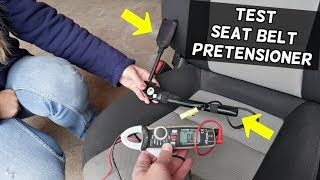
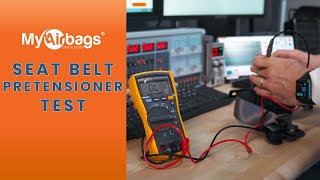
- Failed Seatbelt Pretensioner Assembly (Common) — The pretensioner contains a small pyrotechnic charge (squib) and an internal resistor. This component fails electrically over time, or its internal resistance falls outside the manufacturer's specified range (typically 2.0-3.5 ohms 🎬 See how to perform a professional pretensioner resistance test), triggering the code.
- Previous Accident or Minor Collision (Common) — A collision forceful enough to deploy the seatbelt pretensioners permanently disables them. Deployed pretensioners are one-time-use devices and require replacement or professional rebuilding to clear the code.
- Faulty Airbag (SRS) Control Module (Less Common) — The SRS control module monitors the entire airbag system. The module itself occasionally fails internally, incorrectly reporting a pretensioner circuit fault.
- Cracked Solder Joints in Overhead Console (Subaru) (Uncommon) — On 2005-2009 Subaru models, cracked solder joints on the passenger airbag indicator light circuit board cause a system fault, often misdiagnosed as a pretensioner issue.
- Damaged Clockspring (Rare) — Wiring for the seatbelt pretensioner sometimes routes through the steering column clockspring. A broken circuit inside the clockspring triggers this code, though it more commonly causes faults with the driver's airbag.
- Poor Ground Connection (Rare) — The SRS system relies on solid chassis grounds. A loose or corroded ground strap causes fluctuating voltage and resistance, triggering false B0106 codes.
Symptoms
- Airbag or SRS Warning Light On — This is the most common and often the only symptom. The light stays illuminated on the dashboard as long as the fault is present.
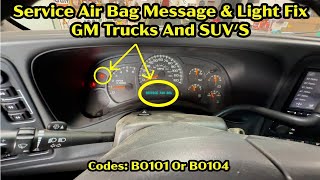
- Message on the Instrument Cluster — Some vehicles display a specific message like "Service Airbag System 🎬 Watch: How to fix common airbag light issues on GM trucks" or "Pretensioner Fault" on the driver information center.
- Seatbelt is Locked or Won't Retract — If the pretensioner deployed due to a malfunction or a past impact, the seatbelt is stuck and will not retract or pull out.
- Seatbelt is Loose or Sags — A faulty or deployed pretensioner causes the seatbelt to lose its normal tension, feeling loose even when buckled.
- Audible Chime or Beep — Many vehicles sound a periodic chime or beep to alert the driver that a fault exists within the SRS system.
Diagnostic Flowchart
Tap your situation to follow the diagnostic path that matches what you're seeing on this code.
Common Fixes & Costs
- Repairing Damaged Wiring or Cleaning Connector — Parts: $0-$25, Labor: $125-$300, ~1.5 hr book time (Intermediate)
- Rebuilding the Original Seatbelt Pretensioner — Parts: $75-$120, Labor: $100-$200, ~1.2 hr book time (Intermediate)
- Replacing the Seatbelt Pretensioner Assembly
— Parts: $200-$500, Labor: $150-$300, ~1.2 hr book time
(DIY)
: OEM
: OEM
: OEM - Resetting the Airbag (SRS) Control Module — Parts: $50-$150, Labor: $50-$100, ~1 hr book time (Intermediate)
- Replacing the Airbag (SRS) Control Module — Parts: $200-$700, Labor: $150-$350, ~1.5 hr book time (Professional)
DIY vs Professional
- Repairing Damaged Wiring or Cleaning Connector — Beginner: No
Tools: Multimeter, soldering iron or quality crimp connectors, heat shrink tubing, electrical contact cleaner. - Replacing the Seatbelt Pretensioner Assembly — Beginner: Yes
Tools: Basic wrench/socket set, trim removal tools. - Rebuilding the Original Seatbelt Pretensioner — Beginner: Yes (Removal/Installation only)
Tools: Basic wrench/socket set, shipping box. - Replacing the Airbag (SRS) Control Module — Beginner: No
Tools: Socket set, trim removal tools, professional scan tool for programming.
Used vs. New Parts: Buying Guide
When a used part is worth it: Buying a used seatbelt pretensioner is not recommended due to its nature as a one-time-use pyrotechnic safety device. Consider it only as an absolute last resort. A professional mail-in rebuild service for your original part is a much safer and more reliable alternative to a used part of unknown history.
Donor quality checklist:
- Must come from a reputable salvage yard that guarantees the donor vehicle was not in a collision.
- Part number must be an exact match to the original.
- Inspect the connector and wiring for any signs of corrosion, damage, or previous repair.
- Never buy a deployed (visibly compressed or locked) pretensioner.
Decision logic:
- If Safety is the top priority and budget allows → buy a new OEM part from a dealer.
- If You want a balance of safety and value → use a mail-in rebuild service to have your original part professionally repaired.
- If Budget is the absolute primary constraint → a used part from a guaranteed non-wrecked vehicle is a possibility, but carries inherent risk.
Warranty tradeoff: New OEM parts carry a 1-year manufacturer warranty. Reputable rebuild services often provide a lifetime warranty on their repair work. Used parts typically offer a minimal 30-90 day functional warranty.
Worst-case if a used part fails: $250-$500. If the used part is faulty or was previously deployed, you lose the money spent on the part and the labor for the initial installation, and pay for labor again to replace it.
What Happens If You Wait — Timeline
- Immediately: Code is set and SRS warning light illuminates. The entire Supplemental Restraint System (airbags, pretensioners) is disabled by the control module as a fail-safe. (MPG impact: 0%% · Added cost: $0)
- First Drive: The vehicle is driven without functioning airbags, posing an immeasurable safety risk. An intermittent fault (e.g., loose wire) is temporarily resolved by vibration, causing the light to go out, giving a false sense of security. (MPG impact: 0%% · Added cost: Potential for injury/death in a crash. The financial cost is incalculable.)
- 1-6 Months: The vehicle automatically fails any mandatory state safety inspection, preventing legal road use. An underlying corrosion issue worsens, potentially damaging connector pins beyond simple cleaning. (MPG impact: 0%% · Added cost: $20-$50 for a failed inspection fee, plus a potential increase in repair cost from a $10 cleaning job to a $150 wiring pigtail replacement.)
- 6+ Months: The known safety defect significantly impacts the vehicle's resale value. Selling the car without disclosing the disabled airbag system leads to legal liability. (MPG impact: 0%% · Added cost: $500-$2000+ in reduced private party resale value.)
Cost of Not Fixing It
- Immediately: The entire Supplemental Restraint System (airbags and pretensioners) is disabled and will not deploy in a collision. (Added cost: The potential cost of serious injury or death in an otherwise survivable accident is immeasurable.)
- At Next Inspection: The vehicle automatically fails its safety inspection in many states due to the illuminated airbag warning light. (Added cost: $20-$50 for the failed inspection fee, plus the eventual cost of the required repair.)
- During Ownership: Reduced resale value and potential legal issues if selling the car without disclosing a known, major safety defect. (Added cost: Lowers vehicle value by $500-$2000+ depending on the model and buyer awareness.)
Diagnosis Steps
- Read the Specific SRS Codes
Use an OBD-II scanner capable of reading SRS (airbag) codes. Confirm B0106 is active and note the full manufacturer-specific definition (e.g., 'Driver Pretensioner Open Circuit' vs. 'P Squib Circuit Open'). This is critical as the location varies by brand. Note any other related codes.
Tools: SRS-capable OBD-II Scanner (Beginner) - Visually Inspect Under the Seats
Look for obvious damage to the wiring harness and the yellow connectors leading to the seatbelt buckle/pretensioner on both driver and passenger sides. Check for pinched wires, disconnected plugs, or items that caused damage. Reconnecting a loose plug often fixes the issue.
Tools: Flashlight (Beginner) - Disconnect the Battery
CRITICAL SAFETY STEP: Disconnect the negative terminal of the car battery and wait at least 15-30 minutes before working on any airbag system components. This allows the system's backup capacitors to discharge, preventing accidental deployment and serious injury.
Tools: Wrench set (Beginner) - Inspect and Clean the Connector
After waiting, unplug the suspect pretensioner connector. Look inside for green or white crusty buildup (corrosion) on the pins. If corrosion is found, clean it thoroughly with electrical contact cleaner and a small brush.
Tools: Electrical contact cleaner, small brush (Intermediate) - Test the Pretensioner Resistance
Using a multimeter set to Ohms, measure the resistance across the two pins on the seatbelt pretensioner itself (NOT the wiring harness side). A good pretensioner squib typically has a resistance between 2.0 and 3.5 ohms. A reading of 'OL' (Over Limit) indicates an open circuit, while a reading near 0 ohms indicates a short. Any reading outside the manufacturer's specified range means the part is faulty. Note: Some connectors have a shorting bar that must be pushed aside to get an accurate reading.
Tools: Multimeter (high-impedance recommended) (Advanced) - Isolate the Fault with an SRS Resistor
If the pretensioner tests good, the fault is in the wiring or module. To confirm, plug a special SRS-safe resistor (typically 2.2 ohms) into the wiring harness connector in place of the pretensioner. Reconnect the battery and try to clear the code. If the code clears and stays cleared, the wiring and module are good, confirming the original pretensioner was intermittently faulty. If the code returns, the fault lies in the wiring harness or the SRS module.
Tools: SRS-safe resistor (2.2 Ohm), OBD-II Scanner (Advanced) - Test the Wiring Harness for Shorts and Opens
With the harness disconnected from the pretensioner, turn the key on. Set a multimeter to DC Volts and probe from each of the two pins in the harness connector to a known good chassis ground. Both should read 0V. Any voltage indicates a short to power. Next, with the key off, set the multimeter to Ohms. Check resistance from each pin to chassis ground; the reading should be OL (infinite resistance). A low resistance reading indicates a short to ground. Finally, check for continuity between the harness connector at the seat and the corresponding pins at the SRS module connector to rule out an open wire.
Tools: Multimeter, Vehicle Wiring Diagram (Advanced) - Perform a 'Wiggle Test'
For intermittent faults, reconnect the multimeter to the harness and monitor the resistance reading. Gently wiggle the wiring harness under the seat, along the floor, and up the B-pillar. If the resistance reading fluctuates wildly or goes to OL, you pinpointed the location of a break or loose connection in the wiring.
Tools: Multimeter (Intermediate)
When This Code Triggers (Freeze-Frame Conditions)
- Ignition Status: Key On (The SRS module performs a self-test the moment the ignition is turned on.)
- System Voltage: 11.5-12.5V (Code is typically set before the engine is started, reflecting battery voltage.)
- Vehicle Speed: 0 mph (The fault is almost always detected during the initial stationary self-check.)
- Time Since Key On: < 10 seconds (The SRS self-test is rapid; if the light doesn't turn off after about 7 seconds, a code is stored.)
Related Codes
- B0107 / B0108 — These codes also relate to the pretensioner circuit but indicate different faults: B0107 is 'Short to Ground' and B0108 is 'Short to Power'. They often share the same root causes (damaged wiring) but point to a different type of electrical failure.
- B0101 / B0105 — These codes typically refer to the opposite side of the vehicle. For example, if B0106 is for the driver side on your car, B0101 might be for the passenger side. Seeing a code for a specific side helps rule out a system-wide module failure.
- B0022 / B0026 — These codes relate to faults in the driver's main airbag in the steering wheel. B0106 points to the seatbelt assembly, while these point to the steering wheel airbag. If you see both types of codes, the clockspring becomes a primary suspect.
- B1620 / U3000 — These are general codes indicating an 'Internal Fault' within the SRS/Restraint Control Module itself. If you ruled out all wiring and component issues for a B0106 code but it still won't clear, the module itself is the problem.
Climate & Environmental Factors
- High Humidity / Water Intrusion: Promotes corrosion on electrical pins within the yellow SRS connectors, especially those located under the seats or carpet. This corrosion increases circuit resistance, which the sensitive SRS module detects as a fault, triggering code B0106.
- Extreme Cold: Cold temperatures cause wires and connectors to contract, creating an intermittent open circuit. This manifests as an airbag light that is on during a cold start but goes away after the vehicle's interior warms up and the components expand.
How to Talk to a Mechanic About This Code
Say this: "I have an airbag light on, and my scanner shows a B0106 code. I'd like to schedule a diagnostic appointment. I know this is often a wiring or connector issue under the seat, so please start by inspecting the harness and connector for the specified pretensioner before quoting a full component replacement."
This signals you've done your research and understand the common, simple causes. It directs the technician to perform a proper diagnosis first, preventing them from immediately quoting an expensive new pretensioner or SRS module, which may not be necessary.
Avoid saying:
- 'My airbag light is on, can you just fix it?'
- 'I think I need a new airbag.'
- 'Just do whatever it takes to turn the light off.'
Questions to ask before authorizing the repair:
- Did you find the fault in the wiring, the connector, or the pretensioner itself?
- If it's the pretensioner, what resistance reading did you get from it?
- Can you confirm you checked for loose or corroded pins in the connector under the seat?
- What is the warranty on this specific repair and the parts used?
Where to Take It: Dealer vs Independent vs Chain
- Dealer:
A safe but expensive choice. Good for a definitive diagnosis if you're not price-sensitive or if others can't solve it.
Best for: Vehicles under warranty., Complex cases involving multiple SRS codes or potential module programming., Confirming manufacturer-specific quirks (like the Toyota passenger-side issue).
Downsides: Highest labor rates., Quicker to replace entire assemblies rather than perform detailed wiring repairs. (Typical cost: +50% vs. baseline) - Independent Shop:
Best fit for most situations. An experienced independent technician easily diagnoses and fixes the common causes of B0106 (wiring, connectors) for a reasonable price.
Best for: Out-of-warranty vehicles where cost is a factor., Diagnosing and repairing common wiring and connector faults., Installing customer-supplied rebuilt parts or used components.
Downsides: Quality and expertise with SRS systems varies greatly. Vet shops based on reviews and ASE certifications., Lacks expensive, dealer-level programming tools for brand new modules. (Typical cost: +0% vs. baseline) - Chain Shop:
AVOID for this code. The risk of misdiagnosis or being sold unnecessary, expensive parts like an SRS module is high. This is not a simple parts-swap job.
Best for: Simple, unrelated maintenance like oil changes or tires.
Downsides: Technicians lack specialized training in complex SRS diagnostics., Business model encourages quick parts replacement over detailed electrical troubleshooting. (Typical cost: -10% vs. baseline)
When to Walk Away From the Repair
If the total estimated repair cost exceeds 50% of your car's current private-party value (check Kelley Blue Book or Edmunds), seriously consider not fixing it and selling the car as-is.
- Car worth $4000, fix is $2200: Walk away. The repair cost is over 50% of the car's value. It is not economically sensible to proceed.
- Car worth $15000, fix is $800: Fix it. This repair is well below the 50% threshold and is necessary for the vehicle's primary safety system.
- Car worth $2500, fix is $1600: Walk away. The repair cost is nearly 65% of the vehicle's value. The money is better put towards a replacement vehicle.
What Scan Tool You Need for This Code
Minimum: An OBD-II scanner that specifically reads and clears 'B' (Body) codes, specifically for the SRS/Airbag system.
A standard $20 engine code reader will NOT see SRS codes like B0106. It reports 'No Codes Found' even with the airbag light on. You need a tool with enhanced diagnostics for the SRS module to even see the problem.
Budget: BlueDriver Pro (~$99) — Connects to your smartphone via Bluetooth. It reads and clears SRS/airbag codes for most major brands (GM, Ford, Toyota, etc.), provides freeze-frame data, and offers repair reports based on the specific code.
Mid-range: Foxwell NT510 Elite / NT630 Plus (~$150) — A powerful handheld unit that provides OE-level diagnostics for a specific car brand (you choose one for free). It reads and clears SRS codes, views live sensor data from the SRS module, and performs some bidirectional tests, which is very helpful for advanced diagnosis.
Professional: Autel MaxiCOM MK808 (~$500) — A professional-grade tablet scanner. It offers comprehensive, all-system diagnostics including full SRS capabilities for a wide range of vehicles. It reads/clears codes, views live data, gets ECU information, and performs advanced functions, making it suitable for a serious DIYer or small shop.
Rent vs buy: Most auto parts stores (like AutoZone) do NOT rent out scanners capable of reading SRS codes due to liability. If this is a one-time fix, your cheapest option is to pay a shop a 1-hour diagnostic fee ($100-$180). If you plan to do your own car repairs regularly, buying a tool like the BlueDriver or Foxwell is a worthwhile investment.
How to Clear the Code After You Fix It
- Perform the physical repair with the battery disconnected.
- Reconnect the battery.
- Use an SRS-capable OBD-II scan tool to access the Restraint Control Module.
- Select the option to 'Clear Codes' or 'Reset Faults'.
- Cycle the ignition off, then on. The SRS light illuminates for its self-test (approx. 7 seconds) and then turns off.
Drive cycle (~10 minutes): An SRS code does not require a traditional drive cycle. After clearing the code, a 10-minute test drive ensures vibrations and movement do not cause an intermittent fault to return.
Readiness monitors affected: None. 'B' (Body) codes do not affect powertrain emissions readiness monitors.
Before emissions retest: drive at least 100 miles to fully set monitors.
Watch out for:
- Attempting to clear the code without first fixing the electrical fault; the code returns instantly.
- Using a basic OBD-II scanner that cannot communicate with the SRS module.
- Assuming disconnecting the battery clears a 'hard fault' from the SRS module's memory.
- Forgetting that disconnecting the battery resets emissions readiness monitors, requiring a separate, full drive cycle (50-100 miles) before the vehicle passes an emissions test.
Will This Fail Emissions / State Inspection?
Yes — this code typically fails an OBD-II emissions inspection.
- California: Will NOT fail. California does not have a comprehensive mandatory safety inspection program for private passenger vehicles, so an airbag light does not prevent registration renewal.
- New York: Will NOT fail, but is noted. The NY DMV states that an illuminated airbag light is an 'advisement only' and not cause for rejection. However, uninformed shops sometimes incorrectly fail the vehicle.
- Texas: Will NOT fail. The airbag system is not a required item on the Texas vehicle inspection checklist.
- Virginia / Pennsylvania: Will FAIL. These states have strict annual safety inspections, and an illuminated SRS/airbag warning light is an automatic failure.
Most Commonly Affected Vehicles
- Toyota Tacoma, Camry, Corolla (1998-2020) — Extremely common for B0106 to mean 'Open in P Squib Circuit,' referring to the PASSENGER side airbag or pretensioner. A generic scanner is misleading.
- Chevrolet/GMC Silverado / Sierra, Corvette (2007-2014 (Trucks), 2005-2013 (Corvette)) — Trucks are known for under-seat wiring issues. GM issued Special Coverage 15643 for Corvettes due to the seat wiring connector being damaged by the seat's crossbar. The fix involves replacing the connector with a soldered connection.
- Subaru Outback, Legacy, Impreza (2005-2009) — Known for the airbag light being caused by cracked solder joints on the overhead console's passenger airbag indicator light circuit. This is misdiagnosed as a pretensioner or sensor issue if not properly investigated.
- Dodge/Ram Ram 1500/2500/3500 (2009-2018) — Similar to GM trucks, the large cabin and frequent seat movement leads to wear and tear on the pretensioner wiring harness under the driver or passenger seat.
- Ford F-150 (2015-2020) — Case studies show B0106 is caused by a corroded airbag igniter connector, often resolved by cleaning the terminals. The Restraint Control Module (RCM) is sensitive to small changes in resistance.
- Honda Civic, Accord (2012-2016) — A documented case on a 2015 Civic showed a B0106 caused by a wiring harness under the passenger seat being damaged by aftermarket seat covers.
- BMW 3-Series (E90) (2006-2012) — These models experience various SRS faults due to faulty wiring and sensors under the seats, including the passenger seat occupancy mat, which triggers system-wide warnings.
- Lexus IS, RX, SC series (2002-2015) — Like Toyota, B0106 almost always indicates a fault in the Passenger side ('P Squib') circuit, which is the pretensioner or another airbag component on that side.
Manufacturer-Specific Notes
- Toyota / Lexus: On most Toyota and Lexus models, B0106 *always* refers to the **Passenger** side pretensioner circuit, defined as 'Open in P Squib Circuit'. A generic scanner incorrectly labels this as a driver-side fault, leading to misdiagnosis. It is critical to use a scanner that provides the full manufacturer definition.
- General Motors (GM): GM issued Special Coverage bulletin 15643 for 2005-2013 Corvettes and 2004-2009 Cadillac XLRs where the seat wiring harness connector is frequently damaged by the seat's crossbar. The fix is to replace the connector with a more robust, soldered connection. A similar bulletin (14710) was issued for 2010-2011 Chevy Equinox and GMC Terrain models.
- Subaru: On models from 2005-2009 like the Outback and Legacy, cracked solder joints on the overhead passenger airbag indicator light cause an airbag warning light. This is misdiagnosed as a sensor or pretensioner fault. Additionally, a warranty extension (WTV-68) was issued for melting dashboards on these models, relevant if the dash needs removal for SRS access.
- Ford: On Ford vehicles, the Restraint Control Module (RCM) is highly sensitive to resistance changes. Corrosion in a connector is a common culprit for setting this code, as seen in F-150 case studies.
Real Owner Stories
1st Gen Toyota Tacoma with B0106
The airbag light came on suddenly after the owner's son pushed a baseball bat under the dashboard near the center console area.
What they tried:
- Attempting to clear the code with a scanner did not work.
- Disconnecting the battery did not clear the light.
Outcome: The owner unplugged the three yellow squib connectors located under the dash, pushed the wires in for a better connection, and plugged them back in. This simple action made the light turn off and stay off.
Lesson: Physical interference is a primary cause for this code. Before any expensive diagnosis, always check for loose connections under the seats and dashboard, especially if an object was recently stored there or the area was disturbed.
2015 Nissan Altima with SRS light
The SRS light came on without any accident. The dealership quoted $3,000 for the repair, likely involving major component replacement.
What they tried:
- The owner sought a second opinion from an independent auto shop before agreeing to the expensive repair.
Outcome: The second shop performed a more thorough diagnosis and discovered the root cause was simply a dirty electrical connector under the car seat. The fix cost only two hours of labor, saving the owner nearly the entire quoted amount.
Lesson: For high-cost SRS repairs, always get a second opinion. A complex system fault has a simple, low-cost root cause like a dirty or loose connector that a thorough diagnosis finds, preventing unnecessary and expensive part replacements.
Lexus SC430 with intermittent B0106
An intermittent airbag light became permanently on. A scan with Techstream revealed code B0106, defined as 'Open in P Squib circuit'. A dealer had previously quoted another owner $1,600, diagnosing a failed SRS Control Unit.
What they tried:
- The owner researched the specific Lexus code definition on forums.
Outcome: Forum members identified that B0106 on this model refers to the Passenger ('P') side circuit and a common cause is a loose connector, often resulting from a poorly performed Takata airbag recall service. The issue was the connection, not the expensive module.
Lesson: Manufacturer-specific code definitions are critical. A generic 'Driver Pretensioner' label leads to misdiagnosis. On Toyota/Lexus vehicles, B0106 almost always points to a passenger-side issue.
How to Prevent This Code From Triggering
- Prohibit storing items under the front seats. (Daily habit) — Prevents water bottles, umbrellas, or other objects from rolling into and disconnecting or damaging the sensitive yellow SRS connectors and wiring harness.
- Use caution when vacuuming. (During cleaning) — Aggressively shoving a vacuum nozzle under the seat easily snags a wire or loosens the main connector, creating an instant fault.
- Install protective wire loom or conduit. (Once) — For vehicles with exposed under-seat wiring, flexible plastic corrugated loom or braided sleeving adds an extra layer of physical protection against snags and abrasion.
- Clean up liquid spills immediately. (As needed) — Prevents moisture from seeping under the seat and into the connectors. Liquid intrusion leads to pin corrosion, which increases resistance and triggers a circuit fault code.
- Periodically check connector security. (Every oil change) — While performing other maintenance, reach under the seat and ensure the yellow connector is fully seated and the locking tab is engaged. This prevents an intermittent connection from developing.
Frequently Asked Questions
I have a P0106 code, is that the same as B0106?
No, they are completely different. A 'B' code like B0106 refers to a Body system (airbags). A 'P' code like P0106 refers to the Powertrain (engine) and indicates a problem with the Manifold Absolute Pressure (MAP) sensor.
What is a 'squib'?
A 'squib' is the automotive industry term for the small, electronically controlled pyrotechnic igniter inside an airbag or seatbelt pretensioner. When the SRS module sends a current to the squib, it fires and deploys the safety device.
Can I just clear the B0106 code?
You can clear the code with a scanner, but it returns immediately if the underlying electrical fault remains. This is a 'hard code' related to a safety system that the module checks continuously. The light stays on until the repair is complete.
If the airbag light goes off by itself, is it fixed?
No. This indicates an intermittent fault, which remains dangerous. A loose wire or corroded connector temporarily makes a good connection, but vibration or temperature changes cause the fault to reappear at any time.
Can the pretensioner deploy if the airbag doesn't?
Yes, this is a normal function. In a moderate collision, the SRS module determines the force only requires the seatbelt pretensioners to fire, without deploying the airbags. This is part of the system's staged safety response.
Is it safe to work on the airbag system myself?
It is safe only if you follow safety procedures exactly. You MUST disconnect the negative battery terminal and wait 15-30 minutes for the system's backup power to discharge before touching any yellow connectors. Failure to do so causes accidental deployment and serious injury.
Will a B0106 code fail a safety inspection?
Yes. In nearly all regions that conduct mandatory safety inspections, an active airbag or SRS warning light on the dashboard is an automatic failure.
What is a seatbelt pretensioner 'rebuild' service?
This is a mail-in service where you send your faulty or deployed pretensioner to a company that specializes in SRS components. They repair the unit (e.g., replace the pyrotechnic charge and reset the mechanism) and send it back, saving hundreds over a new dealer part.
Key Takeaways
- A B0106 code disables your entire airbag system, increasing the risk of driver fatality in a frontal crash by 29%.
- Damaged wiring or a loose yellow connector under the front seats causes over 80% of B0106 faults.
- On Toyota and Lexus vehicles, B0106 specifically indicates a failure in the passenger-side pretensioner circuit, not the driver's side.
- Always disconnect the negative battery terminal and wait 15 minutes before inspecting or repairing any yellow SRS connectors to prevent accidental airbag deployment.
Helpful Videos
Shop the Parts Behind B0106
Below are the parts most often responsible for code B0106, ranked by how frequently each one is the actual culprit (per the diagnosis above). Tap any to see what we have for your vehicle.


The information in this article is provided for general reference and educational purposes only. Vehicle specifications, procedures, and part compatibility can vary by production date, trim level, and region. Always consult your vehicle's factory service manual and verify part numbers before purchasing or performing repairs. Safety-critical components such as airbags, seat belts, and braking systems should be installed by a qualified professional.
- 🧭 Diagnostic Flowchart
- 🎬 Helpful Videos
- 🛍️ Shop This Part
- What Does B0106 Mean?
- Can I Drive With B0106?
- Common Causes
- Symptoms
- Common Fixes & Costs
- DIY vs Professional
- Used vs. New Parts: Buying Guide
- What Happens If You Wait — Timeline
- Cost of Not Fixing It
- Diagnosis Steps
- When This Code Triggers (Freeze-Frame Conditions)
- Related Codes
- Climate & Environmental Factors
- How to Talk to a Mechanic About This Code
- Where to Take It: Dealer vs Independent vs Chain
- When to Walk Away From the Repair
- What Scan Tool You Need for This Code
- How to Clear the Code After You Fix It
- Will This Fail Emissions / State Inspection?
- Most Commonly Affected Vehicles
- Manufacturer-Specific Notes
- Real Owner Stories
- 1st Gen Toyota Tacoma with B0106
- 2015 Nissan Altima with SRS light
- Lexus SC430 with intermittent B0106
- How to Prevent This Code From Triggering
- Frequently Asked Questions
- I have a P0106 code, is that the same as B0106?
- What is a 'squib'?
- Can I just clear the B0106 code?
- If the airbag light goes off by itself, is it fixed?
- Can the pretensioner deploy if the airbag doesn't?
- Is it safe to work on the airbag system myself?
- Will a B0106 code fail a safety inspection?
- What is a seatbelt pretensioner 'rebuild' service?
- Key Takeaways
- 🎟️ Get 5% Off