

OBD-II Code B0123: A Dual-Meaning Fault - Seat Belt Pretensioner or Pedestrian Speaker
The Ultimate Guide to Understanding What B0123 Means, Why It Triggers, and How to Fix It
- Code B0123 indicates a disabled airbag system on gas-powered cars, or a faulty pedestrian warning speaker on EVs and hybrids.
- A seat belt pretensioner fault completely disables the vehicle's airbag system, preventing deployment during a collision.
- Over 70% of B0123 airbag faults stem from a loose, damaged, or corroded yellow wiring connector located directly under the driver's seat.
- A functional pretensioner or pedestrian speaker measures between 2.0 and 3.5 Ohms of electrical resistance when tested with a multimeter.
- Clearing the dashboard airbag light requires an advanced SRS-capable OBD-II scan tool, as basic code readers cannot access the restraint module.
What Does B0123 Mean?
B0123 has two entirely different meanings depending on the vehicle. On most gasoline-powered cars, it signifies an electrical problem in the driver's seat belt pretensioner circuit, which disables the entire airbag system. The pretensioner uses an explosive charge to tighten the seat belt instantly during a crash. On many hybrid and electric vehicles (especially Toyota and Nissan), B0123 indicates a fault in the 'Pedestrian Alert Speaker 'B' Circuit'. This speaker generates a low-speed sound to warn pedestrians of the approaching vehicle.
Technical definition: The official SAE/ISO definition for B0123 is manufacturer-specific. For seat belt faults, it points to a "Seat Belt Pretensioner Circuit Fault" (e.g., "Front Driver Sill End Pretensioner - Circuit Short To Battery"). The SRS module continuously monitors the electrical resistance of the pretensioner's explosive charge (squib). If the resistance falls outside the normal 2.0 to 3.5 ohms range, it sets this code. For hybrid/EVs, the definition is "Pedestrian Alert Speaker 'B' Circuit Fault," where the Body Control Module (BCM) detects an open, short, or out-of-spec resistance in the external speaker's circuit.
Can I Drive With B0123?
Yes, But With Caution. The vehicle drives normally, but a seat belt fault disables the entire airbag and pretensioner system. In a crash, these critical safety features will not activate. The pretensioner fires milliseconds before the airbag to pull you firmly into your seat; without it, your body collides with the airbag inflating at up to 200 mph, significantly increasing the risk of severe injury or death. If the code relates to the pedestrian speaker on an EV/Hybrid, the only functional loss is the low-speed warning sound.
Common Causes
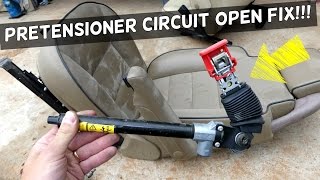
- Damaged Wiring, Loose Connector, or Corrosion Under the Seat (Very Common) — This is the number one cause for the seat belt variation. The wiring harness under the driver's seat is constantly stressed by movement or items shoved underneath. This stretches, breaks, or unplugs the yellow SRS connector. 🎬 Watch: How to diagnose and fix an open pretensioner circuit. Spilled drinks or moisture also cause pin corrosion, increasing circuit resistance.
- Faulty Seat Belt Pretensioner Assembly (Common) — The pretensioner unit fails internally over time. The pyrotechnic charge or its internal wiring degrades, causing its electrical resistance to fall out of the acceptable 2.0-3.5 ohm range.
- Failed Pedestrian Alert Speaker (EV/Hybrid Specific) (Common) — On vehicles where B0123 means a pedestrian alert fault, the external speaker is a frequent failure point. The internal voice coil burns out or the speaker sustains damage from water, road salt, or debris, causing an open or shorted circuit.
- Faulty Clock Spring (Common) — The clock spring in the steering column maintains electrical connections while the wheel turns. A failing clock spring creates an open or high-resistance circuit for all driver-side SRS components, including the pretensioner circuit.
- Previous Incomplete Accident Repair (Rare) — If the vehicle was in a prior accident where the pretensioners deployed, they require replacement, and the SRS module requires a crash data reset. Using incorrect parts or failing to reset the module causes this code.
- Poor SRS Control Module Ground (Rare) — On specific vehicles, particularly Fiat models, a weak or corroded ground connection for the SRS control module causes fluctuating voltage and triggers false high-resistance codes like B0123-1B.
- Faulty SRS (Airbag) Control Module (Rare) — The computer module that monitors the SRS system fails internally due to water damage or electronic failure, causing it to incorrectly report a fault on a perfectly good circuit.
Symptoms
- Airbag / SRS Warning Light On — This is the most common and often the only symptom for the seat belt fault. The light stays on continuously after the car starts.
- No Pedestrian Warning Sound at Low Speeds — For EV/Hybrid vehicles, the primary symptom is the absence of the 'hum' or 'click-clack' sound the car makes below 15 mph to alert pedestrians.
- Warning Message on Instrument Cluster — The dashboard displays a specific message like "Service Airbag System," "Restraint System Fault," or "Check Vehicle Proximity Notification System." 🎬 See how to troubleshoot pedestrian sounder faults on hybrid vehicles.
- Seat Belt Is Locked or Slow to Retract — If the pretensioner mechanically fails or partially deploys, the seat belt gets stuck and will not extend or retract properly.
Diagnostic Flowchart
Tap your situation to follow the diagnostic path that matches what you're seeing on this code.
Common Fixes & Costs
- Repair Under-Seat Wiring or Connector — Parts: $10-$30, Labor: $150-$300, ~1.5 hr book time (Intermediate)
- Replace Seat Belt Pretensioner Assembly — Parts: $150-$400, Labor: $150-$300, ~1.5 hr book time (Professional)
- Replace Pedestrian Alert Speaker — Parts: $150-$250, Labor: $100-$150, ~1.0 hr book time (Intermediate)
- Reset SRS Control Module After Accident — Parts: $50-$150, Labor: $50-$100, ~1.0 hr book time (Intermediate)
- Replace SRS Control Module — Parts: $200-$700, Labor: $100-$220, ~2.0 hr book time (Professional)
Used vs. New Parts: Buying Guide
When a used part is worth it: NEVER use a used seat belt pretensioner. These are single-use pyrotechnic devices with unknown histories. The risk to personal safety far outweighs any cost savings.
Donor quality checklist:
- Do not purchase used SRS components like pretensioners or airbags from salvage yards.
- The only exception is a mail-in repair service for your original pretensioner, where a certified technician rebuilds your specific unit with new OEM parts.
Decision logic:
- If The component is a seat belt pretensioner or airbag → Always buy new OEM or use a certified repair service for your original part.
- If The component is a pedestrian alert speaker → A used speaker from a low-mileage, non-accident vehicle is acceptable if the part number matches exactly.
Warranty tradeoff: Used SRS components carry no safety guarantee. New OEM parts carry a manufacturer's warranty. Reputable mail-in repair services offer a lifetime warranty on their workmanship.
Worst-case if a used part fails: Incalculable. If a used or improperly repaired pretensioner fails to deploy in a crash, the cost is severe injury or death.
What Happens If You Wait — Timeline
- Immediate: Code B0123 sets. The airbag/SRS warning light illuminates. The entire supplemental restraint system (airbags and pretensioners) disables as a fail-safe. (MPG impact: 0%% · Added cost: $0)
- 0-12 months: The safety risk is constant. The vehicle fails mandatory safety inspections in many states, preventing registration renewal. (MPG impact: 0%% · Added cost: $50-$200 in potential fines and fees.)
- Ongoing: If the cause is corrosion, electrical resistance continues to increase. For the EV/Hybrid speaker fault, the risk of a low-speed pedestrian accident remains. (MPG impact: 0%% · Added cost: Potential liability costs in case of an accident.)
- During a collision: The ultimate failure occurs. The seat belt pretensioner and airbags do not deploy. The risk of the driver sustaining severe or fatal injuries drastically increases. (MPG impact: 0%% · Added cost: Incalculable. Represents the total failure of the vehicle's passive safety system.)
Cost of Not Fixing It
- Immediate: For the seat belt fault, the entire airbag and pretensioner system is disabled. In a crash, they will not deploy, drastically increasing the risk of serious injury or death. (Added cost: N/A (Safety Risk))
- Immediate: For the pedestrian speaker fault, the vehicle will not emit a warning sound at low speeds, increasing the risk of an accident with pedestrians or cyclists. (Added cost: Potential liability costs in case of an accident.)
- Next Inspection: The vehicle fails mandatory safety inspections in many states, preventing legal registration renewal. (Added cost: Cost of fines, re-inspection fees, and eventual repair.)
Diagnosis Steps
- Safety First: Disconnect the Battery
Before touching any SRS components (marked with yellow connectors), disconnect the negative battery terminal and wait 30 minutes. This discharges the system's backup power capacitors, preventing accidental deployment of airbags or pretensioners.
Tools: Wrench set (Beginner) - Scan for SRS/BCM Codes
Use an OBD-II scanner that reads SRS/Airbag and BCM codes. Confirm B0123 is the active code. Note any suffixes (like B0123-1B for high resistance or B0123-12 for short to battery), as they specify the exact electrical fault.
Tools: SRS-capable OBD-II Scanner (Beginner) - Visually Inspect and Reseat the Connector
Slide the driver's seat fully forward and up. Look for the bright yellow SRS connector. Check for broken wires, pinched harnesses, or pin corrosion. If clean, unplug it and plug it back in firmly until it clicks. This simple action fixes intermittent resistance faults.
Tools: Flashlight (Intermediate) - Test Component Resistance (The Critical Number)
With the component unplugged, use a multimeter set to a low Ohms scale (Ω). Measure the resistance across the component's two pins. A good pretensioner squib or pedestrian speaker reads between 2.0 and 3.5 Ohms. A reading of 'OL' indicates an open circuit. WARNING: Never perform this test on the wiring harness side going to the control module.
Tools: Digital Multimeter (Advanced) - Advanced: Use an SRS-Approved Resistor Tool
To definitively isolate the fault, plug a special SRS diagnostic resistor (2.0-2.5 ohms) into the vehicle-side harness connector. Reconnect the battery, clear the codes, and see if the fault returns. If the code is gone, the pretensioner itself is faulty. If the code returns, the fault lies in the wiring or the module.
Tools: SRS Diagnostic Resistor Set (Professional) - Test the Wiring Harness
With both the component and the control module disconnected, check the two wires in the harness for continuity to ensure they are not broken. Then, check each wire for a short to ground and a short to each other.
Tools: Digital Multimeter (Advanced) - Advanced: Live Data "Wiggle Test"
Reconnect everything and use a scanner displaying live SRS data for the 'Pretensioner Circuit Resistance' PID. While watching the data (stable between 2.0-3.5 Ohms), carefully wiggle the under-seat harness. If the resistance value spikes or goes to OL, you have confirmed an intermittent break in the wiring.
Tools: SRS Live Data Scanner (Professional)
When This Code Triggers (Freeze-Frame Conditions)
- SRS System Status: Fault Present (The code sets during the initial key-on self-test.)
- System Voltage: 11.5-14.5V (The code triggers if voltage is unstable, but typically sets under normal operating voltage.)
- Ignition Cycles Since Fault: 0 (Indicates the fault was detected on the current or most recent startup.)
- Component Resistance: Varies (e.g., > 4.0 Ohms or < 1.5 Ohms) (The SRS module logs the out-of-spec resistance value that triggered the fault.)
Related Codes
- B0106 — Also for the Driver's Seat Belt Pretensioner. B0123 specifies a high input or short to battery, while B0106 indicates a general circuit malfunction or low resistance. The diagnostic process is identical.
- B0107 — This is the direct equivalent of B0123 but for the Passenger's Seat Belt Pretensioner. Perform all diagnostic steps on the passenger side of the vehicle.
- B0091 — Points to a fault in the Occupant Classification System (passenger seat weight sensor). If sitting in the passenger seat changes the live data status from 'Empty' to 'Occupied', the sensor works, and the fault is elsewhere.
- B0124 — For EV/Hybrids, this is the companion code to B0123. It refers to a fault in the 'Pedestrian Alert Speaker 'A' Circuit' for vehicles utilizing a dual-speaker setup.
Climate & Environmental Factors
- High Humidity / Water Ingress: Moisture from spills, window leaks, or humid climates seeps into connectors and control modules. This leads to pin corrosion, increasing circuit resistance and triggering high-resistance faults like B0123-1B.
- Road Salt (Salt Belt Regions): Road salt creates a highly corrosive saline mist under the vehicle. This accelerates the failure of exposed electrical components, including the pedestrian alert speaker and underbody SRS sensors.
How to Talk to a Mechanic About This Code
Say this: "I have an airbag light on and my scanner shows code B0123. I'd like to schedule a diagnostic. Can you please start by inspecting the wiring and connector under the driver's seat and testing the resistance of the pretensioner before recommending a full component replacement?"
This signals you've done your research and directs the mechanic to the most common, and cheapest, potential failure point first. It prevents them from immediately quoting an expensive pretensioner replacement without performing the necessary electrical checks.
Avoid saying:
- 'My airbag light is on, can you fix it?'
- 'Just do whatever it takes to turn the light off.'
- 'I think I need a new airbag.'
Questions to ask before authorizing the repair:
- Did you test the resistance of the pretensioner/speaker itself? What was the reading in ohms?
- Was there any visible damage or corrosion to the under-seat connector or wiring?
- If the pretensioner needs replacement, is the new part an Original Equipment Manufacturer (OEM) part?
- Does your quoted price include clearing the code from the SRS module to turn off the light?
Where to Take It: Dealer vs Independent vs Chain
- Dealer:
Recommended. For a critical safety system like airbags, dealer technicians have specific training and access to all recalls and service bulletins. This is the safest, albeit most expensive, option.
Best for: Vehicles under warranty, Vehicles with open safety recalls (e.g., Hyundai/Kia), Complex electrical issues or when a module replacement and programming is required.
Downsides: Highest labor rates, typically 50-100% more than independent shops., Defaults to replacing entire assemblies instead of repairing wiring. (Typical cost: +75% vs. baseline) - Independent Shop:
Good Fit, with caution. A qualified independent shop handles this repair easily, especially if it's a known wiring issue. Ask specifically if they have experience with SRS/airbag diagnostics before booking.
Best for: Out-of-warranty vehicles where the cause is likely a common issue (e.g., under-seat wiring)., Cost-conscious owners who have a trusted local mechanic.
Downsides: Shop must be equipped with an SRS-capable scan tool; not all are., Quality and experience with SRS systems varies widely; vet the shop carefully. (Typical cost: +0% vs. baseline) - Chain Shop:
AVOID. SRS repair is a safety-critical task outside the scope of most chain shops. The risk of an incorrect or unsafe repair is too high.
Best for: Simple maintenance like oil changes and tires.
Downsides: Technicians lack training for complex electrical or SRS diagnostics., High pressure to upsell and misdiagnose the issue, leading to unnecessary costs., Lack the specific scan tools required to read and clear SRS codes. (Typical cost: -10% vs. baseline)
When to Walk Away From the Repair
If the estimated repair cost for this safety-critical system exceeds 30-40% of the car's private-party value, and the car has other pending issues, consider selling. An airbag light reduces a car's value by 20-40%.
- Car worth $5000, fix is $2200: Walk away. The repair cost is nearly half the car's value, and you will not recoup that cost on resale.
- Car worth $15000, fix is $450: Fix it. This is a relatively low-cost repair that restores a critical safety feature and the vehicle's value.
- Car worth $3000, fix is $1800: Walk away. The repair cost is over half the car's value. The car is likely only worth its scrap value.
What Scan Tool You Need for This Code
Minimum: An OBD-II scanner that reads and clears codes from the SRS (Airbag) control module. Basic engine-only code readers will not work.
A standard $20 code reader only communicates with the Engine Control Unit (ECU). The B0123 code is stored in the Supplemental Restraint System (SRS) module, a separate computer. You need a scanner that accesses 'B' (Body) codes to diagnose and clear the fault.
Budget: Autel AutoLink AL619 (~$70) — Reads and clears engine, ABS, and SRS (airbag) codes on most major vehicle models. It confirms the B0123 code is present and allows you to clear it after the repair is complete.
Mid-range: BlueDriver Pro (~$100) — Connects to your smartphone and reads/clears SRS codes on many models. It displays live data, allowing you to perform a 'wiggle test' by graphing the pretensioner circuit resistance in real-time.
Professional: Autel MaxiCOM MK808 / Foxwell NT809 (~$450-600) — Offers full-system, bidirectional diagnostics. These tools view live data, access manufacturer-specific codes, and perform advanced functions essential for diagnosing complex wiring issues or module programming.
Rent vs buy: Auto parts stores offer free scanning services, but their tools often cannot read SRS codes. For an airbag light, you must buy your own SRS-capable scanner or pay a shop for a diagnostic. A budget or mid-range pick is a worthwhile investment for DIYers.
How to Clear the Code After You Fix It
- Reconnect battery (if disconnected for repair)
- Use an SRS-capable OBD-II scan tool to access the Supplemental Restraint System module
- Select the option to 'Clear/Erase DTCs'
- Cycle the ignition off and then on, and confirm the airbag light turns off after the initial system check
Drive cycle (~10 minutes): An SRS code does not require a complex drive cycle. After clearing the code, starting the car and letting it run for a few moments is sufficient. If the light does not return after the initial self-test, the repair is successful. A short 5-10 minute test drive verifies the fix.
Readiness monitors affected: None
Watch out for:
- Using a basic OBD-II reader that cannot access the SRS module will fail.
- Simply disconnecting the battery will not clear a 'hard code' from the SRS module.
- If the underlying electrical fault remains, the code reappears instantly after being cleared.
Will This Fail Emissions / State Inspection?
No — by itself this code doesn't fail OBD inspection (but it can keep readiness monitors from setting, which causes a separate fail).
- California: An airbag light does NOT cause a failure of the California Smog Check, as it is an emissions-only inspection. However, it remains a critical safety failure.
- New York: An illuminated airbag warning light is noted as an advisory during the safety inspection but is NOT currently grounds for failure.
- Texas: An airbag light is NOT a criterion for failure on the Texas state safety inspection.
- Pennsylvania / Virginia: In states with strict annual safety inspections, an illuminated airbag light is an automatic failure, as the SRS is a critical safety system.
Most Commonly Affected Vehicles
- Hyundai / Kia Elantra, Accent, Sonata, Optima (2019-2023) — Subject to a major safety recall (NHTSA 22V-354) for seat belt pretensioners that rupture on deployment. The recall fix involves installing a protective cap on the pretensioner assembly.
- Ford F-150 (2015-2020) — Known for broken or corroded wires within the under-seat wiring harness connector, leading to open circuit faults (B0123).
- Chevrolet / GMC Silverado, Sierra, Tahoe (2015-2016) — A Technical Service Bulletin (TSB) addresses the pretensioner cable fatiguing and separating over time, especially in high-use vehicles.
- Subaru Forester, Outback, Impreza (2010-2018) — Subaru models feature sensitive passenger occupant detection systems that share wiring under the seat. A fault in this shared harness area triggers related pretensioner codes.
- BMW 3-Series (E90), 5-Series (2006-2013) — Prone to various SRS faults, including pretensioner and battery safety terminal (BST) codes. A failing clock spring is a very common cause for driver-side faults.
- Fiat 500 (2008-2013) — Frequently logs code B0123-1B for "Driver's abdominal pretensioner" due to high resistance. This is often caused by a poor ground connection at the airbag ECU itself.
- Dodge / Ram Ram 1500, Caliber (2006-2012) — Prone to pretensioner circuit faults, specifically for wires shorting together within the harness.
- Honda / Acura Civic, Accord, CR-V, MDX (2003-2012) — A very common failure is the passenger side Occupant Position Detection System (OPDS) sensor or unit, which throws various SRS codes and disables the system.
Manufacturer-Specific Notes
- Hybrid/Electric Vehicles (Toyota, Nissan, etc.): Code B0123 means "Pedestrian Alert Speaker 'B' Circuit Fault." A fault in this speaker or its wiring triggers a warning light because it is a federally mandated safety feature.
- Ford, Fiat, Chrysler/Dodge: These manufacturers use a two-digit suffix (e.g., B0123-11, B0123-12, B0123-1B) to provide critical diagnostic detail. -11 means 'Circuit Short to Ground', -12 means 'Circuit Short to Battery', and -1B means 'Circuit Resistance Above Threshold'.
- General Motors (GM): The under-seat connector is notoriously sensitive on GM trucks and SUVs. A slightly loose connection is a very common cause, and simply reseating the connector resolves the issue.
- Hyundai / Kia: A major recall campaign (NHTSA 22V-354) addresses pretensioners that explode on deployment. Owners must verify their VIN on the NHTSA website to ensure this free repair has been performed.
Real Owner Stories
2015 Ford F-150 with Airbag Light
Airbag light came on intermittently, then stayed on. Owner frequently stored items under the driver's seat.
Outcome: Mechanic performed a wiring repair on the harness connector pigtail. Total cost was $200 for 1.5 hours of labor and minor parts. The code was cleared and did not return.
Lesson: The first and most common place to check for a pretensioner fault is the wiring under the seat, which is easily damaged by stored items or seat movement.
2017 Toyota Prius Prime with Dashboard Warning
A warning message "Check Vehicle Proximity Notification System" appeared on the dash. The car no longer made the low-speed humming sound.
Outcome: Owner ordered a new OEM pedestrian speaker (Part # 86570-12030) for $180 and replaced it themselves. The warning message cleared upon starting the car.
Lesson: On many hybrids, B0123 points to the pedestrian warning speaker. Unplugging it causes a persistent dashboard error; the system must see a component with the correct resistance to be satisfied.
2012 Fiat 500 with B0123-1B
Airbag light was on, and a scan showed B0123-1B: Driver's abdominal pretensioner - Circuit resistance above threshold.
Outcome: The owner disconnected the battery, cleaned the airbag ECU's ground point, and added a supplementary ground wire. After reconnecting a fully charged battery and clearing the codes, the fault did not return.
Lesson: On certain Fiat models, a high resistance code is a false flag caused by a poor module ground or low system voltage. Always check the freeze-frame data for voltage anomalies.
2021 Hyundai Elantra with Airbag Light
Airbag light came on in a relatively new car with low mileage. Owner was aware of a recall for Hyundai pretensioners.
Outcome: The dealership performed the work for NHTSA recall 22V-354 free of charge, installing a protective cap on the pretensioner. The code was cleared and the light went out.
Lesson: For 2019-2023 Hyundai and Kia models, this code relates to a critical safety recall. Always check your VIN on the NHTSA website before paying for a repair.
How to Prevent This Code From Triggering
- Never store items under the front seats (Daily habit) — Prevents objects from snagging, stretching, or unplugging the sensitive SRS wiring harness under the seat, which is the #1 cause of this fault.
- Apply dielectric grease to connectors (During any related repair or in high-corrosion areas) — Seals electrical connectors from moisture, road salt, and oxygen, preventing the pin corrosion that causes high-resistance faults.
- Secure any loose wiring (Once, during inspection) — Use zip ties to secure dangling sections of the under-seat harness to the seat frame, preventing stress when the seat moves.
- Avoid deep cleaning with excessive water (During interior cleaning) — Excessive water from interior detailing wicks into the under-seat connectors, causing corrosion or immediate shorts that trigger the SRS light.
- Protect wiring from pets or rodents (As needed) — Pets or rodents chewing on wires cause severe damage. Install a physical barrier or wrap the harness in chew-proof conduit.
Frequently Asked Questions
Can I reset the airbag light myself after fixing the problem?
No, not with a basic code reader. Airbag faults are 'hard codes' and must be cleared from the SRS control module using an advanced, bidirectional scan tool. Tools from brands like Autel or Foxwell are required to access this system.
Can a bad clock spring cause a B0123 code?
Yes. A failing clock spring in the steering column creates an intermittent open or high resistance in the driver-side SRS circuits. If you also have faults for the driver's airbag or steering wheel controls, the clock spring is the primary suspect.
I replaced the pretensioner, but the light is still on. What now?
First, ensure you cleared the code with an SRS-capable scanner, as the light will not turn off automatically. If it returns immediately, re-check your wiring connections and confirm the pretensioner resistance is between 2.0-3.5 ohms. The fault likely lies further up the wiring harness, in the clock spring, or the replacement part is defective.
Is it safe to work on the airbag system myself?
It is extremely risky and not recommended for beginners. You must disconnect the negative battery terminal and wait at least 30 minutes for the system to discharge before touching any yellow connectors. Pretensioners contain explosive charges, and accidental deployment causes serious injury.
Why is the connector for the airbag system always yellow?
Yellow is the industry-standard color warning technicians and first responders that they are dealing with the Supplemental Restraint System (SRS). It signals that the components are part of a high-voltage, potentially explosive system. You must take special safety precautions before handling any yellow wiring.
Will my airbags still work if the pretensioner has a fault?
No. When the SRS module detects a critical fault like B0123, it disables the entire system as a safety precaution. Neither the airbags nor the seat belt pretensioners will deploy in a crash until you repair the fault and clear the code.
I had my car detailed and now the airbag light is on. What happened?
This is a very common occurrence. Detailers move the seats to their extreme limits, which pulls on the under-seat wiring and dislodges the SRS connector. Spilled cleaning liquids also seep into the connectors, causing immediate shorts or long-term corrosion.
What's the difference between B0123-11, B0123-12, and B0123-1B?
These suffixes pinpoint the exact electrical fault for technicians. B0123-11 indicates a 'Circuit Short to Ground', while B0123-12 indicates a 'Circuit Short to Battery'. B0123-1B indicates 'Circuit Resistance Above Threshold', which points to an open circuit or high resistance.
Can I just unplug the pretensioner and put a resistor in to trick the system?
While technically possible, installing a resistor to trick the system is extremely dangerous and reckless. The pretensioner will not deploy in an accident, compromising the entire SRS system and drastically increasing your risk of severe injury. Resistors are for temporary diagnostic purposes only.
Key Takeaways
- Code B0123 indicates a disabled airbag system on gas-powered cars, or a faulty pedestrian warning speaker on EVs and hybrids.
- A seat belt pretensioner fault completely disables the vehicle's airbag system, preventing deployment during a collision.
- Over 70% of B0123 airbag faults stem from a loose, damaged, or corroded yellow wiring connector located directly under the driver's seat.
- A functional pretensioner or pedestrian speaker measures between 2.0 and 3.5 Ohms of electrical resistance when tested with a multimeter.
- Clearing the dashboard airbag light requires an advanced SRS-capable OBD-II scan tool, as basic code readers cannot access the restraint module.
Helpful Videos
Shop the Parts Behind B0123
Below are the parts most often responsible for code B0123, ranked by how frequently each one is the actual culprit (per the diagnosis above). Tap any to see what we have for your vehicle.



The information in this article is provided for general reference and educational purposes only. Vehicle specifications, procedures, and part compatibility can vary by production date, trim level, and region. Always consult your vehicle's factory service manual and verify part numbers before purchasing or performing repairs. Safety-critical components such as airbags, seat belts, and braking systems should be installed by a qualified professional.
- 🧭 Diagnostic Flowchart
- 🎬 Helpful Videos
- 🛍️ Shop This Part
- What Does B0123 Mean?
- Can I Drive With B0123?
- Common Causes
- Symptoms
- Common Fixes & Costs
- Used vs. New Parts: Buying Guide
- What Happens If You Wait — Timeline
- Cost of Not Fixing It
- Diagnosis Steps
- When This Code Triggers (Freeze-Frame Conditions)
- Related Codes
- Climate & Environmental Factors
- How to Talk to a Mechanic About This Code
- Where to Take It: Dealer vs Independent vs Chain
- When to Walk Away From the Repair
- What Scan Tool You Need for This Code
- How to Clear the Code After You Fix It
- Will This Fail Emissions / State Inspection?
- Most Commonly Affected Vehicles
- Manufacturer-Specific Notes
- Real Owner Stories
- 2015 Ford F-150 with Airbag Light
- 2017 Toyota Prius Prime with Dashboard Warning
- 2012 Fiat 500 with B0123-1B
- 2021 Hyundai Elantra with Airbag Light
- How to Prevent This Code From Triggering
- Frequently Asked Questions
- Can I reset the airbag light myself after fixing the problem?
- Can a bad clock spring cause a B0123 code?
- I replaced the pretensioner, but the light is still on. What now?
- Is it safe to work on the airbag system myself?
- Why is the connector for the airbag system always yellow?
- Will my airbags still work if the pretensioner has a fault?
- I had my car detailed and now the airbag light is on. What happened?
- What's the difference between B0123-11, B0123-12, and B0123-1B?
- Can I just unplug the pretensioner and put a resistor in to trick the system?
- Key Takeaways
- 🎟️ Get 5% Off