

OBD-II Code B0158: Ambient Air Temperature Sensor Circuit Malfunction
What B0158 means, why it triggers, and how to fix it
- Code B0158 indicates a fault in the outside air temperature sensor circuit, which immediately disables your A/C and automatic climate control.
- A disconnected or internally failed sensor behind the front grille causes over 80% of B0158 codes, especially after recent front-end bodywork.
- You can safely drive with a B0158 code, but the disabled A/C compressor reduces windshield defroster effectiveness by up to 50% in humid weather.
- Fixing this code typically costs under $50 for DIYers, requiring only a simple visual inspection and a $15-$25 replacement sensor.
What Does B0158 Mean?
B0158 is a body trouble code indicating the vehicle's computer—often the Instrument Panel Cluster (IPC) or Body Control Module (BCM)—detects a fault in the ambient air temperature sensor's circuit. This thermistor measures outside air temperature, sending data to the dashboard display and automatic climate control system. The module sets code B0158 when the sensor signal is illogical, missing, or out of range.
Technical definition: The SAE/ISO definition for B0158 points to a fault in the ambient air temperature sensor circuit. General Motors defines variations like 'B0158 02: Outside Air Temperature (OAT) Sensor Short to Ground' and 'B0158 05: Outside Air Temperature (OAT) Sensor Short to Battery or Open'. The control module triggers this code upon detecting sensor voltage outside the 0.09V to 4.90V range, corresponding to an impossible temperature reading like -40°F.
Can I Drive With B0158?
Yes, But With Caution. Yes, you can safely drive with code B0158. It does not affect core engine or transmission functions and will not cause mechanical damage. However, your automatic climate control and A/C will not work correctly, causing inconvenience in extreme temperatures. An inoperative A/C compressor also disables the windshield defrost/demist function, creating a safety issue in cold or humid weather by severely reducing visibility.
Common Causes
- Sensor is Disconnected or Missing (Very Common) — After front-end body work, radiator replacement, or a minor collision, technicians frequently leave the sensor unplugged. Even a small impact knocks it loose from its connector, a scenario GM specifically highlights in service bulletins.
- Faulty Ambient Air Temperature Sensor (Very Common) — The sensor itself fails internally due to constant exposure to moisture, road salt, and extreme temperature cycles at the front of the vehicle.
- Damaged Wiring or Connector (Common) — Road debris, packed snow, or animal strikes easily sever or fray the sensor's exposed wiring harness behind the front grille.
- Corroded Connector Pins (Common) — Water and road salt penetrate the electrical connector, corroding the pins. This creates high resistance, disrupts the signal, and triggers the code.
- Use of Incorrect Aftermarket Sensor (Less Common) — Cheap, non-OE-compliant sensors lack the correct resistance curve. The control module rejects the inaccurate signal and re-triggers the code.
- Faulty Control Module (IPC or BCM) (Rare) — The Instrument Panel Cluster (IPC) or Body Control Module (BCM) rarely fails. Rule out all sensor and wiring issues before suspecting a faulty module.
Symptoms
- Incorrect Outside Temperature Display — The temperature shown on the dashboard or infotainment screen is blank, shows dashes (--), or is stuck on a default low reading like -40°F.
- Air Conditioning (A/C) Does Not Work — The A/C compressor fails to engage because the system sees an illogical outside temperature (like -40°F) and prevents operation as a default safety measure.
- Poor Automatic Climate Control Performance — The system cannot regulate cabin temperature correctly because it lacks an accurate outside temperature reading to compare with the interior temperature.
- Temperature Display Switches to Celsius — On specific vehicles, particularly from General Motors, the system defaults to displaying the temperature in Celsius when this fault occurs.
- Ineffective Windshield Defrost/Demist — The A/C compressor removes moisture from the air for the defrost system. When B0158 disables the A/C, the defrost function fails to clear the windshield effectively.
Diagnostic Flowchart
Tap your situation to follow the diagnostic path that matches what you're seeing on this code.
Common Fixes & Costs
- Reconnect Loose Sensor — Parts: $0, Labor: $0-$50, ~0.1 hr book time (DIY)
- Replace Ambient Air Temperature Sensor — Parts: $15-$60, Labor: $50-$125, ~0.8 hr book time (DIY)
- Replace Connector Pigtail — Parts: $15-$40, Labor: $100-$200, ~1.2 hr book time (Intermediate)
- Repair Damaged Wiring — Parts: $5-$30, Labor: $100-$200, ~1.5 hr book time (Intermediate)
- BCM/IPC Reprogramming or Replacement — Parts: $400-$1000, Labor: $100-$250, ~2.5 hr book time (Expert)
Used vs. New Parts: Buying Guide
When a used part is worth it: Buying a used Ambient Air Temperature Sensor rarely makes sense. A new aftermarket or OEM part costs under $30 and includes a warranty. A used sensor offers minimal savings while carrying the risk of premature failure.
Donor-vehicle mileage cap: roughly under 40000 miles for the part to have meaningful remaining life.
Donor quality checklist:
- Match the part number exactly.
- Visually inspect the used sensor for physical damage, cracks, or corrosion on the pins.
Decision logic:
- If The part is the sensor itself (not a larger assembly). → Always buy new. The $5-$15 savings of a used part do not justify the risk of repeated labor.
- If The part is a Ford mirror assembly because the sensor is integrated. → Splice in a new, compatible sensor first. If you must replace the assembly, a used mirror from a low-mileage vehicle provides a cost-effective alternative to a new OEM mirror.
Warranty tradeoff: Salvage yard parts typically carry a 30-day warranty. New aftermarket sensors offer 1-year to limited lifetime warranties. A new OEM part guarantees fit and function.
Worst-case if a used part fails: $100-$200 if a used part fails after installation, requiring repeat labor costs.
What Happens If You Wait — Timeline
- Immediate: Code B0158 sets. The dashboard temperature display defaults to -40°F. The automatic climate control and A/C compressor are disabled. (MPG impact: 0%% · Added cost: $0)
- First instance of cold or humid weather: The windshield defrost/demist function becomes ineffective because it relies on the disabled A/C compressor to dehumidify the air, creating a safety issue. (MPG impact: 0%% · Added cost: $0 (Potential safety risk is the primary cost))
- 1-6 months: No further mechanical damage occurs. The primary consequence is the ongoing loss of comfort from having no A/C or automatic climate control. (MPG impact: 0%% · Added cost: $0)
- 6+ months: The vehicle continues to operate without issue, aside from non-functional climate features. The cost of the eventual repair does not increase over time. (MPG impact: 0%% · Added cost: $0)
Cost of Not Fixing It
- Immediate: Loss of air conditioning and automatic climate control function. Incorrect outside temperature displays on the dashboard. (Added cost: Negligible. The primary cost is loss of comfort.)
- 1-3 months: Reduced safety in cold or humid weather due to an ineffective windshield defroster, which relies on the A/C compressor to remove moisture from the air. (Added cost: Negligible. The cost is a potential safety risk, not a monetary one.)
- 6+ months: No further mechanical damage occurs. The primary consequence remains the ongoing lack of A/C and proper defrost function. (Added cost: $0. The cost of the eventual repair does not increase over time.)
Diagnosis Steps
- Read the Trouble Code and Live Data
Use an OBD-II scanner capable of reading Body (B-series) codes to confirm B0158 is present. Navigate to the live data stream for the BCM or IPC and view the 'Ambient Air Temperature' parameter. A reading of -40°F/-40°C or another extreme, fixed value confirms a circuit fault.
Tools: OBD-II Scanner (with B-code and live data capability) (Beginner) - Visually Inspect the Sensor and Connector
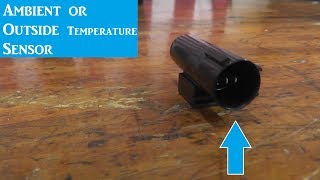
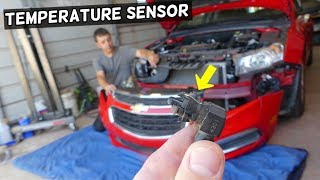
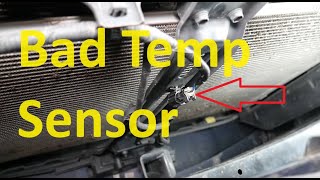
Locate the ambient air temperature sensor at the very front of the car, clipped into the radiator support or a bracket behind the grille. 🎬 See this walkthrough on how to locate and replace the sensor. Verify it is plugged in securely and check for physical damage to the sensor or its connector.
Tools: Flashlight (Beginner) - Inspect the Wiring Harness
Examine the two wires leading to the sensor's connector for cuts, abrasions, or corrosion. The wiring frequently sustains damage right near the connector where it is most exposed. GM TSBs specifically call out checking the integrity of circuits 61 and 636.
Tools: Flashlight (Intermediate) - Test the Sensor's Resistance
Disconnect the sensor and set a multimeter to measure resistance (Ohms) across its two pins. Compare the reading to a manufacturer-specific resistance-temperature chart (e.g., ~10,000 Ω at 77°F). An open circuit (infinite resistance), a short (near-zero resistance), or a significant deviation from the chart confirms a bad sensor.
Tools: Multimeter, Resistance-Temperature Chart (Intermediate) - Perform a Jumper Wire Test (Pro Tip)
With the sensor disconnected and ignition ON, connect a 3-amp fused jumper wire between the signal and ground terminals in the harness connector. While observing live data on your scan tool, the temperature reading drops to its lowest possible value (e.g., less than -39°F). This confirms the wiring and control module function correctly, isolating the fault to the sensor itself.
Tools: Fused Jumper Wire, OBD-II Scanner (Advanced) - Check for Reference Voltage and Ground
With the sensor unplugged and the ignition ON, use a multimeter to test the connector harness. The signal circuit wire requires a 5-volt reference signal from the control module, and the low reference circuit wire requires less than 1.0 ohm of resistance to a known good chassis ground.
Tools: Multimeter (Advanced) - Test for Shorts or Opens in the Harness
If reference voltage or ground is incorrect, a wiring fault exists. Disconnect the harness from both the sensor and the control module (BCM/IPC). Use a multimeter set to continuity to test each wire end-to-end, then test each wire for a short to ground and a short to power.
Tools: Multimeter, Vehicle-specific wiring diagram (Advanced) - Analyze Live Data PIDs for Cold Start Correlation
On a 'cold-soaked' vehicle (not run for several hours), use a scan tool to compare the live data PIDs for the Ambient Air Temperature (AAT), Intake Air Temperature (IAT), and Engine Coolant Temperature (ECT). All three must read within a few degrees of each other. A drastically different AAT reading (e.g., -40°F while others are 65°F) confirms a fault in the AAT sensor circuit.
Tools: OBD-II Scanner (with live data) (Advanced) - Analyze Signal Bias on an Oscilloscope (Expert Tip)
For intermittent faults, connect an oscilloscope to the sensor's signal wire. A good sensor produces a clean, stable DC voltage that changes slowly with temperature. Look for excessive noise, sudden voltage drops, or a signal stuck high or low. Wiggling the harness while watching the pattern reveals hidden wiring issues.
Tools: Oscilloscope (Expert)
When This Code Triggers (Freeze-Frame Conditions)
- DTC that caused freeze frame: B0158 (The BCM/IPC stored this code.)
- Ignition Status: ON (The module continuously monitors the sensor circuit anytime the ignition is on.)
- AAT Sensor Voltage: < 0.1V or > 4.9V (The code sets when the voltage falls outside the normal operating range, indicating a short or open circuit.)
- Module Voltage: 11.5V - 14.5V (The vehicle's electrical system operated at normal voltage when the fault occurred.)
Related Codes
- B0158 02 — A GM-specific symptom byte indicating the signal circuit shorts to ground. A technician sees a voltage reading near zero (<0.09V), pointing to a pinched or rubbed wire touching the chassis.
- B0158 05 — A GM-specific symptom byte indicating an open signal circuit, open ground circuit, or signal wire shorted to voltage. A technician sees a voltage reading near 5 volts (>4.90V), pointing to a broken wire, unplugged sensor, or internal sensor failure.
- P0073 — The generic powertrain code for 'Ambient Air Temperature Sensor Circuit High'. B0158 is reported by the BCM/IPC, while P0073 is reported by the PCM. They appear together and point to the same faulty sensor or open circuit condition.
- P0072 — The generic powertrain code for 'Ambient Air Temperature Sensor Circuit Low'. It is the powertrain equivalent of B0158 02, indicating the PCM detects a short-to-ground condition.
Climate & Environmental Factors
- Cold Climates with Road Salt: Road salt acts as a powerful electrolyte that rapidly accelerates corrosion of the sensor's connector pins and wiring. The constant spray of salty water onto the front of the vehicle makes these components highly vulnerable.
- High Humidity / Coastal Areas: High ambient moisture, especially salt-laden air in coastal regions, penetrates connector seals over time and creates high resistance or short circuits in the sensor wiring.
- Extreme Temperature Cycling: The rapid shift from freezing ambient temperatures to high under-hood heat stresses the thermistor and its internal connections, causing premature failure.
Where to Take It: Dealer vs Independent vs Chain
- Dealer:
Best for: Vehicles still under bumper-to-bumper warranty, Complex manufacturer-specific issues (e.g., Ford sensor-in-mirror problem if you want an OEM mirror replacement)
Downsides: Highest labor rate, typically 1.5-2x more than an independent shop., Defaults to replacing a larger assembly (like the Ford mirror) instead of attempting a cost-effective repair. (Typical cost: +75% vs. baseline) - Independent Shop:
Best fit for most people. This is a straightforward repair that any competent independent shop handles efficiently.
Best for: Out-of-warranty vehicles where cost is a factor., Simple, common repairs like a sensor replacement or wiring fix.
Downsides: Quality varies, requiring you to choose a shop with ASE-certified technicians. (Typical cost: +0% vs. baseline) - Chain Shop:
Acceptable with caution. Be very clear about the work you authorize to avoid extra charges.
Best for: When you know the exact fix (e.g., 'Please replace the ambient air temperature sensor') and can decline upsells.
Downsides: Business model pressures technicians to upsell unnecessary services, like a full A/C system flush, when only a simple sensor is needed. (Typical cost: -10% vs. baseline)
When to Walk Away From the Repair
If an estimated repair cost exceeds 40-50% of the car's private-party value, consider your options. However, for code B0158, the repair is so inexpensive it never approaches this threshold.
- Car worth $4000, fix is $150: Fix it. The repair cost is under 5% of the vehicle's value and restores important comfort and safety features.
- Car worth $12000, fix is $200: Fix it. This is a minor and inexpensive repair relative to the car's value.
- Car worth $2500, fix is $100: Fix it. Even on a low-value car, the small cost is justified to have functional A/C and an effective windshield defroster.
What Scan Tool You Need for This Code
Minimum: A scanner that reads Body (B-prefix) trouble codes and displays live data.
Cheap $20 scanners only read Powertrain (P-prefix) codes for the Check Engine Light. They cannot see the B0158 code. You need a tool that communicates with the Body Control Module (BCM).
Budget: BlueDriver Pro (~$100) — Connects to your smartphone via Bluetooth and reads all code types. It displays the live data needed to see the faulty '-40°F' reading.
Mid-range: Foxwell NT510 Elite (~$180) — A powerful handheld unit that reads all systems and shows live data. A great investment for a serious DIYer.
Professional: Autel MaxiCOM MK808 / MK808BT (~$450-550) — A professional-grade tablet scanner providing OE-level diagnostics for all systems. Overkill for this code, but standard for advanced diagnostics.
Rent vs buy: For a one-time diagnosis, visit an auto parts store like AutoZone. They offer free in-store code scanning services with tools that read Body codes.
How to Clear the Code After You Fix It
- Use an OBD-II scan tool to erase/clear Diagnostic Trouble Codes (DTCs).
- Turn the ignition off and then on again.
- Verify on the dashboard display that the temperature reading is plausible and check that the A/C system engages.
Drive cycle (~5 minutes): Body codes like B0158 do not require a complex drive cycle. The Body Control Module (BCM) re-checks the sensor circuit immediately upon ignition. A short 5-minute drive confirms the A/C and auto climate functions operate normally.
Readiness monitors affected: None
Before emissions retest: drive at least 50 miles to fully set monitors.
Watch out for:
- Clearing the code without fixing the physical fault results in the code returning immediately.
- Disconnecting the battery to clear the code resets all emissions readiness monitors to 'Not Ready', causing an automatic emissions inspection failure.
Will This Fail Emissions / State Inspection?
Yes — this code typically fails an OBD-II emissions inspection.
- California: An active trouble code of any kind results in an emissions test failure. Disconnecting the battery to clear the code sets monitors to 'Not Ready', causing an automatic failure.
- New York: The NYS inspection includes an OBD-II scan. An active B0158 code causes the vehicle to fail the inspection.
- Texas: In counties requiring emissions testing, an active trouble code results in a test failure. Clearing the code by disconnecting the battery causes a failure due to 'Not Ready' monitors.
Most Commonly Affected Vehicles
- Chevrolet Malibu (2013-2016) — GM issued multiple Technical Service Bulletins (TSBs), like PIC5656F, for this exact problem. The sensor part number is typically GM #25775833.
- Buick Verano (2012-2016) — Shares a platform with the Chevy Cruze and suffers from the same common failure of the sensor and its wiring, covered by GM TSB PIC5656F.
- Chevrolet Cruze (2011-2016) — The sensor sits in a vulnerable position behind the lower front grille, making it highly prone to damage from road debris.
- Ford Focus (2012-2018) — The sensor integrates into the bottom of the passenger-side mirror housing. Ford requires replacing the entire mirror assembly, but owners successfully splice in a compatible sensor (Peugeot/Citroen #6445F9).
- Honda Pilot (2009-2015) — The sensor sits behind the front bumper, requiring partial removal of the bumper cover for access, which increases labor time.
- Subaru Forester (2014-2018) — The sensor mounts directly in front of the A/C condenser on the horn bracket, making it susceptible to front-end damage.
- GMC Sierra (2007-2013) — The HVAC control module sets the code when the sensor circuit reads below 0.09V or above 4.90V. A simple HVAC module reset (pulling the fuse) sometimes resolves temporary glitches.
- Chevrolet Silverado (2007-2013) — Experiences this fault due to the sensor circuit reporting an illogical voltage to the HVAC control module. Diagnostic steps mirror the GMC Sierra.
- Dodge/Chrysler/Jeep Various (2005-2015) — The sensor typically sits in the front lower bumper area. Failure immediately prevents the A/C compressor from engaging.
Manufacturer-Specific Notes
- General Motors (Chevrolet, GMC, Buick, Cadillac): GM issued multiple TSBs (PIC5656B through PIC5656F) for this code. A classic symptom is the climate control display switching to Celsius. The diagnostic procedure mandates checking that the sensor is physically connected before performing any other tests.
- Ford: On 2012-2018 Focus and C-Max models, the sensor integrates into the bottom of the passenger-side exterior mirror housing. Ford does not sell the sensor separately. A common workaround involves splicing in a compatible Peugeot/Citroen #6445F9 sensor.
- Honda: Accessing the sensor requires partial removal of the front bumper cover or splash shields, adding labor time compared to vehicles with grille access.
- Subaru: Subaru mounts the ambient air sensor on the same bracket as the horn, directly in front of the radiator. This exposed location makes it highly vulnerable to damage from minor front-end impacts.
Real Owner Stories
2016 Chevy Cruze LT with A/C blowing hot
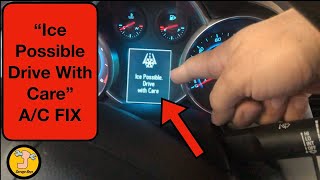
During a 92°F day, the A/C blew hot air. The dashboard displayed the outside temperature as -40°F with an icy conditions warning.
Outcome: The owner purchased a new sensor from a Chevy dealership for $15 and installed it in the front bumper. This immediately restored the correct temperature reading and A/C function.
Lesson: If the B0158 code appears after front-end service, visually check if the sensor is physically present and securely connected. Technicians frequently leave it unplugged.
2015 Ford C-Max with a broken passenger mirror
The owner shattered the passenger-side mirror housing. Separately, the car's outside temperature display always read 3 degrees high.
Outcome: After installing the replacement mirror, the temperature reading became perfectly correct. Ford integrates the ambient air temperature sensor into a small nub on the bottom of the passenger-side mirror on this model. Replacing the mirror inadvertently fixed the sensor issue.
Lesson: On 2012-2018 Ford Focus and C-Max models, the sensor resides in the passenger mirror, not behind the grille. A B0158 code requires mirror replacement or splicing in a new sensor.
2013 Buick Verano with intermittent A/C and incorrect temperature
The A/C blew hot air, the dash display stuck at -40°F, and the climate control display switched to Celsius on its own.
Outcome: Replacing the sensor (GM P/N 13583411) resolved all symptoms. The repair took 15 minutes by accessing the sensor behind the front grille.
Lesson: On GM vehicles, a B0158 code accompanied by the temperature display switching to Celsius strongly points to a failed sensor or its direct wiring circuit, as documented in TSB PIC5656F.
How to Prevent This Code From Triggering
- Apply Dielectric Grease to the Connector Seal (During sensor replacement or any front-end service) — Dielectric grease creates a waterproof barrier on the rubber seal, preventing moisture and road salt from corroding the pins.
- Inspect Sensor After Car Washes or Winter Driving (Seasonally) — High-pressure water or packed snow dislodges the sensor or its connector. A quick visual check ensures the sensor remains securely mounted.
- Secure the Wiring Harness (During any front-end service) — Properly routing and securing the harness with zip ties keeps it away from moving parts and prevents physical damage.
Frequently Asked Questions
Can I fix a B0158 code myself?
Yes, this is an excellent DIY repair. The most common cause is a faulty sensor that is inexpensive and easy to access behind the front grille. Replacing it requires basic hand tools and takes under an hour.
Why is my A/C not working with code B0158?
The climate control system uses the outside temperature to determine if running the A/C compressor is safe. When the sensor fails, it reports an extreme temperature (like -40°F), forcing the system to disable the A/C to prevent damage.
Where is the ambient air temperature sensor located?
On most vehicles, it clips into the radiator core support or a bracket directly behind the front grille. However, on 2012-2018 Ford Focus and C-Max models, it resides inside the passenger-side mirror housing.
My temperature gauge reads -40 degrees. Is that related to code B0158?
Yes, a reading of -40° (Fahrenheit or Celsius) is the default value the computer displays when it receives an invalid signal from the ambient air temperature sensor. It confirms an open or shorted circuit related to this code.
I replaced the sensor but the code came back. What now?
If a new sensor fails to clear the code, the fault lies in the wiring harness or connector. Inspect the wiring for breaks, corrosion, or loose pins. You must also clear the code with a scan tool on some vehicles before the system recognizes the new part.
What is the most common misdiagnosis for a B0158 code?
A common mistake involves confusing the Ambient Air Temperature (AAT) sensor with the Engine Coolant Temperature (ECT) sensor or the Intake Air Temperature (IAT) sensor. The AAT sensor controls climate functions, while the ECT and IAT sensors manage engine performance and set different P-prefix codes.
Will clearing the code fix the problem?
No. Clearing the code only removes the warning message temporarily. The code returns immediately once the control module runs its self-test and detects the circuit fault again.
How do you reset the ambient air temperature sensor?
The sensor itself does not reset. After replacing the sensor or repairing the wiring, use an OBD-II scanner to clear the B0158 trouble code from the module's memory.
Key Takeaways
- Code B0158 indicates a fault in the outside air temperature sensor circuit, which immediately disables your A/C and automatic climate control.
- A disconnected or internally failed sensor behind the front grille causes over 80% of B0158 codes, especially after recent front-end bodywork.
- You can safely drive with a B0158 code, but the disabled A/C compressor reduces windshield defroster effectiveness by up to 50% in humid weather.
- Fixing this code typically costs under $50 for DIYers, requiring only a simple visual inspection and a $15-$25 replacement sensor.
Helpful Videos
Shop the Parts Behind B0158
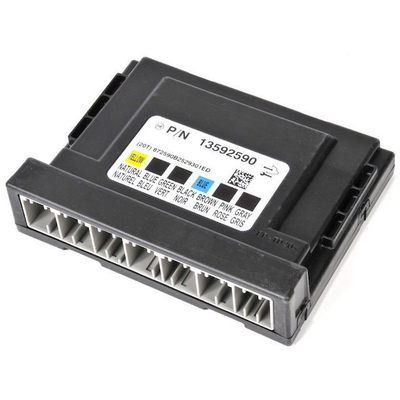
Below are the parts most often responsible for code B0158, ranked by how frequently each one is the actual culprit (per the diagnosis above). Tap any to see what we have for your vehicle.



The information in this article is provided for general reference and educational purposes only. Vehicle specifications, procedures, and part compatibility can vary by production date, trim level, and region. Always consult your vehicle's factory service manual and verify part numbers before purchasing or performing repairs. Safety-critical components such as airbags, seat belts, and braking systems should be installed by a qualified professional.
- 🧭 Diagnostic Flowchart
- 🎬 Helpful Videos
- 🛍️ Shop This Part
- What Does B0158 Mean?
- Can I Drive With B0158?
- Common Causes
- Symptoms
- Common Fixes & Costs
- Used vs. New Parts: Buying Guide
- What Happens If You Wait — Timeline
- Cost of Not Fixing It
- Diagnosis Steps
- When This Code Triggers (Freeze-Frame Conditions)
- Related Codes
- Climate & Environmental Factors
- Where to Take It: Dealer vs Independent vs Chain
- When to Walk Away From the Repair
- What Scan Tool You Need for This Code
- How to Clear the Code After You Fix It
- Will This Fail Emissions / State Inspection?
- Most Commonly Affected Vehicles
- Manufacturer-Specific Notes
- Real Owner Stories
- 2016 Chevy Cruze LT with A/C blowing hot
- 2015 Ford C-Max with a broken passenger mirror
- 2013 Buick Verano with intermittent A/C and incorrect temperature
- How to Prevent This Code From Triggering
- Frequently Asked Questions
- Can I fix a B0158 code myself?
- Why is my A/C not working with code B0158?
- Where is the ambient air temperature sensor located?
- My temperature gauge reads -40 degrees. Is that related to code B0158?
- I replaced the sensor but the code came back. What now?
- What is the most common misdiagnosis for a B0158 code?
- Will clearing the code fix the problem?
- How do you reset the ambient air temperature sensor?
- Key Takeaways
- 🎟️ Get 5% Off