

OBD-II Code P0236: Turbo/Supercharger Boost Sensor 'A' Circuit Performance
The definitive 2026 guide to diagnosing and fixing P0236. Note: This guide addresses the common powertrain code P0236. The body code B0236 is unrelated.
- Code P0236 triggers 'limp mode' and reduces engine power when the turbo boost sensor signal contradicts the MAP or BARO sensors.
- Perform a 'Key On, Engine Off' scan tool test to compare Boost, MAP, and BARO readings; a variance over 0.5 PSI confirms a faulty sensor.
- If a new sensor fails to clear the code, mandate a $100-$200 automotive smoke test to locate hidden intake or intercooler air leaks.
- Never ignore this code for more than 30 days, as unmanaged boost levels will destroy a $1,500 catalytic converter or cause catastrophic engine detonation.
What Does B0236 Mean?

The Engine Control Module (ECM) receives an illogical signal from boost pressure sensor 'A'. The ECM expects specific pressure readings based on engine load and RPM. When the sensor's feedback contradicts these expectations (e.g., showing high pressure when the engine is off), the ECM triggers the check engine light and cuts engine power to prevent damage.
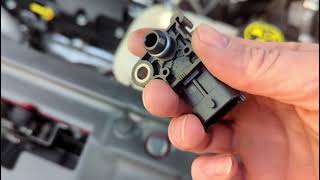
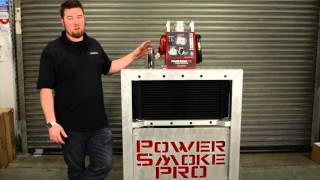
Technical definition: The SAE/ISO definition for P0236 is "Turbocharger/Supercharger Boost Sensor 'A' Circuit Range/Performance". 🎬 Watch this guide to diagnosing boost sensor circuit faults The DTC sets when the ECM detects the boost pressure sensor 'A' signal does not logically correlate with the Manifold Absolute Pressure (MAP) or Barometric Pressure (BARO) sensors during a Key On, Engine Off (KOEO) check or active operation.
Can I Drive With B0236?
Yes, But With Caution. Yes, you can drive under 50 miles to a repair shop, but you must avoid hard acceleration. The vehicle defaults to a power-reduced 'limp mode'. Ignoring this code risks catastrophic engine detonation or destroys the catalytic converter, adding a $1,500 repair bill.
Common Causes

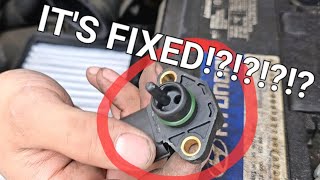
- Faulty Boost Pressure Sensor (Very Common) — The sensor fails from constant exposure to extreme heat and oil vapor. It sends incorrect voltage signals (stuck at 0.2V or 4.8V) or responds too slowly to pressure changes.
- Vacuum or Boost Leaks (Common) — Cracked vacuum hoses, a split intercooler, or loose charge pipes let pressurized air escape. This causes the boost sensor to read lower than the ECM expects under load.
- Damaged Wiring or Connectors (Common) — Corrosion on connector pins, frayed wires, or a short to ground disrupts the 5V reference signal. Ford and VW models frequently suffer from known faulty splices in the main engine harness.
- Sticking Turbocharger Wastegate (Less Common) — If the wastegate sticks open (underboost) or closed (overboost), the turbo produces pressure levels wildly outside the ECM's expected parameters, triggering the rationality fault.
- Exhaust Leak Upstream of Turbo (Uncommon) — A leak in the exhaust manifold gasket allows exhaust gas to escape before spinning the turbine, reducing turbo efficiency and lowering boost pressure.
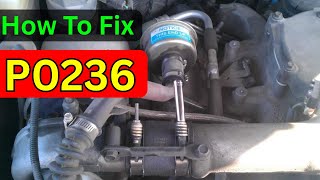
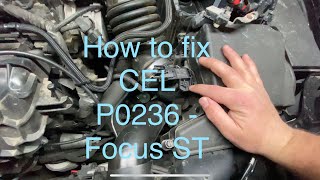
- Restricted Intake or Intercooler Ice (Uncommon) — A severely clogged air filter starves the turbo. On certain GM 1.4L engines, 🎬 Watch: Fixing P0236 on Chevy and Buick 1.4L engines winter ice buildup inside the intercooler creates a physical blockage.
- ECM Faults or Aftermarket Tunes (Rare) — Aggressive aftermarket tunes request boost beyond the factory sensor's limit, triggering the code. Rarely, the ECM itself suffers a hardware failure and misinterprets a valid signal.
Symptoms

- Check Engine Light is On — The ECM confirms a fault and illuminates the Malfunction Indicator Lamp (MIL).
- Reduced Engine Power (Limp Mode) — The vehicle feels sluggish. The ECM intentionally limits turbo boost to prevent engine damage from unknown pressure levels.
- Poor Acceleration and Turbo Lag — Noticeable hesitation in power delivery when pressing the accelerator, especially during highway merging.
- Decreased Fuel Economy — The ECM defaults to an inefficiently rich fuel mixture to prevent engine knock, dropping fuel economy by 10-20%.
- Abnormal Whistling Noises — A distinct 'whooshing' sound from the engine bay that changes pitch with throttle input indicates a physical boost leak.
Diagnostic Flowchart

Tap your situation to follow the diagnostic path that matches what you're seeing on this code.
Common Fixes & Costs
- Replace Boost Pressure Sensor
— Parts: $40-$150, Labor: $80-$150, ~0.8 hr book time
(DIY)
Chevrolet Cruze (2016-2019): OEM AC Delco 55573249 (Alt: Bosch 0261230334)
Ford F-150 EcoBoost (2011-2017): OEM Motorcraft AA5Z-9F479-D (Alt: Bosch 0261230333) - Repair Vacuum or Intake Air Leak — Parts: $10-$120, Labor: $100-$300, ~1.5 hr book time (Intermediate)
- Repair Damaged Wiring Harness — Parts: $5-$50, Labor: $200-$500, ~3.0 hr book time (Advanced)
- Replace Boost Control Solenoid — Parts: $50-$110, Labor: $80-$120, ~1.0 hr book time (Intermediate)
- Replace Turbocharger Assembly — Parts: $600-$2,000, Labor: $500-$1,000, ~6.0 hr book time (Professional)
DIY vs Professional
- Replace Boost Sensor 🟢 Beginner
Tools: Basic socket set, screwdriver. - Repair Air Leak 🟢 Beginner
Tools: Hose clamp pliers, screwdrivers, automotive smoke machine. - Repair Wiring Harness 🟢 Beginner
Tools: Digital Multimeter, soldering iron, heat shrink, wiring diagrams. - Replace Turbocharger 🟢 Beginner
Tools: Professional toolset, lift, torque wrenches, specialty line wrenches.
Used vs. New Parts: Buying Guide
When a used part is worth it: Never buy a used boost pressure sensor. The $30 savings is not worth the risk of installing a failing electronic component.
Donor-vehicle mileage cap: roughly under 50000 miles for the part to have meaningful remaining life.
Donor quality checklist:
- Verify exact part numbers; sensors look identical but have different voltage scaling.
- Avoid rust-belt parts due to connector corrosion.
Decision logic:
- If The part is a boost pressure sensor → Buy new OEM. It eliminates the risk of a faulty used part causing misdiagnosis.
- If The part is a complete turbocharger assembly → A used turbo from a low-mileage donor is viable if budget is strictly constrained.
Warranty tradeoff: Used sensors offer 30-day warranties covering only the part. New OEM parts provide guaranteed compatibility and longevity.
Worst-case if a used part fails: $300 for repeat diagnostic labor and a second replacement part.
What Happens If You Wait — Timeline
- 0-1 month: Check Engine Light illuminates. Vehicle enters limp mode with sluggish acceleration. (MPG impact: 10%% · Added cost: $50)
- 1-3 months: Default rich fuel maps cause carbon buildup on spark plugs and dilute engine oil. (MPG impact: 15%% · Added cost: $150)
- 3-6 months: Sustained rich mixtures overheat and melt the catalytic converter substrate. (MPG impact: 25%% · Added cost: $1500)
- 6+ months: Unmanaged overboost causes catastrophic engine detonation or blown head gaskets. (MPG impact: N/A% · Added cost: $4000)
Cost of Not Fixing It
- 0-1 month: Reduced fuel economy (10-20% drop) and sluggish acceleration due to limp mode. (Added cost: $50)
- 1-6 months: Driving with an unmanaged rich fuel mixture overheats and melts the catalytic converter. (Added cost: $1500)
- 6+ months: Persistent overboost conditions cause engine detonation, damaged pistons, or a blown head gasket. (Added cost: $4000)
Diagnosis Steps
- Compare Sensor Readings (Key On, Engine Off)
Connect a scan tool and view live data for 'Boost Pressure', 'MAP', and 'BARO'. With the key on and engine off, all three must display identical atmospheric pressure (~14.7 PSI at sea level). If the boost sensor deviates by more than 0.5 PSI, replace the sensor.
Tools: Advanced OBD-II Scanner with Live Data (Intermediate) - Scan for Accompanying Trouble Codes
Read all stored codes. Address P0106 (MAP) or P2227 (BARO) first, as the ECM uses them to validate the boost sensor. If P0299 (Underboost) is present, prioritize searching for a physical air leak.
Tools: OBD-II Scanner (Beginner) - Perform an Automotive Smoke Test
If KOEO readings match, the sensor is likely fine. Force low-pressure smoke into the intake system to expose hidden cracks in hoses, gaskets, or the intercooler.
Tools: Automotive Smoke Machine (Intermediate) - Visual Inspection of Intake System
Inspect the air intake path from the filter to the throttle body. Check for disconnected vacuum lines, loose charge pipe clamps, and oil pooling in the intercooler.
Tools: Flashlight, Basic Hand Tools (Beginner) - Test Sensor Circuit Wiring
Disconnect the boost sensor. With the key on, use a multimeter to verify a 5-volt reference signal from the ECM and a solid ground (less than 0.5Ω resistance). Missing voltage indicates a wiring harness or ECM fault.
Tools: Digital Multimeter, Back-probe Kit (Advanced) - Dynamic Voltage Test
Back-probe the connected sensor's signal wire. Voltage should sit around 1.5-2.5V at KOEO and rise smoothly toward 4.5V as you build boost. Erratic jumping or a stuck voltage confirms internal sensor failure.
Tools: Digital Multimeter, Back-probe Kit (Advanced) - Test Wastegate Operation
Apply 15-20 inHg of vacuum to a mechanical wastegate actuator to ensure the arm moves smoothly and holds pressure. For electronic actuators, command them open/closed via a bi-directional scanner.
Tools: Vacuum Pump, Bi-directional Scan Tool (Advanced)
When This Code Triggers (Freeze-Frame Conditions)
- Engine Coolant Temp: 180-205°F (82-96°C) (Engine at full operating temperature.)
- RPM: 2000-3000 RPM (During moderate acceleration or climbing a grade.)
- Engine Load: 40-70% (The engine is producing significant power, demanding turbo boost.)
- Vehicle Speed: 45-65 mph (72-105 kph) (Occurs during highway merging or steady-state cruising.)
Related Codes
- P0299 — Turbo Underboost. Appears with P0236 if the root cause is a significant boost leak or a stuck-open wastegate.
- P0234 — Turbo Overboost. Triggers if the wastegate sticks closed, causing the sensor to report dangerously high pressures.
- P0106 — MAP Sensor Performance. The ECM compares the boost sensor to the MAP sensor. A faulty MAP sensor misleads the ECM into flagging the boost sensor.
- P2227 — BARO Sensor Performance. A faulty BARO sensor corrupts the baseline atmospheric reading, causing a false P0236 rationality failure.
Climate & Environmental Factors
- Extreme Cold: Below 0°F (-18°C), moisture freezes inside the intercooler during short trips. This ice blockage restricts airflow and triggers P0236, a documented issue on GM 1.4L engines.
- High Altitude: Baseline atmospheric pressure is lower at altitude. During a KOEO check, sensors read lower (e.g., 12.2 PSI instead of 14.7 PSI). This is normal, provided all sensors match.
- High Humidity: Increases water vapor in the intake, exacerbating intercooler icing in winter and accelerating corrosion on exposed wiring connectors.
How to Talk to a Mechanic About This Code
Say this: "I have a P0236 code and limp mode. Please start by comparing live data from the Boost, MAP, and BARO sensors with the key on, engine off. If they match, I authorize a smoke test to check for intake leaks before replacing parts."
Directs the technician to perform the two most critical tests first, preventing unnecessary sensor replacement.
Avoid saying:
- 'My turbo is broken.'
- 'Just replace the boost sensor.'
Questions to ask before authorizing the repair:
- What were the KOEO pressure readings for the Boost, MAP, and BARO sensors?
- If you performed a smoke test, can you show me the leak location?
- What is the warranty on parts and labor?
Where to Take It: Dealer vs Independent vs Chain
- Dealer:
Best for: Vehicles under powertrain warranty., Issues covered by TSBs, like GM software updates or VW wiring repairs.
Downsides: Labor rates are up to 50% higher than independent shops., Tendency to replace entire assemblies rather than diagnose component faults. (Typical cost: +50% vs. baseline) - Independent Shop:
Best fit. A reputable independent shop offers the best balance of diagnostic expertise and value.
Best for: Out-of-warranty vehicles requiring accurate diagnosis of complex leaks or wiring.
Downsides: Ensure the shop has turbo experience and owns an automotive smoke machine. (Typical cost: +0% vs. baseline) - Chain Shop:
Avoid. They are poorly equipped to handle the complex leak or wiring diagnostics required for P0236.
Best for: Basic maintenance like oil changes.
Downsides: Lack specialized tools like smoke machines., High pressure to upsell leads to misdiagnosis. (Typical cost: -10% vs. baseline)
When to Walk Away From the Repair
If the estimated repair cost exceeds 50% of the car's private-party value, sell the car as-is.
- Car worth $3500, fix is $2200: Walk away. A $2,200 turbo replacement on a $3,500 car is a poor investment.
- Car worth $12000, fix is $250: Fix it. A sensor replacement or leak repair restores full value.
What Scan Tool You Need for This Code
Minimum: A scanner that displays live data streams for multiple engine PIDs simultaneously.
A $20 code reader cannot display live pressure readings from the Boost, MAP, and BARO sensors required for the KOEO test.
Budget: BlueDriver Pro (~$100) — Connects to a smartphone to display and graph the live sensor data needed for the initial KOEO diagnostic test.
Mid-range: Innova 5610 (~$350) — Adds bi-directional control to command electronic wastegate actuators or boost solenoids, confirming functionality without removal.
Professional: Autel MaxiCOM MK808Z (~$450) — Provides full bi-directional control and access to manufacturer-specific data for diagnosing complex wiring faults.
Rent vs buy: Auto parts stores loan basic scanners, but they often lack live data. Buying a budget live-data scanner is a mandatory investment for DIY diagnosis.
How to Clear the Code After You Fix It
- Use an OBD-II scan tool to clear the P0236 code from the ECM.
- Perform a drive cycle to run the vehicle's readiness monitors.
- Re-scan to ensure the code has not returned.
Drive cycle (~20 minutes): Start cold and idle for 3 minutes. Drive in mixed city/highway conditions with moderate accelerations to engage the turbo. Maintain 55-60 mph for 5 minutes. Cool down completely.
Readiness monitors affected: Catalyst Monitor, Evaporative System (EVAP) Monitor, Oxygen (O2) Sensor Monitor
Before emissions retest: drive at least 50 miles to fully set monitors.
Watch out for:
- Clearing the code without a drive cycle leaves monitors 'Not Ready', causing an automatic emissions failure.
- If the root cause remains, P0236 returns immediately under load.
Will This Fail Emissions / State Inspection?
Yes — this code typically fails an OBD-II emissions inspection.
- California: An active P0236 is an automatic failure. A complete drive cycle must set all monitors before retesting.
- New York: NYS DMV inspections include an OBD-II scan. A check engine light results in immediate failure.
- Texas: Emissions-testing counties (Harris, Dallas, Travis) automatically fail vehicles with an illuminated MIL.
Most Commonly Affected Vehicles
- Chevrolet Cruze (2016-2019) — The intercooler-mounted boost sensor (OEM 55573249) frequently fails. Winter intercooler icing is also common, addressed by GM TSB #22-NA-007.
- Ford F-150 (EcoBoost) (2011-2017) — Intermittent wrench lights on startup point to a failing boost sensor (OEM AA5Z-9F479-D) or a cracked intercooler.
- Volkswagen GTI / Jetta (TSI) (2014-2019) — Often caused by high resistance in the T14 engine harness connector (VW TSB 2037108) or a massive vacuum leak from a failed PCV valve.
- Ford Focus ST (2013-2018) — The intercooler MAP sensor fails from road debris and salt exposure. Use OEM Ford sensors; aftermarket scaling is often incorrect.
- Ford Escape (EcoBoost) (2013-2016) — Ford TSB 16-0161 identifies a faulty 5V reference (VREF) circuit splice causing P0236 and multiple other sensor codes.
- Hyundai Veloster Turbo (2012-2017) — The top-mounted intake manifold boost sensor fails frequently but is highly accessible for DIY replacement.
- BMW 335i / 135i (N54/N55) (2007-2016) — P0236 is heavily linked to boost leaks from cracked plastic charge pipes or failing wastegate vacuum lines.
- Chevrolet Cobalt SS / HHR SS (2008-2010) — Prone to wiring harness corrosion at the MAP sensor connectors. Soldering wires directly to the sensor terminals is a common permanent fix.
Manufacturer-Specific Notes
- General Motors: On 1.4L turbos, winter intercooler icing causes P0236. GM TSB #22-NA-007 details an ECM software update to change shift patterns and reduce ice buildup.
- Ford: EcoBoost engines exhibit intermittent limp mode on startup that vanishes after restarting. This points to a failing sensor or a high-resistance VREF wiring splice (TSB 16-0161).
- Volkswagen/Audi: On TSI engines, P0236 is frequently a wiring issue. VW TSB 2037108 requires replacing specific pins in the T14 engine harness connector.
Real Owner Stories
2017 Chevy Cruze 1.4L with intermittent P0236
Limp mode activated on startup. Restarting temporarily cleared the issue.
What they tried:
- Replaced the accessible MAP sensor on the intake manifold (no change).
Outcome: Replaced the correct boost pressure sensor (GM 55573249) on the intercooler. The old sensor tip was physically broken.
Lesson: Verify which sensor is 'A' before starting repairs. On the Cruze, P0236 refers to the intercooler sensor, not the intake MAP sensor.
2011 Ford F-150 EcoBoost with intermittent Wrench light
Truck lost power and displayed a wrench icon on startup. Restarting cleared the icon, but P0236 was stored.
What they tried:
- Dealer found no hard codes and dismissed it as a glitch.
Outcome: Owner replaced the boost pressure sensor (Motorcraft AA5Z-9F479-D), permanently resolving the intermittent limp mode.
Lesson: Intermittent limp mode on startup is a classic failing sensor symptom on EcoBoosts. Soft codes require immediate attention.
2013 Fiat JTD with P0236 under load
Engine limited to 3000 RPM during hard acceleration.
What they tried:
- Garage replaced the MAP sensor, but the fault returned immediately.
Outcome: Found a 1/4-inch split in a rubber vacuum hose connecting to the boost solenoid. A $1 hose fixed the issue.
Lesson: If a new sensor fails to fix a performance code, inspect all hoses. A cheap vacuum leak mimics an expensive electronic failure.
How to Prevent This Code From Triggering
- Use full synthetic oil and change it on schedule. (Every 5,000 miles.) — Proper lubrication protects high-speed turbo bearings. Degraded oil causes wear and performance codes.
- Replace the engine air filter. (Every 20,000 miles.) — A clogged filter restricts airflow, forcing the turbo to overwork and increasing component wear.
- Allow a 60-second idle cool-down after hard driving. (After spirited driving or towing.) — Circulates oil to cool the turbo, preventing burnt oil deposits (coking) that destroy bearings.
- Visually inspect intake hoses and clamps. (During every oil change.) — Catching a loose clamp early prevents major boost leaks that trigger P0236.
Frequently Asked Questions
Can I just replace the boost sensor to fix P0236?
Replacing the sensor is common but not guaranteed. Perform a 'Key On, Engine Off' data comparison first. If the readings match, the sensor is fine and you likely have a boost leak.
I replaced the boost sensor but the code came back. What now?
A new sensor cannot fix a hidden boost leak or a wiring issue. You must perform a smoke test to find air leaks and inspect the wiring harness for damage.
Will P0236 clear itself?
No, P0236 is a hard code. The Check Engine Light remains on until you repair the fault and manually clear the code with a scanner.
My P0236 code is intermittent. What does that mean?
Intermittent codes indicate a sensor in the early stages of failure or a loose wiring connection. These issues react to temperature changes and engine vibration.
Can my aftermarket cold air intake or tune cause P0236?
Yes. Improperly installed intakes create vacuum leaks. Aggressive tunes request boost levels beyond factory sensor limits, triggering an out-of-range code.
What is the difference between the boost sensor and the MAP sensor?
The Boost Sensor measures total turbo pressure before the throttle body. The MAP sensor measures actual engine ingestion pressure after the throttle body. The ECM compares them for rationality.
The prompt asked for B0236, but this guide is for P0236. Why?
'B' codes are for Body systems, while 'P' codes are for the Powertrain. Turbocharger faults correspond to P0236. B0236 is an unrelated manufacturer-specific body code.
Key Takeaways
- Code P0236 triggers 'limp mode' and reduces engine power when the turbo boost sensor signal contradicts the MAP or BARO sensors.
- Perform a 'Key On, Engine Off' scan tool test to compare Boost, MAP, and BARO readings; a variance over 0.5 PSI confirms a faulty sensor.
- If a new sensor fails to clear the code, mandate a $100-$200 automotive smoke test to locate hidden intake or intercooler air leaks.
- Never ignore this code for more than 30 days, as unmanaged boost levels will destroy a $1,500 catalytic converter or cause catastrophic engine detonation.
Helpful Videos
Shop the Parts Behind B0236
Below are the parts most often responsible for code B0236, ranked by how frequently each one is the actual culprit (per the diagnosis above). Tap any to see what we have for your vehicle.



The information in this article is provided for general reference and educational purposes only. Vehicle specifications, procedures, and part compatibility can vary by production date, trim level, and region. Always consult your vehicle's factory service manual and verify part numbers before purchasing or performing repairs. Safety-critical components such as airbags, seat belts, and braking systems should be installed by a qualified professional.
- 🧭 Diagnostic Flowchart
- 🎬 Helpful Videos
- 🛍️ Shop This Part
- What Does B0236 Mean?
- Can I Drive With B0236?
- Common Causes
- Symptoms
- Common Fixes & Costs
- DIY vs Professional
- Used vs. New Parts: Buying Guide
- What Happens If You Wait — Timeline
- Cost of Not Fixing It
- Diagnosis Steps
- When This Code Triggers (Freeze-Frame Conditions)
- Related Codes
- Climate & Environmental Factors
- How to Talk to a Mechanic About This Code
- Where to Take It: Dealer vs Independent vs Chain
- When to Walk Away From the Repair
- What Scan Tool You Need for This Code
- How to Clear the Code After You Fix It
- Will This Fail Emissions / State Inspection?
- Most Commonly Affected Vehicles
- Manufacturer-Specific Notes
- Real Owner Stories
- 2017 Chevy Cruze 1.4L with intermittent P0236
- 2011 Ford F-150 EcoBoost with intermittent Wrench light
- 2013 Fiat JTD with P0236 under load
- How to Prevent This Code From Triggering
- Frequently Asked Questions
- Can I just replace the boost sensor to fix P0236?
- I replaced the boost sensor but the code came back. What now?
- Will P0236 clear itself?
- My P0236 code is intermittent. What does that mean?
- Can my aftermarket cold air intake or tune cause P0236?
- What is the difference between the boost sensor and the MAP sensor?
- The prompt asked for B0236, but this guide is for P0236. Why?
- Key Takeaways
- 🎟️ Get 5% Off