

OBD-II Code B0770: All-Wheel Drive (AWD) Indicator Circuit Malfunction
The Ultimate 2026 Guide to Diagnosing and Fixing B0770
- Code B0770 is a GM-specific fault indicating an electrical failure in the dashboard All-Wheel Drive (AWD) indicator light circuit.
- If B0770 appears alongside codes B0775, B0780, and B0785, replace the 4WD selector switch immediately, as this combination guarantees a failed internal circuit board.
- Driving with this code is safe, but unknowingly leaving the vehicle in 4WD on dry pavement causes severe drivetrain binding and up to $1,500 in axle or transfer case damage.
- Replacing the 4WD selector switch is a 15-minute DIY repair costing under $100, saving over $150 in shop labor and preventing unnecessary TCCM replacements.
- Always verify the vehicle battery delivers at least 12.4 volts, as the Transfer Case Control Module (TCCM) triggers false B0770 codes when system voltage drops below 9 volts during startup.
What Does B0770 Mean?
Code B0770 indicates the Transfer Case Shift Control Module (TCCM) detected an electrical fault in the circuit for the All-Wheel Drive (AWD) indicator light. This is the dashboard light (often labeled 'Auto 4WD') confirming the system is active. The computer registered a voltage outside the expected range, pointing to an open circuit, a short to ground, or a short to power.
Technical definition: The SAE/OBD-II definition for B0770 is primarily used by General Motors. The TCCM provides a ground to the LED in the 4WD switch to illuminate it and monitors the control circuit voltage to verify operation. B0770 01 (Short to Battery) sets if the TCCM detects 3.4 volts or more when commanded ON (when it should be grounded). B0770 06 (Short to Ground or Open) sets if the TCCM detects 1.6 volts or less for over 1.5 seconds when commanded OFF (when it should be high impedance).
Can I Drive With B0770?
Yes, But With Caution. Yes, the vehicle is safe to drive because this code relates to the dashboard indicator light, not the mechanical function of the 4WD system. However, you lose reliable visual confirmation of your drive mode. Unknowingly leaving the system in 4HI on dry pavement causes severe drivetrain binding, leading to premature tire wear and expensive transfer case damage.
Common Causes
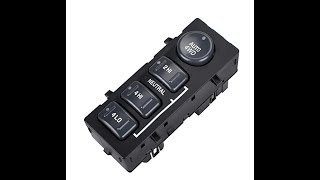
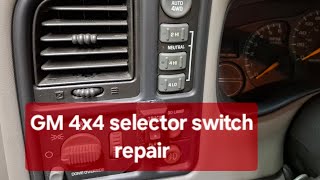
- Defective 4WD Selector Switch (Very Common) — This is the definitive leading cause. The push-button switch assembly contains small resistors and LED lights. Over time, internal solder joints crack and electronic components fail, sending erratic voltage signals to the TCCM.
- Wiring Harness & Ground Damage (Common) — Wires leading to the 4WD switch or TCCM frequently fray, pinch, or corrode behind the dashboard. Additionally, a corroded or loose chassis ground wire for the instrument panel or TCCM destabilizes circuit voltage, instantly triggering the code.
- Water Intrusion at Connector (Common) — On 2019-2022 GM trucks and SUVs, water enters the transfer case actuator connector due to a torn grommet, causing corrosion and short circuits (addressed in GM TSB 22-NA-187). Moisture also affects firewall junction blocks after car washes.
- Failed Transfer Case Shift Control Module (TCCM) (Less Common) — While the TCCM reports the code, internal module failure is far less common than switch or wiring faults. A faulty TCCM fails to send correct 5V reference signals or misinterprets return voltage. Replacement requires VIN programming.
- Blown Fuse (Less Common) — A blown fuse for the 4WD system or instrument cluster cuts power to the indicators. This is a symptom of an underlying short circuit that requires diagnosis.
- Unplugged Component After Prior Repair (Rare) — If the dashboard was recently disassembled for a stereo or HVAC repair, the 4WD selector switch connector is often left unplugged or loosely seated, creating an immediate open circuit.
Symptoms
- AWD or 'Auto 4WD' indicator light is inoperative — When selecting AWD or Auto 4WD mode, the corresponding indicator light on the switch fails to illuminate.
- All 4WD selector lights are out — A complete failure of all lights (2WD, 4HI, 4LO, Auto) guarantees a faulty switch unit, a blown fuse, or a severed power/ground connection to the switch.
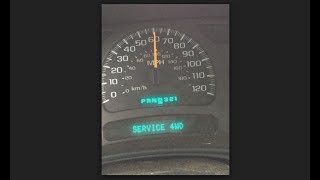
- 'Service 4WD' message displayed — Any electrical fault within the 4WD system triggers a 'Service 4WD' warning on the driver information center (DIC). 🎬 Watch this guide to diagnosing a Service 4WD message.
- Flashing 4WD selector lights — Attempting to change drive modes causes the selected light to flash and revert to the previous mode, indicating the TCCM cannot confirm the shift or the switch signal is dropping out.
Diagnostic Flowchart
Tap your situation to follow the diagnostic path that matches what you're seeing on this code.
Common Fixes & Costs
- Replace the 4WD Selector Switch — Parts: $40 - $120, Labor: $75 - $150, ~0.5 hr book time (DIY)
- Repair Damaged Wiring or Ground Connection — Parts: $10 - $30, Labor: $150 - $300, ~2 hr book time (Intermediate)
- Replace Electrical Connector (Pigtail) — Parts: $20 - $75, Labor: $125 - $250, ~1.5 hr book time (Intermediate)
- Replace Transfer Case Shift Control Module (TCCM) — Parts: $200 - $400, Labor: $150 - $300, ~1.5 hr book time (Professional)
DIY vs Professional
- Replace the 4WD Selector Switch — Beginner:
- Repair Damaged Wiring or Ground Connection — Beginner:
- Replace Transfer Case Shift Control Module (TCCM) — Beginner:
Used vs. New Parts: Buying Guide
When a used part is worth it: Buying used never makes sense for the 4WD selector switch. The part fails due to internal electronic wear, meaning a used part is already near the end of its lifespan.
Donor-vehicle mileage cap: roughly under 20000 miles for the part to have meaningful remaining life.
Donor quality checklist:
- If forced to buy a used TCCM, source it from a low-mileage wrecked vehicle.
- Ensure exact part number matching.
- Avoid parts from high-humidity or salt-belt regions to prevent pre-existing corrosion.
Decision logic:
- If The failed part is the 4WD selector switch. → Buy a new aftermarket (Dorman) or OEM part. It costs under $100 and includes a warranty.
- If The failed part is the TCCM. → Purchase a pre-programmed remanufactured unit online to avoid dealership programming fees.
Warranty tradeoff: Used parts offer 30-day warranties. New aftermarket switches carry limited lifetime warranties, making them the only logical choice.
Worst-case if a used part fails: $150 - $250 (cost of repeated labor and a second replacement part if a used switch fails).
What Happens If You Wait — Timeline
- 0-1 month: Code B0770 sets. The 'Auto 4WD' light stops working. The mechanical 4WD system functions normally, but visual confirmation is lost. (MPG impact: 0%% · Added cost: $0)
- 1-6 months: Lacking an indicator, the driver unknowingly leaves the vehicle in 4HI on dry pavement. Drivetrain binding occurs during tight turns, causing tire scrubbing. (MPG impact: 1-5% (due to drivetrain drag)% · Added cost: $50 - $400 (accelerated tire wear and U-joint stress).)
- 6-18 months: Prolonged drivetrain binding stretches the transfer case chain and subjects axle shafts to immense stress. (MPG impact: 3-8%% · Added cost: $400 - $1,800 (replacing U-joints, transfer case chain, or driveshaft).)
- 18+ months: Catastrophic failure. The stretched transfer case chain breaks or skips teeth, destroying internal gears and resulting in a total loss of power. (MPG impact: N/A (vehicle undrivable)% · Added cost: $2,500 - $8,000 (complete transfer case replacement).)
Cost of Not Fixing It
- 0-6 months: Loss of visual drive mode confirmation creates a high risk of unknowingly driving in 4WD on dry pavement, causing tire scrubbing and U-joint stress. (Added cost: $50 - $400 (premature tire wear or U-joint replacement).)
- 6-18 months: Continued driving in 4WD on high-traction surfaces causes severe drivetrain binding, stretching the transfer case chain and damaging axle shafts. (Added cost: $400 - $1,500 (driveshaft or axle repairs).)
- 18+ months: Catastrophic transfer case failure. The internal chain breaks or skips teeth, resulting in a total loss of drive power. (Added cost: $2,500 - $7,000 (complete transfer case replacement).)
Diagnosis Steps
- Scan for All Trouble Codes
Use an OBD-II scanner capable of reading 'B' (Body) codes. Finding B0770 alongside B0775 (4HI), B0780 (4LO), and B0785 (2HI) guarantees the 4WD selector switch assembly has failed.
Tools: Advanced OBD-II Scanner (Beginner) - Perform a 'Bulb Check'
Turn the ignition key to 'ON' without starting the engine. All lights on the 4WD switch must illuminate briefly. If lights flicker, fail to illuminate, or behave randomly when buttons are pressed, replace the switch.
Tools: None (Beginner) - Inspect 4WD and Instrument Panel Fuses
Locate the cabin and under-hood fuse boxes. Visually inspect and test the fuses labeled for the 4WD system, TCCM, and instrument panel cluster (IPC).
Tools: Fuse puller, multimeter (Beginner) - Inspect the 4WD Switch Connector
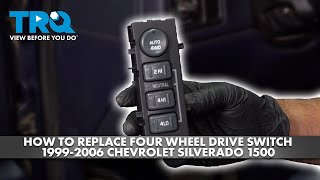
Remove the dash bezel around the 4WD switch. 🎬 See this walkthrough on how to replace the selector switch. Unplug the connector and inspect for bent pins, green corrosion, or liquid damage. Ensure it latches securely upon reinstallation.
Tools: Plastic trim removal tools, flashlight (Intermediate) - Inspect Transfer Case Actuator Connector (2019+ Models)
On newer GM trucks, inspect the large electrical connector on the transfer case actuator motor under the vehicle. Unplug it and check for water intrusion or corrosion per TSB 22-NA-187.
Tools: Flashlight, safety glasses (Intermediate) - Inspect TCCM Connectors and Ground
Locate the TCCM (usually behind the driver's side kick panel). Inspect connectors for damage. Locate the TCCM ground wire bolted to the chassis, remove it, clean the terminal to bare metal, and re-secure it tightly.
Tools: Socket set, wire brush (Intermediate) - [PRO TIP] Test 5V Reference and Ground at Switch
With the switch unplugged and key ON, probe the connector pins using a wiring diagram. Verify a 4.5V-5.5V reference signal from the TCCM and continuity to ground. Missing voltage or ground confirms a wiring or TCCM fault, not a bad switch.
Tools: Multimeter, vehicle-specific wiring diagram (Advanced) - [PRO TIP] Test AWD Indicator Control Circuit Voltage
Probe the AWD indicator control wire at the switch connector. When commanded OFF, voltage must exceed 1.6V. If lower, you have a short to ground. Use a bidirectional scanner to command the light ON; voltage must drop. If it stays above 3.4V, you have a short to power.
Tools: Multimeter, bidirectional scan tool, wiring diagram (Advanced)
When This Code Triggers (Freeze-Frame Conditions)
- System Voltage: 9-18V (The TCCM requires a minimum of 9 volts to run diagnostic tests; lower voltage triggers false codes.)
- Ignition Status: ON (The diagnostic runs continuously whenever the ignition is in the ON position.)
- Time Duration: 1.5 seconds (The incorrect voltage must be present for exactly 1.5 seconds before the TCCM logs the B0770 code.)
Related Codes
- B0775 — Indicates a fault in the '4WD High' indicator circuit. Seeing B0770, B0775, B0780, and B0785 together guarantees a failed selector switch assembly.
- B0780 — Indicates a fault in the '4WD Low' indicator circuit. Follows the exact same diagnostic path as B0770.
- B0785 — Indicates a fault in the '2WD High' indicator circuit. Do not diagnose these codes individually when grouped; replace the switch.
- B2725 — ATC Mode Switch Circuit Malfunction. Sets when the TCCM sees an impossible voltage (e.g., a stuck button). Strongly reinforces the diagnosis of a faulty switch.
Climate & Environmental Factors
- Humidity and Moisture: High humidity and underbody car washes introduce moisture into connectors, causing corrosion and short circuits. TSB 22-NA-187 specifically addresses water intrusion at the transfer case actuator connector on 2019+ models.
- Extreme Cold: Temperatures below 20°F (-7°C) cause aging solder joints inside the 4WD switch to contract, creating an open circuit and triggering the code until the cabin warms up.
- Road Salt: Winter road salt accelerates underbody corrosion, degrading the TCCM chassis ground connection and destabilizing circuit voltage.
How to Talk to a Mechanic About This Code
Say this: "I have a 'Service 4WD' light and a B0770 code. I suspect the 4WD selector switch is failing. Please test the switch and its circuit before considering a TCCM replacement."
This proves you are informed about this specific GM issue, steering the mechanic away from an unnecessary $600 TCCM replacement and toward the $50 switch.
Avoid saying:
- 'My 4x4 is broken.'
- 'The 'Service 4WD' light is on, can you just fix it?'
- 'I think I need a new 4WD computer.'
Questions to ask before authorizing the repair:
- Did you find B0770 grouped with codes B0775, B0780, and B0785?
- If recommending a TCCM, can you show me the test proving the 5V reference and ground at the switch connector are good?
- Is the quoted price for an OEM or an aftermarket switch?
Where to Take It: Dealer vs Independent vs Chain
- Dealer:
Use only for warranty work or complex programming.
Best for: Vehicles under warranty., 2019+ models requiring TSB 22-NA-187 water intrusion repairs., Confirmed TCCM failures requiring proprietary GM programming.
Downsides: Highest labor rates., Tendency to replace the expensive TCCM without thoroughly diagnosing the switch. (Typical cost: +50% vs. baseline) - Independent Shop:
Best fit. Experienced independent mechanics recognize this common GM issue and resolve it quickly.
Best for: Out-of-warranty vehicles., Cost-effective switch replacement and wiring repairs.
Downsides: Must ensure the shop possesses a scanner capable of reading 'B' codes. (Typical cost: +0% vs. baseline) - Chain Shop:
AVOID. High risk of incorrect diagnosis and unnecessary parts replacement.
Downsides: Technicians often lack experience with non-engine codes., High risk of misdiagnosing the TCCM., May lack bidirectional scanners required for testing. (Typical cost: -10% vs. baseline)
When to Walk Away From the Repair
If the estimated repair cost exceeds 40-50% of the car's Kelley Blue Book private-party value, consider your options.
- Car worth $5000, fix is $150: Fix it. This is a cheap, necessary repair to maintain vehicle function.
- Car worth $15000, fix is $650: Fix it. Even a full TCCM replacement falls well below the threshold.
- Car worth $3000, fix is $1500: Walk away. If diagnosis reveals a destroyed wiring harness requiring extensive labor, the cost is too high relative to vehicle value.
What Scan Tool You Need for This Code
Minimum: An OBD-II scanner capable of reading manufacturer-specific 'B' (Body) codes from the Transfer Case Control Module (TCCM). Basic engine-only code readers will report 'No Codes Found'.
Cheap scanners cannot communicate with the TCCM. You must use a tool that accesses ABS, Airbag, and Body control modules.
Budget: BlueDriver Pro (~$100) — Connects via Bluetooth to read and clear 'B' codes from the TCCM and provides freeze-frame data.
Mid-range: Foxwell NT510 Elite for GM (~$180) — Offers bidirectional control, allowing you to actively command the 4WD indicator lights ON and OFF from the tool to definitively test the circuit.
Professional: Autel MaxiCOM MK808S (~$450) — Provides full system diagnostics, live data, and bidirectional controls on a large tablet interface, covering all vehicle makes for future repairs.
Rent vs buy: Buy. A capable scanner costs the same as a single shop diagnostic fee ($100-$150) and empowers you to diagnose all future vehicle issues.
How to Clear the Code After You Fix It
- Complete the physical repair and reconnect all components.
- Use an OBD-II scan tool capable of reading 'B' codes to access the TCCM and clear the DTCs.
- Turn the ignition off, then back to 'ON' to perform a bulb check confirming all 4WD indicator lights illuminate.
Drive cycle (~10 minutes): Start the engine and cycle through all 4WD modes (2HI, Auto, 4HI, 4LO) while stationary or rolling slowly. Confirm each mode engages and the corresponding light stays solid. Drive for 10 minutes making several turns to ensure the code does not return.
Readiness monitors affected: None. This is a body control module code and does not affect emissions readiness.
Watch out for:
- Disconnecting the battery temporarily clears the 'Service 4WD' light, but it returns on the next key cycle if the fault remains.
- Failing to manually clear the code with a scanner leaves the 'Service 4WD' light on until the vehicle completes 100 fault-free ignition cycles.
Will This Fail Emissions / State Inspection?
No — by itself this code doesn't fail OBD inspection (but it can keep readiness monitors from setting, which causes a separate fail).
- California: Will NOT fail. SMOG checks target emissions-related 'P' codes. 'B' codes and the 'Service 4WD' light are ignored.
- New York: Will NOT fail. The NYS OBD-II inspection checks emissions readiness. The 'Service 4WD' message is a warning indicator, not a required safety lamp.
- Texas: Will NOT fail. Texas emissions testing only looks for 'P' codes and Check Engine Light status.
Most Commonly Affected Vehicles
- Chevrolet Silverado 1500/2500/3500 (1999-2013) — Notorious for dash-mounted 4WD selector switch failures.
- GMC Sierra 1500/2500/3500 (1999-2013) — Mechanically identical to the Silverado, suffering the exact same switch failure rates.
- Chevrolet Tahoe / Suburban (2000-2014) — When codes B0770, B0775, B0780, and B0785 appear together on these SUVs, the switch is the root cause over 95% of the time.
- Chevrolet Trailblazer (2002-2009) — Prone to 4WD switch failures and wiring harness chafing near the transfer case.
- Cadillac Escalade / ESV / EXT (2002-2014) — Uses the identical TCCM and selector switch as the Tahoe/Suburban.
- Chevrolet Avalanche (2002-2013) — Shares the failure-prone 4WD selector switch with the Silverado platform.
Manufacturer-Specific Notes
- General Motors (Chevrolet, GMC, Cadillac, Hummer): A group of indicator codes (B0770, B0775, B0780, B0785) is a definitive diagnosis of a failed 4WD selector switch. The internal circuit board fails, causing all circuits to report faults simultaneously.
- General Motors (Chevrolet, GMC, Cadillac, Hummer): GM issued TSB 22-NA-187 for 2019+ models, pointing directly to water intrusion in the transfer case actuator connector causing false B0770 codes.
- Other Manufacturers: Code B0770 is almost exclusively used by GM. Other brands use entirely different code designations and mechanical designs for 4WD indicator faults.
Real Owner Stories
2005 Chevy Silverado 1500 at 145K miles - The Classic Switch Failure
The 'Service 4WD' light illuminated, and all 4WD selector lights went dead. A scan revealed codes B0770, B0775, B0780, and B0785.
What they tried:
- Checked the 4WD fuse, which was intact.
- Ordered a new Dorman selector switch based on forum advice.
Outcome: Replaced the switch in 15 minutes. All lights functioned during the key-on bulb check, codes cleared, and 4WD function was restored. Total cost: $45.
Lesson: The presence of all four indicator circuit codes (B0770, B0775, B0780, B0785) guarantees a failed selector switch over 95% of the time.
2007 GMC Yukon at 110K miles - The Misdiagnosis Story
The 'Service 4WD' light became permanent with a sole B0770 code. A general repair shop recommended a TCCM replacement.
What they tried:
- Paid $650 for a new TCCM and programming.
- The B0770 code returned the next day.
Outcome: A dealership technician correctly diagnosed a faulty 4WD selector switch. Replacing the switch for $220 permanently fixed the issue. The initial $650 TCCM replacement was entirely unnecessary.
Lesson: The module reporting the code is rarely the cause. Always diagnose and replace the cheapest, most common failure point (the switch) before authorizing a TCCM replacement.
2019 Chevy Silverado 1500 at 40K miles - Water Intrusion
Code B0770 appeared immediately after an underbody car wash.
What they tried:
- Dealership tested the dash switch, which passed.
Outcome: Technicians found water inside the transfer case actuator motor connector due to a torn grommet, matching GM TSB 22-NA-187. Replacing the harness pigtail resolved the issue under warranty.
Lesson: On 2019+ GM trucks, immediately inspect the transfer case actuator connector for water intrusion if B0770 appears after heavy rain or a car wash.
How to Prevent This Code From Triggering
- Apply Dielectric Grease to Connectors (When replacing switch or servicing dash) — Dielectric grease seals out moisture and air, preventing pin corrosion that causes intermittent voltage drops and triggers B0770.
- Clean Chassis Grounds (Every 3-5 years (annually in salt belts)) — The TCCM relies on a clean chassis ground for stable voltage. Cleaning ground straps to bare metal prevents resistance buildup that causes erratic electrical faults.
- Maintain a Healthy Battery (Ongoing) — A weak battery dropping below 9V during startup causes the TCCM to log false codes. A healthy battery ensures stable power for all control modules.
Frequently Asked Questions
Can I fix code B0770 myself?
Yes. Replacing the 4WD selector switch requires only a plastic trim tool and 15 minutes. It is a plug-and-play part that saves you over $100 in shop labor.
Will my 4WD still work with a B0770 code?
Yes, the mechanical 4WD system usually remains fully functional. The code strictly indicates a failure of the dashboard indicator light circuit.
How much does it cost to fix code B0770?
A DIY 4WD switch replacement costs $40-$120 for the part. A shop charges $150-$275 for the same repair. If the TCCM requires replacement and programming, expect to pay $350-$700.
What is the most common misdiagnosis for B0770?
Replacing the expensive Transfer Case Control Module (TCCM) without testing the switch first. The TCCM reports the code, but the $50 switch is almost always the actual failure point.
I replaced the 4WD switch, but the code came back. What now?
First, verify the connector is fully seated and latched on the new switch. Next, use a multimeter to confirm the switch connector receives a 5V reference and has a solid ground. If both are present, the fault lies in the wiring harness or a bad TCCM ground.
Can a bad battery cause 4WD problems and code B0770?
Yes. The TCCM requires stable voltage to operate correctly. A weak battery dropping below 9 volts during engine crank triggers false communication errors and B0770 codes.
Does the transfer case control module need to be programmed?
Yes, a new TCCM requires programming with your vehicle's specific VIN and configuration data. This requires a professional scan tool with a J2534 pass-thru device and a GM service subscription. To bypass this, purchase a pre-programmed module online that is flashed to your VIN prior to shipping.
Key Takeaways
- Code B0770 is a GM-specific fault indicating an electrical failure in the dashboard All-Wheel Drive (AWD) indicator light circuit.
- If B0770 appears alongside codes B0775, B0780, and B0785, replace the 4WD selector switch immediately, as this combination guarantees a failed internal circuit board.
- Driving with this code is safe, but unknowingly leaving the vehicle in 4WD on dry pavement causes severe drivetrain binding and up to $1,500 in axle or transfer case damage.
- Replacing the 4WD selector switch is a 15-minute DIY repair costing under $100, saving over $150 in shop labor and preventing unnecessary TCCM replacements.
- Always verify the vehicle battery delivers at least 12.4 volts, as the Transfer Case Control Module (TCCM) triggers false B0770 codes when system voltage drops below 9 volts during startup.
Helpful Videos

Shop the Parts Behind B0770
Below are the parts most often responsible for code B0770, ranked by how frequently each one is the actual culprit (per the diagnosis above). Tap any to see what we have for your vehicle.


The information in this article is provided for general reference and educational purposes only. Vehicle specifications, procedures, and part compatibility can vary by production date, trim level, and region. Always consult your vehicle's factory service manual and verify part numbers before purchasing or performing repairs. Safety-critical components such as airbags, seat belts, and braking systems should be installed by a qualified professional.
- 🧭 Diagnostic Flowchart
- 🎬 Helpful Videos
- 🛍️ Shop This Part
- What Does B0770 Mean?
- Can I Drive With B0770?
- Common Causes
- Symptoms
- Common Fixes & Costs
- DIY vs Professional
- Used vs. New Parts: Buying Guide
- What Happens If You Wait — Timeline
- Cost of Not Fixing It
- Diagnosis Steps
- When This Code Triggers (Freeze-Frame Conditions)
- Related Codes
- Climate & Environmental Factors
- How to Talk to a Mechanic About This Code
- Where to Take It: Dealer vs Independent vs Chain
- When to Walk Away From the Repair
- What Scan Tool You Need for This Code
- How to Clear the Code After You Fix It
- Will This Fail Emissions / State Inspection?
- Most Commonly Affected Vehicles
- Manufacturer-Specific Notes
- Real Owner Stories
- 2005 Chevy Silverado 1500 at 145K miles - The Classic Switch Failure
- 2007 GMC Yukon at 110K miles - The Misdiagnosis Story
- 2019 Chevy Silverado 1500 at 40K miles - Water Intrusion
- How to Prevent This Code From Triggering
- Frequently Asked Questions
- Can I fix code B0770 myself?
- Will my 4WD still work with a B0770 code?
- How much does it cost to fix code B0770?
- What is the most common misdiagnosis for B0770?
- I replaced the 4WD switch, but the code came back. What now?
- Can a bad battery cause 4WD problems and code B0770?
- Does the transfer case control module need to be programmed?
- Key Takeaways
- 🎟️ Get 5% Off