

B1000 on 2013-2018 Hyundai Santa Fe: Airbag ECU Malfunction Causes and Fixes
On a 2013-2018 Hyundai Santa Fe, code B1000 almost always means the main Airbag Control Module (SRS module) has failed internally. This disables the entire airbag system. The most common fix is replacing the module and having it programmed, which requires professional service and can cost between $500 and $1,200. In some cases, the original module can be sent to a specialist for a reset, particularly if the fault was triggered by a collision or voltage spike.
- B1000 on your Santa Fe means the Airbag Control Module has failed and your airbags will not work in a crash.
- This is a critical safety issue that should be addressed immediately.
- The fix requires either replacing the module and programming it at a dealership, or sending your original module to a specialist for a reset.
- The module is located under the center console and requires significant interior disassembly to access.
- This code is almost never caused by other airbag components; it is specific to the main control unit.
What's Unique About the 2013-2018 Hyundai Santa Fe
For many manufacturers, B1000 is a generic internal failure code that could point to various modules. However, on Hyundai and Kia vehicles, it is most commonly and specifically assigned to the Airbag Control Module (also called the SRSCM - Supplemental Restraint System Control Module). The Santa Fe from this era is known for various electrical complaints, but the B1000 code is a direct and serious fault within the SRS system, not a general electrical gremlin. The fix is not typically a simple part swap due to the need for vehicle-specific programming (VIN coding) to the new module.
Symptoms You May Notice
- Airbag warning light is illuminated on the instrument cluster. This is the most common and often only symptom.
- The vehicle's horn may not function if its circuitry is routed through the SRS module in some configurations.
- A diagnostic scan of the SRS system shows code B1000 as active or stored.
- Replacing other SRS components like clock springs or seat sensors. If B1000 is the only code present, the fault is almost certainly within the main control unit itself. 🎬 Watch: Understanding B1000 codes and internal module failure symptoms. Other components would set their own specific codes (e.g., for seat sensors, wiring, or impact sensors).
Most Likely Causes
- Internal Failure of the Airbag Control Module (SRS Module) 🔴 High Probability → Shop Air Bag Control Module Electronic modules can fail over time due to age, heat cycles, or internal component degradation. This is the direct definition of the B1000 code, indicating the module's self-check has failed.
How to confirm: After confirming good power and ground to the module and ruling out other SRS codes, a professional scan tool is used to communicate with the module. If communication is possible but the B1000 code cannot be cleared, the module is condemned.
Typical fix: Replace the Airbag Control Module and program the new module to the vehicle. Alternatively, send the original module to a specialized repair service (like MyAirbags or Safety Restore) for reset/repair, which avoids the need for dealership programming.
Est. part cost: $400-$900 for a new OEM part; $50-$200 for a reset service. - Water Intrusion / Corrosion 🟡 Medium Probability The SRS module is located under the center console, making it vulnerable to liquid damage. Spilled drinks, clogged sunroof drains, or windshield leaks can allow moisture to reach the module, causing corrosion on the circuit board and connectors, leading to short circuits and failure.
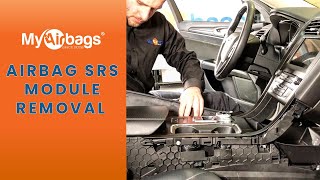
How to confirm: Visually inspect the SRS module and its connectors for any signs of moisture, rust, or greenish-blue corrosion. The module must be accessed by removing parts of the center console. 🎬 Watch: Step-by-step guide on how to remove the SRS module.
Typical fix: Replace the corroded module and any damaged wiring connectors. The source of the water leak must also be found and repaired to prevent repeat failure. A water-damaged module cannot be safely repaired and must be replaced.
Est. part cost: $400-$950 - Corrupted Memory from Voltage Fluctuation ⚪ Low Probability Incorrect jump-starting procedures, a failing alternator, or a weak battery can cause voltage spikes or drops that corrupt the sensitive memory within the SRS module, triggering a B1000 code.
How to confirm: As a first step, attempt to clear the code with a professional scan tool. If the code was triggered by a one-time voltage event, it may clear and not return. If it returns immediately, the memory is likely permanently corrupted.
Typical fix: If the code returns immediately after clearing, the module's memory is permanently corrupted. The module may need to be replaced or sent to a specialist for a data reset. If it doesn't return, address the underlying electrical issue (e.g., replace the battery or alternator).
Est. part cost: $0-$900
Rare But Worth Checking
- Locked Module After a Collision: If the vehicle has a history of a collision, even a minor one that didn't deploy the airbags, the SRS module may have stored 'crash data' and locked itself. In this state, it will often set a B1000 code or other crash-related codes and must be either professionally reset by a specialist service or replaced. This is a designed safety feature.
Diagnosis Steps
- Confirm the airbag warning light is on.
- Scan the Supplemental Restraint System (SRS) with a professional-grade scan tool capable of reading B-codes (Body codes). A basic OBD-II reader will not see this code.
- Confirm B1000 is the primary or only code present. If other SRS codes are stored, diagnose and resolve them first, as they could be causing a communication issue that is misinterpreted as a module failure.
- Attempt to clear the B1000 code. If it clears and does not return after cycling the ignition, it may have been a temporary glitch from a voltage fluctuation. If it returns immediately, proceed with diagnosis.
- Disconnect the vehicle's battery and wait at least 3-5 minutes to allow the system to fully discharge before working on any SRS components.
- Locate the SRS control module. On the 2013-2018 Santa Fe, this requires removing the center console trim to access the module underneath.
- Check the module and its electrical connector (typically a large yellow connector) for any signs of physical damage, water intrusion, or corrosion.
- Using a multimeter and the vehicle's service manual, verify that the SRS module is receiving proper battery voltage and has a solid ground connection at the harness connector.
- If power, ground, and the wiring harness appear intact, and the code cannot be cleared, the Airbag Control Module is faulty.
- The next step is to either replace the module with a new one (which MUST be programmed to the vehicle's VIN by a dealer or qualified shop) or remove the original module and send it to a specialized service for crash data reset and repair.
Parts You'll Likely Need
- Airbag Control Module (SRS Module)
(OEM #95910-2W000 (for 2013-2017 Santa Fe). Note: Always verify with VIN. Other part numbers may apply.)— This code specifically indicates an internal, unrecoverable failure of this module.
Trusted brands: Hyundai Genuine
OEM price range: $400-$900
Aftermarket price range: Not Recommended for new units. Reset services for original modules are a viable alternative ($50-$200).
Technical Service Bulletins (TSBs) & Recalls
- TSB-13-FL-001: While not for the airbag module, this TSB for the 2013 Santa Fe acknowledges issues with internal control module read-only memory on the PCM, showing a precedent for module-level memory faults on this platform.
Platform-Specific Known Issues
- While the 2013-2018 Santa Fe has been subject to numerous recalls and complaints regarding engine failures and electrical issues with the ABS module, the B1000 code is specific to the SRS system and is not directly related to these other common problems.
Mechanic-Grade Diagnostic Values
- SRSCM Operating Voltage — expected: Approx. 8.4V to 17V with ignition ON.. Failure: Voltage below approximately 9V can trigger a B1102 (Battery Voltage Low) code and prevent proper operation or programming. No voltage would indicate a power supply or wiring issue.
- SRSCM Ground Circuit Resistance — expected: Less than 1.0 Ω between the ground pin on the harness connector and a clean chassis ground point.. Failure: High or infinite resistance indicates a broken or corroded ground wire, which can cause intermittent or total module failure.
Hidden / Shadow Codes Worth Checking
- B1762: ACU (Airbag Control Unit) Coding Error. This code sets if the variant coding procedure fails after installing a new module. (see via Hyundai GDS or equivalent professional SRS scan tool during or after a failed programming attempt.)
- B1683: Exceed Maximum Coding Number. The SRSCM can only be variant coded a limited number of times (e.g., 255 times). This code indicates the limit has been reached, and the module must be replaced. (see via Hyundai GDS or equivalent professional SRS scan tool after repeated failed programming attempts.)
- B1102: Battery Voltage Low. This code often appears alongside a B1762 coding error if the system voltage drops below ~9V during the programming procedure. (see via Hyundai GDS or equivalent professional SRS scan tool.)
Scan Tool Commands That Help
- Hyundai GDS (Global Diagnostic System) or equivalent (e.g., Autel): ACU Variant Coding — This function is mandatory after replacing the SRSCM with a new unit. It programs the vehicle's VIN and specific equipment configuration (number of airbags, seatbelt types, etc.) into the new module. Failure to perform this will result in a non-functional SRS system and code B1762.
Wiring & Ground Locations
- SRSCM Power Input — On the main yellow connector (often Connector A) of the SRSCM under the center console. While a specific pin number is not consistently documented across public sources, power is typically supplied via an ignition-switched circuit from the cabin fuse panel (Smart Junction Box).. A loss of power to the SRSCM will prevent it from functioning, but a B1000 code specifically indicates an internal self-test failure, meaning the module likely has power but has failed internally. Verifying power is a crucial first step to rule out a simple wiring fault.
- SRSCM Ground — Pin 2 of Connector A on the SRSCM is listed as 'Power Ground' in some service documents. This circuit connects to a chassis ground point. For the 2014 Santa Fe, ground point 'GM03' is located behind the center of the dash, making it a likely candidate for the SRSCM ground.. A poor or intermittent ground can cause unpredictable behavior, voltage fluctuations, and memory corruption within the module, potentially leading to a B1000 fault. Confirming a clean, tight ground connection is essential.
OEM Part Supersession History
95910-2W000→95910-2W500— Standard part revision or manufacturer change.
Heads up: These parts are for the long-wheelbase (LWB) 3-row Santa Fe. They are NOT compatible with the 2-row Santa Fe Sport, which uses different modules (e.g., 95910-4Z180). Always verify the part number on the original module before ordering.
Model Year Variations Within This Range
- 2013-2018: It is critical to distinguish between the 'Santa Fe' (3-row, LWB) and the 'Santa Fe Sport' (2-row, SWB). They are different models and use different SRSCM part numbers. For example, a 2017 Santa Fe Sport uses part number 95910-4Z180, while a 2015-2018 LWB Santa Fe might use 95910-2W500. Using a module from the wrong body style will result in a programming failure (B1762) as the vehicle's equipment will not match.
Diagnostic Flowchart
Other Known Issues on This Vehicle
Issues unrelated to this code that are worth knowing about as an owner of this generation:
- Theta II Engine Seizure and Failure 🔴 High — Widespread across 2.0L Turbo and 2.4L GDI engines. Subject of a massive class-action lawsuit and multiple recalls/warranty extensions. Failure can occur at various mileages. (Ref: Multiple recalls (e.g., NHTSA 17V-226) and warranty extensions (TXXM) have been issued. A Knock Sensor Detection System (KSDS) software update was deployed to detect early signs of failure.)
- ABS Module Fire Risk 🔴 High — Common enough to trigger a major recall for 2013-2015 Santa Fe Sport models. Brake fluid can leak internally into the ABS module's electronics, causing a short circuit and potential fire, even when the vehicle is parked. (Ref: NHTSA Recall 20V-520, later superseded by Recall 205 (NHTSA 21V-303), was issued to replace a fuse and, if necessary, the ABS module.)
- Peeling Exterior Paint (Especially White) 🟡 Low — A very common complaint, particularly for vehicles with 'White Pearl' or similar white finishes. The paint delaminates and peels off in large sheets, often starting on the hood and roof. (Ref: Hyundai extended the paint warranty to 10 years/unlimited miles for this issue on affected models, including the 2017-2018 Santa Fe Sport and 2019 Santa Fe.)
- Secondary Hood Latch Corrosion 🟠 Medium — Affects 2013-2017 models. The secondary hood latch cable can corrode and fail to engage, creating a risk of the hood flying open if the primary latch fails. (Ref: NHTSA Recall 163 (Hyundai number) was issued to replace the secondary latch cable.)
Used vs. New Parts: Buying Guide for This Vehicle
When a used part is the smart pick: Purchasing a used SRSCM is NOT recommended. While cheaper, it will be programmed to the donor vehicle's VIN and may contain stored crash data. It will require dealer-level programming ('Variant Coding') which may not be possible, leading to wasted money. The only viable non-OEM new option is having your original module reset.
What to inspect on the donor part:
- If considering a used part against advice, you must ensure it comes from a vehicle with an identical part number and has absolutely no collision history.
- Verify the seller guarantees the module is 'unlocked' and free of crash data, which is difficult to confirm without installation.
OEM-only on this vehicle (don't cheap out):
- Airbag Control Module (SRSCM). Due to the critical safety function and VIN-specific programming, a new OEM module or a reset of your original module are the only safe and reliable options.
Aftermarket brands forum-validated for this vehicle:
- For repair services (not new parts), 'Safety Restore' and 'MyAirbags' are frequently cited by owners and shops for successfully resetting original modules, which clears crash data and internal faults, making the module plug-and-play without needing dealer programming.
Brands owners have reported issues with on this vehicle:
- Avoid any 'new' aftermarket SRSCM units from unknown brands. These are unlikely to be programmable or meet OEM safety standards.
Real Owner Stories
Aggregated from forums and TSBs cited above. Mileages and costs reflect what owners reported in those sources.
2016-2019 Hyundai Santa Fe
Symptoms: The airbag warning light is illuminated. A diagnostic scan shows the SRS module is located under the center console and has failed its internal self-check.
What fixed it: Removed the SRS module and sent it to a specialized repair service (like MyAirbags) for a reset/repair to avoid dealership programming.
Cost: $50-$200
Source hint: MyAirbags Blog & YouTube Channel
2014-2020 Kia Sorento (UM)
Symptoms: Airbag system faults similar to the Santa Fe platform, with the SRS control module failing to clear hard codes.
What fixed it: Resetting the original module's crash data and hard codes through a specialized service to maintain 'plug-n-play' compatibility.
Source hint: Safety Restore
Hyundai Internal Fault Experience
Symptoms: An owner reported an illuminated airbag light and a diagnostic scan revealed a B1620 internal fault, which is closely related to the B1000 module failure.
What fixed it: As documented in NHTSA ODI #10778303, the dealer had to order a replacement Airbag Control Electronic Board (SRSCM) to resolve the internal fault issue.
Source hint: NHTSA ODI #10778303
Related OBD-II Codes
Frequently Asked Questions
Does TSB-13-FL-001 mean my 2013 Santa Fe airbag module is defective?
Where is the SRS control module located on my 2013-2018 Santa Fe if I need to check for water damage?
Can I use a standard OBD-II code reader to diagnose the B1000 code on my Santa Fe?
Is the B1000 code related to the major ABS module fire recall on 2013-2015 Santa Fe Sport models?
Should I buy a used SRS module from a salvage yard to fix this code?
Can a weak battery cause the B1000 code on my Hyundai?
Helpful Videos

The information in this article is provided for general reference and educational purposes only. Vehicle specifications, procedures, and part compatibility can vary by production date, trim level, and region. Always consult your vehicle's factory service manual and verify part numbers before purchasing or performing repairs. Safety-critical components such as airbags, seat belts, and braking systems should be installed by a qualified professional.
- Hyundai Santa Fe:
- 🧭 Diagnostic Flowchart
- 🎬 Helpful Videos
- What's Unique About the 2013-2018 Hyundai Santa Fe
- Symptoms You May Notice
- Most Likely Causes
- Rare But Worth Checking
- Diagnosis Steps
- Parts You'll Likely Need
- Technical Service Bulletins (TSBs) & Recalls
- Platform-Specific Known Issues
- Mechanic-Grade Diagnostic Values
- Hidden / Shadow Codes Worth Checking
- Scan Tool Commands That Help
- Wiring & Ground Locations
- OEM Part Supersession History
- Model Year Variations Within This Range
- Other Known Issues on This Vehicle
- Used vs. New Parts: Buying Guide for This Vehicle
- Real Owner Stories
- 2016-2019 Hyundai Santa Fe
- 2014-2020 Kia Sorento (UM)
- Hyundai Internal Fault Experience
- Related OBD-II Codes
- Frequently Asked Questions
- 🎟️ Get 5% Off