

OBD-II Code B1015: Module Configuration/Internal Error
What B1015 means, why it triggers, and how to fix it
- Identify your vehicle's specific manufacturer definition for B1015 before buying parts, as it means 'Diagnosis Sensor Unit' on a Nissan but 'VIN Information Error' on a GM.
- Do not drive the vehicle, as B1015 indicates a disabled primary safety system that will fail to deploy airbags during a collision.
- Fix Nissan and Hyundai airbag module faults by using a $50-$100 mail-in crash data reset service instead of paying $800+ for a dealer replacement.
- Program the correct VIN into any newly installed parking assist or blind-spot module on GM vehicles, or the system will disable itself upon restart.
What Does B1015 Mean?
B1015 is a body trouble code indicating a problem with one of your car's electronic control modules. It means the module has an internal error, stored crash data, or incorrect programming for your specific vehicle. Because its meaning varies widely between carmakers, the warning light you see—often for the airbag—points to the affected system. For example, a B1015 on a Nissan means the airbag module has an internal fault, while on a GM vehicle it points to a VIN mismatch in the parking assist module.
Technical definition: There is no universal SAE/ISO definition for B1015. It indicates a module detected an internal fault, a configuration discrepancy, or a specific circuit failure assigned by the manufacturer. On Nissan vehicles, it means 'Diagnosis Sensor Unit,' indicating an internal airbag module fault. On GM vehicles, it means 'Vehicle Identification Number (VIN) Information Error,' indicating a module's stored VIN doesn't match the car. On VW/Audi models, it means 'Igniter for Battery Interrupt: Resistance Too High', pointing to the pyrotechnic safety device that disconnects the battery in a crash. On Ford and Mazda, it specifies 'Passenger Pretensioner Circuit Open'.
Can I Drive With B1015?
No — Do Not Drive. You can physically drive the car, but it is unsafe. This code indicates a critical safety system—most commonly the airbags and seatbelt pretensioners—is disabled. In a collision, the airbags will not deploy, drastically increasing the risk of serious injury or death. Furthermore, in many jurisdictions, a vehicle with an active airbag warning light automatically fails its safety inspection, making it illegal to register or sell. Address this code immediately.
Common Causes
- Internal Airbag Module Failure or Stored Crash Data (Very Common) — This is the most frequent cause, especially on Nissan, Infiniti, and Hyundai. After an accident, the airbag module stores 'crash data' and sets this code, disabling the system. The module also fails internally from age, a voltage spike, or water damage.
- Improper or Missing Module Programming (VIN Mismatch) (Very Common) — On GM vehicles like the Chevrolet Camaro and Silverado, this code appears when a module is replaced but not programmed with the car's VIN. The new module cannot function correctly. This is a common issue after improper shop repairs.
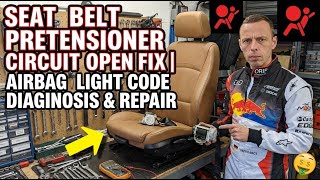
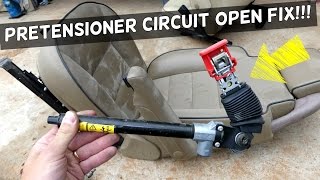
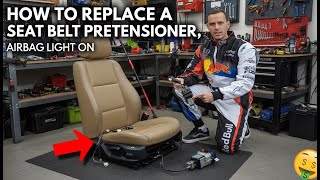
- Faulty Seat Belt Pretensioner or Circuit (Common) — On Ford, Mazda, and Lincoln vehicles, B1015 points to an open circuit or fault in the passenger's seat belt pretensioner or its tension sensor. The fault lies in the pretensioner unit, the wiring, or the connector under the passenger seat. 🎬 See how to diagnose and fix pretensioner circuit open codes.
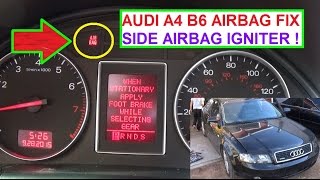
- Faulty Battery Interrupt Igniter (VW/Audi) (Common) — Specific to Volkswagen and Audi, this code points to a problem with the N253 Igniter for Battery Interrupt, a pyrotechnic device that severs the battery connection during a severe accident. The code triggers if the igniter's resistance is too high due to deployment, damaged wiring, or an improper repair.
- Damaged Wiring or Loose Connections (Less Common) — Wiring associated with the affected module frays, corrodes, or disconnects, leading to a fault. This is common for connectors under seats or in bumpers exposed to moisture or road salt.
- Faulty Passenger Occupancy Mat (BMW/Mercedes) (Less Common) — On BMW and Mercedes models, the passenger seat occupancy sensor mat degrades and develops incorrect resistance. This causes the airbag module to set a fault and turn on the warning light.
- Low Battery Voltage or Electrical Spikes (Rare) — A dying battery or an improper jump-start causes voltage fluctuations that corrupt a module's memory or trigger a false internal fault code. A resting battery voltage below 12.2V causes unpredictable behavior in sensitive electronics.
- Stuck Button on a Control Interface (Chrysler/Fiat) (Rare) — On Chrysler and Fiat models, the HVAC or Electronic Steering Lock module sets a B1015 code if a button on the control panel is stuck in the 'On' position for more than two minutes.
Symptoms
- Airbag Warning Light is On — The light stays on continuously or flashes, indicating the entire Supplemental Restraint System (SRS) is disabled and will not deploy in a crash.
- Parking Assist System Inoperative — If the code relates to the parking assist module, the system fails, and a 'SERVICE PARK ASSIST' message appears on the driver information center.
- Other System Malfunctions — On Honda/Acura models, B1015 indicates a communication loss between the main computer (MICU) and door control modules, causing erratic power window or door lock behavior.
- System Works Temporarily, Fails on Restart (also visible on scanner) — A classic symptom of a VIN mismatch error on GM vehicles. After clearing the code, the system works for one ignition cycle. Upon restart, the module re-verifies the mismatched VIN and immediately sets the code again.
- Inability to Clear the Code (scan-tool only — no driver-felt sign) — Unlike engine codes, B1015 represents a 'hard code' that cannot be erased with a standard OBD-II scanner until the underlying hardware or programming issue is fixed. The fault is immediately re-detected on startup.
Diagnostic Flowchart
Tap your situation to follow the diagnostic path that matches what you're seeing on this code.
Common Fixes & Costs
- Reset Airbag Module (Crash Data Removal) — Parts: $0, Labor: $50-$100, ~1.5 hr book time (DIY)
- Program VIN to a Replacement Module — Parts: $0, Labor: $100-$200, ~1.0 hr book time (Professional)
- Replace Seat Belt Pretensioner — Parts: $150-$400, Labor: $100-$200, ~1.5 hr book time (Intermediate)
- Replace Battery Interrupt Igniter (VW/Audi) — Parts: $150-$300, Labor: $75-$150, ~1.0 hr book time (Intermediate)
- Repair Damaged Wiring or Connector — Parts: $5-$50, Labor: $100-$300, ~2.0 hr book time (Intermediate)
- Replace Airbag Control Module — Parts: $200-$1200, Labor: $150-$400, ~2.5 hr book time (Professional)
Used vs. New Parts: Buying Guide
When a used part is worth it: For the Airbag Control Module, buying a used part is strongly discouraged. It has an unknown history, contains stored crash data, and requires expensive VIN programming. Have your original module reset by a professional service.
Donor-vehicle mileage cap: roughly under 10000 miles for the part to have meaningful remaining life.
Donor quality checklist:
- For a pretensioner or igniter, only use a new OEM part or a professionally rebuilt unit.
- Never buy a used airbag module. Send your original module for a reset service.
- Verify the part number matches exactly.
Decision logic:
- If Code is due to crash data in the airbag module → Use a mail-in reset service on your original module. Cost is $50-$100.
- If Code is due to a faulty seatbelt pretensioner or VW igniter → Buy a new OEM part or a professionally rebuilt unit.
- If Module was replaced with a used part and now shows B1015 → The used module needs VIN programming.
Warranty tradeoff: Used safety parts have no reliable warranty. Professional module reset services offer a limited or lifetime warranty. New OEM parts carry a manufacturer's warranty.
Worst-case if a used part fails: $300-$800 if a used module fails to program or is internally faulty.
What Happens If You Wait — Timeline
- Immediately: Code sets and the airbag/SRS warning light illuminates. The associated safety system is disabled and will not deploy in a crash. (MPG impact: 0%% · Added cost: $0 (but personal safety risk is immense))
- At next vehicle inspection: In many states, an illuminated airbag light is an automatic failure of the annual safety inspection. (MPG impact: 0%% · Added cost: $100-$500 in potential fines, re-inspection fees, and the eventual cost of repair.)
- 1-6+ months (if caused by moisture): Ongoing moisture causes corrosion to spread from the initial connector to the wiring harness or module circuit board. (MPG impact: 0%% · Added cost: $500-$2,000+ to diagnose and repair a corroded wiring harness or replace a water-damaged module.)
- At time of sale/trade-in: An active airbag light significantly reduces the vehicle's resale value. Dealers reduce their offer by 20-40%. (MPG impact: 0%% · Added cost: $1,000-$3,000+ in lost vehicle value. A $1500 repair might preserve $3000 in trade-in value.)
Cost of Not Fixing It
- Immediately: The vehicle's supplemental restraint system is disabled and will NOT deploy in an accident, drastically increasing the risk of serious injury or death. (Added cost: Incalculable (Personal Safety))
- At Next Inspection: Vehicle automatically fails the safety inspection in many states, preventing legal registration renewal. (Added cost: $100-$500 in potential fines, re-inspection fees, and the eventual cost of repair.)
- 1-6+ months: If the root cause is water intrusion, corrosion spreads to other wires or modules, leading to complex electrical failures. (Added cost: $500-$2000+ to diagnose and repair additional electrical damage.)
- At time of sale/trade-in: An active airbag light significantly reduces the vehicle's resale value. Dealers reduce their offer by 20-40% or refuse the trade-in altogether. (Added cost: $1,000-$3,000+ in lost vehicle value. A $1500 repair might preserve $3000 in trade-in value.)
Diagnosis Steps
- Identify Manufacturer-Specific Definition
Use a reliable source to find the specific meaning of B1015 for your vehicle's make and model. This critical step tells you exactly which system to focus on.
Tools: Internet access, professional scan tool or service manual (Beginner) - Perform a Full System Scan
Use an advanced scan tool to check for codes in ALL modules. Other codes, like a U-code (communication) or a BCM power-related code, are often the root cause, making B1015 a secondary symptom. Diagnose communication or power codes first.
Tools: Advanced bi-directional scan tool (Beginner) - Visually Inspect the Affected Area
Based on the code's definition, inspect the relevant components. Check wiring under front seats for airbag issues, the seat belt anchor for pretensioner faults, the battery interrupt device for VW/Audi, and the trunk module for park assist. Look for damage, corrosion, or unplugged connectors.
Tools: Flashlight (Beginner) - Check Fuses and Battery Health
Verify the fuse for the affected module is intact. Test your vehicle's battery with a multimeter. A reading below 12.2V indicates a discharged battery that causes false codes. With the engine running, voltage must be between 13.7V and 14.7V.
Tools: Owner's manual, fuse puller, multimeter or battery tester (Beginner) - Use Scan Tool to Check Live Data (Pro Tip)
If you suspect a VIN mismatch on a GM vehicle, navigate to the Parking Assist Module's live data stream with an advanced scan tool. Compare the 'Stored VIN' parameter to the vehicle's actual VIN. If they don't match, programming is required.
Tools: Advanced bi-directional scan tool (Intermediate) - Perform Continuity & Resistance Checks (Pro Tip)
For circuit-specific codes, use a multimeter. For a Ford 'Pretensioner Circuit Open', check for continuity through the wiring harness. For a VW 'Battery Interrupt Resistance Too High', measure the resistance across the N253 igniter's pins; it must be between 2.0 and 3.5 Ω.
Tools: Multimeter, wiring diagram, service manual (Advanced) - Check for Technical Service Bulletins (TSBs)
Search for TSBs related to your vehicle's make, model, year, and the B1015 code. Manufacturers release bulletins for known issues, saving hours of diagnostic time.
Tools: Internet access or subscription to a professional repair database (Intermediate) - Isolate the Module
If all wiring and external components test good, condemn the module itself. Before replacing, ensure the module receives proper power and ground according to the wiring diagram.
Tools: Multimeter, wiring diagram (Advanced) - Test SRS Circuits with a Resistor (Advanced)
For circuit-specific faults, insert a 2.0 to 3.0-ohm resistor into the vehicle-side harness connector to simulate a good component. Clear the codes. If the code is gone, the fault is in the component. If it remains, the fault is in the wiring or module.
Tools: 2.0-3.0 Ohm resistor, wiring diagram, advanced scan tool (Advanced)
When This Code Triggers (Freeze-Frame Conditions)
- Module Voltage: 12.5-14.5V (Normal operating voltage during key-on or engine-running state when the fault was detected.)
- Ignition Status: ON (The code sets during the module's power-on self-test.)
- Fault Type: Internal Electronic Failure / Configuration Error / Open Circuit (The specific sub-type of fault detected by the module.)
- Odometer: Vehicle mileage (The mileage at which the fault was first recorded.)
Related Codes
- U0151 — A 'U' code indicates a communication problem. U0151 means 'Lost Communication With Restraints Control Module.' If B1015 and U0151 are both present, U0151 is the primary fault. Fix the communication issue first.
- B10E5 — On Chevrolet models, B1015 appears with B10E5 (BCM power mode mismatch). Troubleshoot the B10E5 first by checking battery health and BCM power/ground circuits.
- B0052 — On Ford vehicles, B1015 means 'Passenger Pretensioner Circuit Open,' while B0052 indicates a fault in the deployment control circuit. For B1015, find a physical break in the wiring. For B0052, check the control logic.
- B1325 — On GM vehicles, B1325 (Device Power Circuit Voltage Below Threshold) prevents the B1015 diagnostic from running. Ensure B1325 is not present, as it indicates a power supply issue.
Climate & Environmental Factors
- High Humidity / Water Ingress: Moisture penetrates control modules and connectors, causing corrosion on the circuit board. This disrupts electrical signals, leading to high resistance faults or short circuits that trigger a B1015 code.
- Road Salt (Winter Climates): Salt spray creates a highly corrosive brine that attacks under-vehicle wiring, connectors, and module casings. This causes circuit integrity faults for components exposed in the chassis or under seats.
- Extreme Cold: Very cold temperatures cause metal contacts within electrical connectors to contract, leading to loose connections and intermittent open circuits.
How to Talk to a Mechanic About This Code
Say this: "I have a B1015 code on my [Make, Model] and an airbag light. I understand this code is manufacturer-specific. For my [Make], it often points to [specific cause]. I need a diagnostic to confirm the specific cause. What tools do you use for SRS diagnostics?"
This signals you've done your research and forces the shop to address the specific, most likely cause for your vehicle, saving diagnostic time and money.
Avoid saying:
- 'My airbag light is on, can you fix it?' (Invites a high-cost, parts-first approach).
- 'Just replace whatever is broken.' (Gives the shop a blank check).
- 'I heard it's probably the airbag module.' (Leads them to quote an expensive replacement without diagnosing a simpler root cause).
Questions to ask before authorizing the repair:
- Can you provide a written estimate that itemizes parts and labor?
- If the diagnosis is an internal module fault, do you offer a module reset service?
- If the module needs programming, what is your hourly rate for that service?
- What is your warranty on this specific repair?
Where to Take It: Dealer vs Independent vs Chain
- Dealer:
Use for warranty work or complex software fixes. If out of warranty, get a quote from them but use it as a baseline to compare against other options.
Best for: Vehicles under warranty., Complex programming issues where they have exclusive access to software., Recalls and service campaigns.
Downsides: Highest cost, often 1.5-2x the labor rate of an independent shop., Often defaults to expensive module replacement instead of exploring repair or reset options. (Typical cost: +50% vs. baseline) - Independent Shop:
Often the best choice if they have advanced diagnostic tools capable of reading SRS codes and performing module programming.
Best for: Out-of-warranty vehicles where cost is a factor., Diagnosing common, known failure patterns., Performing module programming if they have a J2534 pass-thru tool and OEM software subscriptions.
Downsides: Quality and capabilities vary widely. Must be vetted., May not have the very latest tools for brand-new models. (Typical cost: +0% vs. baseline) - Chain Shop:
AVOID. They are not equipped to handle this code and are likely to misdiagnose the problem.
Best for: Simple, routine maintenance like oil changes and tires.
Downsides: Technicians lack training for complex SRS diagnostics., High pressure to sell unnecessary services., Basic scanners cannot read body codes like B1015. (Typical cost: -10% vs. baseline)
When to Walk Away From the Repair
If the estimated repair cost exceeds 50% of the car's private-party value, and there isn't a significantly cheaper alternative, consider selling or trading in the vehicle.
- Car worth $4000, fix is $2200: Walk away. A $2,200 repair on a $4,000 car is not a good investment.
- Car worth $15000, fix is $150: Fix it. This is likely a programming fee or a simple wiring fix, and it's well below the threshold.
- Car worth $8000, fix is $1200: Borderline, but explore cheaper alternatives first. A $1,200 dealer quote for a new module could become a $100 fix by mailing your original module for a reset.
What Scan Tool You Need for This Code
Minimum: A scanner that reads and clears SRS (Airbag) and Body Control Module (BCM) codes. Basic engine-only code readers will not work.
A standard $20 OBD-II reader only communicates with the Engine Control Unit (ECU). Code B1015 is a Body ('B') code, stored in a different computer. A basic reader won't even see the code.
Budget: BlueDriver Pro (~$99) — Reads and clears SRS/airbag codes on many popular makes. Connects to your phone via Bluetooth.
Mid-range: Foxwell NT809 / Autel MaxiCOM MK808 (~$300-500) — Offers full system diagnostics and some bi-directional controls. Can read the VIN from a module.
Professional: Autel MaxiSys MS906BT / Launch X431 with J2534 (~$1200-2000+) — Full professional-level tools. Offers advanced coding and programming capabilities needed to program a module to a vehicle's VIN.
Rent vs buy: Auto parts stores offer free code reading, but their tools are often basic and cannot read SRS codes. For a one-time, complex issue like B1015, paying for a professional diagnosis is often more effective than buying a high-end tool.
How to Clear the Code After You Fix It
- Ensure the underlying fault is fully repaired.
- Reconnect the vehicle battery.
- Use a professional-grade scan tool with SRS capabilities to clear the code.
- If the code is for stored crash data, send the module to a specialist service for a hard reset.
- If the code is for a VIN mismatch, program the module using OEM software.
Drive cycle (~10 minutes): A traditional emissions drive cycle is not applicable. Turn the ignition off, wait 30 seconds, then turn the ignition on. The airbag light illuminates for a few seconds for a self-check and then turns off. If the light stays on, the fault remains.
Readiness monitors affected: Not applicable. B1015 is a body code and does not affect emissions readiness monitors.
Watch out for:
- Using a basic OBD-II engine code reader, which cannot access or clear SRS/Body codes.
- Failing to fix the root cause. The code returns instantly if the hardware or programming issue exists.
- Assuming a used module works without programming. Most require VIN programming.
Will This Fail Emissions / State Inspection?
Yes — this code typically fails an OBD-II emissions inspection.
- California: Will NOT fail a smog check, as the airbag system is unrelated to emissions. Selling a car with a known safety defect creates legal liability.
- New York: An illuminated airbag warning light is an automatic failure of the annual safety inspection.
- Texas: An airbag light is NOT a cause for failure during the official Texas safety inspection, but you are driving with a disabled safety system.
- Virginia: Virginia's annual safety inspection includes checking for an illuminated airbag light, resulting in an inspection failure.
Most Commonly Affected Vehicles
- Nissan Rogue, Xterra, Armada, Frontier, Murano, X-Trail, Maxima (2001-2020) — Extremely prone to storing the 'Diagnosis Sensor Unit' fault in the airbag module after an accident or from internal failure. Resetting the module is the most common fix.
- Infiniti G37 (2012-2013) — Commonly experiences B1015 due to airbag control unit failure, sometimes triggered by battery issues or jump-starts. A reset service is an attractive option over expensive replacement.
- Chevrolet / GMC Camaro, Silverado, Sierra (2010-2015) — Frequently sets a B1015 'VIN Information Error' in the rear parking assist or Side Object Detection (SOD) modules if a module is replaced and not programmed.
- Ford / Lincoln / Mercury F-150, Fusion, Focus, MKZ (2010-2020) — On these models, the code specifically means 'Passenger Pretensioner Circuit Open,' pointing to a fault in the seatbelt system, its wiring, or connector.
- Volkswagen / Audi A3, Q5, Golf, Passat (2010-2019) — Code B1015 specifically indicates 'Igniter for battery interrupt: Resistance Too High'. This points to the pyrotechnic fuse (N253) that disconnects the battery in a crash.
- Subaru Outback, Forester, Impreza (2008-2014) — Airbag faults related to the Occupant Detection System (ODS) and belt tension sensor trigger module codes like B1015. The fault often lies in the seat belt tension sensor itself.
- Hyundai / Kia Various (2010-2020) — B1015 is commonly used as a general 'faulty module' code for the SRS airbag module, indicating stored crash data that needs clearing by a specialist service.
- Chrysler / Dodge 200, Town & Country (2011-2014) — Indicates a 'Vehicle Configuration Mismatch' if modules are not initialized correctly, or a stuck button on a control panel, such as the rear defroster switch.
- Acura / Honda Various (2005-2015) — On some models, B1015 means 'MICU Lost Communication with Driver's MPCS Unit', pointing to a communication breakdown affecting windows and locks.
Manufacturer-Specific Notes
- Nissan/Infiniti: The airbag module is notoriously sensitive to low voltage and jump-starts. A dead battery leads to a B1015 code upon restart, even without an accident. The code means 'Diagnosis Sensor Unit' fault, pointing directly to the module.
- General Motors (Chevrolet/GMC): This code is frequently a programming issue. Replaced modules MUST be programmed to the vehicle's VIN. The system works once after clearing codes but fails upon restart if the VIN isn't programmed.
- Ford/Mazda: The definition is highly specific: 'Passenger Pretensioner Circuit Open'. Diagnosis must focus entirely on the passenger seat belt assembly, its wiring, and its connector.
- Audi/VW: B1015 refers to the 'Igniter for battery interrupt', a pyrotechnic device that disconnects the battery in a crash. A faulty igniter or a bad repair after an accident triggers this code. Resistance must be between 2.0-3.5 ohms.
Real Owner Stories
2016 Nissan Altima with airbag light on
The airbag light came on after the car was in a minor accident. The deployed airbags were replaced, but the light remained on, showing a B1015 code.
Outcome: The owner found a mail-in reset service online. They removed the original airbag module, sent it in, and received it back for $50. After reinstalling, the B1015 code was gone.
Lesson: For Nissan vehicles with a B1015 code after an accident, don't immediately pay for an expensive new module. A mail-in reset service clears the stored crash data from your original module for a fraction of the cost.
2011 Chevy Camaro with 'Service Park Assist' message
The owner bought a used Parking Assist Module (P/N 20925650) to fix their broken system. After installing it, the system worked for one key cycle, but then the 'Service Park Assist' message appeared and code B1015 was set.
Outcome: The owner took it to an independent shop with a GM MDI tool. The shop charged $150 to program the VIN into the module, permanently fixing the issue.
Lesson: On GM vehicles, B1015 is often a 'VIN Mismatch' error. Replacing modules is not plug-and-play. Budget for professional programming, which costs $100-$200, or the part will not function correctly.
2013 Ford F-150 with airbag light and B1015 code
The airbag light came on intermittently at first, then stayed on. A scan revealed code B1015, which on this Ford means 'Passenger Pretensioner Circuit Open'.
Outcome: The owner disconnected the battery, unplugged the connector under the seat, cleaned the contacts, and secured it with a zip tie. The code cleared permanently for free.
Lesson: Always diagnose the specific definition of B1015 for your vehicle. For Fords, it points directly to the pretensioner circuit. Before replacing parts, check simple solutions first, like cleaning and securing the connector under the seat.
2014 VW Golf after minor accident repair
The car was repaired after a minor front-end collision. A few weeks later, the airbag light came on with code B1015: 'Igniter for Battery Interrupt: Resistance Too High'.
Outcome: The owner discovered the body shop bypassed the deployed igniter with a resistor. A dealership replaced the faulty resistor with a new OEM Battery Interrupt Igniter for $280. This resolved the code.
Lesson: On VW/Audi vehicles, B1015 points specifically to the N253 battery disconnect igniter, not the main airbag module. Be wary of improper repairs after an accident; using a resistor is unsafe and will eventually fail.
How to Prevent This Code From Triggering
- Maintain Battery Health (Monthly) — Low voltage and voltage spikes corrupt module memory and trigger false internal fault codes. Regularly check battery voltage.
- Use Proper Jump-Starting Procedure (As needed) — Improper jump-starting causes voltage spikes that fry sensitive electronics. Follow the correct cable connection order.
- Prevent Water Ingress (Annually) — Water kills electronic modules. Annually check that sunroof and A/C evaporator drains are clear. Inspect windshield and door seals for leaks.
- Apply Dielectric Grease to Connectors (During any related repair) — When working on electrical components, apply dielectric grease to the connector to seal out moisture and prevent corrosion.
- Be Careful with Interior Cleaning (Every cleaning) — Aggressive shampooing introduces excessive moisture under the seats, where critical SRS connectors and modules are located. Avoid soaking these areas.
Frequently Asked Questions
Can I reset the B1015 code myself?
Usually, no. If the code is due to stored crash data or an internal module error, a standard OBD-II scanner cannot clear it. The module needs to be either professionally reset by a mail-in service, or replaced and programmed by a shop with manufacturer-specific tools.
Is it safe to drive with the B1015 code?
No. While the car will run and drive, the safety system indicated by the warning light (usually airbags) is disabled. In a crash, your airbags will not deploy, which leads to severe injury or death.
My car was in an accident, is that why I have this code?
Yes, this is a very common reason. The Restraints Control Module (RCM) or Airbag Module stores crash data and locks itself, triggering the B1015 code on many makes like Nissan and Hyundai. The module needs a reset or replacement after physical repairs are done.
A shop quoted me $1,500 to fix this. Is that too high?
It often is. Dealerships usually replace the entire module, which costs $400-$1,200+ for parts alone. Ask about using a mail-in reset service, which costs $50-$100 and restores your original module, avoiding costly programming.
I replaced a module from a junkyard car and now have this code. What did I do wrong?
You must have the used module programmed to your car's VIN. Modern modules are not 'plug-and-play' and require this step to sync with the vehicle's other computers. An independent shop with the right tools does this for $100-$200.
What are common misdiagnosis pitfalls for B1015?
The biggest mistake is replacing an expensive control module when the fault is in a connected component or wiring. For example, on a VW, B1015 points to the battery interrupt igniter, while on a Ford, it's the seatbelt pretensioner. Always diagnose the specific definition of the code for your vehicle before replacing parts.
My parking sensors work until I restart the car. What does that mean?
This is a classic symptom of a VIN mismatch error, common on GM vehicles. Upon startup, the module re-checks its programming, fails the VIN verification, and sets the B1015 code, disabling the system. This strongly indicates the module needs programming with the correct VIN.
Key Takeaways
- Identify your vehicle's specific manufacturer definition for B1015 before buying parts, as it means 'Diagnosis Sensor Unit' on a Nissan but 'VIN Information Error' on a GM.
- Do not drive the vehicle, as B1015 indicates a disabled primary safety system that will fail to deploy airbags during a collision.
- Fix Nissan and Hyundai airbag module faults by using a $50-$100 mail-in crash data reset service instead of paying $800+ for a dealer replacement.
- Program the correct VIN into any newly installed parking assist or blind-spot module on GM vehicles, or the system will disable itself upon restart.
Helpful Videos
Shop the Parts Behind B1015
Below are the parts most often responsible for code B1015, ranked by how frequently each one is the actual culprit (per the diagnosis above). Tap any to see what we have for your vehicle.



The information in this article is provided for general reference and educational purposes only. Vehicle specifications, procedures, and part compatibility can vary by production date, trim level, and region. Always consult your vehicle's factory service manual and verify part numbers before purchasing or performing repairs. Safety-critical components such as airbags, seat belts, and braking systems should be installed by a qualified professional.
- 🧭 Diagnostic Flowchart
- 🎬 Helpful Videos
- 🛍️ Shop This Part
- What Does B1015 Mean?
- Can I Drive With B1015?
- Common Causes
- Symptoms
- Common Fixes & Costs
- Used vs. New Parts: Buying Guide
- What Happens If You Wait — Timeline
- Cost of Not Fixing It
- Diagnosis Steps
- When This Code Triggers (Freeze-Frame Conditions)
- Related Codes
- Climate & Environmental Factors
- How to Talk to a Mechanic About This Code
- Where to Take It: Dealer vs Independent vs Chain
- When to Walk Away From the Repair
- What Scan Tool You Need for This Code
- How to Clear the Code After You Fix It
- Will This Fail Emissions / State Inspection?
- Most Commonly Affected Vehicles
- Manufacturer-Specific Notes
- Real Owner Stories
- 2016 Nissan Altima with airbag light on
- 2011 Chevy Camaro with 'Service Park Assist' message
- 2013 Ford F-150 with airbag light and B1015 code
- 2014 VW Golf after minor accident repair
- How to Prevent This Code From Triggering
- Frequently Asked Questions
- Can I reset the B1015 code myself?
- Is it safe to drive with the B1015 code?
- My car was in an accident, is that why I have this code?
- A shop quoted me $1,500 to fix this. Is that too high?
- I replaced a module from a junkyard car and now have this code. What did I do wrong?
- What are common misdiagnosis pitfalls for B1015?
- My parking sensors work until I restart the car. What does that mean?
- Key Takeaways
- 🎟️ Get 5% Off