

OBD-II Code B1040: Manufacturer-Specific Fault Guide
The Ultimate Guide to B1040: What it means, why it triggers, and how to fix it on your specific vehicle
- Code B1040 is 100% manufacturer-specific; you must use an advanced scanner to read the exact sub-code (like B1040-96) for your specific make and year.
- On 2017-2023 Honda models, B1040 almost always indicates a failed windshield wiper motor assembly requiring a $300-$450 replacement.
- For Chrysler, Dodge, and Ram vehicles, this code typically flags a failed HVAC mode door actuator, a $35 part that costs up to $600 in labor if dashboard removal is required.
- If B1040 appears immediately after a windshield replacement on a Kia or Hyundai, the shop skipped a mandatory $250-$500 ADAS camera software flash and recalibration.
What Does B1040 Mean?
B1040 is a manufacturer-specific Body Control Module (BCM) code. Its definition changes completely depending on your car's make and model. It signals that the BCM—the central computer for comfort, convenience, and safety features—has detected a fault in a supervised system. Common culprits include the climate control (HVAC) system, windshield wipers, CAN bus communication networks, or the airbag control unit.
Technical definition: The SAE/ISO definition for B1040 is not standardized; it is a Body (B-prefix) code reserved for automakers. On Chrysler/Dodge/Ram vehicles, it means 'Panel Mode Door 1 Control Circuit/Performance'. On modern Hondas, it means 'BCM Lost Communication with Front Wiper'. For Mercedes-Benz, it indicates a 'Fault in CAN communication'. Other makes use it for internal airbag module faults (BMW), faulty LED daytime running lights (Alfa Romeo), or wireless charging system failures (Ford/Toyota).
Can I Drive With B1040?
Yes, But With Caution. Driving safety depends entirely on your vehicle's make. If the code flags the airbag system (BMW/Renault), the supplemental restraint system will not deploy in an accident. If it flags failed windshield wipers (Honda), driving is extremely hazardous in precipitation. For ADAS-related faults (Kia/Hyundai), critical collision avoidance features are disabled. Address the issue immediately to restore safety.
Common Causes
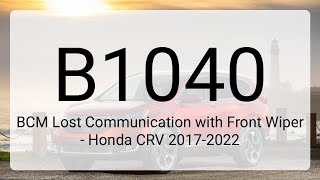
- Faulty Windshield Wiper Motor Assembly (Honda) (Very Common) — The wiper motor's integrated control unit fails internally, breaking LIN bus communication with the BCM and causing total wiper failure. 🎬 Watch: Troubleshooting Honda BCM communication and wiper motor failure.
- Faulty HVAC Mode Door Actuator (Chrysler/Dodge/Ram) (Very Common) — The electric motor directing dashboard airflow fails, binds, or shorts internally. The HVAC control module detects the performance drop and logs the fault.
- Improper or Skipped ADAS Recalibration (Kia/Hyundai) (Common) — After a windshield replacement, the forward-facing camera must be recalibrated. If skipped, or if a new camera lacks the required software update (per Kia TSB ELE246 🎬 See how to perform basic ADAS calibrations for Kia and Hyundai.), the BCM loses communication.
- Wiring or Connector Issue (Common) — A damaged, corroded, shorted, or loose wire in the affected circuit (e.g., wiper LIN bus, HVAC actuator, CAN bus) interrupts the signal.
- Blown Fuse (Less Common) — A fuse protecting the affected circuit (like the 30A wiper fuse on a Honda CR-V) blows due to a momentary short or component failure, cutting power.
- Internal Airbag Control Unit Fault (Less Common) — On BMW and Renault models, B1040 points directly to a software error, self-test failure, or corrupted data within the airbag control unit itself.
- Low Battery Voltage (Rare) — On Fiat or Alfa Romeo, a B1040-64 'Signal Plausibility Failure' sets if the RF Hub module detects system voltage below 10.0 volts for over 15 seconds during a difficult start.
- Faulty Control Module (BCM, HVAC, AAM) (Rare) — The computer module responsible for the system suffers an internal hardware or software failure. This is uncommon and should be the absolute last item suspected.
Symptoms
- Windshield wipers do not work at all (Honda) — The front wipers fail to turn on, stop mid-swipe, or ignore the control stalk entirely.
- Air blows from the wrong vents or at the wrong temperature (Chrysler/Dodge/Ram) — You cannot switch between defrost, dash, and floor vents, or the temperature blend door is stuck.
- ADAS features (Lane Keep, Collision Avoidance) are disabled — A dashboard warning message states that driver assistance systems are unavailable.
- Specific warning light is illuminated — The Airbag (SRS), A/C, or ADAS system warning light illuminates on the instrument cluster.
- Daytime Running Light (DRL) not working (Alfa Romeo) — The left front LED DRL unit fails to illuminate due to an internal component failure.
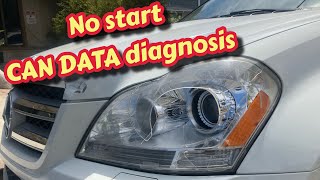
- No-start or no-crank condition (Mercedes-Benz) (scan-tool only — no driver-felt sign) — A CAN communication fault prevents the engine from cranking, often accompanied by limp mode.
Diagnostic Flowchart
Tap your situation to follow the diagnostic path that matches what you're seeing on this code.
Common Fixes & Costs
- Replace Windshield Wiper Motor Assembly — Parts: $150-$250, Labor: $125-$200, ~1.5 hr book time (Intermediate)
- Replace HVAC Blend/Mode Door Actuator — Parts: $20-$50, Labor: $150-$600, ~2.5 hr book time (Intermediate)
- Perform ADAS Camera Recalibration / Software Update — Parts: $0, Labor: $250-$500, ~1.5 hr book time (Professional)
- Repair Damaged Wiring or Connectors — Parts: $10-$50, Labor: $150-$400, ~2.0 hr book time (Professional)
- Repair or Replace Airbag Control Module — Parts: $100-$200, Labor: $150-$300, ~1.5 hr book time (Professional)
Used vs. New Parts: Buying Guide
When a used part is worth it: Used parts make sense for high-cost, low-wear items like a Body Control Module (BCM). Used HVAC actuators or Honda wiper motors are never recommended due to their notoriously high failure rates.
Donor-vehicle mileage cap: roughly under 60000 miles for the part to have meaningful remaining life.
Donor quality checklist:
- Verify the exact part number matches; modules look identical but run different software.
- Ensure the donor vehicle lacked water or fire damage.
- Inspect connectors for green corrosion or bent pins.
Decision logic:
- If Part is an HVAC actuator or Honda wiper motor → Buy new OEM or premium aftermarket. The labor is too high to risk a used part failing.
- If Part is an electronic module requiring programming → Factor in the $150-$300 cost of dealer programming for a used module; a pre-programmed new part may be cheaper overall.
Warranty tradeoff: Used parts carry 30-90 day warranties covering only the part. New aftermarket parts offer 1-year to lifetime warranties. New OEM parts guarantee compatibility.
Worst-case if a used part fails: $300-$800 if a used part fails, requiring you to pay labor twice.
What Happens If You Wait — Timeline
- 0-2 weeks: Fault code is logged. Intermittent faults trigger temporary warning lights. Hard faults (Honda wiper motor) cause immediate, total system failure. (MPG impact: 0%% · Added cost: $0)
- 2 weeks - 3 months: Safety risks escalate. ADAS features disable, increasing crash risk. Airbags will not deploy. HVAC actuators emit persistent clicking noises. (MPG impact: 0%% · Added cost: $0 - $250)
- 3-9 months: Cascading failures begin. A stuck HVAC actuator continuously draws power, overheating and destroying the HVAC control module. Unaddressed shorts drain the battery. (MPG impact: 0%% · Added cost: $300-$1200)
- 9+ months: Vehicle becomes unsafe to drive. Ignored ADAS or wiper faults lead to preventable collisions. Persistent CAN bus faults cause a permanent no-start condition. (MPG impact: 0%% · Added cost: $2,500 - $15,000+)
Cost of Not Fixing It
- Immediate: Total loss of function for the affected system: wipers fail, HVAC is stuck, or ADAS safety features disable. (Added cost: 0)
- 1-6 Months: Severe safety risks. Driving without wipers in rain is hazardous. Inoperative ADAS features increase crash risk. An ignored airbag fault guarantees non-deployment in an accident. (Added cost: High potential for accident liability.)
- 6+ Months: Cascading electrical failures. A stuck HVAC actuator motor continuously draws current, potentially overheating and destroying the HVAC control module. (Added cost: $300-$1000)
Diagnosis Steps
- Identify the Exact Manufacturer Definition
Use a high-quality scan tool to read the B1040 code and any accompanying suffix (e.g., -96, -64) or U-codes. Search for 'B1040 [Your Car's Make and Model]' to find the precise meaning.
Tools: Advanced OBD-II Scanner, Internet access (Beginner) - Check All Relevant Fuses
Locate the fuse box and identify fuses for the affected system (e.g., 'Wiper', 'HVAC', 'ADAS'). Pull each fuse and inspect it visually. For Honda CR-V wiper issues, check the 30A fuse A25 under the hood.
Tools: Fuse puller, Owner's manual (Beginner) - Perform a Thorough Visual Inspection
Inspect the relevant components based on the code's definition. Look for damaged wires, loose connectors, or water intrusion around the wiper motor cowl, under the dash, or at the BCM.
Tools: Flashlight, Trim removal tools (Beginner) - Scan with a Manufacturer-Specific Tool
Generic scanners fail to interpret B-codes correctly. Use an OEM-level tool (Honda HDS, Chrysler wiTECH) to get detailed fault descriptions, view live data streams, and perform necessary programming.
Tools: OEM or Professional-grade diagnostic scanner (Professional) - Pro Tip: Test Honda Wiper LIN Bus Circuit
Disconnect the BCM connector A and the wiper motor 6-pin connector. Check for continuity between pin 60 at the BCM and pin 4 at the wiper motor. Good continuity (under 1.0 Ohm) means the LIN wire is intact. With ignition on, the LIN bus wire should show a fluctuating 9V-11V.
Tools: Multimeter, Vehicle-specific wiring diagram (Advanced) - Pro Tip: Run a Module Self-Test / Calibration
For Chrysler/Dodge HVAC issues, command an 'Actuator Calibration Test' with a bidirectional scanner. If the code changes from 'Stored' to 'Active', it confirms a hard fault with the actuator or its circuit.
Tools: Advanced bidirectional OBD-II scanner (Advanced) - Pro Tip: Test Chrysler HVAC Actuator Circuit for Shorts
Disconnect the A/C Heater Control harness. Turn the ignition on. Measure voltage on the Mode Door Driver circuit. Any voltage indicates a short to voltage. Check for resistance to ground; below 100k Ohms indicates a short to ground.
Tools: Multimeter, Vehicle-specific wiring diagram (Advanced) - Pro Tip: Bench Test Chrysler HVAC Actuator
Test a removed actuator with a 9V battery. Connect the battery terminals to the two pins in the actuator's connector. The motor should spin smoothly. Reversing polarity reverses direction. If it fails to spin or grinds, it is faulty.
Tools: 9V Battery, Jumper wires (Advanced) - Pro Tip: Check CAN Bus Resistance (Mercedes-Benz)
Disconnect the battery. At the OBD-II port, measure resistance between Pin 6 (CAN High) and Pin 14 (CAN Low). A healthy bus reads ~60 Ohms. 120 Ohms indicates a missing termination resistor or broken line. 0 Ohms indicates a short.
Tools: Multimeter (Professional)
When This Code Triggers (Freeze-Frame Conditions)
- System Voltage: 11.5-14.5V (Drops below 10V during crank on some models trigger spurious communication faults.)
- Component Command: On/Off or Position Request (Sets when the BCM commands a component (wiper motor, HVAC actuator) and receives no electrical response or confirmation signal.)
- Ignition Status: On / Run (Detected when the ignition is on, as the BCM performs self-tests and communicates with peripheral modules.)
- Network Status: Active (Sets when a specific module fails to transmit data on the CAN or LIN bus for a manufacturer-defined period.)
Related Codes
- B-prefix codes with suffixes (e.g., B1040-96, B1040-64) — The two-digit suffix provides critical failure type data. On Alfa Romeo, B1040-96 is an 'Internal Component Failure' while B1040-24 is a 'Signal Stuck High'. Always research the suffix.
- Other B-prefix codes (e.g., B1041, B1042) — Indicates multiple failed parts or a shared circuit problem. On Chrysler, B1040 for 'Panel Mode Door 1' often appears alongside B1041 for 'Panel Mode Door 2'.
- U-prefix codes (e.g., U0100, U0140, U0235) — Accompanies B1040 during communication failures. The B-code identifies the module detecting the problem, while the U-code identifies the module that went offline.
- CAN bus codes (Mercedes-Benz specific) — B1040 is a generic CAN fault code often stored with B1041 (transmission control module) or B1042 (instrument cluster) to pinpoint the network failure scope.
Climate & Environmental Factors
- High Humidity / Road Salt: Salt-laden moisture accelerates corrosion on electrical connectors and wiring, causing intermittent or total failure in semi-exposed circuits for wipers, HVAC actuators, and CAN bus networks.
- Extreme Cold / Ice & Snow: Cold weather makes plastic HVAC actuator gears brittle and prone to cracking. Operating wipers frozen to the glass instantly overloads the motor or strips the linkage.
How to Talk to a Mechanic About This Code
Say this: "I have an OBD-II code B1040 on my [Your Car's Make and Model]. Based on my research, this points to a specific issue. For a Honda: '...a faulty wiper motor assembly.' For a Chrysler: '...a bad HVAC mode door actuator.' For ADAS warnings after a windshield replacement: '...a problem with the ADAS camera calibration.' I would like to schedule a diagnostic to confirm this before authorizing repairs."
This language signals you are an informed consumer. It directs their diagnostic efforts, prevents broad upselling, and establishes you as a partner in the repair process.
Avoid saying:
- 'My check engine light is on, can you just fix it?' (Too vague; invites upselling).
- 'I think it's the BCM, just replace it.' (Never command a specific repair without professional diagnosis).
- 'Do whatever you think is best.' (Relinquishes all control over repair scope and cost).
Questions to ask before authorizing the repair:
- Can you show me the faulty part or the diagnostic data confirming the failure?
- For Chrysler HVAC: Did you confirm if the actuator is accessible without full dashboard removal?
- For Honda wipers: Have you tested the LIN bus circuit to rule out a simple wiring break?
- For ADAS: Is this a calibration, a software update, or a faulty part? Do you have the OEM equipment to perform the calibration here?
- What is the warranty on the recommended parts and labor?
Where to Take It: Dealer vs Independent vs Chain
- Dealer:
Best for: Vehicles under warranty., ADAS calibration and module programming (especially Kia/Hyundai)., Complex CAN bus communication diagnostics on European vehicles.
Downsides: Highest labor rates, often 1.5x to 2x more than independent shops., May recommend replacing an entire assembly when a smaller component repair suffices. (Typical cost: +50% vs. baseline) - Independent Shop:
Best fit for common mechanical faults associated with B1040. A trusted local shop with good diagnostic tools offers the best balance of expertise and value.
Best for: Common, well-documented B1040 faults on out-of-warranty vehicles (Honda wiper motors, Chrysler HVAC actuators)., General electrical diagnostics and wiring repair., Shops specializing in your vehicle's brand.
Downsides: Quality varies widely; ensure they have advanced scanners that read manufacturer-specific B-codes., May lack expensive, specialized equipment for ADAS calibration. (Typical cost: +0% vs. baseline) - Chain Shop:
AVOID for B1040 diagnosis. The risk of misdiagnosis is very high. They may replace parts unnecessarily without proper electrical testing.
Best for: Simple, unambiguous repairs like a blown fuse., Windshield replacement (ensure they subcontract or perform proper ADAS calibration).
Downsides: Technicians lack experience with complex diagnostics., High pressure to upsell unrelated services., Unlikely to have bidirectional scanners needed for accurate B1040 diagnosis. (Typical cost: -10% vs. baseline)
When to Walk Away From the Repair
If the estimated repair cost for a safety-critical B1040 fault (airbags, wipers, ADAS) exceeds 40-50% of the car's private-party value, sell or trade in the vehicle.
- Car worth $15000, fix is $600: Fix it. The repair cost is a small fraction of the car's value and restores a critical safety function.
- Car worth $4000, fix is $1200: Borderline. The repair is 30% of the car's value. Get a second opinion and assess the car's overall health before proceeding.
- Car worth $2500, fix is $1500: Walk away. The repair cost is 60% of the car's value. It is not financially sound to invest this much into an aging vehicle.
What Scan Tool You Need for This Code
Minimum: A scanner that reads manufacturer-specific Body (B) trouble codes. A basic $20 code reader that only shows Powertrain (P) codes is insufficient.
A generic reader shows 'No Codes' or a misleading definition. To diagnose B1040, you must see the specific definition for your make and access the Body Control Module (BCM).
Rent vs buy: AutoZone's free loaner tools are basic code readers and insufficient for B1040. For a one-time fix, paying a shop $150 for a professional diagnosis is more cost-effective than buying a mid-range scanner.
How to Clear the Code After You Fix It
- Reconnect any disconnected components (battery, modules).
- Use an OBD-II scan tool to clear the DTC from the BCM.
- Perform required recalibration procedures (HVAC actuator calibration, ADAS camera calibration).
- Operate the repaired system to confirm the fix.
Drive cycle (~15 minutes): A specific drive cycle is rarely required. The code clears and stays cleared if the fault is absent during the module's next power-on self-test. For ADAS issues, a short drive verifies functionality.
Readiness monitors affected: Not applicable. B-codes do not affect emissions readiness monitors.
Watch out for:
- Clearing the code without repairing the mechanical/electrical fault causes it to return immediately.
- Failing to perform a necessary recalibration after replacing an HVAC actuator or ADAS camera.
- Using a generic scanner that cannot communicate with the specific body module to clear the code.
Will This Fail Emissions / State Inspection?
No — by itself this code doesn't fail OBD inspection (but it can keep readiness monitors from setting, which causes a separate fail).
- California: B-prefix codes do not cause a failure of the OBD-II emissions (smog) test, which focuses strictly on powertrain (P-prefix) codes.
- New York: If B1040 illuminates the airbag warning light, the vehicle automatically fails the annual safety inspection.
- Texas: Inoperative windshield wipers are a specific failure item. A B1040 code disabling the wipers causes a safety inspection failure.
Most Commonly Affected Vehicles
- Honda CR-V, Accord, Civic (2017-2023) — Prone to B1040 for 'BCM Lost Communication with Front Wiper'. The wiper motor assembly is the primary failure point.
- Chrysler / Dodge / Ram Grand Caravan, Town & Country, Ram 1500/2500 (2006-2018) — Commonly sets B1040 for 'Panel Mode Door 1 Control Circuit/Performance' due to failing HVAC mode door actuators.
- Kia / Hyundai Telluride, Seltos, Venue, and others (2019-2024) — Shows a B1040-range fault related to the ADAS front camera after windshield replacement. Requires mandatory software update per TSB ELE246.
- Mercedes-Benz ML-Class (W163), E-Class (W210) (1998-2005) — Frequently shows B1040 for a 'Fault in CAN communication' with the engine or transmission control module.
- BMW 5-Series (F10), others (2010-2017) — Indicates an 'internal software error' or 'self-test failure' within the airbag control module (SRS).
- Alfa Romeo Giulia, Stelvio (2016-2024) — Triggers B1040-96 for an 'internal component failure' in the left front LED DRL unit, or B1040-64 for low voltage.
- Ford / Toyota Various models with wireless charging (2020-2024) — Displays B1040 for 'Wireless charging station low output power', indicating a fault with the phone charging pad.
- General Motors (GM) Various (2005-2015) — Means 'Audio [-] output #2 (RF) malfunction', pointing to a fault in the right-front speaker circuit or amplifier channel.
Manufacturer-Specific Notes
- Honda: The fault is almost always an internal failure within the wiper motor's integrated control module, not the BCM or wiring. Replacing the entire motor assembly is the standard fix.
- Chrysler/Dodge/Ram: These vehicles use multiple identical HVAC actuators. When one fails and sets B1040, others are near the end of their life. Proactively replace adjacent actuators during dashboard removal.
- Kia/Hyundai: Per TSB ELE246, brand new Front View Cameras ship without operating software. They MUST be programmed with a dealer-level tool after installation, or they immediately set ADAS DTCs.
- Mercedes-Benz: B1040 points to a CAN bus communication problem. A brand-specific scanner is required to identify which module is offline and diagnose the network issue.
Real Owner Stories
2018 Honda CR-V with ~75,000 miles
Wipers suddenly stopped working in a rainstorm. Code B1040 ('BCM Lost Communication with Front Wiper') was present.
What they tried:
- Checked the 30A wiper fuse under the hood (intact).
- Attempted to clear the code with a basic scanner, but it returned immediately.
Outcome: Replaced the entire windshield wiper motor assembly with OEM part 76505-TLA-A02. The $200 part and 1.5 hours of DIY labor resolved the issue permanently.
Lesson: On modern Hondas, B1040 is almost always an internal failure of the wiper motor's control unit. Do not replace the expensive BCM; replace the wiper motor assembly.
2014 Dodge Grand Caravan with 110,000 miles
A loud clicking noise emerged from the passenger dashboard, and airflow stuck on defrost. Code B1040 ('Panel Mode Door 1 Control Circuit/Performance') was stored.
What they tried:
- Received a $900 shop quote citing full dashboard removal.
- Researched online and found the specific faulty actuator was accessible behind the glove box.
Outcome: Purchased a Dorman 604-024 actuator for $35. Removed the glove box and replaced the actuator in under an hour. Disconnected the battery for 10 minutes to force a calibration, restoring full HVAC function.
Lesson: Verify actuator location before accepting a high repair quote. Many common Chrysler/Dodge actuators are accessible for DIY replacement without removing the dashboard.
2021 Kia Seltos after windshield replacement
Immediately after a windshield replacement, Forward Collision-Avoidance and Lane Keeping Assist warnings illuminated. A scan revealed a B1040-range code for the front view camera.
What they tried:
- Returned to the glass shop, who claimed calibration was unnecessary.
Outcome: A Kia dealer confirmed the glass shop installed a new camera but failed to perform the mandatory software installation and calibration (TSB ELE246). The dealer charged $450 to program and calibrate the camera, restoring ADAS functions.
Lesson: B1040 after a windshield replacement guarantees a missed or improper ADAS camera calibration. New Kia/Hyundai cameras require a specific software flash that non-dealer shops often cannot perform.
1999 Mercedes-Benz ML430 with 150,000 miles
Vehicle stuck in limp mode. A generic scanner showed B1040. A Mercedes-specific scanner revealed 'CAN communication fault with engine control module' alongside B1041 and B1042.
What they tried:
- Suspected a major transmission failure.
Outcome: Visual inspection of the driver's side floor wiring harness revealed severe water corrosion in a major CAN bus junction block. Cleaning the connector and repairing the brittle wires restored network communication and fixed the limp mode.
Lesson: On older European cars, B1040 is a generic CAN bus network failure. The root cause is frequently physical wiring corrosion, not a failed module. A manufacturer-specific scanner is essential to see the scope of the failure.
How to Prevent This Code From Triggering
- Clean wiper blades and windshield regularly (Monthly) — Removes dirt that causes friction and strain on the wiper motor, extending its life.
- Never run wipers on a dry or frozen windshield (Daily habit) — Operating wipers on a dry screen overloads the motor. Moving frozen wipers instantly strips motor gears or blows a fuse. Always de-ice first.
- Cycle the HVAC system through all modes and temperatures (Weekly) — Regularly moving the HVAC blend doors prevents plastic actuator gears from seizing or developing flat spots from lack of use.
- Maintain a healthy battery and charging system (Annually) — Low voltage during engine cranking causes sensitive electronic modules to log spurious communication fault codes, including B1040.
Frequently Asked Questions
Can I fix a B1040 code myself?
It depends on the cause. Replacing a fuse or a Honda wiper motor is a manageable DIY job for an intermediate mechanic. However, diagnosing CAN bus wiring, programming an airbag module, or calibrating an ADAS camera requires professional tools and expertise.
My B1040 code appeared after a windshield replacement. What's the connection?
Modern cars use windshield-mounted cameras for Advanced Driver-Assistance Systems (ADAS). After a replacement, this camera must be precisely recalibrated. If a shop skips this step, the Body Control Module detects a performance fault and logs B1040.
My mechanic replaced the front camera on my Kia and a code appeared. Why?
According to Kia TSB ELE246, new replacement front view cameras ship without operating software. The technician must use a dealer-level scan tool to download and install the software after installation. Failure to do so triggers diagnostic trouble codes.
What are common misdiagnosis pitfalls for B1040?
The biggest pitfall is replacing the wrong part because you didn't look up the manufacturer-specific definition. Examples include replacing a Honda BCM when the wiper motor is the actual fault, or trying to diagnose a Mercedes CAN fault with a generic $20 scanner.
Can a low battery cause a B1040 code?
Yes. On certain Alfa Romeo and Fiat models, a B1040-64 code triggers if the Radio Frequency Hub voltage drops below 10 volts for over 15 seconds. This frequently happens during a slow engine crank with a weak battery.
How much does it cost to diagnose a B1040 code?
Most repair shops charge a diagnostic fee ranging from $125 to $250. This covers using an advanced scan tool to pull the manufacturer-specific code definition and performing initial circuit testing to pinpoint the cause.
Will clearing the code make it go away?
You can clear the code with a scanner, but if the underlying electrical or mechanical problem persists, the code returns immediately during the module's next self-test. Clearing the code is only useful to confirm a successful repair.
What does the B1040-96 code on an Alfa Romeo mean?
This specific code points to an 'Internal Component Failure' within the left-side front Daytime Running Light (DRL) LED unit. The light assembly itself has failed and requires replacement.
Key Takeaways
- Code B1040 is 100% manufacturer-specific; you must use an advanced scanner to read the exact sub-code (like B1040-96) for your specific make and year.
- On 2017-2023 Honda models, B1040 almost always indicates a failed windshield wiper motor assembly requiring a $300-$450 replacement.
- For Chrysler, Dodge, and Ram vehicles, this code typically flags a failed HVAC mode door actuator, a $35 part that costs up to $600 in labor if dashboard removal is required.
- If B1040 appears immediately after a windshield replacement on a Kia or Hyundai, the shop skipped a mandatory $250-$500 ADAS camera software flash and recalibration.
Helpful Videos

Shop the Parts Behind B1040
Below are the parts most often responsible for code B1040, ranked by how frequently each one is the actual culprit (per the diagnosis above). Tap any to see what we have for your vehicle.



The information in this article is provided for general reference and educational purposes only. Vehicle specifications, procedures, and part compatibility can vary by production date, trim level, and region. Always consult your vehicle's factory service manual and verify part numbers before purchasing or performing repairs. Safety-critical components such as airbags, seat belts, and braking systems should be installed by a qualified professional.
- 🧭 Diagnostic Flowchart
- 🎬 Helpful Videos
- 🛍️ Shop This Part
- What Does B1040 Mean?
- Can I Drive With B1040?
- Common Causes
- Symptoms
- Common Fixes & Costs
- Used vs. New Parts: Buying Guide
- What Happens If You Wait — Timeline
- Cost of Not Fixing It
- Diagnosis Steps
- When This Code Triggers (Freeze-Frame Conditions)
- Related Codes
- Climate & Environmental Factors
- How to Talk to a Mechanic About This Code
- Where to Take It: Dealer vs Independent vs Chain
- When to Walk Away From the Repair
- What Scan Tool You Need for This Code
- How to Clear the Code After You Fix It
- Will This Fail Emissions / State Inspection?
- Most Commonly Affected Vehicles
- Manufacturer-Specific Notes
- Real Owner Stories
- 2018 Honda CR-V with ~75,000 miles
- 2014 Dodge Grand Caravan with 110,000 miles
- 2021 Kia Seltos after windshield replacement
- 1999 Mercedes-Benz ML430 with 150,000 miles
- How to Prevent This Code From Triggering
- Frequently Asked Questions
- Can I fix a B1040 code myself?
- My B1040 code appeared after a windshield replacement. What's the connection?
- My mechanic replaced the front camera on my Kia and a code appeared. Why?
- What are common misdiagnosis pitfalls for B1040?
- Can a low battery cause a B1040 code?
- How much does it cost to diagnose a B1040 code?
- Will clearing the code make it go away?
- What does the B1040-96 code on an Alfa Romeo mean?
- Key Takeaways
- 🎟️ Get 5% Off