

OBD-II Code B1138: Understanding the Airbag Diagnosis Module Fault
What B1138 means, why it triggers, and how to fix it comprehensively
- Code B1138 disables your entire Supplemental Restraint System, meaning 0% of your airbags or seatbelt pretensioners will deploy in a collision.
- Verify your specific vehicle's code definition first, as B1138 means an airbag fault in Nissans, but indicates a harmless radio or climate control error in many GM and Chrysler models.
- If the code appears after a collision, do not buy a new $800 module; instead, use a $50–$150 professional mail-in service to clear the stored crash data from your original unit.
- Before replacing the SRS module, test the CAN bus network with a multimeter to ensure it reads exactly 60 ohms, ruling out a simple wiring break.
What Does B1138 Mean?
B1138 is a body trouble code indicating an internal error within the Supplemental Restraint System (SRS) control module. The module failed its self-check, detecting a fault in its diagnostic unit. As a non-negotiable safety precaution, the entire airbag system shuts down and the dashboard warning light illuminates.
Technical definition: The official SAE/ISO definition for code B1138 varies critically by vehicle manufacturer. For Nissan and Infiniti, it is defined as 'Diagnosis Sensor Unit Fault,' indicating an internal airbag control module malfunction. For Mitsubishi, it means 'Vehicle Speed Data Fail' related to the Keyless Operation System (KOS). For General Motors (GM), it points to an audio circuit fault, and for Chrysler/Dodge/Jeep, it indicates a 'Cabin Heater 3 Control Circuit Low.' This variability makes manufacturer-specific diagnosis mandatory.
Can I Drive With B1138?
Yes, But With Caution. You can physically drive, but doing so is a severe safety risk. Code B1138 confirms the entire Supplemental Restraint System (SRS)—including airbags and seatbelt pretensioners—is disabled. They will not deploy in a crash. This dramatically increases the risk of serious injury or death. Have the vehicle diagnosed and repaired immediately.
Common Causes
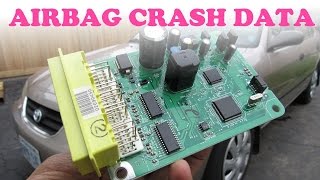
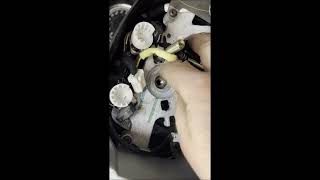
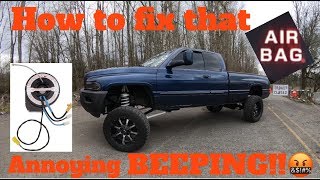
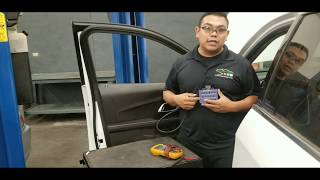
- Stored Crash Data After a Collision (Very Common) — After a collision (even a minor one without airbag deployment), the SRS module stores 'crash data' and locks itself to prevent unintended deployment. This data requires a professional reset service to clear. 🎬 Watch: How to reset an SRS module after a crash.
- Internal SRS Module Hardware Failure (Common) — The SRS module's internal components (processors, capacitors, memory) fail due to age, thermal stress, or manufacturing defects. This permanent hardware fault requires module replacement.
- Water Intrusion and Corroded Wiring (Common) — The SRS module sits under seats or center consoles, making it vulnerable to spills, sunroof leaks, or wet shoes. Moisture causes short circuits or connector corrosion, triggering an internal fault.
- Low Battery Voltage or Alternator Spikes (Less Common) — A weak battery, failing alternator, or incorrect jump-starting causes low voltage conditions or transient spikes. Sensitive SRS electronics interpret this as an internal fault and set code B1138.
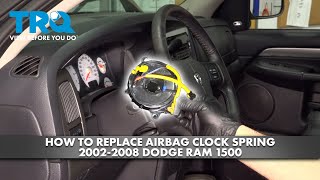
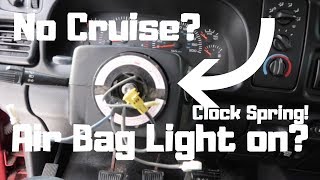
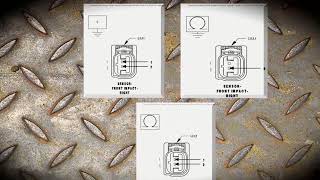
- Failed Clock Spring (Dodge/Ram Specific) (Less Common) — A bad clock spring (the coiled wire behind the steering wheel) disrupts communication. The main SRS module flags this with a general internal fault code like B1138, especially in Dodge and Ram vehicles. 🎬 See this walkthrough for replacing a Dodge clock spring.
- CAN Bus Communication Glitches (Uncommon) — A temporary software glitch caused by a momentary loss of communication between modules on the CAN bus network. Clearing the code resolves the issue unless a deeper wiring problem exists.
Symptoms
- Illuminated Airbag Warning Light and Cluster Message — The dashboard airbag light remains on constantly, often accompanied by a 'Service Airbag System' message on the driver information center.
- Airbags Do Not Deploy in a Crash — With the SRS system deactivated, no airbags or seatbelt pretensioners function during an accident, significantly increasing injury risk.
- Failure to Pass Safety Inspection — A vehicle fails state-mandated safety inspections if the airbag warning light is illuminated.
- Horn, Cruise Control, or Steering Wheel Buttons Inoperative — If the B1138 code is indirectly caused by a failing clock spring, steering wheel-mounted controls also fail.
Diagnostic Flowchart
Tap your situation to follow the diagnostic path that matches what you're seeing on this code.
Common Fixes & Costs
- Reset SRS Module (Clear Crash Data) — Parts: $0, Labor: $50 - $150, ~1.5 hr book time (Professional)
- Replace SRS Control Module — Parts: $250 - $800, Labor: $150 - $350, ~1.5 hr book time (Professional)
- Repair Wiring or Replace Connector — Parts: $20 - $100, Labor: $150 - $400, ~2 hr book time (Intermediate)
- Replace Clock Spring — Parts: $70 - $450, Labor: $120 - $250, ~1 hr book time (Intermediate)
- Replace Vehicle Battery — Parts: $150 - $350, Labor: $50 - $100, ~0.5 hr book time (Beginner)
Used vs. New Parts: Buying Guide
When a used part is worth it: Buying a used SRS module from a junkyard is highly discouraged by safety experts. The only time a non-new module is viable is when sending your original module to a professional service for a 'reset' to clear crash data.
Donor-vehicle mileage cap: roughly under 10000 miles for the part to have meaningful remaining life.
Donor quality checklist:
- Verify the used module has no stored crash data (impossible for a DIYer to check without advanced tools).
- Ensure the part number matches exactly.
- Avoid modules from flood-damaged or high-impact collision vehicles.
- Acknowledge that a used module is likely VIN-locked to the donor car and requires expensive dealer reprogramming.
Decision logic:
- If The fault is stored crash data ONLY and the module is physically undamaged → Use a professional mail-in reset service on your original module. This is the most cost-effective and reliable option.
- If The module has an internal hardware failure (e.g., processing error, water damage) → Buy a new OEM module. This is the only way to guarantee safety and function.
- If Budget is the absolute primary concern and you accept the risks → A used module requires reprogramming by a dealer or specialist, and its history is unknown. This is not recommended.
Warranty tradeoff: Used (Junkyard): Minimal to no warranty, sold 'as-is', high risk. Reset Service: Often includes a limited or lifetime warranty on the service. New OEM: Comes with a manufacturer's part warranty, typically 1 year.
Worst-case if a used part fails: $400 - $1500 if a used module is faulty or non-programmable, including the part cost, repeat labor, and the eventual cost of a new module.
What Happens If You Wait — Timeline
- Immediate (0 seconds): The B1138 code sets, the airbag warning light illuminates, and the entire Supplemental Restraint System is disabled.
- 1 day - 1 year: The vehicle is operated with the safety system disabled. Driver becomes accustomed to the warning light.
- At time of sale/trade-in: A potential buyer or dealership appraises the vehicle and notes the active airbag warning light.
- Long-term (if caused by water/corrosion): If the root cause is an unaddressed water leak, moisture and corrosion spread to other nearby wiring or modules.
Cost of Not Fixing It
- Immediate: The entire Supplemental Restraint System is disabled and will not deploy in a crash, representing a critical safety risk to all occupants. (Added cost: N/A (Safety Risk))
- At Next State Inspection: The vehicle fails safety inspection in most states. An illuminated airbag warning light is an automatic failure, preventing legal registration. (Added cost: $20 - $50 (Failed inspection fee) + eventual repair cost)
- At Time of Resale: The vehicle's resale value is significantly reduced. A known, active safety system fault deters buyers and makes the vehicle difficult to sell legally. (Added cost: $500 - $2000+ (Diminished vehicle value))
Diagnosis Steps
- Verify Battery Health and System Voltage
Ensure the vehicle's battery is fully charged and terminals are clean and tight. A weak battery causes false electronic codes. Use a multimeter to check voltage. A healthy battery reads 12.4-12.6V with the engine off. With the engine on, system voltage should be 13.7-14.7V.
Tools: Digital Multimeter (Beginner) - Perform Full System Scan with a Capable Scanner
Use an OBD-II scanner that reads manufacturer-specific Body (B), Chassis (C), and Network (U) codes. Record ALL codes from the SRS/RCM module and other related modules. B1138 is often a general code triggered by a more specific fault.
Tools: Advanced OBD-II Scanner (Beginner) - Attempt to Clear Codes and Observe Behavior
Try to clear the fault codes. If the code will not clear, it is stored crash data or a permanent 'hard fault'. If it clears but returns immediately upon starting the car, a hard fault is present. If it stays off and returns intermittently, suspect a wiring issue.
Tools: Advanced OBD-II Scanner (Intermediate) - Visually Inspect the SRS Module and Connectors
Locate the SRS control module (often under the center console or front seats). Disconnect the battery. Unplug the module's electrical connectors and inspect for water damage (white or green powder), corrosion, bent pins, or physical casing damage.
Tools: Flashlight, Trim Removal Tools, Socket Set (Intermediate) - Verify Power and Ground at the SRS Module Connector
Using a wiring diagram, identify the power and ground pins on the SRS module's harness connector. With the key on, confirm battery voltage (12.0V+) at the power pin(s). Measure resistance between the ground pin(s) and a known-good chassis ground point. A good ground measures less than 0.5 ohms.
Tools: Digital Multimeter, Vehicle-Specific Wiring Diagram (Advanced) - Check CAN Bus Resistance
With the battery disconnected, measure the resistance between the CAN High (Pin 6) and CAN Low (Pin 14) pins at the DLC or the SRS module connector. A healthy CAN bus network reads approximately 60 ohms. A reading of 120 ohms indicates a missing terminating resistor or a broken wire.
Tools: Digital Multimeter, Vehicle-Specific Wiring Diagram (Advanced) - Check CAN Bus Live Voltage
With the key on and engine off, measure DC voltage. Between CAN High and chassis ground, voltage should be approximately 2.5V. Between CAN Low and chassis ground, voltage should also be approximately 2.5V. Significant deviation points to a wiring short or faulty transceiver.
Tools: Digital Multimeter (Advanced) - Scope the CAN Bus Signal
For intermittent issues, use an oscilloscope to monitor the CAN High and CAN Low signals at the SRS module. Look for a clean, mirror-image square wave pattern. Any noise, distortion, or dropouts when wiggling the harness pinpoints a poor connection.
Tools: Automotive Oscilloscope, Wiring Diagram (Professional) - Isolate the Module
If all wiring, power, ground, and network tests are good, and the code persists, the fault is internal to the SRS module. Substitute the module with a known-good unit or send the original module to a specialized service for bench testing.
Tools: Known-Good SRS Module or Professional Testing Service (Professional)
When This Code Triggers (Freeze-Frame Conditions)
- System Voltage: 11.8V - 14.8V (SRS modules are highly sensitive to voltage. A code sets during engine cranking on a cold day with a weak battery, or during a voltage spike. The module records the voltage at the exact moment of the fault.)
- Odometer Reading: N/A (The SRS module stores the vehicle's mileage at the time the fault was first detected, helping technicians correlate the fault with the vehicle's service history.)
- Fault Status: Present, Intermittent, or Historic (The module records if the fault is currently active ('Present'), comes and goes ('Intermittent'), or happened in the past but is inactive ('Historic'). This is crucial for diagnosing loose connections.)
- Crash Event Data: Data Locked / Not Locked (The module indicates if crash data is stored. If data from an impact is recorded, the module locks itself and sets a fault code like B1138, even if no airbags deployed.)
Related Codes
- B0091 — Means 'Control Module Issue'. B0091 is a definitive confirmation of an internal hardware or software failure within the SRS module itself. If present with B1138, the module requires replacement.
- B1231 — Means 'Event Threshold Exceeded' and directly confirms stored crash data. If you see B1231, a module reset is the required fix.
- U0151 — Means 'Lost Communication With Restraints Control Module'. Indicates a failure in the communication pathway TO the module (wiring, network gateway). Diagnose the CAN bus wiring and module power/ground first.
- B1156 — On Mitsubishi vehicles, this code appears alongside B1138. Both relate to the Keyless Operation System (KOS). Diagnose the CAN bus lines if B1138 is present.
Climate & Environmental Factors
- High Humidity / Water Intrusion: Moisture from leaks or snowmelt carrying road salt seeps into the cabin carpet, corroding the floor-mounted SRS module and its connectors. This corrosion causes electrical shorts or high resistance, triggering an internal fault code.
- Cold Weather: Extreme cold reduces a battery's cranking power. During engine startup, the large power draw causes system voltage to drop significantly. Sensitive modules interpret this transient low voltage as a fault and trigger the airbag light.
How to Talk to a Mechanic About This Code
Say this: "I have an airbag warning light on and my scanner shows a B1138 code. I've already checked the battery and visually inspected the under-seat connectors. Can you please check for stored crash data, verify power and ground to the SRS module, and check the CAN bus before recommending a module replacement?"
This signals you are an informed customer. It directs the technician to follow a logical diagnostic path, preventing them from jumping to the most expensive conclusion (module replacement).
Avoid saying:
- 'My airbag light is on, can you fix it?' (Too vague, invites a high quote)
- 'I think I need a new airbag computer.' (Don't diagnose the car for them)
- 'Just do whatever it takes to turn the light off.' (Invites shortcuts or unnecessary repairs)
Questions to ask before authorizing the repair:
- What specific fault did you find? Is it crash data, a wiring issue, or a confirmed internal module failure?
- Can you show me the voltage and resistance readings you took at the module connector?
- If it's crash data, can you send my original module out for a reset service, or must it be replaced?
- If the module needs to be replaced, is the new part VIN-programmed, and what is the warranty on the part and labor?
Where to Take It: Dealer vs Independent vs Chain
- Dealer:
Recommended if the diagnosis is complex, requires programming a new module, or if other shops refuse to work on SRS systems.
Best for: Vehicles under warranty, Complex programming and VIN-locking issues, Diagnosing manufacturer-specific quirks where B1138 is not an airbag code (e.g., GM or Mitsubishi)
Downsides: Highest labor rates, Often recommends expensive module replacement over diagnostics or reset services. (Typical cost: +50% vs. baseline) - Independent Shop:
Best fit for most scenarios, provided you find a reputable shop with strong diagnostic skills and experience with SRS systems.
Best for: Out-of-warranty vehicles, Diagnosing wiring, connector, or clock spring issues, Removing the module to be sent for a third-party reset service
Downsides: Quality and diagnostic capabilities vary greatly; some shops refuse airbag systems for liability reasons., May lack the expensive tools to program a new module if replacement is necessary. (Typical cost: +0% vs. baseline) - Chain Shop:
AVOID for diagnosing a B1138 code. They are not the right place for this type of safety-critical repair.
Best for: Simple, unrelated jobs like battery replacement.
Downsides: Not equipped or trained for complex electronic or safety system diagnostics like SRS., High potential for misdiagnosis or refusal to work on the system. (Typical cost: -10% vs. baseline)
When to Walk Away From the Repair
If the estimated repair cost for the airbag system exceeds 40-50% of the car's private-party value, and the car has other pending issues, sell the vehicle as-is rather than repairing it.
- Car worth $5000, fix is $2200: Walk away. A $2,200 repair on a $5,000 car is a poor investment. The airbag light alone reduces trade-in value by 20-40%.
- Car worth $15000, fix is $1200: Fix it. The repair cost is well below the threshold and is necessary to maintain the vehicle's value and safety.
- Car worth $3000, fix is $150: Fix it. If the issue is confirmed to be 'crash data' and solved with a ~$150 module reset service, this is a highly cost-effective repair.
What Scan Tool You Need for This Code
Minimum: An OBD-II scanner that reads and clears Supplemental Restraint System (SRS) codes, also known as Body (B-codes). A basic engine-only (P-code) scanner will NOT work.
A standard $20 scanner cannot communicate with the SRS module. It won't see the B1138 code, leaving you blind to the problem and wasting time guessing at the cause.
Rent vs buy: Most auto parts stores do NOT rent out SRS-capable scanners due to liability. Buying a budget pick like the BlueDriver or Foxwell NT630 Plus is a worthwhile investment.
How to Clear the Code After You Fix It
- Ensure the underlying mechanical or electrical fault is repaired.
- Reconnect the vehicle battery if disconnected for the repair.
- Connect an OBD-II scan tool with SRS/Body control module capabilities.
- Use the scanner's function to specifically clear codes from the Restraints Control Module / SRS module.
- Cycle the ignition off, then on, and verify the airbag warning light performs its self-check and turns off.
Drive cycle (~10 minutes): Unlike powertrain codes, SRS codes do not require a complex drive cycle to clear. After the repair and code clear, a 5-10 minute test drive confirms the light does not return. The light returns immediately if the root fault persists.
Readiness monitors affected: None
Watch out for:
- Using a basic engine-only code reader that cannot communicate with the SRS module.
- Assuming disconnecting the battery clears SRS fault codes from non-volatile memory (it does not).
- Failing to fix the root cause, causing the code to reappear instantly after being cleared.
Will This Fail Emissions / State Inspection?
No — by itself this code doesn't fail OBD inspection (but it can keep readiness monitors from setting, which causes a separate fail).
- California: An airbag light does NOT cause a failure of the emissions-related smog check. California separates emissions and safety inspections.
- New York: Per NYS DMV regulations, an illuminated airbag warning light is an advisory item only and is NOT cause for rejection. The vehicle passes the safety inspection.
- Texas: Airbags are not a required inspection item under Texas law. A vehicle with an active airbag light passes the state safety inspection.
Most Commonly Affected Vehicles
- Nissan Quest, Sentra, Pathfinder, Altima (1996-2007) — This model series explicitly defines B1138 as a 'Diagnosis Sensor Unit' fault, pointing directly to the airbag module.
- Ford F-150 (2004-2008) — Airbag issues are a known problem on these models, with recalls issued for random deployment. A B1138 code requires prompt investigation.
- Ford Mustang (2005-2009) — The S197 platform is prone to clock spring and airbag module communication issues that trigger internal module fault codes.
- Dodge / Ram Ram 1500/2500 (2009-2018) — Widely known for clock spring failures which manifest as a general SRS module fault. Replacement clock springs differ based on heated steering wheel options.
- Infiniti G35 (2007-2008) — On models with 4-Wheel Active Steer (4WAS), a fault in the 4WAS system causes the ABS module to log a C1138, related to the overall safety system network.
- Chevrolet / GMC Silverado, Sierra, Tahoe, various models (2003-2014) — CRITICAL: On many GM vehicles, B1138 is an audio system code for 'Audio [+] output circuit high' and is NOT related to the airbag system.
- Mitsubishi Lancer, Outlander, Mirage (2008-2015) — B1138 means 'Vehicle Speed Data Fail' and relates to the Keyless Operation System (KOS) not receiving a valid speed signal from the ECM.
- Hyundai / Kia Elantra, Forte, Sonata (2005-2012) — Often confused with powertrain codes like P1138 related to O2 sensors. Careful diagnosis confirms if it is a Body (B-code) SRS fault.
Manufacturer-Specific Notes
- Nissan / Infiniti: B1138 specifically means 'Diagnosis Sensor Unit' and points directly to an internal fault in the airbag control module. Many older Nissans were part of the Takata airbag recall.
- Mitsubishi: B1138 means 'Vehicle Speed Data Fail', indicating the keyless entry/start module (KOS-ECU) did not receive a valid speed signal. This is not an airbag fault.
- Chrysler/Dodge/Jeep: B1138 indicates 'Cabin Heater 3 Control Circuit Low', a code related to the climate control system and managed by the Totally Integrated Power Module (TIPM). It is unrelated to the airbag system.
- General Motors (GM): B1138 relates to a high voltage fault in an audio output circuit ('Audio [+] output #12 circuit high'), which is unrelated to the safety system.
Real Owner Stories
2020 Honda Civic after minor collision
Vehicle was in a minor front-end collision. After repairs, the airbag light remained on.
What they tried:
- Disconnecting the battery to reset the system, but the light returned immediately.
Outcome: The SRS module stored 'crash data' from the impact, even though airbags did not deploy. This required a professional mail-in reset service to clear the hard code.
Lesson: After any collision, an airbag light almost always indicates stored crash data that a simple battery disconnect cannot clear. A professional scan and reset service is mandatory.
Toyota Tundra with airbag light after DIY battery replacement
Immediately after replacing the battery, the airbag warning light illuminated.
What they tried:
- Searching online forums for similar experiences.
Outcome: The owner accidentally bumped and loosened a critical yellow SRS connector located between the battery and the radiator. Securely reconnecting it resolved the code.
Lesson: If a fault appears immediately after a DIY job, inspect all components and connectors in the work area. SRS wiring is almost always bright yellow.
2013 Honda Fit with a $3,200 dealer quote
Airbag light illuminated randomly. The dealer recommended replacing the entire SRS module for $3,200.
What they tried:
- Sought advice from independent mechanics online regarding the high cost.
Outcome: The owner got a second opinion from an independent diagnostic shop, which found a corroded ground wire. Fixing the wire cost $150 and permanently resolved the issue.
Lesson: If a shop quotes a module replacement without providing specific fault codes or ruling out cheaper possibilities (wiring, sensors, ground), always get a second opinion.
How to Prevent This Code From Triggering
- Maintain a Healthy Battery (Every 3-4 years) — A weak battery causes low voltage spikes during startup, corrupting sensitive electronics like the SRS module and triggering false fault codes.
- Address Water Leaks Immediately (As needed) — Water from leaking sunroofs or windshields seeps into the cabin and corrodes the floor-mounted SRS module and its connectors.
- Use Proper Jump-Starting Procedure (When jump-starting) — Incorrectly connecting jumper cables causes voltage surges that permanently damage the SRS module. Always connect the final ground cable to a chassis ground point.
- Apply Dielectric Grease to Connectors (During any related repair) — Applying dielectric grease to the exterior of SRS connectors seals them from moisture intrusion and prevents corrosion.
Frequently Asked Questions
Can I just replace the fuse to fix the B1138 code?
No. While a blown fuse disables the system, B1138 specifically indicates the module is powered but has detected an internal logic error. The problem lies deeper than a fuse.
Will disconnecting the battery clear the airbag light for code B1138?
No. SRS fault codes are stored in non-volatile memory (EEPROM) and survive battery disconnects. They require a specialized SRS-capable scan tool to clear.
Is it safe to buy a used SRS module from a junkyard?
It is highly discouraged. A used module often contains hidden crash data or is VIN-locked to the donor car, preventing it from working in yours. The small cost savings do not justify the severe safety risks.
What is the difference between replacing and resetting the airbag module?
Resetting clears stored crash data from your original, undamaged module via a $50-$150 mail-in service. Replacing involves buying a new $250-$800 module and paying a dealer to program it to your VIN.
My airbags never deployed, why do I have a crash data code?
The SRS module constantly monitors impact sensors and records data even during minor incidents like hitting a large pothole. The system locks itself as a precaution because it flagged the event as significant enough to require inspection.
What is the most common misdiagnosis for a B1138 code?
The most common mistake is assuming B1138 is an airbag fault on GM or Mitsubishi vehicles, where it actually relates to the radio or keyless entry system. The second is replacing the SRS module without verifying its power, ground, and CAN bus integrity first.
My scan tool can't read or clear the B1138 code. Is the tool broken?
Not necessarily. Basic $20 OBD-II scanners only read engine codes and cannot communicate with the SRS module. You need an advanced scanner capable of reading Body (B-codes) to access this system.
Can a bad clock spring cause a B1138 code?
Yes, particularly in Dodge and Ram trucks. A failing clock spring disrupts communication between the steering wheel controls and the SRS module, which the module interprets as a general internal fault.
Key Takeaways
- Code B1138 disables your entire Supplemental Restraint System, meaning 0% of your airbags or seatbelt pretensioners will deploy in a collision.
- Verify your specific vehicle's code definition first, as B1138 means an airbag fault in Nissans, but indicates a harmless radio or climate control error in many GM and Chrysler models.
- If the code appears after a collision, do not buy a new $800 module; instead, use a $50–$150 professional mail-in service to clear the stored crash data from your original unit.
- Before replacing the SRS module, test the CAN bus network with a multimeter to ensure it reads exactly 60 ohms, ruling out a simple wiring break.
Helpful Videos

Shop the Parts Behind B1138
Below are the parts most often responsible for code B1138, ranked by how frequently each one is the actual culprit (per the diagnosis above). Tap any to see what we have for your vehicle.



The information in this article is provided for general reference and educational purposes only. Vehicle specifications, procedures, and part compatibility can vary by production date, trim level, and region. Always consult your vehicle's factory service manual and verify part numbers before purchasing or performing repairs. Safety-critical components such as airbags, seat belts, and braking systems should be installed by a qualified professional.
- 🧭 Diagnostic Flowchart
- 🎬 Helpful Videos
- 🛍️ Shop This Part
- What Does B1138 Mean?
- Can I Drive With B1138?
- Common Causes
- Symptoms
- Common Fixes & Costs
- Used vs. New Parts: Buying Guide
- What Happens If You Wait — Timeline
- Cost of Not Fixing It
- Diagnosis Steps
- When This Code Triggers (Freeze-Frame Conditions)
- Related Codes
- Climate & Environmental Factors
- How to Talk to a Mechanic About This Code
- Where to Take It: Dealer vs Independent vs Chain
- When to Walk Away From the Repair
- What Scan Tool You Need for This Code
- How to Clear the Code After You Fix It
- Will This Fail Emissions / State Inspection?
- Most Commonly Affected Vehicles
- Manufacturer-Specific Notes
- Real Owner Stories
- 2020 Honda Civic after minor collision
- Toyota Tundra with airbag light after DIY battery replacement
- 2013 Honda Fit with a $3,200 dealer quote
- How to Prevent This Code From Triggering
- Frequently Asked Questions
- Can I just replace the fuse to fix the B1138 code?
- Will disconnecting the battery clear the airbag light for code B1138?
- Is it safe to buy a used SRS module from a junkyard?
- What is the difference between replacing and resetting the airbag module?
- My airbags never deployed, why do I have a crash data code?
- What is the most common misdiagnosis for a B1138 code?
- My scan tool can't read or clear the B1138 code. Is the tool broken?
- Can a bad clock spring cause a B1138 code?
- Key Takeaways
- 🎟️ Get 5% Off