

OBD-II Code B1155: Comprehensive Guide to a Manufacturer-Specific Fault
What B1155 means, why it triggers, and how to fix it on Toyota, Honda, Ford, and more
- Code B1155 is a manufacturer-specific fault meaning a failed left rear airbag sensor on Toyotas, a dead instrument cluster on Hondas, or a broken left front ABS sensor on Fords.
- On Toyota and Lexus models, swapping the left and right rear airbag sensors is a zero-cost, 15-minute diagnostic trick to confirm if the sensor itself is dead.
- For Ford vehicles logging the equivalent C1155 code, replacing the $20 to $90 left front ABS wheel speed sensor resolves the issue 80% of the time.
- Driving with a B1155 code guarantees a failed state safety inspection and leaves you without critical side airbags or ABS braking during an emergency.
What Does B1155 Mean?
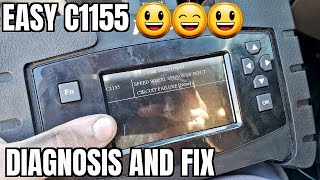
B1155 is a manufacturer-specific code. For Toyota, Lexus, and Scion, it indicates a left rear airbag sensor circuit failure. For Honda and Acura, it means the instrument cluster lost communication with the combination switch or main body computer (MICU). For Ford, Lincoln, and Mercury, it appears as C1155, indicating a left front ABS wheel speed sensor circuit failure. For Chevrolet, it flags a Sensing and Diagnostic Module (SDM) calibration mismatch.
Technical definition: The official SAE/ISO definition varies by manufacturer. Common definitions include 'Rear Airbag Sensor LH Circuit Malfunction' (Toyota), 'Gauge Control Module Lost Communication with the Combination Switch Control Unit' (Honda), 'Left Front Wheel Speed Sensor Input Circuit Failure' (Ford, as C1155), and 'SDM Calibration Mismatch' (Chevrolet).
Can I Drive With B1155?
Yes, But With Caution. You can drive the vehicle, but a key safety system is disabled. For Toyota and Lexus, the side airbags will not deploy in a collision. For Ford, the ABS and traction control are disabled, increasing the risk of skidding during emergency braking. This causes an automatic failure of any state safety inspection. Diagnose and repair this immediately.
Common Causes
- Faulty Rear Airbag Impact Sensor (Toyota/Lexus) (Very Common) — The internal side-impact sensor fails, triggering the code and disabling the airbag system on that side.
- Faulty ABS Wheel Speed Sensor (Ford) (Very Common) — The front left ABS wheel speed sensor fails internally or becomes blinded by brake dust and road grime.
- Wiring or Connection Issue (Common) — Impact, chafing, corrosion, or disconnection damages the wiring harness or connectors leading to the affected component, interrupting the signal.
- Faulty Multiplex Integrated Control Unit (MICU) (Honda) (Common) — The under-dash MICU fails, causing widespread B-CAN network communication issues and triggering B1155 alongside codes B1156, B1157, and B1159.
- Faulty Gauge Control Module (Honda/Acura) (Less Common) — The instrument cluster fails, preventing communication with the combination switch and other modules.
- Faulty Combination Switch (Honda/Acura) (Less Common) — The steering column multi-function switch fails, breaking communication with the instrument cluster.
- Weak Battery or Poor Electrical Ground (Rare) — A failing battery or corroded ground causes low voltage, triggering intermittent communication faults between control modules.
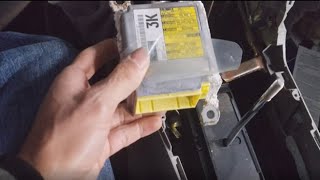
- Faulty Airbag Control Module (SRS/ECU) (Rare) — The main SRS computer fails and incorrectly reports a sensor problem. Suspect this only after verifying sensors and wiring. 🎬 See this walkthrough for removing and replacing a Toyota airbag module.
Symptoms
- Airbag Warning Light On — The most common symptom for Toyota and Lexus vehicles. The light indicates the airbag system has a fault and will not deploy in a crash.
- ABS and Traction Control Light On (Ford) — A faulty wheel speed sensor illuminates the ABS and traction control warning lights, indicating these systems are disabled.
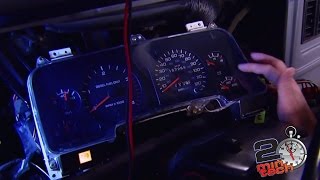
- Instrument Cluster Malfunction (Honda/Acura) — Gauges stop working, the display goes blank, or various warning lights illuminate simultaneously 🎬 Watch: A mechanic's guide to diagnosing and repairing gauge clusters. due to communication loss.
- Headlights, Wipers, or Horn Malfunction (Honda/Acura) — Communication loss with the combination switch or MICU disables headlight, wiper, horn, or cruise control functions.
- Failed Safety Inspection — A vehicle automatically fails a state safety inspection if the airbag or ABS warning light is illuminated.
Diagnostic Flowchart
Tap your situation to follow the diagnostic path that matches what you're seeing on this code.
Common Fixes & Costs
- Replace ABS Wheel Speed Sensor (Ford) — Parts: $20-$90, Labor: $75-$150, ~1 hr book time (Beginner)
- Replace Rear Airbag Impact Sensor (Toyota) — Parts: $70-$350, Labor: $50-$150, ~1.2 hr book time (Intermediate)
- Repair or Replace Damaged Wiring/Connector — Parts: $10-$50, Labor: $100-$300, ~1.5 hr book time (Intermediate)
- Replace MICU / Under-Dash Fuse Box (Honda) — Parts: $300-$700, Labor: $100-$250, ~2 hr book time (Professional)
- Replace Gauge Control Module / Instrument Cluster (Honda) — Parts: $400-$1000, Labor: $100-$200, ~1.5 hr book time (Professional)
- Replace Airbag Control Module (SRS ECU) — Parts: $200-$600, Labor: $100-$200, ~1.5 hr book time (Professional)
Used vs. New Parts: Buying Guide
When a used part is worth it: For electronic modules like a Honda MICU, a used part from a salvage yard offers significant savings. For simple sensors (Toyota airbag, Ford ABS), the low cost of new aftermarket parts makes them a better choice.
Donor-vehicle mileage cap: roughly under 100000 miles for the part to have meaningful remaining life.
Donor quality checklist:
- Match the part number EXACTLY, especially for Honda MICUs which are trim-specific.
- Check for any signs of water damage or corrosion on the casing and pins.
- Verify the donor vehicle's history to avoid parts from flood-damaged cars.
Decision logic:
- If The part is a Ford ABS sensor → Buy new aftermarket. The cost is low ($20-$90) and it is a wear item exposed to the elements.
- If The part is a Toyota airbag impact sensor → Used is acceptable if the part number matches. New is preferred for peace of mind.
- If The part is a Honda MICU (fuse box) → Used is a cost-effective option, but factor in the cost of immobilizer programming for 2006+ models.
Warranty tradeoff: Used parts typically have a 30-90 day warranty. New aftermarket parts offer a 1-year to limited lifetime warranty. New OEM parts carry a 1-year warranty.
Worst-case if a used part fails: 250-500
What Happens If You Wait — Timeline
- Immediate: Warning light illuminates. The related safety system (left side airbags on a Toyota, ABS on a Ford) is disabled by the control module. (MPG impact: 0%% · Added cost: 0)
- First State Inspection: Vehicle automatically fails any mandatory safety inspection, preventing registration renewal. (MPG impact: 0%% · Added cost: 50-150)
- 1-6 Months (For communication issues): If the cause is a faulty module with a parasitic draw, the battery dies overnight, requiring jump starts. Repeated deep cycling damages the battery. (MPG impact: 0%% · Added cost: 150-300)
- In the event of an emergency: The disabled safety system fails to perform. This means locked wheels in a panic stop or a non-deploying side airbag in a collision. (MPG impact: N/A% · Added cost: Thousands in medical bills or total loss of vehicle.)
Cost of Not Fixing It
- Immediate: For Toyota/Lexus, the airbag on the affected side will not deploy in a crash. For Ford, ABS and traction control are disabled, increasing stopping distances and risk of skidding. (Added cost: 0)
- First State Inspection: Vehicle automatically fails any state safety inspection due to the illuminated ABS or Airbag warning light, preventing legal registration renewal. (Added cost: 50-100)
- 1-6 Months (For communication issues): If the cause is a faulty module with a parasitic draw, the battery dies overnight, requiring jump starts. Repeated deep cycling destroys the battery.
- In the event of an emergency: The disabled safety system fails to perform. This means locked wheels in a panic stop for a Ford, or a non-deploying side airbag in a Toyota collision.
Diagnosis Steps
- Identify Your Vehicle's Specific Code Definition
Use a scan tool with manufacturer-specific definitions to confirm what B1155 means for your exact make and model. For Toyota it is an airbag sensor, for Honda it is a communication issue, and for Ford it is an ABS sensor (as C1155).
Tools: OBD-II Scanner (with manufacturer-specific capability) (Beginner) - Visual Inspection of Component and Wiring
Locate the component identified in Step 1. Inspect the wiring and connector for physical damage, corrosion, chafing, or a loose connection. Follow the harness as far back as possible.
Tools: Flashlight, Trim removal tools (Beginner) - Swap Rear Airbag Sensors (Toyota/Lexus)
Swap the left and right rear airbag sensors. Clear the codes and rescan. If the code changes to B1154 (right sensor), the sensor is faulty. If B1155 returns, the problem is in the wiring or the main module.
Tools: Socket set, Trim removal tools, OBD-II scanner (Intermediate) - Check Related Fuses (Honda)
For communication-related versions of the code, check the under-dash and under-hood fuse boxes for blown fuses related to the instrument cluster, MICU, or combination switch.
Tools: Fuse puller or needle-nose pliers (Beginner) - [PRO TIP] Live Data Wheel Speed Sensor Test (Ford)
Use a scan tool to monitor wheel speed signals while driving. The left front wheel speed sensor will read 0 MPH or show erratic data compared to the other three sensors if it has failed.
Tools: Advanced diagnostic scan tool with live data stream (Advanced) - Perform Honda B-CAN System Diagnosis
Clear the DTCs. Turn the ignition off, then on, and wait 6 seconds. Re-check for codes. If only B1155 returns, the gauge control module is the primary suspect. If B1155 returns with B1156, B1157, or B1159, the fault is the MICU.
Tools: Honda-Specific Scanner (HDS) or equivalent (Intermediate) - [PRO TIP] Test Airbag Sensor Circuit Resistance (Toyota)
Disconnect the battery and wait 90 seconds. Disconnect the suspect airbag sensor. Measure the resistance across the two terminals on the sensor. A typical specification is between 800 and 1,700 Ohms. An 'OL' reading indicates an open circuit, confirming a faulty sensor.
Tools: Multimeter, Trim removal tools (Advanced) - [PRO TIP] Test Ford ABS Sensor Circuit Voltage
With the ignition ON, disconnect the LF wheel speed sensor. Measure the voltage between the two pins on the harness-side connector. You should see a reference voltage greater than 10 volts. If voltage is low or absent, the problem is in the wiring or the ABS module.
Tools: Multimeter, Wiring diagram (Advanced) - Test Wiring for Continuity and Shorts
Disconnect the battery, the component, and the control module. Check for continuity on each wire between the component connector and the module connector. A reading of 'OL' indicates a broken wire. Check each wire for a short to ground.
Tools: Multimeter, Vehicle-specific wiring diagram (Advanced) - [PRO TIP] Test Honda B-CAN Network Resistance
Disconnect the battery. At the Data Link Connector, measure the resistance between Pin 1 (CAN High) and Pin 9 (CAN Low). A healthy network reads approximately 60 Ohms. A reading of 120 Ohms indicates an offline terminating resistor in the gauge cluster or MICU.
Tools: Multimeter, DLC pinout diagram (Advanced)
When This Code Triggers (Freeze-Frame Conditions)
- Ignition Status: ON (The code sets during the initial power-on self-test of the respective module (SRS, ABS, or Body Control).)
- Vehicle Speed (Ford C1155): > 10 mph (The ABS module monitors wheel speed sensors while driving. A fault registers when the vehicle starts moving and a sensor signal is lost.)
- System Voltage: 11.5V - 14.5V (The code triggers if system voltage drops during startup, causing communication modules to initialize improperly.)
- Ignition Cycles Since Fault: 0 (Freeze frame shows the fault occurred on the current ignition cycle, as the warning light appears immediately after the self-test fails.)
Related Codes
- B1154 — On Toyota vehicles, this is the code for the right rear airbag sensor. Swapping the left and right sensors changes B1155 to B1154 if the sensor is faulty.
- C1296 — On Ford vehicles, this code for 'Left Front Wheel Speed Sensor Input Signal Fault' appears alongside C1155, pointing to a problem with the sensor or its circuit.
- B1007 — On Honda vehicles, this code points to the combination switch. If B1155 and B1007 appear together, test the combination switch control unit first.
- U0155 — This is a generic communication code for 'Lost Communication With Instrument Panel Cluster'. It is the standardized equivalent of the issue seen on Honda vehicles with B1155.
Climate & Environmental Factors
- Cold Weather and Road Salt: Road salt and moisture cause corrosion on ABS sensor wiring and connectors, increasing electrical resistance and disrupting the signal. Packed snow and ice physically obstruct the sensor, causing temporary faults.
- High Heat and Humidity: Prolonged exposure to extreme heat stresses electronic modules and wiring connections over time, accelerating the failure of components like the Honda MICU.
How to Talk to a Mechanic About This Code
Say this: "State your vehicle and code, then describe the specific system. For a Toyota: 'I have a B1155 code on my [Year/Model] and an airbag light; I need a diagnosis of the left rear airbag sensor circuit.' For a Ford: 'I have a C1155 code on my [Year/Model] with the ABS light on; I need the left front wheel speed sensor circuit diagnosed.' For a Honda: 'I have a B1155 communication code on my [Year/Model] and the gauges are malfunctioning; I need the B-CAN network diagnosed.'"
This signals you have done your research and directs the technician to the specific system involved. It frames the job as a targeted diagnosis rather than a vague 'check the warning light,' preventing unnecessary diagnostic time.
Avoid saying:
- 'My airbag/ABS light is on, can you just look at it?'
- 'Just fix whatever is wrong.'
- 'A guy on the internet said to replace the sensor.'
Questions to ask before authorizing the repair:
- For Ford C1155: 'Did you check for voltage at the harness connector and view the live data from the sensor before recommending replacement?'
- For Toyota B1155: 'Did you test the sensor, or did you confirm the fault is not in the wiring harness? Did you try swapping it with the right-side sensor?'
- For Honda B1155: 'What other communication codes did you find? What was the result of the B-CAN network resistance test?'
- Will the diagnostic fee be applied toward the final repair cost?
- What is the warranty on the recommended parts and labor?
Where to Take It: Dealer vs Independent vs Chain
- Dealer:
Best for: Vehicles under warranty., Complex SRS/airbag system repairs., Honda communication issues requiring manufacturer-specific tools (HDS) and programming.
Downsides: Highest labor rates ($150-$250 per hour)., Defaults to expensive module replacement over targeted wiring repair. (Typical cost: +50% vs. baseline) - Independent Shop:
Best overall fit for Ford C1155. A strong choice for Toyota B1155 if the shop is reputable and experienced with SRS. For Honda's B1155, a dealer or Honda-specialist indie is preferred.
Best for: Out-of-warranty vehicles., Common, well-documented issues like the Ford C1155 ABS sensor fault., Shops specializing in your vehicle's make or in auto electrics.
Downsides: Quality varies greatly; vet shops based on reviews and ASE certifications., Lacks expensive, dealer-level programming equipment for newer modules. (Typical cost: +0% vs. baseline) - Chain Shop:
Acceptable for a straightforward Ford ABS sensor replacement if you are certain that is the problem. AVOID for airbag (Toyota) or communication (Honda) diagnosis and repair.
Best for: Simple part replacement after a confident diagnosis has already been made elsewhere.
Downsides: Technician skill varies dramatically., High pressure to upsell; not recommended for diagnosing complex electrical or safety system faults., Replaces parts without proper circuit testing, leading to repeat repairs. (Typical cost: -10% vs. baseline)
When to Walk Away From the Repair
If the estimated repair cost exceeds 40% of the car's private-party market value, seriously consider selling the car as-is or trading it in rather than repairing it.
- Car worth $8000, fix is $350: Fix it. This is a relatively low-cost repair for a critical safety system and is well below the threshold.
- Car worth $4000, fix is $1200: Borderline. A costly Honda MICU or gauge cluster replacement falls in this range. Get a second opinion and evaluate the car's overall condition before proceeding.
- Car worth $2500, fix is $1500: Walk away. The repair cost is over half the car's value. It is not economically sensible to proceed.
What Scan Tool You Need for This Code
Minimum: A scanner that reads and clears ABS (Chassis) and SRS (Body) codes. Basic engine-only (Powertrain) code readers will not see or clear a B1155 or C1155 code.
A $20 scanner only reads 'P' codes for the check engine light. It shows 'No Codes Found' for an ABS or Airbag light. You need a tool that accesses the specific computer module controlling these safety systems.
Budget: BlueDriver Pro or Foxwell NT301+ (~$100) — Reads and clears engine, ABS, and SRS codes. The BlueDriver app provides repair reports based on real-world data, which helps distinguish a sensor vs. wiring issue.
Mid-range: Foxwell NT510 Elite or Autel MaxiCOM MK808S (~$150-350) — Adds critical features like live data graphing and some bi-directional controls. For a Ford C1155, you can watch the live wheel speed data as you drive to confirm the sensor is dead.
Professional: Autel MaxiCOM MK808S/MK808Z or Launch X431 series (~$400-800) — Provides full bi-directional control and advanced service functions. This level is necessary for advanced Honda diagnostics and programming a new MICU after replacement.
Rent vs buy: Most auto parts store loaner tool programs offer basic code readers that CANNOT read ABS/SRS codes. For a one-time fix, pay a shop's diagnostic fee ($75-$150) rather than buying a mid-range scanner. Buy a scanner only if you plan to do your own maintenance regularly.
How to Clear the Code After You Fix It
- Fix the underlying mechanical or electrical fault.
- Reconnect battery if it was disconnected for the repair.
- Use an SRS/ABS-capable OBD-II scan tool to read and clear the fault code.
- Cycle the ignition off, then on, and verify the warning light turns off and stays off.
Drive cycle (~10 minutes): After clearing the code, start the vehicle and let it idle to confirm the light is off. For Ford ABS codes, a short test drive reaching over 15 mph is needed for the system to verify the sensor is reading correctly.
Watch out for:
- Using a basic OBD-II code reader that cannot access Body (B) or Chassis (C) codes.
- Disconnecting the battery will not reliably clear SRS or ABS codes on modern vehicles.
- The warning light returns immediately if the root cause of the fault is not repaired.
Will This Fail Emissions / State Inspection?
No — by itself this code doesn't fail OBD inspection (but it can keep readiness monitors from setting, which causes a separate fail).
- California: An airbag or ABS light will not fail the emissions (smog check) portion of the test, but it is a safety hazard.
- New York: An illuminated ABS or airbag warning light is grounds for immediate failure of the annual safety inspection.
- Texas: An illuminated warning light for a required safety system like ABS or airbags causes the vehicle to fail the safety inspection.
Most Commonly Affected Vehicles
- Toyota Highlander (2004-2010) — Prone to rear airbag sensor circuit malfunctions triggering B1155. This is separate from the P1155 A/F sensor code.
- Toyota Sienna (2008-2012) — Frequently logs B1155 due to failures in the left rear airbag sensor circuit.
- Ford F-150 (2004-2008) — Commonly logs C1155 for 'Left Front Wheel Speed Sensor Input Circuit Failure'. The sensor and harness are often replaced together.
- Honda Accord (2003-2007) — Experiences B1155 from a loss of communication between the gauge module and combination switch. The 2003-2005 MICU is plug-and-play if the part number matches.
- Honda Civic (2006-2011) — Known for communication-related B1155 codes. A faulty ABS module shorts the B-CAN communication line, causing this failure.
- Honda Fit (2009-2013) — Susceptible to B1155 when the gauge control module loses communication with the MICU.
- Acura TL (2004-2008) — Displays B1155 and other communication codes as a result of a parasitic battery drain caused by a faulty HandsFreeLink (HFL) module.
- Chevrolet Express (2008-2024) — Logs B1155 for 'SDM Calibration Mismatch' after module replacement if the new module is not programmed correctly.
- Nissan Titan and Armada (2004-2015) — Logs related code C1155 indicating 'Low Brake Fluid Level' or a faulty brake fluid level sensor, disabling ABS and VDC systems.
Manufacturer-Specific Notes
- Toyota: The code is specific to the left rear side impact sensor. The corresponding code for the right side is B1154.
- Honda: B1155 is part of a group of communication loss codes. Seeing multiple 'B' or 'U' codes together points to a central problem like a faulty MICU or a short on the communication network.
- Ford: The fault is logged as Chassis code C1155, not Body code B1155. Replacing the sensor requires removing the brake rotor for access on 4x4 models.
- Harley-Davidson: On motorcycles, this code means 'Neutral Switch Input Short to Battery'. This guide does not cover that application.
Real Owner Stories
2005 Ford F-150 with C1155 & C1296
ABS and Brake warning lights came on intermittently. Codes read C1155 (Left Front Wheel Speed Sensor Input Circuit Failure) and C1296 (Left Front Wheel Speed Sensor Input Signal Fault).
What they tried:
- Initially suspected a bad sensor.
- Upon visual inspection, found the wiring harness for the sensor rubbing against the tire, exposing copper wires.
Outcome: Replaced the entire left front ABS wheel speed sensor and harness assembly. Rerouted the wire to prevent rubbing. Cleared codes, and the lights stayed off.
Lesson: For 'circuit failure' codes, perform a thorough visual inspection of the wiring harness. Damage from rubbing or impact is a common cause, and replacing the sensor alone will not fix it.
2009 Honda Odyssey with multiple B-CAN codes including B1155
High-beam headlights, high-speed wipers, and windshield washers stopped working. Scan tool showed B1155 and a host of other communication codes.
What they tried:
- Attempted to use bidirectional controls on a scan tool to activate the failing components, but functions were 'not supported'.
- Followed diagnostic procedure to check connectors and power at the under-hood fuse/relay box.
Outcome: Identified a failure within the under-hood fuse box assembly. Replacing the entire unit restored all functions and cleared the communication codes.
Lesson: On a Honda, a flood of communication codes rarely means all components failed at once. It points to a central network failure, typically the MICU or under-hood relay center.
2010 Toyota Sienna with B1155
Airbag warning light came on. A scan revealed code B1155, pointing to the left rear airbag sensor circuit.
What they tried:
- Swapped the left rear airbag sensor with the right rear sensor.
- Cleared codes and re-scanned. The code changed from B1155 (Left side) to B1154 (Right side).
Outcome: The code followed the sensor, proving the sensor itself was faulty. Purchased a new sensor and installed it in the left rear position, resolving the fault.
Lesson: For paired components, swapping them is a powerful diagnostic technique. If the trouble code moves to the other side, the part is bad. If the original code returns, the problem is in the wiring.
2008 Ford Edge with C1155 after replacing sensor
ABS light was on with code C1155. The owner replaced the left front wheel speed sensor, but the light returned.
What they tried:
- Tested for voltage at the harness-side connector for the sensor and got 0 volts, while the working passenger side showed over 11 volts.
- Tested the two wires for continuity from the sensor connector back to the main harness loom, and continuity was good.
Outcome: Concluded there was a broken wire between the main harness connection and the ABS control module. Traced and repaired the broken wire.
Lesson: A 'circuit failure' code means the entire circuit is suspect. A simple voltage check at the connector quickly determines if the problem is the sensor or the wiring side.
How to Prevent This Code From Triggering
- Apply Dielectric Grease to Connectors (During any related service (e.g., brake job, suspension work)) — Applying non-conductive dielectric grease to the connector's weather seal prevents moisture and road salt from causing corrosion on the pins, a primary cause of circuit codes.
- Maintain a Healthy Battery (Ongoing) — Electronic modules require stable voltage to initialize. A weak battery causes voltage drops during startup, leading to random communication codes like Honda's B1155.
- Secure and Inspect Wiring Harnesses (During oil changes or other maintenance) — ABS sensor wires get brittle from heat and break, or rub against moving suspension components. Checking that harnesses are secured prevents physical wire damage.
- Keep Cabin and Cowl Drains Clear (Annually, especially in fall) — On Hondas, clogged cowl or sunroof drains allow water to leak into the cabin and drip onto the MICU, causing corrosion and catastrophic electronic failure.
Frequently Asked Questions
Is it safe to drive with code B1155?
While the car runs and drives, it is unsafe. The code indicates a fault in a key safety system like airbags (Toyota) or ABS (Ford). In an accident, these systems will not function as designed.
Can I reset the airbag light myself?
You can clear the code with an OBD-II scanner, but if the underlying fault remains, the light returns immediately. This is a temporary reset, not a repair.
What is the most common misdiagnosis for B1155/C1155?
A common mistake is replacing the sensor without testing the wiring first. The code indicates a circuit malfunction, which includes the sensor, wiring, and module. If a new sensor fails to fix the problem, a damaged wire is the likely culprit.
Can a bad battery cause code B1155?
Yes, a weak battery causes low voltage conditions, leading to unpredictable communication errors between modules and triggering codes like B1155 on Honda and Acura vehicles.
My ABS light came on after hitting a pothole, is it related to C1155?
Yes, a hard impact from a pothole severs the delicate wiring inside the ABS wheel speed sensor. This causes an open circuit and triggers code C1155.
My car is a Honda and the speedometer and gas gauge are dead. Is this related to B1155?
Yes, on Hondas, B1155 indicates a communication failure with the gauge control module. This directly causes the instrument cluster gauges to stop working.
How much does it cost to diagnose code B1155?
Most repair shops charge a diagnostic fee ranging from $75 to $150. This fee covers the initial electrical testing required to pinpoint the exact cause of the code.
Key Takeaways
- Code B1155 is a manufacturer-specific fault meaning a failed left rear airbag sensor on Toyotas, a dead instrument cluster on Hondas, or a broken left front ABS sensor on Fords.
- On Toyota and Lexus models, swapping the left and right rear airbag sensors is a zero-cost, 15-minute diagnostic trick to confirm if the sensor itself is dead.
- For Ford vehicles logging the equivalent C1155 code, replacing the $20 to $90 left front ABS wheel speed sensor resolves the issue 80% of the time.
- Driving with a B1155 code guarantees a failed state safety inspection and leaves you without critical side airbags or ABS braking during an emergency.
Helpful Videos



Shop the Parts Behind B1155
Below are the parts most often responsible for code B1155, ranked by how frequently each one is the actual culprit (per the diagnosis above). Tap any to see what we have for your vehicle.



The information in this article is provided for general reference and educational purposes only. Vehicle specifications, procedures, and part compatibility can vary by production date, trim level, and region. Always consult your vehicle's factory service manual and verify part numbers before purchasing or performing repairs. Safety-critical components such as airbags, seat belts, and braking systems should be installed by a qualified professional.
- 🧭 Diagnostic Flowchart
- 🎬 Helpful Videos
- 🛍️ Shop This Part
- What Does B1155 Mean?
- Can I Drive With B1155?
- Common Causes
- Symptoms
- Common Fixes & Costs
- Used vs. New Parts: Buying Guide
- What Happens If You Wait — Timeline
- Cost of Not Fixing It
- Diagnosis Steps
- When This Code Triggers (Freeze-Frame Conditions)
- Related Codes
- Climate & Environmental Factors
- How to Talk to a Mechanic About This Code
- Where to Take It: Dealer vs Independent vs Chain
- When to Walk Away From the Repair
- What Scan Tool You Need for This Code
- How to Clear the Code After You Fix It
- Will This Fail Emissions / State Inspection?
- Most Commonly Affected Vehicles
- Manufacturer-Specific Notes
- Real Owner Stories
- 2005 Ford F-150 with C1155 & C1296
- 2009 Honda Odyssey with multiple B-CAN codes including B1155
- 2010 Toyota Sienna with B1155
- 2008 Ford Edge with C1155 after replacing sensor
- How to Prevent This Code From Triggering
- Frequently Asked Questions
- Is it safe to drive with code B1155?
- Can I reset the airbag light myself?
- What is the most common misdiagnosis for B1155/C1155?
- Can a bad battery cause code B1155?
- My ABS light came on after hitting a pothole, is it related to C1155?
- My car is a Honda and the speedometer and gas gauge are dead. Is this related to B1155?
- How much does it cost to diagnose code B1155?
- Key Takeaways
- 🎟️ Get 5% Off