

B1291 on 2014-2017 Ram 3500: Park Assist Sensor Fault Causes and Fixes
Code B1291 on a 2014-2017 Ram 3500 indicates a fault with the #4 park assist sensor, located on the inner passenger side of the front bumper. The most common cause is a dirty or obstructed sensor, which can often be fixed by cleaning. If cleaning doesn't work, the sensor has likely failed. Replacing the faulty sensor is the next step, with OEM parts costing around $90-$150. Wiring issues are also a notable possibility.
- B1291 points to a fault with a park assist sensor, most often sensor #4 (front inner passenger side).
- Always start with the simplest fix: thoroughly clean the face of all parking sensors.
- The most reliable DIY diagnostic is to swap the suspect sensor with a neighboring one to see if the fault code follows the sensor.
- This is a very DIY-friendly repair; the main part is usually a single sensor that can be replaced without specialized tools.
- You can continue to drive the truck safely, but the parking assistance feature will not work until the fault is corrected.
What's Unique About the 2014-2017 Ram 3500
On fourth-generation Ram HD trucks (2010-2018), the park assist sensors are known to be sensitive to dirt, ice, and moisture. The sensor numbering is clockwise, starting from the front driver's side: front sensors are 1-6 (driver to passenger), and rear sensors are 8-11 (passenger to driver), skipping numbers 7 and 12. Code B1291 specifically refers to sensor #4, the inner sensor on the front passenger-side bumper. The wiring harnesses, particularly the main connectors in the bumpers, are exposed to the elements and are a common point of failure due to corrosion or physical damage from road debris.
Diagnostic Flowchart
Tap your situation to follow the diagnostic path that matches what you're seeing on this vehicle.
Symptoms You May Notice
- "Service Park Assist System" or "ParkSense Unavailable" message on the instrument cluster.
- Park assist system is disabled and does not produce audible beeps when approaching an object.
- The park assist on/off switch light may flash or stay illuminated solid, indicating a fault.
- Backup camera continues to function normally.
- A constant, steady tone when shifting into reverse can also indicate a system fault.
- Replacing the Park Assist Module (PAM) first. This is an expensive part and is rarely the cause of a single sensor fault. Diagnosis should always start with the sensor and its wiring.
- Replacing a sensor without clearing the stored DTC. On many Ram trucks, the system will remain disabled even after a successful hardware repair until the fault code is cleared from the module's memory with a capable scan tool.
Most Likely Causes
- Obstructed or Dirty Sensor 🔴 High Probability The sensors are located on the bumpers and are directly exposed to road grime, mud, snow, and ice, which can block the ultrasonic waves. Even heavy wax buildup can cause issues.
How to confirm: Visually inspect the face of all park assist sensors on the front and rear bumpers. Clean them gently with car soap, water, and a soft cloth. Clear the code and see if it returns.
Typical fix: Thoroughly clean the sensor face. This is the first step recommended by Ram's own Technical Service Bulletin #9003059, which advises cleaning both the front and back of the sensor if accessible.
Est. part cost: $0 - Failed Park Assist Sensor 🟡 Medium Probability → Shop Collision Avoidance Sensor These electronic sensors (often Bosch-made) are exposed to harsh conditions, including vibration, moisture, and temperature swings, which can lead to internal failure over time. Aftermarket sensors have been reported by owners to fail prematurely or not work correctly.
How to confirm: Swap the suspected faulty sensor with an adjacent one (e.g., swap sensor #4 with #3). Clear the codes. If the trouble code follows the sensor to the new location (e.g., changes from B1291 to B1290), the sensor is confirmed bad.
Typical fix: Replace the failed park assist sensor. The sensors are typically held in place by plastic tabs and can be accessed from behind the bumper, sometimes requiring only a small pick or flathead screwdriver 🎬 See this walkthrough on how to replace a bumper sensor. to release.
Est. part cost: $35-$150 - Wiring Harness or Connector Issue 🟡 Medium Probability The wiring harness runs along the bumper and is highly susceptible to damage from road debris, moisture intrusion causing corrosion, and wires chafing against the frame or bumper brackets. A specific weak point for rear sensors is the 24-way connector XY630A located behind the rear left wheel liner. The front harness has a main connector behind the driver's side wheel well liner that is also a common failure point.
How to confirm: Visually inspect the wiring leading to the sensor. Unplug the connector and check for green/white corrosion, bent pins, or broken wires. Follow the harness looking for pinch points or chafing. In one documented case, three wires were found broken inside the harness sheathing near the bumper due to stress.
Typical fix: Repair the broken/chafed wire or clean/replace the corroded connector. In severe cases, the entire bumper harness (e.g., Mopar P/N 68031820AA for rear) may need to be replaced.
Est. part cost: $10-$200
Rare But Worth Checking
- Failed Park Assist Module (PAM): → Shop Collision Avoidance Sensor This is rare. The module is located inside the cabin (often above the headliner or behind trim panels) and is well-protected. All other possibilities, especially individual sensors and wiring, should be exhausted before condemning the module.
- Loose Sensor Connector: A STAR case (S2208000107) notes that performance codes (like B1291-92) can be set simply by a loose connector at the sensor. The fix is to firmly disconnect and reconnect the plug to ensure it is fully seated and locked.
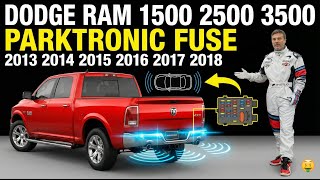
- Blown Fuse: A blown fuse can disable the entire system. On these trucks, the park assist fuse is often F95 in the main fuse box 🎬 Watch: How to find and check your parking sensor fuse. under the hood.
Diagnosis Steps
- Read the specific trouble code with a scan tool capable of reading Body (B) codes to confirm B1291 is present.
- Visually inspect all park assist sensors on the front and rear bumpers for dirt, snow, ice, or damage. Clean them thoroughly as per TSB #9003059.
- Check fuse F95 in the under-hood fuse box to ensure it's not blown.
- Clear the trouble codes and test the system. Put the vehicle in drive (for front sensors) or reverse (for rear sensors). See if the code returns.
- If the code returns, identify sensor #4 (inner sensor, front passenger side bumper). With the ignition on and system active, listen closely to the sensor. A healthy sensor will emit a faint, rapid clicking or buzzing sound. You can also lightly touch the sensor face to feel for a palpable vibration. A silent, dead sensor is likely faulty.
- A definitive test is to swap the suspected faulty sensor (#4) with a known good sensor from another position (e.g., sensor #3). Clear the codes and re-test. If the code changes to B1290 (for sensor #3), the sensor you moved is bad and needs replacement.
- If the code remains B1291 after the swap, the problem is in the wiring to that specific sensor location. Disconnect the plug and inspect the connector and harness for damage, corrosion, pushed-out pins, or loose connections.
- If wiring appears intact, use a multimeter to check for correct voltage, ground, and signal at the sensor connector based on the vehicle's service manual.
Parts You'll Likely Need
- Park Assist Sensor
(OEM #1EW63TZZAA)— This is the most common point of failure for code B1291 after ruling out obstructions. The sensor's internal electronics fail due to exposure to the elements. This part number supersedes many previous versions, including 1EW63DX8AA, 1EW63AB5AA, and others.
Trusted brands: Mopar (Bosch), Standard (SMP), Dorman, Crown
OEM price range: $90-$150
Aftermarket price range: $25-$70
Related Codes That Often Appear With This One
- B1290, B1292, B1293 — These are codes for other park assist sensors on the front bumper. If multiple codes are present, it could point to a more systemic issue like a wiring harness problem common to several sensors, or multiple sensors failing around the same time.
- B1295, B1296, B1297, B1298 — These codes correspond to the rear park assist sensors (numbers 8, 9, 10, 11). Seeing B1291 with these codes indicates faults in both front and rear systems, possibly pointing to a module or main power/ground issue, or a common wiring failure point like the XY630A connector for the rear.
Technical Service Bulletins (TSBs) & Recalls
- 9003059: Addresses Signal Shape / Waveform Failure faults (B1291-25) for park assist sensors, recommending cleaning the sensors as the first step.
- S2208000107 (STAR Case): Notes that loose sensor connectors can cause performance-related DTCs and that the fix is to ensure the connector is fully seated.
Platform-Specific Known Issues
- A Technical Service Bulletin (TSB #9003059) was issued for 2014 models for this and related codes, instructing technicians to first check for and clean any obstructions like snow, mud, or ice from the sensors before proceeding with further diagnostics.
- FCA STAR Case S2208000107 highlights that performance-related codes (e.g., B1291-92) are frequently caused by a sensor connector that is not fully seated. The recommended repair is to simply disconnect and securely reconnect the plug.
- Owners on forums frequently report that aftermarket sensors can be unreliable, sometimes working intermittently or failing quickly. Using an OEM Mopar/Bosch sensor is often recommended to ensure a lasting repair.
Mechanic-Grade Diagnostic Values
- Park Assist Sensor Supply Voltage — expected: ~8.4 Volts. Failure: Significantly lower or no voltage indicates an issue with the Park Assist Module (PAM) or the supply circuit.
- Park Assist Sensor Signal Circuit Resistance — expected: Below 5.0 Ohms. Failure: Resistance above 5.0 Ohms indicates an open or high resistance in the signal circuit wiring between the module and the sensor.
Hidden / Shadow Codes Worth Checking
- B1291-11: PTS Sensor 4 - Circuit Short to Ground. This code points specifically to a wiring problem where the signal wire is grounded, rather than an internal sensor fault. (see via Advanced OBD-II scanner capable of reading manufacturer-specific Body codes (e.g., AlfaOBD, Autel, wiTECH).)
- B1291-25: PTS Sensor 4 - Signal Shape/Waveform Failure. This is the most common variant and indicates the signal from the sensor is illogical or corrupt. It's often caused by an obstructed or internally failed sensor. (see via Most scan tools capable of reading Body (B) codes.)
- B1291-92: PTS Sensor 4 - Performance or Incorrect Operation. This suggests data corruption or a performance issue in the communication between the sensor and the module, often due to a loose connection or internal sensor fault. (see via Advanced OBD-II scanner capable of reading manufacturer-specific Body codes.)
Scan Tool Commands That Help
- wiTECH: Reprogram the PAM (Park Assist Module) — Used to apply software updates that can resolve erroneous DTCs or system sensitivity issues, as outlined in several TSBs. This should be done if a TSB matches the symptom, like false alerts or codes setting without a hardware fault.
- wiTECH: Clear all DTCs — This is a critical final step after any hardware replacement (like a sensor) or software flash. The ParkSense system may remain disabled, with the fault light on, until stored codes are manually cleared.
- wiTECH: Restore configuration and align PROXI — This procedure may be required after reprogramming or replacing the Park Assist Module to ensure it communicates correctly with other vehicle modules.
Wiring & Ground Locations
- Front Bumper Harness Connector — Located behind the driver's side front wheel well liner. You must pull the liner back to access it.. This is the main connection point for the entire front sensor harness. It is exposed to road spray and is a common location for corrosion or pin damage that can affect any of the front sensors, including #4.
- Sensor Supply Wire — Gray with Orange stripe wire at the sensor connector.. This wire provides the ~8.4V operating voltage to all the sensors. A fault in this wire can cause multiple sensor codes to appear simultaneously.
- Sensor Ground Wire — Gray with Blue stripe wire at the sensor connector.. This is the shared ground for the sensors. A poor ground connection can cause erratic sensor behavior and performance codes.
Real Owner Repair Stories
- YouTube channel 'Rain City Wrench' (2012 Ram (similar system)) — Inoperative rear park aid with codes for all four rear sensors shorted to ground (B1295, B1296, B1297, B1298).
❌ Tried (didn't work) Replacing the Parktronics (Park Assist) control module.
✅ What actually fixed it The technician tested power and communication, which were both good. He then replaced all four rear sensors with aftermarket units ('Amazon special'), which resolved all the codes and restored system function. This suggests a scenario where multiple sensors failed simultaneously.
OEM Part Supersession History
1EW63DX8AA, 1EW63AB5AA, and many others→1EW63TZZAA— Standard part consolidation and revision over multiple model years and vehicle lines.
Heads up: While many part numbers are superseded by 1EW63TZZAA, it is crucial to verify fitment for the specific vehicle generation. The sensors for 4th Gen (2010-2018) and 5th Gen (2019+) Rams are generally not interchangeable.
Model Year Variations Within This Range
- 2014: A specific TSB (08-071-14) was released for 2014 Ram 1500 models (and other platforms) to address overly sensitive front park assist systems that could cause false object detection on gravel or sloped surfaces, potentially logging B1291-25. The fix was a software update for the Park Assist Module.
Helpful Videos

The information in this article is provided for general reference and educational purposes only. Vehicle specifications, procedures, and part compatibility can vary by production date, trim level, and region. Always consult your vehicle's factory service manual and verify part numbers before purchasing or performing repairs. Safety-critical components such as airbags, seat belts, and braking systems should be installed by a qualified professional.
- Ram 3500:
- 🧭 Diagnostic Flowchart
- 🎬 Helpful Videos
- What's Unique About the 2014-2017 Ram 3500
- Symptoms You May Notice
- Most Likely Causes
- Rare But Worth Checking
- Diagnosis Steps
- Parts You'll Likely Need
- Related Codes That Often Appear With This One
- Technical Service Bulletins (TSBs) & Recalls
- Platform-Specific Known Issues
- Mechanic-Grade Diagnostic Values
- Hidden / Shadow Codes Worth Checking
- Scan Tool Commands That Help
- Wiring & Ground Locations
- Real Owner Repair Stories
- OEM Part Supersession History
- Model Year Variations Within This Range
- 🎟️ Get 5% Off