

OBD-II Code B1312: Passenger Seat Sensor Fault
What B1312 means, why it triggers, and how to fix it
- Code B1312 triggers a hard SRS fault that disables the passenger airbag or permanently arms it, creating a severe safety risk for children.
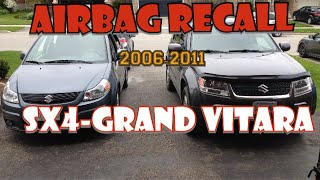
- Check your VIN for NHTSA Campaign 13V405000; 2006-2011 Suzuki Grand Vitara and 2007-2011 SX4 models receive a free lifetime seat cushion replacement for this exact code.
- Never replace the $800+ seat cushion without first inspecting the yellow under-seat connectors for broken wires, corrosion, or jammed objects.
- If you replace the OCS sensor or seat cushion, you must perform a Zero Point Calibration with an advanced bi-directional scanner, or the B1312 code will instantly return.
What Does B1312 Mean?
Code B1312 indicates the vehicle's Supplemental Restraint System (SRS) module detects a fault in the passenger seat Occupant Classification System (OCS). The OCS uses a pressure-sensitive mat embedded in the seat cushion to determine passenger weight and presence, dictating whether the passenger airbag deploys during a crash.
Technical definition: For most vehicles (notably Suzuki, Hyundai, and Kia), B1312 defines an open circuit or high resistance in the Front Passenger Sensing System mat located inside the seat cushion. On Ford and Jaguar, this specific code indicates a 'Headlamp Input Circuit Short to Battery', requiring you to verify the code definition against your specific VIN.
Can I Drive With B1312?
Yes, But With Caution. You can drive the vehicle, but the passenger airbag system is compromised and non-functional. On affected Suzuki models, the fault permanently arms the passenger airbag, creating a lethal risk for children in the front seat. Prompt repair is mandatory for passenger safety.
Common Causes
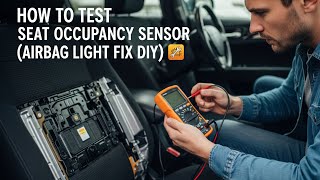
- Defective Passenger Occupant Sensor Mat (Very Common) — The sensor mat, a grid of delicate wires inside the seat cushion, breaks from repeated flexing. 🎬 Watch: DIY guide on how to test a seat occupancy sensor. This is the primary cause on Suzuki, Hyundai, and Kia models, prompting multiple NHTSA recalls.
- Damaged Under-Seat Wiring or Connectors (Common) — The yellow SRS wiring harness under the passenger seat is highly vulnerable. Items shoved under the seat, kicked wires, or corrosion from spilled liquids and winter road salt sever the connection to the OCS module.
- Foreign Object Interference (Common) — Heavy, wet, or electronic items (like a laptop or power inverter) placed on or jammed under the passenger seat interfere with the sensor's pressure and capacitance readings, triggering a fault.
- Faulty Airbag Control Module (SRS/OCS/SDM) (Less Common) — The main computer for the airbag system fails internally, preventing communication with the seat sensor. This usually triggers additional ECU internal failure codes alongside B1312.
- Blown SRS/OCS Fuse (Rare) — A blown fuse for the Supplemental Restraint System cuts power to the OCS components. This is rare but takes only seconds to verify via the interior fuse panel.
Symptoms
- Airbag Warning Light is On — The red airbag or SRS warning light stays illuminated permanently on the dashboard after the initial startup check.
- 'Passenger Airbag Off' Light is Inoperative — The center console indicator light showing passenger airbag status stays off (airbag always armed) or stays on (airbag always disabled), regardless of seat occupancy.
- Passenger Seatbelt Reminder Stays On — The seatbelt reminder chime for the passenger side activates when the seat is empty, or fails to activate when a passenger is present.
- Erratic Headlight Operation — On Ford or Jaguar models where B1312 relates to lighting circuits, headlights behave incorrectly (unrelated to the airbag system).
- No Communication with OCS Module (scan-tool only — no driver-felt sign) — Advanced scan tools fail to communicate with the Occupant Classification System module, indicating a severed power, ground, or CAN bus line.
Diagnostic Flowchart
Tap your situation to follow the diagnostic path that matches what you're seeing on this code.
Common Fixes & Costs
- Replace Passenger Seat Cushion Assembly — Parts: $800-$1500, Labor: $150-$300, ~1.5 hr book time (Professional)
- Repair Damaged Wiring or Clean Connectors — Parts: $10-$30, Labor: $100-$200, ~1.0 hr book time (Intermediate)
- Perform OCS Calibration/Reset — Parts: $0, Labor: $100-$200, ~0.5 hr book time (Professional)
- Install Occupant Sensor Emulator — Parts: $50-$150, Labor: $50-$100, ~0.5 hr book time (DIY)
- Replace Airbag (OCS/SRS) Control Module — Parts: $200-$800, Labor: $150-$300, ~1.2 hr book time (Professional)
Used vs. New Parts: Buying Guide
When a used part is worth it: Never. Buying a used seat cushion with an integrated occupant sensor is strongly discouraged by safety experts. The risk of acquiring a part with hidden moisture damage or internal wire fatigue is extremely high.
Donor quality checklist:
- NHTSA and vehicle manufacturers explicitly warn against using salvaged airbag components.
- There is no reliable way to verify the remaining lifespan of a used occupant sensor mat.
- Used parts often have different internal calibrations, rendering them incompatible and unsafe.
Decision logic:
- If The vehicle is a 2006-2011 Suzuki Grand Vitara or 2007-2011 SX4. → Do not buy any part. Contact a dealer for a free OEM replacement part and installation under NHTSA Campaign 13V405000.
- If The part is a critical SRS component like an occupant sensor or control module. → Always buy new from an OEM or reputable supplier to guarantee safety system integrity.
Warranty tradeoff: Used SRS parts carry no functional warranty against premature failure. New OEM parts installed by a dealer carry a standard 12-month/12,000-mile parts and labor warranty.
Worst-case if a used part fails: $500 if a used part fails, requiring you to pay labor twice and ultimately purchase the new OEM part you originally avoided.
What Happens If You Wait — Timeline
- 0-1 week: The airbag warning light illuminates permanently. The passenger airbag system disables or defaults to an unsafe state. (MPG impact: 0%% · Added cost: $0)
- 1 week - 6 months: The vehicle automatically fails state safety inspections, preventing legal registration renewal. (MPG impact: 0%% · Added cost: $50-$250 in failed inspection fees and fines.)
- In case of an accident: The compromised SRS system fails to deploy the passenger airbag correctly, resulting in severe injury or death. (MPG impact: 0%% · Added cost: Tens of thousands in medical bills and legal liability.)
Cost of Not Fixing It
- Immediate: The passenger airbag system disables or defaults to an unsafe state (always armed). In a collision, the airbag will not deploy correctly, drastically increasing the risk of severe injury or death. (Added cost: N/A)
- Next State Inspection: The vehicle automatically fails safety inspections in states that check for illuminated airbag warning lights, preventing legal registration. (Added cost: $50-$250 in failed inspection fees, fines, and re-testing costs.)
- Long-Term: You assume massive legal and financial liability if a passenger is injured in an accident where a functional airbag system would have mitigated the damage. (Added cost: Tens of thousands in potential medical bills and legal liability.)
Diagnosis Steps
- Verify Code & Check Recalls
Use an SRS-capable OBD-II scanner to confirm B1312 is the active fault. Immediately search your VIN on the NHTSA website. Suzuki models (2006-2011) have a lifetime free recall (13V405000) for this exact issue.
Tools: SRS-capable OBD-II Scanner, Internet access (Beginner) - Perform Visual Inspection & Wiggle Test
Look under the front passenger seat with a flashlight. Check for disconnected yellow electrical connectors, frayed wires, or jammed objects. While monitoring the airbag light, gently wiggle the harness. If the light flickers, you have a broken wire or loose pin.
Tools: Flashlight, SRS-capable OBD-II Scanner (Beginner) - Monitor Live OCS Data
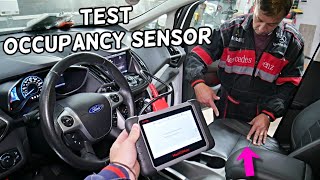
Navigate to the OCS/SRS module on an advanced scanner and view live data. Watch the 'Occupant Weight' parameter. With the seat empty, it must read 0 lbs. Have an adult sit down; it should jump above 100 lbs. An erratic or unchanging value confirms a dead sensor or severed wire.
Tools: Advanced SRS-capable OBD-II Scanner (Intermediate) - Test Sensor Mat Resistance
Disconnect the sensor mat connector from the OCS module. Using a multimeter set to ohms (Ω), measure resistance across the sensor pins. A reading of 'OL' (infinite resistance) confirms an open circuit and a broken sensor mat.
Tools: Multimeter, Vehicle-specific service manual (Advanced) - Test Power and Ground at OCS Module
Disconnect the OCS module. Turn the ignition on. Use a multimeter to verify battery voltage (11-14V) at the power pin and check for continuity (less than 1.0 ohm) to a chassis ground. Lack of power indicates an upstream wiring failure.
Tools: Multimeter, Vehicle-specific wiring diagram (Advanced) - Perform OCS Zero Point Calibration
If you replace the sensor, seat cushion, or OCS module, you must perform a 'Zero Point Calibration' using a bi-directional scan tool. This teaches the module the baseline weight of the empty seat. Skipping this step guarantees the B1312 code will return instantly.
Tools: Advanced SRS-capable OBD-II Scanner (Advanced)
When This Code Triggers (Freeze-Frame Conditions)
- System Status: Active/On (The SRS control module continuously monitors the occupant classification system whenever the ignition is in the 'ON' or 'RUN' position.)
- Fault Type: Open Circuit / High Resistance (The code sets instantly when the SRS module detects resistance in the passenger seat sensor mat circuit above the manufacturer's specified threshold, indicating a broken wire.)
- Ignition Cycle Count: 1 (B1312 is a hard fault detected and logged during the initial system self-test at every key-on cycle.)
- Battery Voltage: 9-16V (The fault logs as long as the SRS module has sufficient operating voltage. Low voltage triggers different, system-wide SRS codes.)
Related Codes
- B00A0 — Common on Nissan and Infiniti, this code points to an 'Occupant Detection Sensor Unit Fault'. It is functionally identical to B1312 on a Suzuki, requiring the exact same diagnosis and repair.
- B1318 — Points to a logic or calibration error in the OCS, often caused by detecting an abnormal load. B1312 is a hard electrical fault, while B1318 is frequently cleared by an OCS recalibration.
- B1490 / B1764 — Kia's specific codes for a defect in the OCS mat or wiring. They represent the exact same physical problem that triggers B1312 on other makes.
- B1342 — A generic ECU internal failure code. If B1342 appears alongside B1312, the OCS control module itself has failed, not the sensor mat.
Climate & Environmental Factors
- High Humidity / Road Salt: In the 'Salt Belt' or coastal areas, saltwater spray wicks into undercarriage electrical connectors, causing high resistance or short circuits in the OCS module pins.
- Extreme Cold: Sub-zero temperatures cause wiring insulation and plastic connectors under the seat to become brittle, cracking instantly if kicked or disturbed by a passenger.
How to Talk to a Mechanic About This Code
Say this: "I have an airbag warning light on, and my scanner shows code B1312 for the passenger occupant sensor. I've inspected the wiring under the seat. I'd like to book a diagnostic appointment to confirm the fault, and I need to know if your shop has the software to perform the OCS Zero Point Calibration if a part is replaced."
This proves you are an informed customer. It directs the technician to the specific system, prevents them from blindly replacing the $800 seat cushion without checking wires, and ensures they actually possess the expensive software required to finish the job.
Avoid saying:
- 'My airbag light is on, can you fix it?' (Invites a costly, open-ended diagnostic process.)
- 'I need a new seat sensor.' (You might be wrong and end up paying $1,000 for a part you didn't need.)
- 'Just turn the light off.' (Leads to unsafe shortcuts like emulators.)
Questions to ask before authorizing the repair:
- Did you confirm the sensor mat is faulty by testing its resistance with a multimeter?
- Did you verify the yellow under-seat wiring harness is intact and receiving 12V power?
- Does your quoted price include the mandatory OCS Zero Point Calibration after installation?
Where to Take It: Dealer vs Independent vs Chain
- Dealer:
The mandatory choice for affected Suzuki models (it's free). For other makes, it guarantees access to the required calibration software, albeit at a premium.
Best for: Suzuki models eligible for the free recall repair., Complex cases requiring vehicle-specific programming and calibration tools.
Downsides: Highest labor rates and parts markup., May default to replacing the entire $1,000 seat cushion assembly without investigating cheaper wiring repairs. (Typical cost: +50% vs. baseline) - Independent Shop:
A great choice, provided you explicitly ask if they have the software to perform an OCS/SRS calibration for your specific make *before* booking.
Best for: Out-of-warranty vehicles where the cause is likely a broken wire., Owners looking for a more affordable diagnostic fee.
Downsides: May lack the $3,000+ bi-directional scan tools required to perform the mandatory OCS Zero Point Calibration. (Typical cost: +0% vs. baseline) - Chain Shop:
AVOID. SRS system repair is a safety-critical task requiring specialized knowledge beyond what chain shops provide.
Best for: Simple maintenance like oil changes or tires.
Downsides: Technicians lack specialized training for high-liability SRS repairs., Rarely possess the software required for OCS calibration. (Typical cost: -10% vs. baseline)
When to Walk Away From the Repair
If the estimated repair cost for the airbag system exceeds 40-50% of the car's current private-party market value, consider selling the vehicle as-is.
- Car worth $5000, fix is $2200: Walk away. The repair cost is nearly half the car's value. Selling the car 'as-is' with full disclosure is the financially sound decision.
- Car worth $10000, fix is $1200: Fix it. The repair cost is a reasonable percentage of the vehicle's value, and fixing it restores a critical safety feature.
What Scan Tool You Need for This Code
Minimum: An OBD-II scanner with specific support for reading and clearing Supplemental Restraint System (SRS) codes. A basic $20 engine code reader will NOT work.
Standard scanners only read 'P' (Powertrain) codes. B1312 is a 'B' (Body) code stored in the separate SRS module. You need an SRS-capable scanner to view the code, monitor live seat weight data, and clear the light.
Budget: Autel AutoLink AL619 (~$60) — Explicitly designed to read and clear ABS and SRS/Airbag codes. It retrieves the B1312 code and turns off the warning light after a successful wiring repair.
Mid-range: BlueDriver Pro (~$120) — A Bluetooth dongle that reads/clears SRS codes and displays live data from the OCS module, allowing you to verify if the sensor detects weight.
Professional: Foxwell NT630 Plus / Autel MaxiCOM MK808 (~$150-500) — These bi-directional tools are essential for performing the mandatory OCS Zero Point Calibration required after replacing a sensor or seat cushion.
Rent vs buy: Auto parts stores do NOT rent out SRS-capable scanners due to liability. Buying a budget $60 model is cheaper than paying a shop $150 for a single diagnostic session.
How to Clear the Code After You Fix It
- Ensure all under-seat connectors are securely fastened.
- Reconnect the vehicle's negative battery terminal.
- Use an SRS-capable OBD-II scan tool to access the Supplemental Restraint System menu.
- Select 'Clear Codes' or 'Erase DTCs'.
- Cycle the ignition off, then on. Verify the airbag warning light illuminates for 3-5 seconds and then turns off permanently.
Drive cycle (~5 minutes): No drive cycle is required. The SRS system performs a complete self-diagnostic check instantly when the ignition turns on. If the repair failed, the light returns immediately.
Readiness monitors affected: No emissions readiness monitors are affected by SRS codes.
Watch out for:
- Using a standard $20 engine code reader, which physically cannot access or clear SRS fault codes.
- Failing to perform the mandatory OCS Zero Point Calibration after replacing a seat cushion.
- Clearing the code without fixing the broken wire; the code will return the moment you turn the key.
Will This Fail Emissions / State Inspection?
No — by itself this code doesn't fail OBD inspection (but it can keep readiness monitors from setting, which causes a separate fail).
- California: An airbag light will NOT cause a smog check failure. However, DMV examiners will refuse to conduct a driving test in a vehicle with an illuminated airbag light.
- New York: An illuminated airbag warning light is currently an advisory during the NYS safety inspection, but proposed legislation aims to make it an automatic failure.
- Texas: An illuminated airbag light is NOT on the Texas vehicle safety inspection checklist and will not cause a failure.
Most Commonly Affected Vehicles
- Suzuki Grand Vitara (2006-2011) — Covered under Safety Recall VD (NHTSA 13V405000). The passenger seat sensor mat defect is repaired free at a dealer regardless of age or mileage.
- Suzuki SX4 (2007-2011) — Also covered under Safety Recall VD (NHTSA 13V405000) for a free seat cushion replacement.
- Hyundai / Kia Sonata, Optima, Sedona (2006-2018) — Prone to occupant sensor mat failures. Kia issued recall SC175 (NHTSA 19V109000) for 2015-2018 Sedona models for a related wiring harness issue.
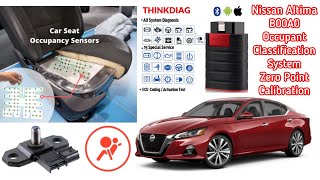
- Nissan Altima, Rogue (2013-2018) — Often associated with code B00A0-00, Nissan has a known OCS issue. TSB NTB19-071D addresses this, frequently requiring a system recalibration as the sole fix.
- Chevrolet / GMC Silverado, Sierra (2007-2014) — Airbag lights are commonly caused by high resistance in yellow under-seat connectors. A 'wiggle test' is the primary diagnostic step.
- Ford Fiesta, Crown Victoria (2005-2019) — On Ford models, B1312 is defined as 'Headlamp Input Circuit Short to Battery,' completely unrelated to the airbag system.
- Jaguar XJ, S-Type (2003-2009) — Similar to Ford, Jaguar uses B1312 to indicate a headlamp circuit malfunction.
Manufacturer-Specific Notes
- Suzuki: Suzuki issued Safety Recall VD (NHTSA 13V405000) for the 2006-2011 Grand Vitara and 2007-2011 SX4, mandating a free seat cushion replacement for code B1312 regardless of vehicle age or mileage.
- Ford / Jaguar: The definition of B1312 on these models is 'Headlamp Input Circuit Short to Battery.' It is completely unrelated to the airbag system.
- Nissan / Infiniti: These brands use code B00A0 for identical OCS mat failures. A mandatory OCS zero point calibration with a dealer-level scan tool is required after any repair, and is sometimes the only fix needed (TSB NTB19-071D).
Real Owner Stories
2008 Suzuki SX4 with airbag light on
The airbag light stayed on permanently. The dealer diagnosed code B1312 and quoted $1,009 to replace the passenger seat cushion.
What they tried:
- Took the vehicle to a Suzuki dealer for diagnosis.
- Searched the VIN online for known issues.
Outcome: The owner discovered the vehicle was eligible for a free repair under NHTSA Campaign 13V405000. The dealer replaced the seat cushion at zero cost.
Lesson: Always check your VIN for recalls before paying for repairs. B1312 is a guaranteed free fix on specific Suzuki models.
2008 Hyundai Sonata with airbag light and code B1448
The airbag light was on, and the 'Passenger Air Bag Off' indicator was off even with the seat empty. A scanner showed code B1448 (Hyundai's equivalent of B1312).
What they tried:
- Disconnected the battery to reset the system, but the light returned instantly.
- Purchased a plug-in occupant sensor emulator for $60.
Outcome: The emulator turned off the warning light by tricking the computer into thinking an adult was seated. The passenger airbag is now permanently armed.
Lesson: Emulators are cheap workarounds that defeat critical safety systems. They create a lethal risk for child passengers and should be avoided.
2013 Nissan Altima with intermittent airbag light and code B00A0-00
The airbag light illuminated when the seat was empty but turned off when occupied. A scanner showed code B00A0-00.
What they tried:
- Paid an independent shop to replace the OCS sensor.
- The code cleared temporarily but returned as soon as the passenger exited the vehicle.
Outcome: The independent shop lacked the software to perform the mandatory Zero Point Calibration. The owner had to pay a dealer $150 to calibrate the new sensor, finally resolving the issue.
Lesson: Replacing an OCS component is only half the job. You must perform a Zero Point Calibration with a bi-directional scanner, or the repair will fail.
How to Prevent This Code From Triggering
- Keep the area under the passenger seat clear. (Always) — Water bottles or umbrellas shoved under the seat crush the sensitive yellow SRS wiring harness, severing the connection to the OCS module.
- Avoid kneeling on the passenger seat. (Always) — Concentrated, heavy loads snap the delicate wire grid embedded inside the sensor mat, permanently destroying it.
- Protect against moisture and corrosion. (Winter / Humid Climates) — Applying dielectric grease to under-seat connector seals prevents winter road salt and spilled drinks from corroding the electrical pins.
Frequently Asked Questions
Is it safe to drive with code B1312?
No. The passenger airbag will not operate correctly. It either disables entirely or permanently arms, creating a severe hazard for children.
Will my airbags deploy in an accident with the B1312 code?
Assume they will not deploy correctly. The SRS module typically disables the passenger airbag as a fail-safe when this code is active.
Can I just clear the B1312 code?
You can clear it with an SRS scanner, but it returns instantly. B1312 is a hard electrical fault requiring physical repair.
What is an occupant sensor emulator and should I use one?
An emulator tricks the computer into thinking an adult is always seated, turning off the light. This permanently arms the airbag, creating a lethal risk for children and massive legal liability.
My car has an airbag light, but the code is B00A0, not B1312. Is it the same problem?
Yes, B00A0 is Nissan's specific code for the exact same Occupant Classification System fault. The diagnostic and repair procedures are identical.
Why is the official repair so expensive?
The sensor mat is permanently integrated into the seat bottom foam cushion. You must purchase the entire cushion assembly from the dealer, which often costs over $1000.
My car is a Suzuki with code B1312. Is the repair free?
Yes. NHTSA campaign 13V405000 mandates a free seat cushion replacement for affected 2006-2011 Grand Vitara and 2007-2011 SX4 models.
What is an OCS Zero Point Reset and why is it important?
This mandatory calibration teaches the SRS module the exact weight of the empty seat. If you skip this after replacing a sensor, the airbag light stays on permanently.
Key Takeaways
- Code B1312 triggers a hard SRS fault that disables the passenger airbag or permanently arms it, creating a severe safety risk for children.
- Check your VIN for NHTSA Campaign 13V405000; 2006-2011 Suzuki Grand Vitara and 2007-2011 SX4 models receive a free lifetime seat cushion replacement for this exact code.
- Never replace the $800+ seat cushion without first inspecting the yellow under-seat connectors for broken wires, corrosion, or jammed objects.
- If you replace the OCS sensor or seat cushion, you must perform a Zero Point Calibration with an advanced bi-directional scanner, or the B1312 code will instantly return.
Helpful Videos
Shop the Parts Behind B1312
Below are the parts most often responsible for code B1312, ranked by how frequently each one is the actual culprit (per the diagnosis above). Tap any to see what we have for your vehicle.


The information in this article is provided for general reference and educational purposes only. Vehicle specifications, procedures, and part compatibility can vary by production date, trim level, and region. Always consult your vehicle's factory service manual and verify part numbers before purchasing or performing repairs. Safety-critical components such as airbags, seat belts, and braking systems should be installed by a qualified professional.
- 🧭 Diagnostic Flowchart
- 🎬 Helpful Videos
- 🛍️ Shop This Part
- What Does B1312 Mean?
- Can I Drive With B1312?
- Common Causes
- Symptoms
- Common Fixes & Costs
- Used vs. New Parts: Buying Guide
- What Happens If You Wait — Timeline
- Cost of Not Fixing It
- Diagnosis Steps
- When This Code Triggers (Freeze-Frame Conditions)
- Related Codes
- Climate & Environmental Factors
- How to Talk to a Mechanic About This Code
- Where to Take It: Dealer vs Independent vs Chain
- When to Walk Away From the Repair
- What Scan Tool You Need for This Code
- How to Clear the Code After You Fix It
- Will This Fail Emissions / State Inspection?
- Most Commonly Affected Vehicles
- Manufacturer-Specific Notes
- Real Owner Stories
- 2008 Suzuki SX4 with airbag light on
- 2008 Hyundai Sonata with airbag light and code B1448
- 2013 Nissan Altima with intermittent airbag light and code B00A0-00
- How to Prevent This Code From Triggering
- Frequently Asked Questions
- Is it safe to drive with code B1312?
- Will my airbags deploy in an accident with the B1312 code?
- Can I just clear the B1312 code?
- What is an occupant sensor emulator and should I use one?
- My car has an airbag light, but the code is B00A0, not B1312. Is it the same problem?
- Why is the official repair so expensive?
- My car is a Suzuki with code B1312. Is the repair free?
- What is an OCS Zero Point Reset and why is it important?
- Key Takeaways
- 🎟️ Get 5% Off