

Ultimate Guide to OBD-II Code B1329: Front Impact Sensor (Driver Side) Communication Error
The Most Comprehensive B1329 Resource: Outranking the Competition with Pro-Level Diagnostics and Fixes
- Code B1329 completely disables your vehicle's airbag system, creating an immediate, life-threatening safety risk in a collision.
- Disconnect the negative battery terminal and wait exactly 30 minutes before touching any yellow-harnessed SRS components to prevent accidental deployment.
- Inspect the driver-side front impact sensor behind the grille first; 80% of B1329 faults stem from a disconnected plug, corroded pins, or a failed $80 OEM sensor.
- Never replace the $800+ SRSCM module until you have verified the sensor wiring has less than 1.0 ohm of resistance.
What Does B1329 Mean?
Code B1329 signifies your car's main safety computer, the Supplemental Restraint System Control Module (SRSCM), lost communication with the driver-side front crash sensor. Without this signal, the SRSCM cannot trust the airbag system's integrity. It immediately illuminates the airbag warning light and deactivates the entire system to prevent unintended deployment.
Technical definition: The SRSCM sets DTC B1329 when it detects a communication error in the Driver Front Impact Sensor (DFIS) data circuit. This triggers when the SRSCM misses the expected 'heartbeat' signal or acceleration data for 1 to 5 seconds. Normal line voltage during operation is 3V to 11V.
Can I Drive With B1329?
No — Do Not Drive. No. While the vehicle's engine operates normally, driving is a severe safety risk. The B1329 code confirms the entire Supplemental Restraint System (SRS) is disabled. In a collision, the airbags WILL NOT deploy, and seatbelt pretensioners fail to activate. The cost of ignoring this is the risk of serious injury or death in an accident.
Common Causes
- Damaged, Corroded, or Water-Intruded Wiring/Connector (Very Common) — The front impact sensor sits exposed behind the grille, making its wiring highly vulnerable to road debris, water intrusion, and salt corrosion. This causes an open or short circuit that severs communication.
- Failed Driver-Side Front Impact Sensor (DFIS) (Very Common) — Internal electronic components fail due to vibration, moisture seeping past seals, or age. This is the primary hardware failure once wiring is verified intact.
- Disconnected Sensor After Collision Repair (Common) — Technicians frequently forget to reconnect the front impact sensor after replacing the front bumper, grille, or radiator. Always check for an unplugged connector first.
- Incorrect or Low-Quality Aftermarket Sensor (Less Common) — The SRS system requires precise voltage signals. Cheap aftermarket sensors often fail to communicate correctly with the SRSCM, preventing the code from clearing. Always use OEM parts.
- Failed SRSCM (Airbag Control Module) (Very Rare) — A failed SRSCM is the absolute last resort. Condemn this module only after exhaustively testing the sensor, wiring, and connectors. Certain 2011-2013 Hyundai Sonatas have a recall related to this module.
Symptoms
- Airbag Warning Light On — This is the primary symptom. The light on the instrument cluster remains steadily illuminated.
- Failed Safety Inspection — A vehicle automatically fails mandatory safety inspections if the airbag warning light is on.
- "Service Airbag System" Message — Many vehicles display a text-based warning in the driver information center (DIC).
- Inoperative Steering Wheel Controls (Ford/GM Specific) — On specific Ford or GM models, B1329 indicates a loss of vehicle speed signal or electrical fault, manifesting as a dead speedometer or broken steering wheel buttons.
- Airbag System Disabled (scan-tool only — no driver-felt sign) — With B1329 active, the entire supplemental restraint system is offline. Airbags fail to deploy in a crash.
Diagnostic Flowchart
Tap your situation to follow the diagnostic path that matches what you're seeing on this code.
Common Fixes & Costs
- Replace Front Impact Sensor (Driver Side) — Parts: $60-$150 for a single OEM sensor., Labor: $75-$150 for 0.5-1 hour of labor., ~0.7 hr book time (DIY)
- Repair Damaged Wiring or Connector Pigtail — Parts: $15-$40 for an OEM pigtail connector and heat-shrink supplies., Labor: $150-$300 for 1-2 hours of diagnostic and repair time., ~1.5 hr book time (Intermediate)
- Clean and Secure Corroded Connectors — Parts: $10 for electrical contact cleaner and dielectric grease., Labor: $0-$75 if performed during diagnosis., ~0.2 hr book time (DIY)
- Install SRSCM/ACU Filter Kit (Hyundai Recall) — Parts: $0 (Covered by recall)., Labor: $0 (Covered by recall)., ~1.0 hr book time (Professional)
- Replace SRSCM (Airbag Control Module) — Parts: $500-$1200 for the module., Labor: $150-$300 for installation and mandatory programming., ~2.0 hr book time (Professional)
Used vs. New Parts: Buying Guide
When a used part is worth it: Never. Safety experts and manufacturers mandate new OEM parts for all SRS components.
Donor quality checklist:
- You cannot verify if a used sensor suffered hidden internal damage from a previous collision.
- Sensors are single-use components in an accident and must never be reused.
Decision logic:
- If The part needed is a front impact sensor. → Buy a new OEM part. The cost savings of a used part never justify the immense safety risk.
- If Budget is extremely tight. → Postpone the repair until a new part is affordable. Do not compromise safety with a junkyard sensor.
Warranty tradeoff: Used sensors offer a 30-day warranty at best. New OEM parts carry a 12-month/12,000-mile manufacturer's warranty.
Worst-case if a used part fails: The worst-case cost is the failure of the airbag system to deploy in an accident, resulting in severe injury or fatality.
What Happens If You Wait — Timeline
- Immediate (0 seconds): The SRSCM detects the communication fault during its self-test. The airbag warning light illuminates, and the entire SRS system disables as a fail-safe. (MPG impact: 0%% · Added cost: $0)
- Ongoing: The vehicle operates normally, but with a constant, extreme safety risk. Airbags fail to deploy in a collision. (MPG impact: 0%% · Added cost: $0 (The cost is the non-monetary risk of injury/death))
- At First State Inspection: The vehicle automatically fails its mandatory safety inspection due to the illuminated airbag light, preventing registration renewal. (MPG impact: 0%% · Added cost: $20-$50 (Cost of re-inspection fees).)
- In The Event of a Collision: The supplemental restraint system fails to activate. This turns a survivable accident into one with serious or fatal injuries. (MPG impact: 0%% · Added cost: N/A (Represents catastrophic personal injury).)
Cost of Not Fixing It
- Immediate: The entire Supplemental Restraint System (SRS) is disabled. Airbags fail to deploy in a collision, dramatically increasing the risk of serious injury or death. (Added cost: N/A (Safety Risk))
- First Inspection: The vehicle automatically fails state-mandated safety inspections, preventing registration renewal. (Added cost: $20-$50 for re-inspection fees.)
- Long-Term: No escalating mechanical damage occurs, but the extreme safety risk and legal liability persist.
Diagnosis Steps
- Read the Codes with an SRS-Capable Scanner
Use an OBD-II scanner that accesses the SRS/airbag module to confirm B1329 is active. Note any other codes, especially B1334 (passenger side), as this indicates a shared wiring harness failure.
Tools: SRS-capable OBD-II Scanner (Beginner) - Visually Inspect Sensor and Connector
Locate the driver-side front impact sensor on the radiator core support. Inspect for physical damage to the sensor and wiring. Confirm the connector is plugged in securely and the harness is not pinched.
Tools: Flashlight, Inspection Mirror (Beginner) - Perform a 'Wiggle Test'
With the ignition on (engine off) and a scanner's live data stream open, gently wiggle the wiring harness and connector for the sensor. If the code status changes from 'Active' to 'History', you have a loose connection or broken wire.
Tools: SRS-capable OBD-II Scanner (Intermediate) - Check for Technical Service Bulletins (TSBs)
Check for TSBs for your specific vehicle. Manufacturers frequently release bulletins with updated repair procedures or improved wiring pigtails for B1329, especially for Hyundai and Kia.
Tools: TSB Database Access (e.g., ALLDATA, Mitchell1) (Beginner) - Test with a Known-Good Sensor
If visual inspections pass, substitute the suspect sensor with a new OEM part. Reconnect the battery, clear the codes, and cycle the ignition. If B1329 does not return, the original sensor failed.
Tools: New OEM Front Impact Sensor (Intermediate) - Advanced Circuit Integrity Test (Voltage & Resistance)
Disconnect the battery. Disconnect the sensor and SRSCM connectors. Using a wiring diagram, check for continuity on the two communication wires. Resistance must be less than 1.0 ohm. Check each wire for a short to ground and power.
Tools: Multimeter, Vehicle Wiring Diagram (Advanced) - Analyze Sensor Data with an Oscilloscope
Connect an oscilloscope to the sensor's communication line. A healthy sensor outputs a specific Pulse Width Modulated (PWM) signal. A flat line or distorted waveform proves a failed sensor or severe wiring issue.
Tools: Oscilloscope, Wiring Diagram (Professional) - Diagnose the SRSCM
If wiring tests perfectly and a known-good sensor fails to resolve the issue, the SRSCM is the culprit. Use a professional scanner to check for internal module faults before replacing this expensive component.
Tools: Advanced Diagnostic Scanner (Professional)
When This Code Triggers (Freeze-Frame Conditions)
- System State: Ignition ON (The SRSCM performs a self-test of all components every time the key turns to the 'ON' position.)
- Fault Detection Time: 1-5 Seconds (The code sets if the SRSCM misses the expected communication signal within seconds of the initial self-test.)
- System Voltage: 9-16 Volts (The test requires normal vehicle battery voltage. B1329 is specific to the sensor circuit, not general low voltage.)
- Engine/Vehicle Speed: 0 mph / Engine OFF (This SRS communication fault is detected and stored before the engine starts or the vehicle moves.)
Related Codes
- B1334 — The identical fault for the passenger-side front impact sensor. If both B1329 and B1334 are present, it strongly suggests a damaged central wiring harness.
- B1328 — Indicates an internal DEFECT in the driver front impact sensor, rather than a communication error. B1328 points directly at the sensor itself, skipping wiring diagnosis.
- B1762 — A general communication error between the SRSCM and other SRS modules. Resolve B1762 first, as it causes the specific sensor communication failure.
Climate & Environmental Factors
- Road Salt & Humidity: In regions using road salt, the sensor's electrical connector suffers severe corrosion. This creates high resistance or a short circuit, directly triggering B1329.
- Extreme Cold: Extreme cold makes wiring and plastic connectors brittle. Condensation freezes within the connector, causing intermittent connection issues.
- Physical Obstruction: Heavy buildup of snow, ice, or mud physically damages the sensor or wiring, particularly if splash shields are missing.
How to Talk to a Mechanic About This Code
Say this: "I have an airbag light on and my scanner shows code B1329 for the driver-side front impact sensor. I need a diagnostic to confirm if the issue is the sensor, the wiring, or the connector. Please start with a visual inspection and a wiggle test before quoting a new sensor."
This signals you know the common, simple causes like a loose connector versus a failed part. It directs the technician to perform a logical diagnosis instead of immediately replacing the most expensive component.
Avoid saying:
- 'My airbag light is on, can you just fix it?'
- 'I think I need a new airbag computer.'
- 'Just do whatever it takes to turn the light off.'
Questions to ask before authorizing the repair:
- Did you find visible damage or corrosion on the sensor and its connector?
- Did you test the wiring circuit for continuity between the sensor and the SRSCM?
- Is the replacement part OEM or a certified equivalent?
- Does the estimate include clearing the code from the SRS module and confirming the light stays off?
Where to Take It: Dealer vs Independent vs Chain
- Dealer:
Recommended. A dealer is a safe choice. They are best equipped for recalls and have guaranteed access to OEM parts and diagnostics.
Best for: Vehicles under warranty., Diagnosing manufacturer-specific quirks (e.g., non-airbag definitions for B1329 on Ford/GM)., Performing related safety recalls (like the Hyundai ACU recall).
Downsides: Highest labor rates and part costs., May refuse to perform a simple wiring repair, opting to replace the entire harness. (Typical cost: +50% vs. baseline) - Independent Shop:
Best Fit. A reputable independent shop with ASE-certified technicians easily handles the vast majority of B1329 causes at a lower cost than the dealer.
Best for: Out-of-warranty vehicles where cost is a major factor., Straightforward sensor replacement or wiring repair on common models.
Downsides: Shop quality and experience with SRS systems varies greatly., May lack access to specific programming tools for rare module failures. (Typical cost: +0% vs. baseline) - Chain Shop:
Avoid. SRS repair requires specialized knowledge beyond the scope of most chain shops. The risk of an incorrect repair on a critical safety system is too high.
Best for: Simple, unrelated maintenance like oil changes or tires.
Downsides: Technician skill for complex diagnostics is inconsistent., Many locations refuse to work on SRS systems due to liability., High risk of misdiagnosis leading to unnecessary parts replacement. (Typical cost: -10% vs. baseline)
When to Walk Away From the Repair
Because this is a critical safety issue, the decision is about making the vehicle safe to operate. If the repair cost makes you question the car's viability, sell it, but you must legally disclose the fault.
- Car worth $4000, fix is $350: Fix it. This is a low-cost repair that restores a critical safety function and makes the car sellable.
- Car worth $5000, fix is $1500: Borderline. This indicates a worst-case scenario (SRSCM failure). Get a second opinion. If confirmed, consider selling the car 'as-is' with full disclosure.
- Car worth $2500, fix is $1500: Walk away. The repair cost is over 50% of the car's value. Sell the vehicle as a 'mechanic special' with the airbag fault clearly disclosed in writing.
What Scan Tool You Need for This Code
Minimum: A scanner that specifically reads and clears codes from the SRS (Airbag) control module. A basic engine-only code reader fails to communicate with this system.
A standard $20 OBD-II reader only sees the Powertrain Control Module. It is completely blind to the SRS module where B1329 is stored.
Budget: Autel AutoLink AL619 (~$80) — Reads and clears engine, ABS, and SRS codes on most major vehicle makes. It correctly identifies and clears B1329 after the repair.
Mid-range: BlueDriver Pro (~$100) — Connects to a smartphone app via Bluetooth and provides full system scanning, including SRS. It reads and clears B1329 and provides repair reports.
Professional: Autel MaxiCOM MK808 / MK906BT (~$500-1200) — Offers professional-level diagnostics, bidirectional control, and the ability to diagnose complex wiring or module issues that cheaper scanners miss.
Rent vs buy: Most auto parts store loaner tools are basic engine code readers and fail to read SRS codes. Buying a budget pick like the Autel AL619 is a mandatory investment for this repair.
How to Clear the Code After You Fix It
- Ensure the physical repair is complete.
- Reconnect the negative battery terminal.
- Use an SRS-capable OBD-II scan tool to access the Supplemental Restraint System module.
- Select the option to 'Clear Codes' or 'Reset DTCs'.
- Cycle the ignition off, wait 10 seconds, then turn it back on to confirm the airbag light stays off after its initial self-check.
Drive cycle (~10 minutes): An extensive drive cycle is not required. After clearing the code, a simple ignition cycle (off-on) forces the SRSCM to re-run its self-test. A short 10-minute test drive confirms the repair is stable.
Readiness monitors affected: None. SRS system status does not affect engine emissions readiness monitors.
Watch out for:
- Using a basic OBD-II scanner that only reads engine codes fails to communicate with the SRS module.
- Disconnecting the battery does NOT clear a B1329 code. The fault is stored in non-volatile memory and requires a scan tool.
- The code returns immediately upon the next ignition cycle if the root cause remains unfixed.
Will This Fail Emissions / State Inspection?
No — by itself this code doesn't fail OBD inspection (but it can keep readiness monitors from setting, which causes a separate fail).
- California: An airbag light does NOT cause a failure of the emissions-only Smog Check.
- New York: An illuminated airbag light causes an automatic FAIL for the annual safety inspection.
- Texas: The airbag system is NOT a required item on the Texas annual safety inspection checklist.
Most Commonly Affected Vehicles
- Hyundai Sonata (2010-2015) — Extremely common. For 2011-2013 models, check for Safety Recall 174 regarding the Airbag Control Unit (ACU/SRSCM) filter kit installation.
- Hyundai Elantra (2011-2016) — Frequently experiences this code due to sensor failure or corrosion in the connector pins. OEM part number is often 95930-3X100.
- Hyundai Tucson (2010-2022) — Reported across multiple generations, indicating a persistent vulnerability of the front impact sensor and its wiring.
- Kia Forte (2014-2018) — Shares platform components with Hyundai, resulting in the same high frequency of B1329 due to sensor or wiring faults.
- Kia Sorento (2011-2015) — A top SRS fault code for this platform; diagnosis is identical to the Sonata.
- Ford F-150 / Super Duty (2009-2014) — Often caused by a corroded sensor connector. The updated OEM part number is AL3Z-14B004-A.
- Chevrolet Silverado / Suburban (2007-2013) — Beware: On many GM models, B1329 is defined as 'Power Supply #1 Circuit Open' and is NOT related to the airbag system.
Manufacturer-Specific Notes
- Hyundai / Kia: This code is exceptionally common. Always check for the latest TSBs and Recall 174 (2011-2013 Sonatas) regarding the ACU filter kit installation.
- Ford: Code definition varies wildly. On 2009-2014 F-150s, it points to the impact sensor. On older models, B1329 means 'Vehicle Speed Signal Not Received'. Always verify with a manufacturer-specific scanner.
- Chevrolet / GM: B1329 is defined as 'Power Supply #1 Circuit Open', an electrical fault completely unrelated to the SRS. Verify the definition before replacing sensors.
Real Owner Stories
2013 Hyundai Sonata after front-end work
Owner purchased a Sonata with a replaced radiator support. The airbag light was on with codes B1329 and B1334.
What they tried:
- Connected an SRS-capable scanner to confirm both driver and passenger front impact sensor communication error codes were 'Active'.
Outcome: Upon removing the front grille, the technician found both front impact sensor connectors unplugged. The previous mechanic forgot to reconnect them. Reconnecting the sensors cleared the codes permanently.
Lesson: If an SRS code appears immediately after front-end repair, suspect a disconnected plug. Always perform a thorough visual inspection before buying parts.
2011 Ford F-150 with intermittent airbag light
The airbag light illuminated intermittently in damp weather, showing code B1329.
What they tried:
- Performed a 'wiggle test' on the sensor connector and harness, causing the airbag light to flicker.
Outcome: The owner found green corrosion on the connector pins. Cleaning the pins with electrical contact cleaner and applying dielectric grease solved the issue without replacing the sensor.
Lesson: Intermittent faults tied to weather point directly to wiring or connection issues. Corrosion is the leading cause for sensors located in exposed grilles.
2014 Kia Forte with B1329 after replacing sensor
The owner replaced the driver-side front impact sensor with a new OEM part, but the B1329 code returned immediately.
What they tried:
- Replaced the front impact sensor (DFIS) with a new part.
- Tested the wiring harness for continuity.
Outcome: A continuity test revealed an open circuit on one communication wire. The harness rubbed against a sharp frame edge, severing the wire. Repairing the wire solved the issue.
Lesson: If a new sensor fails to resolve the code, exhaustively test the circuit wiring for continuity and shorts before condemning the expensive SRSCM.
How to Prevent This Code From Triggering
- Apply Dielectric Grease to Connector Seals (Anytime the front bumper or grille is removed.) — A thin layer of dielectric grease on the rubber gasket seals out moisture and road salt, preventing the corrosion that triggers B1329.
- Ensure All Splash Shields Are Intact (Check during every oil change.) — Plastic splash shields protect wiring and sensors from direct impact with road debris and water. Missing shields leave the sensor vulnerable.
- Gentle Engine Bay Cleaning (When cleaning the engine bay.) — Avoid spraying high-pressure water directly at the front impact sensors. High pressure forces water past the seals, causing immediate shorts.
Frequently Asked Questions
Is it safe to drive with code B1329?
No. The vehicle drives normally, but the airbag system is completely disabled. In an accident, your primary supplemental safety system fails to function. Treat this repair as urgent.
Will clearing the code fix the airbag light?
No. The SRSCM performs a self-check every time the ignition turns on. The code returns instantly until you repair the physical wiring or sensor problem.
Can I replace the front impact sensor myself?
Yes, this is a manageable DIY repair. You MUST disconnect the negative battery terminal and wait exactly 30 minutes before working on any SRS component to prevent accidental deployment.
I replaced the sensor, but the light is still on. What now?
If a new OEM sensor fails to clear the code, the fault lies in the wiring. Re-inspect the harness for subtle chafing and verify the connector pins are clean. Perform a 'wiggle test' to pinpoint internal wire breaks.
Is B1329 always an airbag code?
No. For Hyundai and Kia, it always is. For Ford and GM, this code number frequently indicates instrument cluster or door circuit faults, requiring definition verification.
What does 'active' vs 'history' mean on the scanner?
An 'Active' code means the fault is happening right now. A 'History' code means the fault occurred in the past but is not currently present, indicating an intermittent connection.
Can I use a sensor from a junkyard?
Never use a junkyard sensor, as front impact sensors are single-use items in a collision. You cannot verify if a used sensor has hidden internal damage. Always install a new, OEM-quality sensor.
Key Takeaways
- Code B1329 completely disables your vehicle's airbag system, creating an immediate, life-threatening safety risk in a collision.
- Disconnect the negative battery terminal and wait exactly 30 minutes before touching any yellow-harnessed SRS components to prevent accidental deployment.
- Inspect the driver-side front impact sensor behind the grille first; 80% of B1329 faults stem from a disconnected plug, corroded pins, or a failed $80 OEM sensor.
- Never replace the $800+ SRSCM module until you have verified the sensor wiring has less than 1.0 ohm of resistance.
Helpful Videos

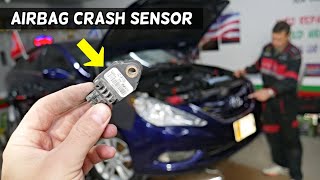
Shop the Parts Behind B1329
Below are the parts most often responsible for code B1329, ranked by how frequently each one is the actual culprit (per the diagnosis above). Tap any to see what we have for your vehicle.



The information in this article is provided for general reference and educational purposes only. Vehicle specifications, procedures, and part compatibility can vary by production date, trim level, and region. Always consult your vehicle's factory service manual and verify part numbers before purchasing or performing repairs. Safety-critical components such as airbags, seat belts, and braking systems should be installed by a qualified professional.
- 🧭 Diagnostic Flowchart
- 🎬 Helpful Videos
- 🛍️ Shop This Part
- What Does B1329 Mean?
- Can I Drive With B1329?
- Common Causes
- Symptoms
- Common Fixes & Costs
- Used vs. New Parts: Buying Guide
- What Happens If You Wait — Timeline
- Cost of Not Fixing It
- Diagnosis Steps
- When This Code Triggers (Freeze-Frame Conditions)
- Related Codes
- Climate & Environmental Factors
- How to Talk to a Mechanic About This Code
- Where to Take It: Dealer vs Independent vs Chain
- When to Walk Away From the Repair
- What Scan Tool You Need for This Code
- How to Clear the Code After You Fix It
- Will This Fail Emissions / State Inspection?
- Most Commonly Affected Vehicles
- Manufacturer-Specific Notes
- Real Owner Stories
- 2013 Hyundai Sonata after front-end work
- 2011 Ford F-150 with intermittent airbag light
- 2014 Kia Forte with B1329 after replacing sensor
- How to Prevent This Code From Triggering
- Frequently Asked Questions
- Is it safe to drive with code B1329?
- Will clearing the code fix the airbag light?
- Can I replace the front impact sensor myself?
- I replaced the sensor, but the light is still on. What now?
- Is B1329 always an airbag code?
- What does 'active' vs 'history' mean on the scanner?
- Can I use a sensor from a junkyard?
- Key Takeaways
- 🎟️ Get 5% Off