

OBD-II Code B1405: A Manufacturer-Specific Fault Guide
What B1405 Means for Your Ford, GM, VW, and More — And How to Fix It
- Code B1405 lacks a universal definition; you must look up the specific meaning for your vehicle's exact make, model, and year before diagnosing.
- On Ford vehicles, B1405 indicates a disabled airbag system; on 2019-2021 Transits, a sagging driver's seat physically damages the wiring and requires TSB 24-2053 repair.
- For GM vehicles, B1405 flags a parking assist failure, typically caused by a melted rear wiring harness near the exhaust or a single shorted sensor.
- Never replace a $1,000 control module without first testing the circuit; dirty under-seat connectors or a blown 15A fuse cause over 50% of these faults.
What Does B1405 Mean?
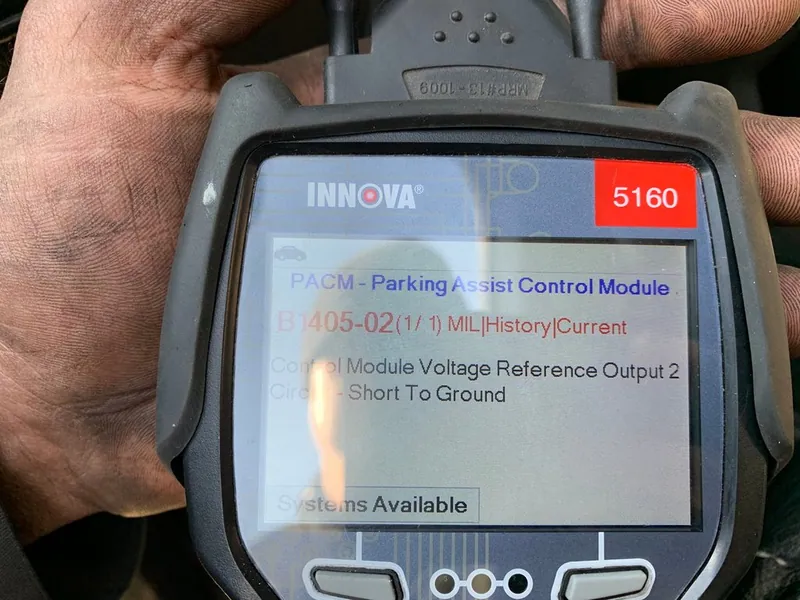
B1405 is a manufacturer-specific body code with no universal definition. Depending on your vehicle's make, it indicates a failure in the airbag system, parking assist, power windows, or fuel door lock. You must look up the exact definition for your specific year, make, and model before attempting any diagnosis.
Technical definition: SAE/ISO J2012 does not standardize B1405; the vehicle manufacturer assigns its meaning. Ford defines it as 'Driver Side Curtain Deployment Control 1 Circuit'. GM defines it as 'Parking Assist Control Module Voltage Reference Circuit'. Other manufacturers use it for power window switches, audio speakers, or fuel door lock motors.
Can I Drive With B1405?
Yes, But With Caution. Driving is unsafe if the airbag warning light is on. On Ford, Lincoln, and VW vehicles, B1405 disables the airbag system, meaning airbags will not deploy in a crash. If the code relates to a non-safety system like parking assist or a power window, driving is safe, but you must address the electrical fault promptly to prevent control module damage.
Common Causes

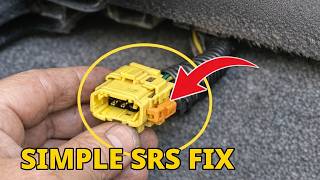
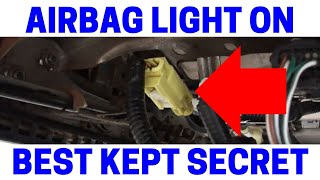
- Faulty Wiring or Poor Connections (Very Common) — This is the most frequent cause. Wires short, open, or corrode due to vibration, heat, or rodents. Connectors—especially yellow airbag connectors under seats—loosen or fill with moisture, causing high-resistance faults. 🎬 Watch: How to fix common under-seat airbag connector issues.
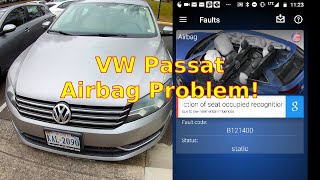
- Damaged Seat Internals (Suspension Mat / Occupant Sensor) (Very Common) — On 2019-2021 Ford Transits, the driver's seat cushion suspension mat breaks, causing the seat to sag and stretch the integrated airbag sensor wiring. Volkswagen models suffer a similar issue with faulty passenger occupant recognition sensor mats.
- Failed Sensor (Airbag, Park Assist, etc.) (Common) — The specific sensor tied to your vehicle's B1405 definition fails internally. An internal short circuit within a parking assist ultrasonic sensor or airbag impact sensor pulls down the voltage of the entire circuit.
- Low System Voltage / Weak Battery (Uncommon) — A weak battery causes system voltage to drop below 10 volts during startup. This voltage drop forces control modules to behave erratically and set false diagnostic codes.
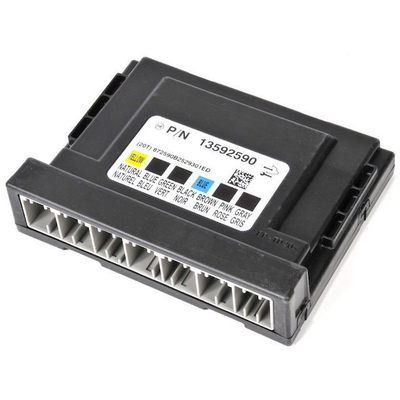
- Faulty Control Module (Less Common) — The Restraint Control Module, Park Assist Module, or Body Control Module fails internally. You must rule out all wiring and sensor issues before condemning a module.
- Faulty Clock Spring (Uncommon) — On vehicles where B1405 relates to a driver-side airbag, the clock spring inside the steering column fails. This breaks the electrical connection between the steering wheel airbag and the control module.
- Blown Fuse (Rare) — A blown fuse interrupts power to the specific circuit. One Chevy Suburban owner traced a B1405 side impact sensor code directly to a blown 15A airbag fuse.
Symptoms

- Airbag Warning Light On — This critical symptom on Ford, Lincoln, and VW vehicles indicates the entire airbag system is disabled.
- 'Service Park Assist' Message — On GM, Saab, and Opel vehicles, the driver information center displays a warning that the parking sensor system is offline.
- Affected System Inoperative — The specific system identified by the code fails to function (e.g., power window won't roll down, fuel door won't lock).
- Sagging Driver's Seat — Specific to the 2019-2021 Ford Transit, a noticeable collapse of the driver's seat cushion is the direct physical cause of the B1405 code.
- Check Engine Light On — The primary Malfunction Indicator Lamp illuminates alongside system-specific warnings.
Diagnostic Flowchart

Tap your situation to follow the diagnostic path that matches what you're seeing on this code.
Common Fixes & Costs
- Repairing Damaged Wiring or Connectors — Parts: $5-$25, Labor: $150-$400, ~1.5 hr book time (Intermediate)
- Replacing a Failed Parking Assist Sensor — Parts: $20-$80, Labor: $75-$200, ~1.2 hr book time (DIY)
- Repairing Driver's Seat Cushion/Sensor Mat (Ford Transit) — Parts: $400-$660, Labor: $250-$550, ~2.5 hr book time (Professional)
- Replacing a Failed Airbag Sensor or Clock Spring — Parts: $150-$600, Labor: $125-$300, ~2.0 hr book time (Professional)
- Replacing Fuel Fill Door Lock Actuator (Kia/Hyundai) — Parts: $40-$110, Labor: $50-$150, ~0.8 hr book time (DIY)
- Replacing a Control Module (RCM, PAM, BCM) — Parts: $400-$1200, Labor: $150-$250, ~1.5 hr book time (Professional)
Used vs. New Parts: Buying Guide
When a used part is worth it: For non-safety components like parking sensors or fuel door actuators, a used OEM part from a reputable salvage yard is a cost-effective choice. For airbag components, used parts are extremely risky and generally not recommended.
Donor-vehicle mileage cap: roughly under 100000 miles for the part to have meaningful remaining life.
Donor quality checklist:
- For airbag components, ONLY consider non-deployed parts from certified recyclers who guarantee they were never exposed to moisture or damage.
- For electronic sensors, match the part number exactly. Minor revisions are often incompatible.
- Visually inspect connectors on used wiring harnesses for any signs of corrosion, cuts, or heat damage.
Decision logic:
- If The part is a primary airbag, seatbelt pretensioner, or clock spring. → Buy new OEM only. The risk of malfunction from a used part is too high.
- If The part is an external sensor (e.g., park assist) and the new OEM part is very expensive. → A used OEM or new aftermarket part is an acceptable budget-friendly alternative.
- If The part is a control module (RCM, PAM). → Favor new, as a used module requires expensive dealer programming that negates any savings.
Warranty tradeoff: Used parts typically have a 30-90 day warranty. New aftermarket parts carry a 1-year to limited lifetime warranty. New OEM parts have a 1-2 year warranty.
Worst-case if a used part fails: $1500+ if a used airbag fails to deploy. For other parts, the cost is repeated labor ($200-$500) plus the cost of buying the correct new part.
What Happens If You Wait — Timeline
- Immediate: If related to an airbag (Ford), the warning light illuminates and the entire Supplemental Restraint System (SRS) is disabled. Airbags will not deploy in a crash. (MPG impact: 0%% · Added cost: $0 (Immediate and extreme safety risk is the primary cost))
- 1-12 Months: The safety risk remains. In states with safety inspections, the vehicle fails, preventing registration renewal. An electrical short puts continuous stress on the control module. (MPG impact: 0%% · Added cost: $50-$200 (Cost of failed inspection, fines, or re-inspection fees))
- 1-2 Years (Park Assist Scenario): For a non-safety fault like park assist, the initial issue is inconvenience. However, a persistent short circuit in a sensor or harness eventually damages the driver circuit within the control module. (MPG impact: 0%% · Added cost: $200-$500 (Risk of minor parking damage due to inoperative system))
- 2+ Years: A simple wiring or sensor fault that was ignored now requires replacing the control module itself, turning a $250 repair into a $1,000+ repair. (MPG impact: 0%% · Added cost: $800-$1500 (Cost of new control module + programming))
Cost of Not Fixing It
- Immediate: If the code relates to the airbag system (e.g., Ford), airbags are disabled. This represents an extreme and immediate safety risk, as they will not deploy in a collision. (Added cost: N/A (Risk of injury/death))
- 0-6 months: If the code relates to park assist (e.g., GM), you risk minor parking collisions. The underlying electrical fault (short/open) continuously stresses the control module. (Added cost: $0 - $500 (Cost of a minor bumper scuff or increased diagnostic time if the fault spreads))
- 6+ months / State Inspection: In states with safety inspections, an active airbag light causes the vehicle to fail, preventing legal registration renewal. A persistent electrical short in a non-safety circuit eventually destroys the control module. (Added cost: $500 - $1500 (Cost of a failed inspection and/or module replacement))
Diagnosis Steps
- Identify Your Vehicle's Specific Definition
Use a search engine with your vehicle's make, model, year, and 'B1405' to find the exact definition. A Ford code (airbag) requires a completely different diagnostic path than a Kia code (fuel door).
Tools: Internet access (Beginner) - Perform a Thorough Visual Inspection
Based on the definition, visually inspect the system. For park assist, check bumper sensors and wiring for exhaust heat damage. For airbags, inspect yellow wiring under seats. For a 2019-2021 Ford Transit, physically check for a sagging driver's seat.
Tools: Flashlight (Beginner) - Check for Related Fuses
Locate your fuse box and test fuses for the affected system (e.g., 'SRS', 'PAM', 'BCM'). A blown fuse is a fast, cheap root cause.
Tools: Owner's manual, fuse puller or needle-nose pliers (Beginner) - Inspect Connectors and Perform a 'Wiggle Test'
Disconnect the battery and wait 10 minutes. Unplug the primary electrical connectors, inspect for bent pins or corrosion, clean with contact cleaner, and reconnect. Perform a 'wiggle test' while monitoring live data to expose intermittent faults.
Tools: Socket set (for battery), electrical contact cleaner, professional scan tool (Intermediate) - Test Circuit Voltage and Resistance with a Multimeter
Using a multimeter and wiring diagram, test the circuit for proper voltage, ground, and continuity. This differentiates a broken wire from a failed component when a professional scan tool is unavailable.
Tools: Digital multimeter, vehicle-specific wiring diagram (Advanced) - [Pro Tip] Check Circuit Resistance on Ford Airbag Systems
For Ford vehicles, use a scan tool to read the live resistance PID for the specific airbag deployment loop (e.g., DEPLOY_11_R). A healthy circuit reads 1.44–3.52 ohms. Readings over 4.0 ohms indicate an open circuit or broken wire.
Tools: Professional scan tool (Ford IDS or equivalent) (Advanced) - [Pro Tip] Check Reference Voltage on GM/Saab Park Assist Systems
For GM/Saab park assist systems, observe the 'Park Assist Sensor Reference Voltage' on a scan tool. It must read 6.3–10.4V. If voltage is low, unplug sensors one by one; when voltage normalizes, the last unplugged sensor is shorted.
Tools: Professional scan tool, basic hand tools (Advanced) - Test or Swap the Component
If wiring and voltages test perfectly, the component itself failed. Swap the suspect sensor with an identical working one (like an adjacent parking sensor) to see if the fault follows the part. Never test airbag resistance directly with a multimeter.
Tools: Scan tool, basic hand tools (Advanced)
When This Code Triggers (Freeze-Frame Conditions)
- System Voltage: 11.5-14.5V (The voltage of the vehicle's electrical system when the fault was recorded. A low value indicates a battery or alternator issue is contributing to the fault.)
- Ignition Cycles: 0-255 (A counter of how many times the vehicle has been started since the code was first set. A low number indicates a recent or hard fault.)
- Fault Status: Active / Stored / Intermittent (Indicates if the fault is currently present ('Active') or if it occurred in the past but is not currently detected ('Stored' or 'Intermittent').)
- Odometer: Vehicle Mileage (The vehicle's mileage at the time the fault code was logged by the control module, helping to establish a timeline of when the issue began.)
Related Codes
- B1405-02, B1405-03, B1405-07 — These suffixes provide critical details. On a GM/Saab vehicle, '-02' means 'Short to Ground', '-03' means 'Low Voltage' (below 6.3V), and '-07' means 'High Voltage' (above 10.4V).
- B1405:1A, B1405:13 (Ford) — On a Ford, a suffix like ':1A' means 'Resistance Below Threshold' and ':13' means 'Open Circuit'. These are read with a professional scan tool and point directly to the type of wiring failure.
- B0001, B0010, B1408 (Ford Transit) — If B1405 appears on a Ford Transit alongside B0001 or B1408, the combination confirms the fault is located within the driver's seat assembly, pointing to the known seat-sag issue.
- U-series codes (e.g., U0140, U0155, U0154) — If a U-code like U0154 (Lost Communication With Restraint Occupant Classification System) is present alongside B1405, it suggests the control module itself is offline or failing.
Climate & Environmental Factors
- High Humidity / Water Exposure: Moisture is a primary cause of wiring and connector failure. It corrodes terminals and pins, increasing electrical resistance and causing intermittent circuit failure in external components like parking sensors.
- Extreme Cold: Cold temperatures make wire insulation and plastic connectors brittle and susceptible to cracking under vibration. Ice buildup physically obstructs parking sensors, causing false obstacle reports.
- Extreme Heat: Prolonged exposure to high heat melts wire insulation on harnesses routed too close to exhaust components. This causes short circuits, a known issue for the rear parking sensor harness on GM trucks.
How to Talk to a Mechanic About This Code
Say this: "I have a [Your Year, Make, Model] with a B1405 code and the airbag light is on. My research indicates this is a manufacturer-specific code for the driver's side airbag circuit. I need a diagnostic to confirm the fault, specifically checking wiring and connectors before condemning any modules."
This signals you've done your research, directs the technician to the correct system, and establishes that you expect a thorough diagnosis rather than just replacing the most expensive part. It protects you from a shop guessing on your dime.
Avoid saying:
- 'My airbag light is on, can you just reset it?'
- 'Just fix whatever is wrong.'
- 'I read online it's probably the clock spring, can you just replace that?'
Questions to ask before authorizing the repair:
- What specific tests did you perform to confirm this part has failed?
- Have you ruled out a wiring, connector, or fuse issue first?
- If it's a Ford Transit, did you check for a sagging seat and TSB 24-2053?
- If you are recommending a module replacement, can you show me why the old one is condemned?
- Is programming required for the new part, and is that included in the quote?
- What is the warranty on this specific repair, including both parts and labor?
Where to Take It: Dealer vs Independent vs Chain
- Dealer:
Best for: Airbag (SRS) system repairs due to safety liability and specialized tools., Vehicles under warranty., Diagnosing known manufacturer-specific issues covered by TSBs (like the Ford Transit seat).
Downsides: Highest labor rates, often 1.5-2x an independent shop., Defaults to replacing entire assemblies instead of repairing a simple wire. (Typical cost: +50% vs. baseline) - Independent Shop:
A top-rated independent shop with strong electrical diagnostic skills is a great choice for non-airbag faults. For any airbag-related repair, the dealer is the safest, albeit more expensive, option.
Best for: Out-of-warranty vehicles., Non-airbag related versions of B1405 (e.g., park assist, fuel door)., Pinpointing complex wiring or electrical faults.
Downsides: Quality and expertise vary widely; vet shops based on reviews and ASE certifications., Lacks the very latest manufacturer-specific software for module programming. (Typical cost: +0% vs. baseline) - Chain Shop:
AVOID. This code requires specialized diagnostic procedures that are beyond the scope of a chain repair shop.
Best for: Simple jobs like tires, batteries, and oil changes.
Downsides: Technician skill varies dramatically., Lacks the advanced diagnostic tools and training for complex body codes like B1405., High pressure to upsell. (Typical cost: -10% vs. baseline)
When to Walk Away From the Repair
If the estimated repair cost exceeds 50% of the car's private-party value (from a source like Kelley Blue Book), you should strongly consider selling or trading in the vehicle instead of repairing it.
- Car worth $3000, fix is $1800: Walk away. The repair cost is 60% of the car's value. It's not a sound investment.
- Car worth $15000, fix is $750: Fix it. The repair is only 5% of the vehicle's value and addresses a critical safety issue.
- Car worth $5000, fix is $2200: Borderline. At 44% of the car's value, get a second opinion before proceeding. If the car is otherwise in excellent condition, it might be worth it.
What Scan Tool You Need for This Code
Minimum: A scanner that can read manufacturer-specific Body (B) codes and SRS/Airbag system faults. Basic engine-only code readers will not work.
A cheap, generic OBD-II scanner only reads 'P' (Powertrain) codes and shows 'No Codes Found' for a B1405 fault. You need a tool that communicates with the Restraint Control Module (RCM), Body Control Module (BCM), or Parking Assist Module (PAM).
Budget: BlueDriver Pro or Autel AP200 (~$100) — These Bluetooth dongles connect to your smartphone and read SRS/Airbag codes, view freeze-frame data, and display live data, which is essential for diagnosing this code.
Mid-range: Foxwell NT510 Elite or Innova 5610 (~$180) — Provides deeper manufacturer-specific functions, including reading live data PIDs like airbag circuit resistance (Ford) or reference voltage (GM). Some offer bidirectional controls to test components.
Professional: Autel MaxiCOM MK808 (~$500) — Offers full-system, OEM-level diagnostics, all bidirectional controls, and service functions like module programming and calibration needed after a repair.
Rent vs buy: AutoZone's loaner tool program offers scanners capable of reading SRS codes, but you must specifically ask for one. Basic loaner tools cannot. If the right tool isn't available to borrow, buying a budget pick is a smart investment for future DIY diagnostics.
How to Clear the Code After You Fix It
- Ensure the vehicle's ignition is OFF.
- Perform the physical repair (e.g., replace sensor, repair wiring).
- If the repair involved the airbag system, disconnect the battery and wait 15 minutes before starting.
- Reconnect battery if it was disconnected.
- Turn ignition to the 'ON' position (engine off).
- Use an OBD-II scan tool to connect to the appropriate module (BCM, RCM, PAM).
- Select the 'Clear/Erase Codes' function.
- Cycle the ignition off, then start the vehicle to confirm the warning light is off.
Drive cycle (~15 minutes): For non-emissions codes like B1405, a complex drive cycle is not required. The system performs a self-test at every key-on. After clearing the code, a 15-minute test drive with varied conditions is sufficient to confirm if an intermittent fault will re-trigger the code. For airbag systems, the warning light extinguishes immediately after clearing if the fault is truly fixed.
Readiness monitors affected: None
Watch out for:
- Clearing the code without fixing the underlying issue results in the code and warning light returning almost immediately.
- Using a basic OBD-II scanner that only reads powertrain codes; a more advanced scanner capable of communicating with Body (B) or Chassis (C) modules is required.
- Forgetting to disconnect the battery when working on the airbag system, which is a major safety risk.
Will This Fail Emissions / State Inspection?
No — by itself this code doesn't fail OBD inspection (but it can keep readiness monitors from setting, which causes a separate fail).
- California: Will NOT fail a smog check. The airbag system is not part of the emissions inspection. However, a salvage vehicle requires a separate brake and lamp inspection where safety systems are checked.
- New York: Will NOT fail the inspection. An illuminated airbag light is noted as an advisory on the inspection report, but it is not a reason for rejection.
- Texas: Should NOT fail the inspection. The airbag system is not an item on the official safety inspection checklist.
- Pennsylvania / Virginia: WILL FAIL. In states with comprehensive annual safety inspections, an illuminated airbag warning light is considered a critical safety defect and results in an automatic failure.
Most Commonly Affected Vehicles
- Ford Transit (2019-2021) — Extremely common issue where a sagging driver's seat cushion damages internal airbag wiring, triggering B1405. Covered by TSB 24-2053 for vehicles built on or before Feb 11, 2021.
- Ford F-150, Explorer, Mustang (2009-2024) — Prone to airbag system faults related to curtain or side impact sensor circuits. For the 2009-2014 F-150, issues with seatbelt pretensioner connectors under the seats are a common cause.
- Chevrolet / GMC Tahoe, Suburban, Silverado, Sierra (2007-2015) — Commonly experiences B1405 related to the parking assist system. The rear wiring harness is vulnerable to heat from the exhaust, and individual sensors fail frequently.
- Saab / Opel 9-5, Astra (2010-2019) — This code specifically points to a 'Control Module Voltage Reference Output 2 Circuit' fault in the Parking Assist Module. Diagnosis involves checking for 6.3-10.4V at the sensor connectors.
- Volkswagen Jetta, Golf, Passat (2011-2018) — Indicates a fault with the 'Seat Occupied Recognition Sensor Mat', an issue internal to the passenger seat cushion related to the airbag system. Requires seat disassembly to repair.
- Kia / Hyundai Sorento, Sportage (2010-2016) — On these models, this code indicates a fault in the 'Fuel Fill Door Lock Control Circuit', meaning the electronic gas cap door lock is malfunctioning.
- Alfa Romeo / Fiat Giulia, 500 (2010-2024) — Defines B1405 as 'Front left electric window lowering switch short to positive' or an audio speaker circuit fault, highlighting the need to verify the code's meaning.
- Nissan Altima, Rogue (2013-2019) — Often linked to SRS/airbag circuit faults, with owners reporting success checking and cleaning under-seat connectors.
Manufacturer-Specific Notes
- Ford, Lincoln, Mercury: The code almost always means 'Driver Side Curtain Deployment Control 1 Circuit'. On 2019-2021 Transit models, this is specifically caused by a sagging driver's seat cushion as outlined in TSB 24-2053.
- General Motors (Chevrolet, GMC, Cadillac, Opel): Most commonly relates to the 'SERVICE PARK ASSIST' system. The fault is often in the rear bumper wiring harness, which is exposed to the elements, or a single failed sensor that shorts the voltage reference circuit.
- Volkswagen: Relates to the airbag system's 'Seat Occupied Recognition Sensor Mat' in the passenger seat, which fails and requires seat disassembly to replace. VW has issued warranty extensions for this issue on certain models.
- Kia: Defined as 'Fuel Fill Door Lock Control Circuit', indicating a problem with the electronic locking mechanism for the gas cap door.
- Saab: Specifically defined as 'Control Module Voltage Reference Output 2 Circuit' within the Parking Assist Control Module. The specified diagnostic voltage range is 6.3-10.4V.
- Alfa Romeo / Fiat: Has multiple unrelated meanings, including 'Front left electric window lowering switch short to positive' or a fault in an audio speaker output circuit.
Real Owner Stories
2020 Ford Transit with Airbag Light
Owner noticed the airbag warning light came on around 45,000 miles. Shortly after, they felt the driver's seat sag noticeably on one side.
Outcome: The dealer performed the TSB repair, installing a new seat suspension mat and reinforcement straps (Part No. LK4Z-61632A22-C). The repair was covered under warranty, and the airbag light did not return.
Lesson: On a 2019-2021 Transit, a sagging driver's seat accompanied by an airbag light is a textbook case for TSB 24-2053. Mentioning the TSB to your service advisor speeds up the diagnosis significantly.
2013 Chevy Tahoe 'Service Park Assist' Message
The 'Service Park Assist' message appeared on the dash. The owner bought aftermarket sensors online to save money.
Outcome: The shop diagnosed that the aftermarket sensors were incompatible with the GM system. After replacing them with used OEM GM sensors from a salvage yard, the system immediately started working.
Lesson: For GM park assist systems, only OEM sensors work correctly. Using cheaper aftermarket sensors leads to frustrating misdiagnoses and wasted money.
2014 Nissan Altima with Intermittent Airbag Light
The airbag light came on randomly. A dealership quoted over $2,000, claiming the Restraints Control Module (RCM) needed replacement.
Outcome: The owner sprayed the connectors with electronic contact cleaner and reconnected them securely. The airbag light disappeared permanently, turning a $2,000 quote into a $15 DIY fix.
Lesson: Always check the simplest failure points first. For intermittent airbag faults, dirty under-seat connectors are a frequent cause and a cheap fix compared to replacing modules.
How to Prevent This Code From Triggering
- Apply Dielectric Grease to Connector Seals (During any related repair or inspection) — Dielectric grease is non-conductive and waterproof. Applying it to the rubber seals of external connectors prevents moisture intrusion, stopping the corrosion that leads to circuit faults.
- Protect Wiring Near Heat Sources (Once, as a proactive measure) — Harnesses routed near exhaust components melt over time, causing shorts. Wrapping these sections with high-temperature reflective sleeving provides a thermal barrier, preventing insulation breakdown.
- Perform Periodic Connector Cleaning (Every 3-5 years or if electrical issues arise) — Connectors in vulnerable areas accumulate dust and corrosion. Disconnecting the battery and cleaning these connections with electronic contact cleaner prevents the high-resistance faults that trigger airbag codes.
- Maintain a Healthy Battery and Charging System (Test annually on vehicles over 5 years old) — A weak battery causes system voltage to drop during startup, leading control modules to set false diagnostic codes. Ensuring stable voltage prevents these 'ghost' faults.
Frequently Asked Questions
Is it safe to drive with a B1405 code?
It depends on your car. If the code is for the airbag system (common in Fords), driving is unsafe because airbags will not deploy in a crash. If it indicates a parking assist or window fault, driving is safe, but you must fix the electrical issue promptly to prevent module damage.
My shop quoted thousands for an airbag repair. Could it be something simpler?
Yes. Misdiagnosis is common, and shops often prematurely condemn expensive modules. Always check simple failure points first; one owner saved $3,000 by cleaning a dirty under-seat connector with a $15 can of contact cleaner.
What are the most common mistakes when diagnosing B1405?
The biggest mistake is guessing the definition based on another manufacturer, leading you to diagnose the wrong system entirely. The second mistake is replacing an expensive control module or airbag without testing the wiring, connectors, and fuses first.
Why can't I find one simple definition for B1405?
Unlike 'P' (Powertrain) codes, which are highly standardized, 'B' (Body) codes are left to the manufacturer's discretion. B1405 is a prime example of a code with multiple, unrelated meanings across different brands.
Can I fix a B1405 code myself?
Intermediate DIYers can easily fix wiring issues, blown fuses, or bad parking sensors. However, if the code relates to the airbag system, a professional must perform the repair to avoid accidental deployment or improper installation.
How much will it cost to fix a B1405 code?
Costs range from $15 for DIY connector cleaning to over $1,300 for a dealer-programmed control module. A typical parking sensor replacement costs $95–$270. Ford Transit seat repairs average $650–$1,200 for parts and labor.
What is the Ford TSB for code B1405?
For 2019-2021 Ford Transit models, TSB 24-2053 addresses code B1405 caused by a sagging driver's seat cushion that damages internal airbag wiring. The official fix requires installing a seat repair kit (Part No. LK4Z-61632A22-C) with a new suspension mat and reinforcing straps.
Can a bad battery cause a B1405 code?
Yes. A weak battery causes system voltage to drop during startup, making control modules behave erratically. If you experience other electrical gremlins alongside B1405, test your battery and alternator before replacing any sensors.
Key Takeaways
- Code B1405 lacks a universal definition; you must look up the specific meaning for your vehicle's exact make, model, and year before diagnosing.
- On Ford vehicles, B1405 indicates a disabled airbag system; on 2019-2021 Transits, a sagging driver's seat physically damages the wiring and requires TSB 24-2053 repair.
- For GM vehicles, B1405 flags a parking assist failure, typically caused by a melted rear wiring harness near the exhaust or a single shorted sensor.
- Never replace a $1,000 control module without first testing the circuit; dirty under-seat connectors or a blown 15A fuse cause over 50% of these faults.
Helpful Videos

Shop the Parts Behind B1405
Below are the parts most often responsible for code B1405, ranked by how frequently each one is the actual culprit (per the diagnosis above). Tap any to see what we have for your vehicle.





The information in this article is provided for general reference and educational purposes only. Vehicle specifications, procedures, and part compatibility can vary by production date, trim level, and region. Always consult your vehicle's factory service manual and verify part numbers before purchasing or performing repairs. Safety-critical components such as airbags, seat belts, and braking systems should be installed by a qualified professional.
- 🧭 Diagnostic Flowchart
- 🎬 Helpful Videos
- 🛍️ Shop This Part
- What Does B1405 Mean?
- Can I Drive With B1405?
- Common Causes
- Symptoms
- Common Fixes & Costs
- Used vs. New Parts: Buying Guide
- What Happens If You Wait — Timeline
- Cost of Not Fixing It
- Diagnosis Steps
- When This Code Triggers (Freeze-Frame Conditions)
- Related Codes
- Climate & Environmental Factors
- How to Talk to a Mechanic About This Code
- Where to Take It: Dealer vs Independent vs Chain
- When to Walk Away From the Repair
- What Scan Tool You Need for This Code
- How to Clear the Code After You Fix It
- Will This Fail Emissions / State Inspection?
- Most Commonly Affected Vehicles
- Manufacturer-Specific Notes
- Real Owner Stories
- 2020 Ford Transit with Airbag Light
- 2013 Chevy Tahoe 'Service Park Assist' Message
- 2014 Nissan Altima with Intermittent Airbag Light
- How to Prevent This Code From Triggering
- Frequently Asked Questions
- Is it safe to drive with a B1405 code?
- My shop quoted thousands for an airbag repair. Could it be something simpler?
- What are the most common mistakes when diagnosing B1405?
- Why can't I find one simple definition for B1405?
- Can I fix a B1405 code myself?
- How much will it cost to fix a B1405 code?
- What is the Ford TSB for code B1405?
- Can a bad battery cause a B1405 code?
- Key Takeaways
- 🎟️ Get 5% Off