

OBD-II Code B1443: Air Outlet Damper Control Servo Motor Circuit Malfunction
The Ultimate Guide to Diagnosing and Fixing Code B1443
- Code B1443 indicates a circuit failure in the air outlet servo motor, permanently disabling your ability to switch airflow between the face, floor, and defrost vents.
- A 30-to-45-second delay in climate control operation upon vehicle startup is the hallmark symptom of a dead B1443 servo motor.
- While the vehicle remains mechanically safe to drive, a stuck servo prevents windshield defrosting, creating a severe visibility hazard in cold or humid weather.
- Professional repair costs range from $1,200 to $2,500 because replacing the $150 servo motor requires 8 to 12 hours of labor to completely remove the dashboard.
- This is a highly documented pattern failure on 2013-2021 Lexus (IS, GS, RC) and Toyota (RAV4, Prius) models, often requiring updated OEM parts to prevent recurrence.
What Does B1443 Mean?
Code B1443 indicates your vehicle's climate control module (A/C Amplifier) detected a circuit fault in the air outlet damper servo motor. This small electric motor moves the internal HVAC doors that direct air to your face, feet, or windshield. When the module commands an airflow change but receives incorrect position feedback from the servo, it logs the B1443 code and enters a fail-safe mode.
Technical definition: The SAE/ISO definition for B1443 is "Air Outlet Damper Control Servomotor Circuit". 🎬 Watch: Diagnostic steps for B1443 on a Lexus GS350. The A/C Amplifier continuously monitors the servo's position sensor and runs a self-test upon startup. If the actual position fails to match the target position for a set period (typically 30 seconds), the fault is logged. A fixed position reading of 50% on a scan tool confirms an open circuit in the signal wire.
Can I Drive With B1443?
Yes. You can safely drive your vehicle with a B1443 code. It does not affect engine performance or drivetrain reliability. The only impact is on the climate control system's ability to direct airflow. However, if the airflow is stuck on a setting other than defrost, it prevents you from clearing a foggy windshield, creating a severe safety hazard in cold or humid weather.
Common Causes
- Failed Air Outlet Damper Servo Motor (Very Common) — The small electric motor, internal plastic gears, or position sensor within the servo assembly wear out and fail. This is the primary culprit in 90% of B1443 cases, especially on 2013-2021 Lexus and Toyota models. 🎬 See how to fix a servo stuck on feet-only airflow.
- Jammed Damper Door or Linkage (Less Common) — The plastic doors or linkage arms moved by the servo break or jam. Debris entering the HVAC case—often during an improper cabin air filter replacement—or material fatigue causes this mechanical bind.
- Low 12V Battery Voltage (Less Common) — A weak 12V battery interrupts the A/C amplifier's startup self-test, logging spurious history codes like B1443 even if the servo functions perfectly. Clearing the code after replacing the battery permanently resolves this specific trigger.
- Wiring Harness or Connector Fault (Rare) — A poor connection at the servo motor, a loose pin at the A/C amplifier, or a compromised ground connection causes intermittent communication loss. These faults are highly temperature-sensitive.
- Incorrect Repair or Reassembly (Rare) — If a technician recently disassembled the dashboard (e.g., for an evaporator core), they likely reinstalled a linkage incorrectly, left a connector unplugged, or pinched a wiring harness.
- Improper Servo Initialization (Rare) — After a battery disconnect, the HVAC system must relearn the damper endpoints. If this process fails, it sets a servo code. A manual re-initialization with a bi-directional scan tool resolves this.
- Faulty A/C Amplifier (Very Rare) — The HVAC control module itself fails, but this is exceptionally rare. Rule out the servo motor, wiring, and mechanical linkage entirely before replacing this expensive module.
Symptoms
- Airflow stuck in one position — The system refuses to change where the air blows. It remains locked on the defrost, floor, or face vents regardless of the selected mode.
- 30-to-45-second HVAC startup delay — Upon starting the vehicle, the climate controls remain completely unresponsive for up to 45 seconds. The A/C amplifier is running its self-test, waiting for the dead servo to respond, and timing out before entering fail-safe mode.
- Clicking or grinding noise from the dashboard — A repetitive clicking sound emerges from behind the dashboard when starting the car or changing climate settings. This is the sound of stripped internal plastic gears slipping inside the failing servo. 🎬 Watch: How to identify and fix dashboard clicking noises.
- Inaccurate 'Auto' Climate Control — The 'Auto' setting fails to adjust airflow correctly based on cabin temperature because it cannot confirm or change the position of the mode doors.
- Climate Control Service Message — While B1443 does not illuminate the Check Engine Light, it triggers a specific climate control service message on the navigation screen or instrument cluster.
Diagnostic Flowchart
Tap your situation to follow the diagnostic path that matches what you're seeing on this code.
Common Fixes & Costs
- Replace Air Outlet Damper Servo Motor — Parts: $120-$295, Labor: $1,200-$2,500, ~8.5 hr book time (Professional)
- Servo Motor Re-initialization — Parts: $0, Labor: $50-$150, ~0.5 hr book time (Beginner)
- Replace Damper Door Linkage Lever — Parts: $15-$30, Labor: $1,200-$2,500, ~8.5 hr book time (Professional)
- Repair Wiring or Replace Connector — Parts: $10-$50, Labor: $200-$500, ~2 hr book time (Intermediate)
- Replace A/C Amplifier — Parts: $300-$800, Labor: $150-$300, ~1.5 hr book time (Intermediate)
Used vs. New Parts: Buying Guide
When a used part is worth it: Never buy a used servo motor for this repair. Because the labor requires 8+ hours of dashboard removal, installing a used part with an unknown lifespan risks paying the $1,500 labor charge twice.
Donor-vehicle mileage cap: roughly under 20000 miles for the part to have meaningful remaining life.
Donor quality checklist:
- Verify the exact OEM part number matches perfectly.
- Favor OEM-supplier parts (Denso) over unbranded aftermarket parts.
- Reject parts with stripped gear splines or corrosion on the electrical pins.
Decision logic:
- If The repair is being done professionally → Buy a brand new OEM part. The risk of a used part failing and doubling your labor cost is unacceptable.
- If The vehicle is a 2013-2020 Lexus IS/GS → Buy a brand new OEM part. The original factory design is inherently flawed, making used parts a guaranteed future failure.
Warranty tradeoff: Used parts offer 30-day warranties. New OEM parts carry a 1-year warranty. The warranty matters less than the part's reliability, as no warranty covers the $1,500 labor cost to replace a failed replacement part.
Worst-case if a used part fails: $2,500 (Paying full labor costs a second time to replace a failed used part).
What Happens If You Wait — Timeline
- 0-1 month: Intermittent failure. Airflow gets stuck occasionally but corrects itself after restarting the car. A faint clicking occurs on startup. (MPG impact: 0%% · Added cost: $0)
- 1-3 months: The 30-to-45-second delay for climate control response on startup becomes a daily occurrence. The clicking noise grows louder. The B1443 code becomes 'current' and returns immediately after clearing. (MPG impact: 0%% · Added cost: $0)
- 3-6 months: Permanent failure. The servo motor completely dies. Airflow is permanently locked in one position. The clicking noise stops because the motor has burned out entirely. (MPG impact: 0%% · Added cost: $0)
- First cold or humid season: Severe safety hazard. If airflow is stuck off the defrost setting, the driver cannot clear a fogged windshield, severely impairing visibility and risking an accident. (MPG impact: 0%% · Added cost: $150 (Cost of a failed state safety inspection or traffic citation))
Cost of Not Fixing It
- Immediate: Loss of ability to direct airflow, locking the system on an undesirable setting like floor vents during summer. (Added cost: $0)
- First cold/humid season: Inability to clear fog or frost from the windshield dramatically reduces visibility and increases crash risk. (Added cost: $150 (Potential for traffic citation or failing a state safety inspection))
- Long-term (6+ months): The faulty servo will not cause a chain reaction of other parts to fail. The primary cost remains the safety hazard. (Added cost: $0)
Diagnosis Steps
- Verify Code and Attempt Initialization
Connect a bi-directional OBD-II scanner. Confirm B1443 is present. Before disassembling anything, run the 'Servomotor Initialization' utility. If the code was caused by a low-voltage calibration glitch, this permanently resolves it. If the code returns, proceed to step 2.
Tools: Advanced Bi-Directional Scan Tool (Intermediate) - Perform Scan Tool Active Test
Navigate to the Air Conditioner module. Use the 'Active Test' to command the 'Air Outlet Damper' servo. Monitor the live data PIDs for 'A/O DAMP POS' (Actual) and 'A/O DAMP TARG' (Target). If the 'POS' value stays fixed at 50.0% or fails to match the 'TARG' value, the servo is dead.
Tools: Advanced Bi-Directional Scan Tool (Intermediate) - Visually Inspect and Manually Test Linkage
Locate the air outlet servo motor (often requiring glovebox or lower dash removal). Watch the servo arm while commanding mode changes. If you hear grinding but see no movement, the motor is stripped. Disconnect the servo and manually move the linkage arm to ensure the internal HVAC door is not physically jammed by debris.
Tools: Flashlight, Trim removal tools (Advanced) - Bench Test the Servo Motor
Remove the servo. Apply 12V power and ground to the motor terminals specified in your repair manual (typically pins 4 and 5). The arm must move smoothly to one end. Reverse polarity to move it back. Jerky movement, grinding, or no movement confirms internal failure.
Tools: 12V Power source, Jumper wires, Basic hand tools (Advanced) - Test Wiring with a Multimeter
Check the resistance between the position sensor terminals on the disconnected servo (typically pins 2 and 3). Normal reading is 3.6 to 6.7 kΩ. Next, check the wiring harness continuity between the A/C amplifier and the servo connector; resistance must be below 1 Ω.
Tools: Multimeter, Vehicle-specific wiring diagram (Advanced) - Analyze Position Sensor with an Oscilloscope
Connect an oscilloscope to the servo's position signal wire and ground. A functional servo produces a clean pulse-width modulated square wave that changes duty cycle as it moves. A flat line or noisy signal confirms sensor failure.
Tools: Oscilloscope, Wiring diagram (Professional)
When This Code Triggers (Freeze-Frame Conditions)
- Vehicle Status: Ignition ON (The code sets during the HVAC system's 30-second startup self-test.)
- A/C Amplifier Command: Mode Change Requested (The fault logs when the driver or 'Auto' function requests a change in airflow direction.)
- Servo Position Feedback: Fixed at 50% (The A/C amplifier logs the code when it commands movement but sees a fixed 50% position sensor signal, indicating an open circuit.)
Related Codes
- B1441 — Air Mix Damper Servo. B1443 affects WHERE the air blows (face/feet), while B1441 affects the TEMPERATURE of the air (hot/cold). They often fail around the same mileage.
- B1442 — Air Inlet Damper Servo. B1443 affects airflow direction inside the cabin, whereas B1442 affects the air source (fresh vs. recirculated).
- B1446 — Air Mix Damper Control Servo (often driver's side). On RAV4 models, having B1441, B1442, B1443, and B1446 appear at once points to a single master servo assembly failure.
- B1455 — Foot/Defrost Damper Servo. Swapping the connector from a suspected bad B1443 servo to the B1455 servo is a definitive diagnostic trick to prove the motor is dead.
Climate & Environmental Factors
- Temperature and Humidity: Extreme cold or high humidity makes a B1443 failure highly dangerous. The inability to direct warm, dry air to the windshield prevents defogging, completely blinding the driver.
- Altitude: Altitude has no impact on the failure rate or symptoms of HVAC servo motors.
How to Talk to a Mechanic About This Code
Say this: "I have a B1443 code and my airflow direction is stuck. Please use a bi-directional scan tool to perform an active test on the Air Outlet Damper Servo to confirm it is the point of failure before quoting the dashboard removal."
This proves you know the specific part involved, the correct diagnostic procedure, and prevents the shop from blindly replacing the $1,200 A/C amplifier.
Avoid saying:
- 'My A/C is broken, can you fix it?'
- 'I have an A/C code, just replace the part.'
- 'Just do whatever it takes to fix it.'
Questions to ask before authorizing the repair:
- Did the active test confirm that the Air Outlet servo is the specific motor that failed?
- Did you manually check if the damper linkage is jammed by debris?
- Given the 8-hour labor cost, what is the warranty on both the new OEM part and your labor?
- How many times has your technician performed a full dashboard removal on this specific model?
Where to Take It: Dealer vs Independent vs Chain
- Dealer:
A strong, albeit expensive, choice. Dealer technicians perform this exact, difficult dashboard removal frequently due to the high failure rate.
Best for: Vehicles where a Customer Support Program (CSP) might still apply., Owners who prioritize a guaranteed fix with an OEM part and nationwide warranty.
Downsides: Highest labor rates, pushing the repair bill toward $2,500. (Typical cost: +40% vs. baseline) - Independent Shop:
Excellent choice if you find a trusted independent shop specializing in Japanese vehicles. Ask them specifically about their experience with Lexus/Toyota servo replacements.
Best for: Out-of-warranty vehicles where cost is a major factor., Shops that specialize exclusively in Toyota/Lexus vehicles.
Downsides: General mechanics lack the bi-directional scanners needed for proper diagnosis and may break interior trim during dashboard removal. (Typical cost: +0% vs. baseline) - Chain Shop:
AVOID. This repair is far too complex for a typical chain repair shop.
Best for: Routine maintenance like oil changes and tires.
Downsides: Technicians lack the skill and diagnostic equipment for complex, electronics-heavy interior disassembly., Extreme risk of misdiagnosis and broken dashboard trim. (Typical cost: -10% vs. baseline)
When to Walk Away From the Repair
If the estimated repair cost of $2,000 exceeds 40% of your car's current private-party market value, sell the car as-is rather than repairing it.
- Car worth $18000, fix is $2200: Fix it. The repair cost is 12% of the car's value and solves a major safety and usability issue.
- Car worth $6000, fix is $2200: Borderline. The repair is 37% of the car's value. Consider selling 'as-is' with a disclosed issue, as you will not recoup the repair cost on resale.
- Car worth $3500, fix is $2200: Walk away. The repair cost is 63% of the vehicle's value. Sell the car as a 'mechanic's special'.
What Scan Tool You Need for This Code
Minimum: A scanner that reads manufacturer-specific Body (B) codes AND performs bi-directional Active Tests for the Air Conditioner module.
A $50 code reader cannot see Body codes. Even if it reads B1443, you must use an Active Test to command the specific Air Outlet servo to prove it is dead before tearing apart the dashboard.
Budget: Not Recommended (~$None) — Scanners under $100 lack the essential bi-directional control needed for an accurate B1443 diagnosis.
Mid-range: Foxwell NT510 Elite (with Toyota/Lexus Software) (~$180) — Reads the B1443 code, views live data for servo position, performs the Active Test to command the servo, and runs the Servomotor Initialization utility.
Professional: Autel MaxiCOM MK808S (~$450) — Offers full bi-directional control for all vehicle systems, including HVAC active tests and initialization routines, with a faster tablet interface.
Rent vs buy: Auto parts store loaner tools are basic code readers and lack bi-directional capability. For a one-time fix, paying a shop for one hour of diagnostic time is more cost-effective than buying a mid-range scanner.
How to Clear the Code After You Fix It
- Use an OBD-II scan tool to clear the B1443 fault code from the A/C module.
- Perform a 'Servo Motor Initialization' procedure using a bi-directional scan tool to force the A/C amplifier to relearn the new motor's endpoints.
- Cycle the ignition off and on, then operate all climate control modes (Face, Foot, Defrost) to confirm proper operation.
Drive cycle (~5 minutes): A traditional engine drive cycle is unnecessary. Start the vehicle, turn the A/C on, and switch the airflow direction every 30 seconds between all available vent positions. Ensure no codes return.
Readiness monitors affected: None. B1443 is a Body (B) code and does not affect emissions readiness monitors.
Watch out for:
- Clearing the code without replacing the dead servo results in the code returning immediately upon the next startup self-test.
- Skipping the scan tool initialization procedure after replacement causes the new servo to operate incorrectly and immediately set a new code.
Will This Fail Emissions / State Inspection?
No — by itself this code doesn't fail OBD inspection (but it can keep readiness monitors from setting, which causes a separate fail).
- General: B1443 is a Body code. It does not illuminate the Check Engine Light and passes the OBD-II emissions scan in all 50 states.
- New York: NYS performs a safety inspection alongside emissions. Verifying the defroster is a mandatory safety check. If B1443 prevents air from hitting the windshield, the vehicle fails the safety inspection.
- Texas: While it passes emissions, law enforcement cites drivers for operating unsafe vehicles, which includes driving with an inoperable defroster in inclement weather.
Most Commonly Affected Vehicles
- Lexus IS, GS, RC (2013-2020) — Extremely high failure rate. Lexus TSB L-SB-0001-21 Rev1 addresses this. Repair requires full dashboard removal.
- Toyota Prius (2004-2009) — Access is notoriously difficult and requires removing the parking brake assembly to reach the servo.
- Toyota RAV4 (2013-2021) — Simultaneous appearance of B1441, B1442, B1443, and B1446 points directly to a failure of the master No. 1 air conditioning radiator damper servo sub-assembly.
- Toyota Corolla (2014-2019) — Frequently reported in conjunction with B1441 (Air Mix Damper), indicating a pattern of rapid, successive servo failures.
- Toyota Highlander (2014-2019) — Owners frequently report the hallmark 30-to-45-second delay in climate control startup followed by this code.
- Lexus NX300h (2015-2020) — Often appears with B1441. Access requires removing the glove box and significant lower dash components.
- Toyota Sequoia (2015-2021) — Appears for issues with the rear climate control unit, causing airflow to stop for backseat passengers.
Manufacturer-Specific Notes
- Lexus/Toyota: Lexus and Toyota issued multiple TSBs (L-SB-0001-21 Rev1, T-SB-0002-21) acknowledging these servos are a common design flaw. The official repair procedure mandates complete dashboard removal, driving labor costs over $1,500.
- Lexus: Lexus offered Customer Support Program (CSP) 20LE01 for failing servos, but primary coverage expired in January 2022. Owners must now pay out of pocket unless they secure goodwill assistance from a dealer.
- Toyota: On RAV4 models, Toyota service data explicitly states that if B1441, B1442, B1443, and B1446 are all present, the root cause is a single component: the No. 1 air conditioning radiator damper servo sub-assembly.
Real Owner Stories
2016 Lexus IS 300 with 30-second HVAC delay and B1443
The climate controls were unresponsive for 45 seconds after startup, followed by stuck airflow. A Techstream scan confirmed code B1443.
Outcome: The software initialization temporarily resolved the fault for two weeks. The permanent fix required replacing the Air Outlet Damper Servo Motor (Part No. 87106-30540).
Lesson: A 30+ second startup delay guarantees a failing servo. Software re-initialization un-sticks a failing motor temporarily, but the internal mechanical wear requires eventual replacement.
2014 Lexus IS250 with $4,000 in misdiagnosed repairs
The vehicle exhibited classic B1443 stuck airflow. An independent mechanic attempted the repair without proper bi-directional scan tools.
Outcome: After spending $4,000, the owner visited a Lexus dealership. The dealer used an Active Test to pinpoint the specific Air Outlet servo, replaced it, and permanently solved the issue.
Lesson: Never replace the A/C Amplifier before confirming the servo motor failure via a scan tool's Active Test. Guessing which of the 10+ servos failed wastes thousands of dollars.
2015 Lexus GS 350 with intermittent airflow failure
Airflow intermittently stuck on the defrost vents. A Carista scanner revealed a history code for B1443.
Outcome: The battery disconnect restored normal operation for a month before the code returned permanently.
Lesson: A battery disconnect is a free, temporary fix for an intermittent B1443. When the problem returns, it confirms irreversible hardware failure inside the servo.
How to Prevent This Code From Triggering
- Replace the cabin air filter every 12,000 miles (Annually) — A clogged filter restricts airflow, forcing the HVAC system to work harder. More importantly, it prevents debris from bypassing the filter, entering the HVAC case, and physically jamming the damper doors.
- Use the 'Auto' climate control setting exclusively (Daily) — The 'Auto' function makes gradual, efficient adjustments to airflow. This minimizes the harsh, full-range, rapid movements that strip the servo motor's internal plastic gears.
- Perform a 'Servo Motor Initialization' after any battery replacement (As needed) — Running the initialization procedure with a scan tool forces the system to relearn proper travel limits. This prevents the A/C amplifier from driving the servos past their physical endpoints, which causes severe mechanical stress.
Frequently Asked Questions
Can I just clear the code?
You can clear it, but the A/C computer performs a self-test every time you start the car, so the code returns immediately if the servo motor is dead.
Is this an expensive fix?
Yes. While the servo motor costs $150-$300, replacing it requires 8 to 12 hours of labor to completely remove the dashboard. Total repair bills range from $1,200 to $2,500.
Can I do this repair myself?
This is not a DIY-friendly repair. It requires extensive disassembly of the dashboard, instrument panel, and center console, carrying a high risk of breaking expensive interior trim pieces.
What is the most common misdiagnosis for B1443?
Mechanics frequently replace the expensive A/C amplifier module instead of the $150 servo motor. Another common error is replacing the wrong servo out of the 10+ located under the dash because they failed to use a scan tool's Active Test.
My airflow works sometimes but fails at other times. Could it still be the servo?
Yes. Intermittent failure is the classic first stage of a dying servo motor. The internal plastic gears stick and free themselves temporarily, but the motor will eventually fail permanently.
What does it mean if I get B1441, B1442 and B1443 all at once?
On specific vehicles like the Toyota RAV4, this exact combination indicates a known pattern failure of the master No. 1 air conditioning radiator damper servo sub-assembly, rather than three separate problems.
Why does my A/C take 45 seconds to turn on?
When you start the car, the A/C amplifier commands the servos to move and waits for a position report. When the B1443 servo fails to respond, the system waits for a 45-second timeout period before giving up and turning on the rest of the A/C.
Key Takeaways
- Code B1443 indicates a circuit failure in the air outlet servo motor, permanently disabling your ability to switch airflow between the face, floor, and defrost vents.
- A 30-to-45-second delay in climate control operation upon vehicle startup is the hallmark symptom of a dead B1443 servo motor.
- While the vehicle remains mechanically safe to drive, a stuck servo prevents windshield defrosting, creating a severe visibility hazard in cold or humid weather.
- Professional repair costs range from $1,200 to $2,500 because replacing the $150 servo motor requires 8 to 12 hours of labor to completely remove the dashboard.
- This is a highly documented pattern failure on 2013-2021 Lexus (IS, GS, RC) and Toyota (RAV4, Prius) models, often requiring updated OEM parts to prevent recurrence.
Helpful Videos
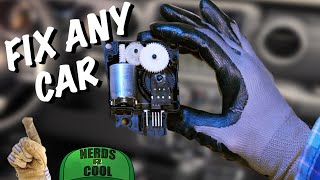
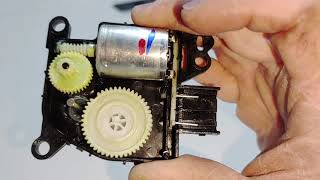
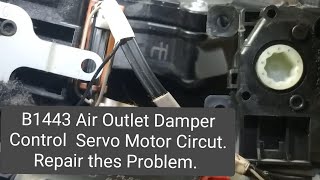
![[ENG] B1443 / 43 Damper Servo Actuator Motor Stuck Blow Air Feet Only Prius ZVW30 Lexus CT200H](https://img.youtube.com/vi/fIow-p9zR5Q/mqdefault.jpg)
Shop the Parts Behind B1443
Below are the parts most often responsible for code B1443, ranked by how frequently each one is the actual culprit (per the diagnosis above). Tap any to see what we have for your vehicle.



The information in this article is provided for general reference and educational purposes only. Vehicle specifications, procedures, and part compatibility can vary by production date, trim level, and region. Always consult your vehicle's factory service manual and verify part numbers before purchasing or performing repairs. Safety-critical components such as airbags, seat belts, and braking systems should be installed by a qualified professional.
- 🧭 Diagnostic Flowchart
- 🎬 Helpful Videos
- 🛍️ Shop This Part
- What Does B1443 Mean?
- Can I Drive With B1443?
- Common Causes
- Symptoms
- Common Fixes & Costs
- Used vs. New Parts: Buying Guide
- What Happens If You Wait — Timeline
- Cost of Not Fixing It
- Diagnosis Steps
- When This Code Triggers (Freeze-Frame Conditions)
- Related Codes
- Climate & Environmental Factors
- How to Talk to a Mechanic About This Code
- Where to Take It: Dealer vs Independent vs Chain
- When to Walk Away From the Repair
- What Scan Tool You Need for This Code
- How to Clear the Code After You Fix It
- Will This Fail Emissions / State Inspection?
- Most Commonly Affected Vehicles
- Manufacturer-Specific Notes
- Real Owner Stories
- 2016 Lexus IS 300 with 30-second HVAC delay and B1443
- 2014 Lexus IS250 with $4,000 in misdiagnosed repairs
- 2015 Lexus GS 350 with intermittent airflow failure
- How to Prevent This Code From Triggering
- Frequently Asked Questions
- Can I just clear the code?
- Is this an expensive fix?
- Can I do this repair myself?
- What is the most common misdiagnosis for B1443?
- My airflow works sometimes but fails at other times. Could it still be the servo?
- What does it mean if I get B1441, B1442 and B1443 all at once?
- Why does my A/C take 45 seconds to turn on?
- Key Takeaways
- 🎟️ Get 5% Off