

OBD-II Code B1445: A Comprehensive Guide to a Manufacturer-Specific Fault
What B1445 means, why it triggers, and the definitive guide to diagnosing and fixing it
- Code B1445 is manufacturer-specific; always search your exact year, make, and model first, as it means 'Rear Park Lamps' on a Ford but 'HVAC Servo' on a Toyota.
- If B1445 appears immediately after installing aftermarket LED bulbs, install a 6-Ohm, 50-Watt load resistor to mimic the original 2-amp filament bulb draw.
- On 2015-2020 Ford F-150s, fix this code by removing the tail light with an 8mm socket, draining trapped water, and applying dielectric grease to the connector.
- Never replace a Body Control Module (BCM) for B1445 without first cleaning the main chassis ground points with a wire brush to ensure resistance is under 1.0 Ohm.
What Does B1445 Mean?
Code B1445 is a manufacturer-specific Body ('B') code. It signifies the Body Control Module (BCM) detected an electrical fault in one of its circuits. The failing component depends entirely on your vehicle's make: on Ford trucks, it indicates a rear parking light fault, while on Toyotas, it points to a failing HVAC climate control servo.
Technical definition: The B1445 OBD-II code indicates the Body Control Module (BCM) detected an abnormal circuit condition—such as a short to ground, short to power, or an open circuit. Common definitions include 'Rear Park Lamps Output Circuit Short to Battery or Open' (Ford), 'Passenger Side Cool Air Bypass Damper Control Servo Motor Circuit' (Toyota/Lexus), and 'ECU Malfunction Watch Dog Failure' (General Motors).
Can I Drive With B1445?
Yes, But With Caution. Driving is possible but carries specific risks depending on the fault. If the code disables parking lights, you risk a traffic ticket exceeding $100 and reduced nighttime visibility. If it disables an airbag, that specific airbag will not deploy in a collision. Diagnose and repair the issue promptly to restore your vehicle's safety systems.
Common Causes
- Corroded or Damaged Wiring/Connectors (Very Common) — Wiring for exterior components is exposed to the elements. Moisture and road salt cause pin corrosion in connectors, creating high resistance or short circuits. This is the primary cause for lighting-related B1445 codes on Ford F-150s due to water intruding into tail light housings.
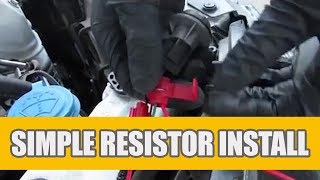
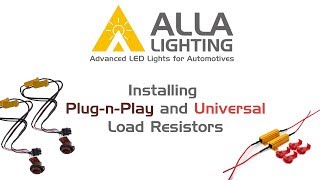
- Improper LED Bulb Installation (Very Common) — When replacing factory incandescent bulbs with aftermarket LEDs, the BCM misinterprets the LED's low electrical resistance as an open circuit. This triggers the B1445 code and causes rapid blinking (hyperflash). Installing a 6-Ohm load resistor in parallel fixes this. 🎬 See this walkthrough on installing LED load resistors
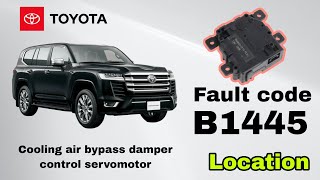
- Faulty Component (Bulb, Actuator, Switch) (Common) — The specific part the circuit controls failed internally. This is often a burnt-out incandescent bulb, a seized HVAC blend door actuator motor (common on Toyotas), or a defective 🎬 Watch: How to locate the Toyota HVAC servo motor door latch switch.
- Bad Ground Connection (Common) — The BCM and its components rely on clean ground connections to the vehicle's chassis. A single rusty or loose ground point introduces electrical resistance, causing unpredictable behavior and triggering multiple fault codes simultaneously.
- Blown Fuse (Less Common) — A blown fuse creates an open circuit and logs the code. Because a fuse is a safeguard, a blown fuse always indicates an underlying short circuit that must be located and repaired.
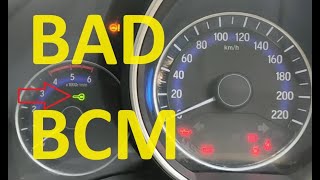
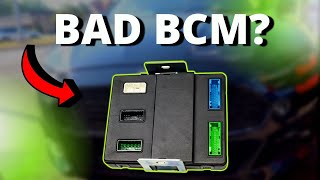
- Failed Body Control Module (BCM) (Less Common) — An internal short, failed driver circuit, or software corruption causes the BCM to set false codes or lose communication entirely. This is a frequent cause on 2014-2019 GM trucks and SUVs. 🎬 Watch: Common symptoms of a failing Body Control Module
Symptoms
- Exterior Lighting Failure — Specific lights (like parking lights) do not turn on, stay on continuously, or blink rapidly (hyperflash).
- HVAC System Malfunction — Air blows from the wrong vents, temperatures are incorrect, or a repetitive clicking noise comes from behind the dashboard as a servo motor attempts to move.
- Warning Light on Dash — A Check Engine Light, a dedicated BCM/Body fault light, or a system-specific warning like an airbag (SRS) light illuminates.
- Multiple Unrelated Electrical Failures — The radio, power windows, and wipers act erratically at the same time. This indicates a failing BCM or a bad main chassis ground.
- Parasitic Battery Drain — The BCM fails to enter its low-power sleep mode, continuously drawing current and killing the battery overnight.
Diagnostic Flowchart
Tap your situation to follow the diagnostic path that matches what you're seeing on this code.
Common Fixes & Costs
- Repairing Damaged Wiring or Connectors — Parts: $10-$50, Labor: $150-$300, ~1.5 hr book time (Intermediate)
- Install LED Load Resistors — Parts: $15-$30, Labor: $0-$100, ~0.5 hr book time (DIY)
- Replacing Tail Light Assembly (Ford F-150) — Parts: $150-$1,200, Labor: $75-$150, ~0.5 hr book time (DIY)
- Replacing HVAC Blend Door Actuator (Toyota) — Parts: $40-$150, Labor: $200-$800, ~4.5 hr book time (Intermediate)
- Replacing the Body Control Module (BCM) — Parts: $300-$800, Labor: $150-$400, ~2 hr book time (Professional)
Used vs. New Parts: Buying Guide
When a used part is worth it: For simple, non-electronic components like a basic halogen tail light assembly, a used part from a salvage yard saves money. Buying a used BCM is viable only if you use a cloning service.
Donor-vehicle mileage cap: roughly under 100000 miles for the part to have meaningful remaining life.
Donor quality checklist:
- For tail lights, check for cracks, haziness, and ensure it matches your exact trim level.
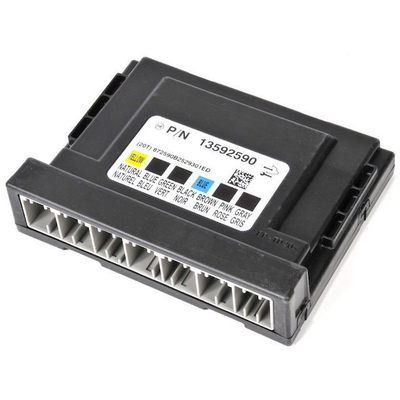
- For a BCM, you MUST match the part number exactly.
- Avoid parts from flood-damaged cars at all costs.
Decision logic:
- If The part is a simple tail light assembly without integrated radar/LEDs → Used is a highly cost-effective option.
- If The part is a complex tail light with BLIS radar → Buy new or remanufactured. Used units often have hidden water damage and require costly dealer calibration.
- If The part is a BCM → Buy new if budget allows. If buying used, factor in the $150-$300 cost of a mail-in cloning service to transfer your VIN data.
Warranty tradeoff: Salvage yard parts have a 30-90 day warranty. New aftermarket parts offer 1-year to lifetime warranties. New OEM parts carry a 12-month warranty.
Worst-case if a used part fails: $400-1500 if a used BCM fails after installation, requiring repeat labor, another cloning service, and a new part.
What Happens If You Wait — Timeline
- 0-1 month: A hard fault occurs. The B1445 code sets, a warning light appears, and a single component (e.g., one parking light, one HVAC actuator) stops working. (MPG impact: 0%% · Added cost: $0 (but carries risk of a $100+ traffic ticket))
- 1-6 months: If the fault is a water leak, corrosion spreads to other pins in the connector, triggering additional codes. If it is a parasitic drain, the battery deep-cycles repeatedly, causing permanent sulfation. (MPG impact: 0%% · Added cost: $200 - $400 (for a new battery and cleaning corroded terminals))
- 6-12 months: A persistent short circuit overheats and destroys the BCM's internal output driver. This turns a $50 external wiring problem into a mandatory module replacement. (MPG impact: 0%% · Added cost: $500 - $1,500 (Cost of a replacement BCM and programming))
- 12+ months: A completely failed BCM causes cascading network failures. It immobilizes the vehicle or causes other electronic modules to malfunction due to unstable voltage. (MPG impact: 0%% · Added cost: $1,500 - $3,000+ (for diagnosing and replacing multiple electronic modules))
Cost of Not Fixing It
- Immediate: Reduced visibility at night and risk of a traffic ticket if lighting is affected. Loss of climate control if HVAC is affected. Disabled airbags if SRS is affected. (Added cost: $100+ (for a traffic ticket))
- 1-3 months: A persistent short circuit overheats wiring and destroys the BCM's internal driver, turning a simple wiring fix into an expensive module replacement. (Added cost: $300 - $1200+ (for BCM and/or battery replacement))
- 6+ months: Ignoring a faulty BCM leads to cascading electrical problems, unpredictable vehicle behavior, and damage to other connected electronic modules. (Added cost: $500 - $2500+ (for multiple module replacements and complex wiring repairs))
Diagnosis Steps
- Identify the Manufacturer-Specific Definition
Use a search engine with your vehicle's make, model, year, and 'B1445' to find the precise meaning. A code for 'Rear Park Lamps' on a Ford requires a completely different diagnostic path than 'HVAC Servo' on a Toyota.
Tools: Internet access (Beginner) - Perform a Thorough Visual Inspection
Examine the component related to your code's definition. Check tail light housings for moisture or burnt bulbs. Look for pinched, melted, or corroded wiring leading to the component.
Tools: Flashlight (Beginner) - Check All Related Fuses
Consult your owner's manual to locate fuse boxes. Inspect every fuse related to the BCM and the faulty component. A blown fuse indicates an underlying short circuit that must be found.
Tools: Owner's manual, fuse puller (Beginner) - Test Power and Ground at the Connector
Unplug the component. With the circuit activated, use a multimeter to check for 12V+ at the power supply pin. Switch to Ohms and check the ground pin for a path to the chassis (must read under 1.0 Ohm).
Tools: Multimeter, wiring diagram (Intermediate) - Isolate and Test the Component
Swap a suspect light bulb with a known good bulb from the other side. For an HVAC actuator, listen for clicking when changing settings, which proves the motor receives a signal but is mechanically stuck.
Tools: Basic hand tools (Intermediate) - Perform a 'Wiggle Test' for Intermittent Faults
With the circuit activated, gently flex the wiring harness and wiggle the connectors. If the component flickers or the fault code appears/disappears, you isolated the physical break in the wire.
Tools: Hands (Intermediate) - Verify BCM Command
Connect a test light between the BCM output pin at the connector and the positive battery terminal. When activated, the test light illuminates if the BCM is successfully providing the ground command.
Tools: Test light or Multimeter (Advanced) - Inspect BCM Grounds
Locate the primary BCM ground points on the chassis. Unbolt them and clean the ring terminal and chassis to bare metal with a wire brush. Bad grounds cause 80% of false BCM failure symptoms.
Tools: Socket set, wire brush (Advanced) - Measure Parasitic Draw
If the battery dies overnight, connect a multimeter in series with the negative battery cable. A draw over 50mA confirms a parasitic drain. Pull fuses one by one until the draw drops to identify the circuit.
Tools: Multimeter with 10A fused circuit (Advanced) - Install LED Load Resistors
If B1445 appeared after an LED conversion, wire a 6-Ohm, 50-Watt resistor in parallel across the power and ground wires for each LED bulb to simulate the resistance of a standard filament bulb.
Tools: Wire strippers, crimpers, load resistors (Advanced)
When This Code Triggers (Freeze-Frame Conditions)
- System Voltage: 11.5V - 14.8V (The BCM continuously monitors circuit voltage. The code sets when voltage falls outside the expected range (short circuit) or when a command is sent but no change is detected (open circuit).)
- Component State: On or Off (The fault is detected the instant the BCM commands a component to change state, such as turning on the parking lights or adjusting the HVAC temperature.)
- Key Status: Key On, Engine Off (KOEO) or Key On, Engine Running (KOER) (The BCM performs circuit self-tests when the ignition turns on. A hard fault is detected immediately during this self-test before the component is used.)
- Time Delay: Immediate to several seconds (The BCM logs the fault code instantaneously as soon as its internal diagnostics confirm an invalid electrical reading on a specific circuit pin.)
Related Codes
- U0140 — Indicates 'Lost Communication With Body Control Module'. If seen with B1445, the problem is a fundamental issue like a bad BCM ground or a failed BCM, not the individual circuit. Diagnose U0140 first.
- B1247 — On Fords, this code for 'Left Rear Turn Indicator' appears with B1445. They share the same wiring harness and ground points. Seeing both strongly suggests water in the connector or a bad chassis ground.
- B1443 — On Toyotas, this code for 'Air Outlet Damper Control Servo' appears with B1445. Multiple HVAC servo codes suggest a systemic issue with the shared A/C Amplifier (control unit) rather than a single broken motor.
- B1325 — On GM vehicles, this code for 'Device Power Circuit Voltage Below Threshold' accompanies B1445. It indicates the BCM is experiencing low system voltage. Test the battery and alternator immediately.
Climate & Environmental Factors
- High Humidity & Rain: Moisture is the primary catalyst for corrosion on wiring and connectors. It penetrates worn seals and collects in tail light housings, leading to short circuits.
- Road Salt (Rust Belt): Saline moisture is highly corrosive and accelerates the degradation of underbody wiring harnesses and chassis ground connections. This is a major contributor to lighting codes on trucks.
- Extreme Cold: Cold temperatures make wire insulation brittle and susceptible to cracking. It also causes mechanical components, like HVAC actuators, to bind and stall the circuit.
How to Talk to a Mechanic About This Code
Say this: "I have a B1445 code on my [Year, Make, Model] and the symptom is [e.g., passenger tail light is out, A/C is clicking]. I'd like to schedule a diagnostic appointment. I understand this is a manufacturer-specific code requiring electrical testing. Please authorize only the diagnostic fee to start, and call me with a detailed estimate before proceeding."
This signals you've done research, states specific symptoms, and sets clear boundaries. It directs the technician towards proper electrical diagnosis rather than parts-swapping, and prevents surprise charges.
Avoid saying:
- 'My check engine light is on.' (Too vague, and B1445 rarely lights the CEL).
- 'Just fix whatever is wrong with it.' (An open invitation for unnecessary up-sells).
- 'My friend said it's probably the BCM, can you replace it?' (Describe symptoms and let them perform the tests).
Questions to ask before authorizing the repair:
- What was the specific cause of the failure? Was it the component, the wiring, or a bad ground?
- Can you show me the failed part or the corrosion on the connector?
- If the BCM needs replacement, does the estimate include the mandatory programming?
- What is the warranty on the parts and labor for this specific repair?
Where to Take It: Dealer vs Independent vs Chain
- Dealer:
Recommended for BCM replacement or if a TSB applies. Otherwise, a qualified independent shop is more cost-effective.
Best for: Vehicles under warranty., Complex BCM replacement and programming., Diagnosing manufacturer-specific TSB-related issues (e.g., Toyota HVAC servos).
Downsides: Highest labor rates, typically $150-$250+ per hour., Often recommends replacing an entire expensive assembly when only a connector is bad. (Typical cost: +50% vs. baseline) - Independent Shop:
Best overall fit for most B1445 scenarios, especially common wiring and component failures.
Best for: Out-of-warranty vehicles., Diagnosing common B1445 faults like wiring issues, bad grounds, or simple component swaps., Shops specializing in automotive electronics.
Downsides: Shop quality varies; ensure they are ASE certified for electrical work., May lack the latest OEM-specific programming tools for BCM replacement. (Typical cost: +0% vs. baseline) - Chain Shop:
AVOID for B1445 diagnosis. The risk of misdiagnosis or an incorrect repair is extremely high.
Best for: Simple, unrelated maintenance like oil changes or tires.
Downsides: Technicians lack experience with complex electrical diagnostics., High pressure to meet sales quotas leads to misdiagnosis., Unlikely to have the tools or expertise for BCM-level issues. (Typical cost: -10% vs. baseline)
When to Walk Away From the Repair
If the estimated repair cost for the B1445 fault exceeds 40-50% of your car's private-party value, seriously consider selling or trading it in.
- Car worth $3500, fix is $1600: Walk away. A $1,600 repair for a BCM replacement and programming is not a sound investment in a $3,500 car.
- Car worth $25000, fix is $1400: Fix it. A $1,400 repair for a complex F-150 BLIS tail light assembly is significant, but well below the threshold for a $25,000 truck.
- Car worth $8000, fix is $450: Fix it. A $450 repair for a corroded tail light harness is a straightforward and worthwhile repair.
What Scan Tool You Need for This Code
Minimum: A scanner that reads and clears manufacturer-specific Body ('B') codes from the Body Control Module (BCM). A basic code reader only pulls powertrain ('P') codes and will not see B1445.
A generic $20 scanner reports 'No Codes Found' even with a B1445 fault present because it cannot access the BCM. You need a tool specifically listing enhanced codes (B, C, U).
Budget: BlueDriver Pro (~$119) — Reads and clears enhanced B-codes for major brands. It views live data from the BCM, which is helpful for diagnosis, but lacks bidirectional control.
Mid-range: Foxwell NT510 Elite (~$180) — Provides OE-level diagnostics for a single chosen car brand. It reads BCM codes and performs bidirectional 'active tests' to command components directly from the scanner.
Professional: Autel MaxiCOM MK808 / MK900 Series (~$450-700) — Offers full-system diagnostics with extensive bidirectional control. It performs advanced functions like BCM setup and relearn procedures after a component is replaced.
Rent vs buy: Most auto parts stores do NOT rent scanners capable of reading B-codes. Buying a midrange tool with bidirectional capabilities is a wise investment for modern DIY repairs.
How to Clear the Code After You Fix It
- Fix the underlying electrical fault (e.g., replace bulb, repair wiring).
- Use an OBD-II scan tool capable of reading Body ('B') codes to clear the fault from the BCM.
- For GM vehicles, perform a 'hard reset' by disconnecting the battery and touching the cables together for 30 seconds to exit 'self-protection' mode.
- Operate the repaired component to confirm functionality.
Drive cycle (~5 minutes): A specific drive cycle is not required. After clearing the code, cycle the ignition and operate the affected component multiple times. If repaired properly, the code will not return.
Readiness monitors affected: None
Watch out for:
- Clearing the code without fixing the electrical issue results in the code returning immediately.
- Forgetting to perform a hard reset on GM vehicles leaves the circuit disabled even after the physical repair is complete.
- Using a basic $20 OBD-II scanner fails because it only reads Powertrain ('P') codes, not Body ('B') codes.
Will This Fail Emissions / State Inspection?
No — by itself this code doesn't fail OBD inspection (but it can keep readiness monitors from setting, which causes a separate fail).
- California: A B-code does not cause an automatic OBD-II emissions failure. However, if the code disables a tail light or brake light, the vehicle fails the safety/visual inspection.
- New York: NYS inspection includes checking all required lights. A B1445 code related to a non-functional parking light or turn signal results in a safety inspection failure.
- Texas: Law enforcement tickets for defective equipment like inoperative lights. In emissions counties, a B-code does not cause a failure, but an illuminated Check Engine Light will.
Most Commonly Affected Vehicles
- Ford F-150 (2015-2020) — Commonly logs B1445 for 'Rear Park Lamps Output'. The primary cause is water intrusion into the tail light assembly connectors.
- Toyota Land Cruiser / Sequoia (2008-2021) — Logs B1445 for 'Passenger Side Cool Air Bypass Damper Control Servo Motor'. Toyota issued TSB T-SB-0002-21 for updated repair procedures.
- Lexus GX460 / RC350 (2010-2023) — Shares the same HVAC servo motor fault as Toyota models. Diagnosis involves using Techstream to command the servo and check its pulse count.
- Ford Fusion (2013-2020) — Reported for both 'Rear Park Lamp' circuits and 'Door Handle Circuit Short to Ground', affecting lighting and keyless entry features.
- Chevrolet / GMC Silverado / Sierra (2014-2019) — B1445 indicates 'ECU Malfunction' or 'Device Voltage Output', pointing to an internal BCM failure. Mail-in cloning services are a popular fix.
- Hyundai Elantra / Sonata (2011-2017) — Points to intermittent faults in body electrical systems, such as wiring inside the flexible boot between the door and chassis breaking from repeated use.
- Kia Forte / Soul (2019-2022) — Electrical faults logged by the BCM relate to a wide range of components. A dealer-level scan tool is required for accurate diagnosis.
- Mitsubishi Lancer / Outlander (2008-2017) — Defined as 'Cruise or Brake Switch (A) Circuit Malfunction'. This disables cruise control and points diagnosis towards the brake pedal switch.
Manufacturer-Specific Notes
- Ford: The definition is 'Rear Park Lamps Output'. It is frequently caused by water intrusion into F-150 tail light connectors. The BCM logic is confusing; a code for a REAR lamp is sometimes triggered by a fault in a FRONT lamp.
- Toyota / Lexus: This code points to the 'Passenger Side Cool Air Bypass Damper Control Servo Motor'. Toyota issued multiple TSBs (like T-SB-0002-21) providing dealers with specific diagnostic and repair procedures.
- General Motors (Chevrolet, GMC): GM uses a generic definition like 'ECU Malfunction Watchdog Failure', indicating an internal BCM failure. After a repair, the BCM stays in a protective 'disabled' mode, requiring a battery disconnect to restore function.
- Mitsubishi: Defined as 'Cruise or Brake Switch (A) Circuit Malfunction'. This fault disables the cruise control system and affects brake light operation, pointing diagnosis directly at the brake pedal switch.
- Other (Airbag Systems): On some vehicles, B1445 is an SRS code for 'FR Curtain Airbag Active Circuit Open'. The airbag warning light illuminates, and the affected airbag is disabled. Diagnosis must follow strict safety procedures.
Real Owner Stories
2018 Ford F-150 with 75,000 miles
Owner noticed the 'Park Lamps Fault' message on the dash and found the passenger-side tail light was out. Code B1445 was stored.
What they tried:
- Replaced the bulb, but the fault remained.
- Inspected the tail light assembly and found standing water inside the housing.
- Removed the assembly, drained the water, and dried the connector with compressed air.
Outcome: After drying the connector and applying dielectric grease to the pins, the light functioned correctly and the code cleared. The owner drilled a 1/8" drain hole in the bottom of the housing to prevent recurrence.
Lesson: On F-150s, B1445 is almost always caused by water in the tail light assembly. Check for moisture, clean the connectors, and apply dielectric grease before replacing expensive parts.
2017 Toyota Land Cruiser with 110,000 miles
A/C system blew air at incorrect temperatures, accompanied by a faint clicking sound from the passenger side of the dashboard. A scan revealed code B1445.
What they tried:
- A mechanic quoted over $1,000 to replace the servo, citing extensive dashboard disassembly.
- The owner found Toyota TSB T-SB-0002-21 describing this exact issue.
- Another shop used the TSB procedure to replace the servo without full dashboard removal.
Outcome: The faulty servo motor (Part No. 87106-60100) was replaced. The new part resolved the clicking and temperature issue for under $500.
Lesson: For Toyota/Lexus HVAC codes, always search for relevant TSBs. They provide efficient repair procedures that save hundreds of dollars in labor.
2019 Kia Soul with LED tail light upgrade
Immediately after replacing stock incandescent parking light bulbs with aftermarket LEDs, the B1445 code appeared and turn signals hyperflashed.
What they tried:
- Tried 'CANbus-ready' LED bulbs, but the code persisted.
- Cleared the code, but it returned instantly when lights were turned on.
Outcome: The owner installed a 6-Ohm, 50-Watt load resistor in parallel with each new LED bulb's circuit. This simulated the electrical load of the original filament bulb. The code cleared and hyperflashing stopped.
Lesson: If B1445 appears right after installing LED lights, the lower resistance is the cause. Add a 6-Ohm load resistor to the circuit to fix it.
2015 GMC Sierra with 125,000 miles
Vehicle experienced bizarre electrical problems: radio turning off, windows failing, and a dead battery overnight. Codes B1445 and U0140 ('Lost Communication with BCM') were present.
What they tried:
- Replaced the battery, but problems returned within a week.
- Checked all fuses and visually inspected wiring.
- A shop diagnosed a failing Body Control Module (BCM).
Outcome: Dealer quoted $1,200 for a new BCM. The owner used a mail-in cloning service for $125, sending their original BCM and a matching used unit. They installed the cloned module themselves, resolving all issues.
Lesson: Multiple electrical faults combined with U0140 strongly point to a failed BCM. Mail-in cloning services are a cost-effective alternative to dealer programming.
How to Prevent This Code From Triggering
- Apply Dielectric Grease to Exterior Connectors (Anytime a bulb is changed or connector is disconnected.) — Dielectric grease is a waterproof sealant. Applying it to rubber seals and electrical connectors prevents moisture and road salt from corroding metal pins, stopping B1445 faults before they start.
- Install Load Resistors with LED Upgrades (During installation of any aftermarket LED bulb.) — LEDs draw significantly less current than incandescent bulbs. Wiring a 6-Ohm, 50W resistor in parallel prevents the BCM from falsely detecting an open circuit and triggering a code.
- Address Water Leaks Immediately (After heavy rain or car wash.) — If you see condensation in a light housing, remove it, drain it, and fix the seal. Proactively drilling a 1/8" drain hole at the bottom of the housing prevents water accumulation.
- Inspect and Clean Key Chassis Ground Points (Every 30,000 miles or if electrical issues appear.) — The BCM relies on clean chassis connections. Unbolting, cleaning the contact point to bare metal with a wire brush, and re-tightening ground straps ensures stable voltage.
Frequently Asked Questions
Why can't I find one single meaning for code B1445?
Unlike universal powertrain ('P') codes, body ('B') codes are not standardized. Each automaker uses B1445 for a different purpose. Identifying the definition for your specific vehicle is the mandatory first step of any diagnosis.
Is it safe to drive with a B1445 code?
It depends entirely on the symptom. If your parking lights are out, it is a safety hazard and risks a traffic ticket. If it is an airbag code, that specific airbag is disabled and will not deploy in a crash.
Why did multiple, unrelated warning lights appear with B1445?
This is a classic symptom of a failing Body Control Module (BCM) or a bad ground connection. The BCM communicates with many modules. When it malfunctions, it triggers a cascade of communication error codes and false warnings across the vehicle.
Can a bad battery cause a B1445 code?
Yes. A weak battery provides unstable voltage, causing sensitive electronic modules like the BCM to malfunction and store false codes. If your battery is over four years old, test it before starting expensive electrical diagnosis.
Can I just clear the code and see if it comes back?
You can, but B1445 indicates a hard electrical fault, not a random glitch. The code returns as soon as the BCM runs its circuit self-test. On some GM vehicles, a BCM hard reset is required to clear the code after a physical repair.
I installed LED tail lights and now have a B1445 code. What happened?
The BCM expects the 1.5-2.5 Ohm electrical resistance of a standard filament bulb. An LED has very low resistance, which the BCM misinterprets as a burnt-out bulb. Install a 6-Ohm, 50-Watt load resistor across the LED's wiring to simulate standard resistance and clear the code.
How much does it cost to diagnose this code?
Most repair shops charge a diagnostic fee ranging from $125 to $250. This covers the technician's time to find the specific definition, trace the circuit with a multimeter, and pinpoint the exact cause.
Can I reset the BCM without a scan tool?
Yes, perform a 'hard reset' by disconnecting both battery cables and touching the cable ends together for 30 seconds. This drains residual power from module capacitors and clears temporary memory. It does not erase the module's core programming.
Key Takeaways
- Code B1445 is manufacturer-specific; always search your exact year, make, and model first, as it means 'Rear Park Lamps' on a Ford but 'HVAC Servo' on a Toyota.
- If B1445 appears immediately after installing aftermarket LED bulbs, install a 6-Ohm, 50-Watt load resistor to mimic the original 2-amp filament bulb draw.
- On 2015-2020 Ford F-150s, fix this code by removing the tail light with an 8mm socket, draining trapped water, and applying dielectric grease to the connector.
- Never replace a Body Control Module (BCM) for B1445 without first cleaning the main chassis ground points with a wire brush to ensure resistance is under 1.0 Ohm.
Helpful Videos
Shop the Parts Behind B1445
Below are the parts most often responsible for code B1445, ranked by how frequently each one is the actual culprit (per the diagnosis above). Tap any to see what we have for your vehicle.


The information in this article is provided for general reference and educational purposes only. Vehicle specifications, procedures, and part compatibility can vary by production date, trim level, and region. Always consult your vehicle's factory service manual and verify part numbers before purchasing or performing repairs. Safety-critical components such as airbags, seat belts, and braking systems should be installed by a qualified professional.
- 🧭 Diagnostic Flowchart
- 🎬 Helpful Videos
- 🛍️ Shop This Part
- What Does B1445 Mean?
- Can I Drive With B1445?
- Common Causes
- Symptoms
- Common Fixes & Costs
- Used vs. New Parts: Buying Guide
- What Happens If You Wait — Timeline
- Cost of Not Fixing It
- Diagnosis Steps
- When This Code Triggers (Freeze-Frame Conditions)
- Related Codes
- Climate & Environmental Factors
- How to Talk to a Mechanic About This Code
- Where to Take It: Dealer vs Independent vs Chain
- When to Walk Away From the Repair
- What Scan Tool You Need for This Code
- How to Clear the Code After You Fix It
- Will This Fail Emissions / State Inspection?
- Most Commonly Affected Vehicles
- Manufacturer-Specific Notes
- Real Owner Stories
- 2018 Ford F-150 with 75,000 miles
- 2017 Toyota Land Cruiser with 110,000 miles
- 2019 Kia Soul with LED tail light upgrade
- 2015 GMC Sierra with 125,000 miles
- How to Prevent This Code From Triggering
- Frequently Asked Questions
- Why can't I find one single meaning for code B1445?
- Is it safe to drive with a B1445 code?
- Why did multiple, unrelated warning lights appear with B1445?
- Can a bad battery cause a B1445 code?
- Can I just clear the code and see if it comes back?
- I installed LED tail lights and now have a B1445 code. What happened?
- How much does it cost to diagnose this code?
- Can I reset the BCM without a scan tool?
- Key Takeaways
- 🎟️ Get 5% Off