

B1446 on 2016-2017 Lexus GS 200T: Driver's Side Air Mix Damper Causes and Fixes
On a 2016-2017 Lexus GS 200T, code B1446 almost always means the driver's side lower air mix servo motor has failed. This is a very common, well-documented issue across the entire 4th-gen GS platform and its relatives (IS, RC). The fix is to replace the servo motor (Part No. 87106-30570), which is a difficult DIY job due to its location deep in the dashboard, often leading to high labor costs at a shop.
- B1446 on a 2016-2017 GS 200T points directly to a failed driver's side temperature blend door servo motor.
- The primary symptom is incorrect air temperature (usually full hot) from the driver's side vents.
- This is a widely acknowledged defect by Lexus, covered by TSBs and a now-expired Customer Support Program (20LE01).
- The repair is labor-intensive due to the servo's location behind the dashboard and knee airbag, making professional repair costly.
- The OEM part number for the failed servo is 87106-30570.
What's Unique About the 2016-2017 Lexus GS 200T
The fourth-generation Lexus GS (2013-2020), including the GS 200T, uses a complex dual-zone climate system with numerous servo motors to provide precise temperature control. Unfortunately, these servo motors are a well-documented, common failure point across this platform and its relatives like the IS and RC models. The root cause is often an internal electrical malfunction within the servo motor itself. Lexus acknowledged the high failure rate by issuing multiple Technical Service Bulletins (TSBs) and a Customer Support Program (20LE01) to address the issue, confirming it's a widespread problem rather than an isolated incident.
Diagnostic Flowchart
Tap your situation to follow the diagnostic path that matches what you're seeing on this vehicle.
Symptoms You May Notice
- Uneven air temperature, with the driver's side blowing hot air when A/C is on, or cold air when heat is on.
- Inability to adjust the temperature for the driver's side vents.
- Clicking, buzzing, or knocking noises from behind the driver's side dashboard as the faulty servo attempts to move or gets stuck.
- Airflow may be stuck on one temperature setting (e.g., full hot or full cold).
- The issue may temporarily resolve after re-initializing the servos via Techstream or a button-press sequence, but it almost always returns.
- Replacing the wrong servo motor. The HVAC unit contains many servos; B1446 specifically points to the driver's side lower air mix servo, located on the front left lower side of the HVAC unit.
- Assuming the issue is low refrigerant. Low refrigerant can cause poor cooling but does not typically cause one side to blow full hot while the other is cold, nor does it trigger a specific servo motor circuit code.
- Thinking a software re-initialization is a permanent fix. While re-initializing the servos using Techstream or a button-press sequence can sometimes restore function temporarily, the problem almost always returns if the servo has an internal fault.
Most Likely Causes
- Failed Driver's Side Lower Air Mix Servo Motor 🔴 High Probability Lexus has acknowledged a high failure rate for these components due to an 'internal electrical malfunction'. Forum discussions and DIY repairs suggest this is often due to contamination or wear on the internal potentiometer's conductive traces, leading to incorrect position feedback. Lexus issued TSB L-SB-0001-21 Rev and Customer Support Program 20LE01 specifically for this widespread issue.
How to confirm: Using a diagnostic tool like Toyota's Techstream, command the servo motor to move while observing its live data. If the 'Air Mix Servo Actual Pulse (D)' value does not change or doesn't match the 'Air Mix Servo Targ Pulse (D)', the motor has failed. Another method is to physically access the motor and observe if it moves when the temperature is changed. A built-in diagnostic can also be run by holding the 'Auto' and 'Recirculate' buttons while starting the car; the climate display will then show any stored codes.
Typical fix: Replace the faulty servo motor. The official part name is 'Damper Servo Sub-Assembly, Air Conditioner Radiator, No. 5'. In some cases, owners have had success by disassembling the servo, cleaning the internal conductive disc and contacts with a non-residue cleaner, and re-lubricating it.
Est. part cost: $170-$250
Rare But Worth Checking
- Faulty A/C Amplifier (HVAC Control Module): → Shop HVAC Control This is very unlikely, especially if only a single servo code is present. If multiple, unrelated servos fail simultaneously, the A/C amplifier or its wiring could be a suspect. Diagnosis is by exclusion after confirming the servo and wiring are good.
- Wiring Harness or Connector Issue: A damaged wire or loose connection between the A/C amplifier and the servo motor can cause this code. A visual inspection of the harness for any signs of damage is recommended during diagnosis. The relevant pins on the A/C Amplifier for this servo are 14 (MCOOL), 15 (MHOT), 20 (SG-1), and 23 (TPD).
- Mechanical Obstruction: Less common than motor failure, but it's possible for the blend door or its linkage to become physically stuck, preventing the servo from moving. The service manual explicitly states to confirm no mechanical problem is present before replacing parts.
Diagnosis Steps
- Connect a professional scan tool (like Toyota Techstream) to the vehicle's OBD-II port.
- Read the fault codes from the Air Conditioning module. Confirm B1446 is present.
- Alternatively, use the built-in diagnostic mode: With the car off, press and hold the 'Auto' and 'Recirculate' buttons on the climate panel, then start the engine. The display will cycle through any stored HVAC codes (e.g., 46 for B1446).
- Listen for clicking or buzzing noises from the driver's side lower dashboard when changing the temperature settings from full cold to full hot.
- Use the scan tool's 'Active Test' function to command the driver's side air mix servo to move from full hot to full cold.
- Monitor the live data for the servo's target position ('Air Mix Servo Targ Pulse (D)') and actual position ('Air Mix Servo Actual Pulse (D)'). If the actual position does not change, or is stuck at a value like 128 or 255, the servo or its circuit is faulty.
- If a scan tool is not available, gain access to the servo motor under the driver's side dashboard. Visually inspect if the servo's arm moves when the temperature is adjusted.
- If the servo does not move, inspect the wiring connector for a secure connection and check for any visible damage to the harness.
- If the wiring appears intact, the servo motor is the most likely culprit and should be replaced.
Parts You'll Likely Need
- Damper Servo Sub-Assembly, Air Conditioner Radiator, No. 5
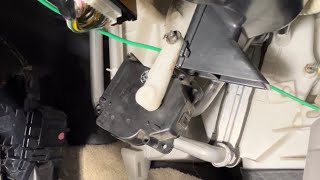
(OEM #87106-30570)— This is the specific servo motor for the driver's side lower air mix and is the most common point of failure for code B1446. It is located on the front left lower side of the HVAC unit.
Trusted brands: Lexus (Genuine OEM)
OEM price range: $170-$250
Aftermarket price range: $50-$120
Related Codes That Often Appear With This One
- B1441 — This code is for the passenger side air mix servo. It's common for multiple servos to fail around the same time due to being a common failure part. The TSBs from Lexus list a wide range of servo codes together.
- B1443 — This is for the Air Outlet Damper Control Servo. Like B1441, it is another HVAC servo motor that is prone to failure and is often listed in the same TSBs.
- B1453 — This code is for the Driver Side Air Outlet Damper COOL Control Servo. It is located near the B1446 servo and is also listed in the same TSB as a common failure.
Technical Service Bulletins (TSBs) & Recalls
- L-SB-0019-20: HVAC Servo Motor Malfunction
- L-SB-0001-21 Rev: HVAC Servo Motor Malfunction
- L-SB-0001-21: HVAC Servo Motor Malfunction
Platform-Specific Known Issues
- Lexus Customer Support Program 20LE01: Lexus initiated this program due to the high failure rate of A/C servo motors. It provided coverage for diagnosis and replacement of failed servos free of charge. Primary coverage ended on January 12, 2022. Secondary coverage was for 7 years or 125,000 miles from the date of first use. Most 2016-2017 vehicles are now outside this coverage period, but it serves as official acknowledgment of the defect.
- Technical Service Bulletin L-SB-0001-21 Rev: This TSB provides dealers with detailed diagnostic flowcharts and repair procedures for a long list of HVAC servo motor codes, including B1446. It covers reprogramming, a 'servo cleaning process', and full replacement.
- Difficult Repair Access: The repair for the B1446 servo (Driver's Side Lower Air Mix) is particularly labor-intensive because it requires the removal of the driver's side knee airbag assembly and other dash panels to gain access, increasing the complexity and cost of the job. This is a primary reason dealer quotes can exceed $2,000 for the repair.
Mechanic-Grade Diagnostic Values
- Servo Motor Bench Test — expected: Connect 12V positive lead to terminal 5 and negative to terminal 4; the servo lever should move smoothly to the 'MAX HOT' position. Reversing polarity (positive to 4, negative to 5) should move it smoothly to 'MAX COOL'.. Failure: The servo motor lever does not move or moves erratically when voltage is applied.
- Techstream Live Data Comparison — expected: The 'Air Mix Servo Actual Pulse (D)' value should closely follow the 'Air Mix Servo Targ Pulse (D)' value as the temperature setting is changed on the control panel.. Failure: The 'Actual Pulse' value is stuck (e.g., at 128 or 255) or does not change when the 'Targ Pulse' is commanded to change.
Hidden / Shadow Codes Worth Checking
- 46: This is the two-digit code corresponding to the full B1446 trouble code. (see via Use the climate control panel's built-in diagnostic mode, typically by holding the 'Auto' and 'Recirculate' buttons while starting the vehicle.)
Scan Tool Commands That Help
- Toyota Techstream: Servomotor Initialization — Found under 'Body Electrical / Air Conditioner / Utility'. This must be performed after replacing a servo motor or disconnecting the battery to recalibrate the motor's start and end points. It can also be used as a first diagnostic step, as it can sometimes temporarily resolve a stuck servo.
- Toyota Techstream: AC Damper Servo Operation Check Tool (Servo Cleaning Utility) — This special utility is referenced in TSB L-SB-0001-21. It cycles the servos for 8-14 minutes to clean the internal contacts and redistribute grease. If DTCs are still present after running this utility, the TSB directs replacement of the servo.
- Toyota Techstream: Active Test — Used to directly command the servo motor to move between its hot and cold positions while observing live data to confirm if it is physically responding to commands from the A/C Amplifier.
Wiring & Ground Locations
- A/C Amplifier Assembly (HVAC Control Module) — Located behind the glove box on the passenger side of the dashboard in Left-Hand Drive (LHD) vehicles. Requires removal of the glove box assembly for access.. This module controls the servo motor. All wiring from the servo terminates here. A poor connection at this module, due to a tight or stressed harness, can cause an intermittent B1446 code and mimic a failed servo motor.
Real Owner Repair Stories
- ClubLexus user 'sha4000' (2007 Lexus LS460 (similar servo system)) — A/C would reset to 75 degrees on startup, face vents wouldn't work correctly, and Techstream showed a B1497 AC communication bus failure.
❌ Tried (didn't work) Running the 'AC Servomotor Initialization' in Techstream would fix the problem temporarily, but it would return after a couple of weeks.
✅ What actually fixed it The user unplugged the wiring harnesses from the A/C amplifier, cleaned the connections, and re-seated them securely, ensuring there was more slack in the harness. The problem did not return, indicating the root cause was a poor connection at the control module, not a failed servo. - ClubLexus user 'peasodos' (2015 Lexus GS (same generation)) — Unspecified servo motor issue.
❌ Tried (didn't work) The owner assumed the servo motor needed replacement.
✅ What actually fixed it The dealership service department ran a check and determined only a firmware update for the A/C controller was needed. The service advisor noted that about 50% of these issues they see are fixed with the firmware update alone, without replacing hardware.
OEM Part Supersession History
87106-30530→87106-30570— Likely an internal revision to improve reliability and address the common failure mode of the servo motors.
Heads up: The parts are reportedly interchangeable, but 87106-30570 is the correct and revised part for the 2016-2017 GS 200T.
Helpful Videos
We Have This Part in Stock

The information in this article is provided for general reference and educational purposes only. Vehicle specifications, procedures, and part compatibility can vary by production date, trim level, and region. Always consult your vehicle's factory service manual and verify part numbers before purchasing or performing repairs. Safety-critical components such as airbags, seat belts, and braking systems should be installed by a qualified professional.
- Lexus GS 200T:
- 🧭 Diagnostic Flowchart
- 🎬 Helpful Videos
- 🛍️ Shop This Part
- What's Unique About the 2016-2017 Lexus GS 200T
- Symptoms You May Notice
- Most Likely Causes
- Rare But Worth Checking
- Diagnosis Steps
- Parts You'll Likely Need
- Related Codes That Often Appear With This One
- Technical Service Bulletins (TSBs) & Recalls
- Platform-Specific Known Issues
- Mechanic-Grade Diagnostic Values
- Hidden / Shadow Codes Worth Checking
- Scan Tool Commands That Help
- Wiring & Ground Locations
- Real Owner Repair Stories
- OEM Part Supersession History
- 🎟️ Get 5% Off