

OBD-II Code B1447: Varies by Manufacturer (Telematics, HVAC, SRS, or OCS Fault)
What B1447 means, why it triggers, and how to fix it on your vehicle
What Does B1447 Mean?
Code B1447's meaning depends entirely on your vehicle's manufacturer. For General Motors (GM), it signals a dead OnStar emergency backup battery. For Toyota and Lexus, it indicates a failed rear climate control servo motor. For Mitsubishi, it points to a faulty side impact airbag sensor. For Kia and Hyundai, it means the passenger seat Occupant Classification System (OCS) sensor has failed.
Technical definition: The official SAE/ISO definition for B1447 is manufacturer-specific. General Motors: 'Backup Power Source Open Circuit'. Toyota/Lexus: 'Rear Air Mix Damper Control Servo Motor Circuit'. Mitsubishi: 'Rear side impact sensor (RH) voltage error'. Kia/Hyundai: 'Occupant Classification (OC) ECU Defect'. Ford: 'Control Module: System Internal Failure' or 'Wiper Park Position Detect Circuit Open'.
Can I Drive With B1447?
Yes, But With Caution. Driving is permissible as this code does not affect the engine, braking, or steering. However, safety risks vary significantly by make. GM vehicles lose OnStar automatic crash response, Mitsubishi, Kia, and Hyundai vehicles disable the passenger airbag, and Toyota/Lexus vehicles only lose rear climate control comfort.
Common Causes
- Failed OnStar Backup Battery (GM) (Very Common) — This is the primary cause for GM vehicles like Chevrolet, Buick, and Cadillac. The small, non-rechargeable lithium battery for the telematics system has a finite lifespan of 3 to 7 years and fails with age.
- Failed Occupant Classification System (OCS) Sensor Mat (Kia/Hyundai) (Very Common) — For Kia and Hyundai models, this code points to a failed sensor mat inside the passenger seat cushion. This mat detects an occupant's weight to enable or disable the passenger airbag. This is a well-known defect covered by a 15-year warranty extension. 🎬 Watch this guide on fixing Hyundai and Kia airbag light issues.
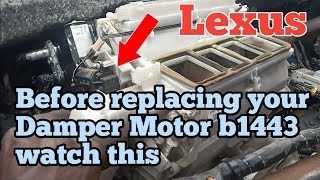
- Failed Rear Air Mix Damper Servo (Toyota/Lexus) (Very Common) — On Lexus and Toyota models, the small electric motor that blends hot and cold air for the rear vents fails. The internal plastic gears or electrical contacts wear out over time, prompting Lexus to issue a Customer Support Program for the issue.
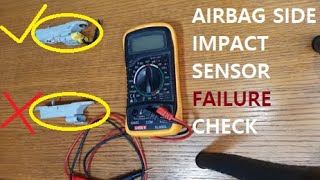
- Failed Rear Side Impact Sensor (Mitsubishi) (Common) — For Mitsubishi vehicles, this code indicates a failure in the right-hand rear side impact sensor. 🎬 Watch: How to test a side impact sensor yourself and save. The sensor fails internally, detecting a persistent low voltage condition and disabling the airbag system.
- Improper Service Procedure (GM) (Less Common) — On GM vehicles, disconnecting the main car battery or the OnStar fuse while the ignition is on or Retained Accessory Power (RAP) is active instantly and permanently drains the OnStar backup battery, triggering code B1447.
- Corrupted A/C Amplifier Software (Toyota/Lexus) (Less Common) — Corrupted software in the A/C Amplifier causes communication errors with the servo motors. Lexus issued TSBs recommending reprogramming the module 🎬 See how to repair a Lexus damper motor without replacing it. as a first step before replacing hardware.
- Damaged Wiring or Connectors (Less Common) — Wiring to the affected component (OnStar battery, HVAC servo, OCS mat, or SRS sensor) becomes frayed, corroded, or disconnected, causing an open or short circuit. This frequently happens under seats where wiring is easily disturbed.
- Faulty Control Module (Rare) — The main computer controlling the system—such as the Airbag ECU, A/C Amplifier, or Vehicle Communication Interface Module—fails and incorrectly reports a fault. This is only considered after ruling out the component and wiring.
Symptoms
- Red Light on OnStar Mirror & 'Service OnStar' Message (GM) — The status light on the rearview mirror or overhead console turns from green to red, and a 'Service OnStar' message displays on the Driver Information Center.
- Airbag Warning Light On (Mitsubishi, Kia, Hyundai) — The SRS or airbag warning light illuminates on the instrument cluster. On Kia/Hyundai, the 'PASSENGER AIR BAG OFF' light also behaves incorrectly.
- Clicking Noise & Incorrect Rear Climate Temperature (Toyota/Lexus) — A faint, repetitive clicking sound comes from the center console, and the rear passenger vents blow air stuck on full hot or full cold.
- OnStar System Inoperative (GM) — The OnStar service is completely unavailable and cannot place a call in an emergency if the main battery disconnects in a crash.
Common Fixes & Costs
- Replace OnStar Backup Battery (GM) — Parts: $30-$60, Labor: $60-$150, ~0.8 hr book time (DIY)
- Replace Passenger Seat Cushion / OCS Sensor (Kia/Hyundai) — Parts: $400-$800, Labor: $150-$300, ~1.2 hr book time (Intermediate)
- Replace Rear Air Mix Damper Servo (Toyota/Lexus) — Parts: $100-$250, Labor: $800-$1800, ~8.5 hr book time (Professional)
- Replace Rear Side Impact Sensor (Mitsubishi) — Parts: $90-$300, Labor: $140-$250, ~1.0 hr book time (Professional)
- Repair Damaged Wiring — Parts: $5-$50, Labor: $100-$400, ~1.5 hr book time (Intermediate)
Used vs. New Parts: Buying Guide
When a used part is worth it: For the Toyota/Lexus HVAC servo motor, a used part from a reputable auto recycler is a cost-effective option given the high labor cost of the repair. For all other components related to B1447, buying new is mandatory.
Donor-vehicle mileage cap: roughly under 75000 miles for the part to have meaningful remaining life.
Donor quality checklist:
- For HVAC servos, verify the part number matches exactly and inquire about the donor vehicle's mileage.
- For any SRS component (OCS mat, impact sensor), buying used is highly discouraged and often illegal. These are single-use safety devices with an unknown history.
- There is no market for used OnStar backup batteries, as they are a consumable item with a limited lifespan. Always buy new.
Decision logic:
- If The part is an airbag sensor, OCS mat, or OnStar battery → Always buy new OEM or OEM-equivalent parts. The safety risk or limited lifespan of used parts outweighs any cost savings.
- If The part is a Toyota/Lexus HVAC servo and the repair is out-of-pocket → A used part from a low-mileage, non-flood-damaged donor vehicle is a reasonable consideration to save on part costs.
Warranty tradeoff: Used parts from recyclers typically have a 30-90 day warranty on the part only, not labor. New OEM parts carry a 1-year warranty. Aftermarket new parts vary widely.
Worst-case if a used part fails: $800-$2000 if a used HVAC servo fails after installation, as you must pay the high labor cost for dashboard removal again.
Cost of Not Fixing It
- Immediate: On Kia, Hyundai, and Mitsubishi vehicles, the passenger airbag is disabled. In a collision, this dramatically increases the risk of serious injury or death for a front-seat passenger. (Added cost: N/A (Safety Risk))
- Immediate: On GM vehicles, the OnStar Automatic Crash Response fails if the main battery is damaged in an accident, preventing the vehicle from automatically calling for help. (Added cost: N/A (Safety Risk))
- Ongoing: On Toyota/Lexus vehicles, you lose rear climate control comfort and experience a persistent, annoying clicking sound from the dashboard. No mechanical damage occurs. (Added cost: 0)
Diagnosis Steps
- Identify Your Vehicle's System
Determine which system this code relates to for your specific manufacturer (GM: OnStar, Toyota/Lexus: HVAC, Mitsubishi: Airbag, Kia/Hyundai: OCS/Airbag). Search your make, model, and the code online to confirm the affected system.
Tools: Internet access (Beginner) - Check for TSBs and Warranty Extensions
For Kia, Hyundai, and Lexus owners, call a dealership with your VIN. Kia/Hyundai offered a 15-year/unlimited mileage warranty extension for the OCS mat failure. Lexus offered a Customer Support Program for the failing HVAC servo. This often results in a free repair.
Tools: Phone, Vehicle Identification Number (VIN) (Beginner) - Visual Inspection & Symptom Confirmation
For GM, confirm the red OnStar light. For Toyota/Lexus, listen for clicking in the dash when changing rear temperature. For Mitsubishi, Kia, or Hyundai, confirm the airbag warning light is illuminated on the dash.
Tools: Flashlight (Beginner) - Scan for Related Codes
Use an OBD-II scanner that reads Body (B) and Undercarriage (U) codes. For GM, look for B1446. For Toyota/Lexus, look for other B14XX codes like B1441. For Kia/Hyundai, look for B1448. This confirms if a single component failed or if it is a wider system issue.
Tools: OBD-II Scanner (Body code capable) (Beginner) - Pro Tip: Test OnStar Backup Battery Voltage (GM)
Use a professional scan tool to check for symptom bytes. B1447 04 ('Open Circuit') confirms a dead battery. Alternatively, perform a direct voltage test. A new battery measures 3.2-3.6 volts DC. A reading below 3.0V confirms the battery requires replacement.
Tools: Professional scan tool, Multimeter (Advanced) - Pro Tip: Analyze Live Data (Lexus/Toyota)
Access the A/C Amplifier live data. Monitor the 'Rear Air Mix Servo Targ Pulse' and 'Rear Air Mix Servo Actual Pulse' values while commanding temperature changes. If the 'Actual' value is stuck or does not respond to the 'Target' value, the servo or its circuit is faulty.
Tools: Professional scan tool (Advanced) - Pro Tip: Test Circuit Voltage (Mitsubishi)
Check the CAN bus line status. If normal, check the wiring harness between the SRS-ECU and the sensor for open circuits or shorts to ground. If the wiring is good, the fault is the sensor itself or the SRS-ECU.
Tools: Multimeter, vehicle-specific wiring diagram, professional scan tool (Advanced) - Locate and Inspect the Component
For GM, the OnStar module is in the trunk or behind the glove box. For Kia/Hyundai, inspect the wiring connectors under the front passenger seat. For Mitsubishi, locate the rear side impact sensor behind the C-pillar trim. For Toyota/Lexus, the servo is deep in the dash and requires extensive disassembly.
Tools: Trim removal tools, Flashlight (Intermediate) - Pro Tip: Test HVAC Servo Circuit Resistance (Toyota/Lexus)
Disconnect the servo and the A/C amplifier. Check for continuity on the three signal wires between the two connectors. Resistance must be below 1 ohm. Check for a short to ground by measuring resistance between each wire and the chassis; it must be 10 k-ohms or higher.
Tools: Multimeter, Vehicle-specific wiring diagram (Advanced) - Pro Tip: Perform OCS Zero Point Calibration (Kia/Hyundai)
After replacing the OCS sensor mat, the system MUST be recalibrated. Use a manufacturer-specific scan tool to perform the 'OCS Zero Point Calibration'. This zeroes out the empty seat value. Failure to calibrate leaves the airbag light permanently on.
Tools: Professional scan tool (Professional)
When This Code Triggers (Freeze-Frame Conditions)
- System Self-Test Trigger: Key-On or Key-Off (The control module performs a self-test when the ignition turns on or off. The code sets if the component fails this test.)
- Battery Voltage: 9-16 Volts (The self-test for the OnStar and SRS systems requires normal vehicle battery voltage to run.)
- Time Delay: 1-5 seconds (For Mitsubishi SRS sensors, the code sets if the sensor voltage remains below the threshold for a continuous period of 1 to 5 seconds after the initial key-on self-test.)
- Component State Change: N/A (For Toyota/Lexus HVAC systems, the code sets when the driver adjusts the temperature, commanding the servo motor to move, and the A/C Amplifier detects the servo's actual position does not match the target position.)
How to Clear the Code After You Fix It
- For GM/Toyota/Lexus, use an OBD-II scan tool to clear the 'B' code from the relevant module after the repair is complete.
- For Kia/Hyundai, replacing the OCS sensor mat requires a mandatory 'OCS Zero Point Calibration' with a dealer-level scan tool. Simply clearing the code is not sufficient.
- For Mitsubishi, clear the code from the SRS-ECU with a compatible scan tool after replacing the sensor.
- For GM, a history DTC clears on its own after 50 consecutive malfunction-free ignition cycles.
Drive cycle (~15 minutes): A specific drive cycle is not required. The system self-tests upon the next key-on event. For Toyota/Lexus, operate the climate controls through all temperature ranges to confirm the fix. For GM, the green OnStar light appears. For SRS systems, the airbag light extinguishes after the initial bulb check.
Readiness monitors affected: None
Watch out for:
- Forgetting to perform the mandatory OCS calibration on a Kia/Hyundai causes the code to persist even with a new part.
- Clearing the code without fixing the underlying hardware failure results in the code returning immediately on the next self-test.
- On Toyota/Lexus, failing to attempt a 'Servomotor Initialization' function before replacing hardware leads to unnecessary parts spending.
Will This Fail Emissions / State Inspection?
No — by itself this code doesn't fail OBD inspection (but it can keep readiness monitors from setting, which causes a separate fail).
- California: An illuminated airbag light does NOT cause a vehicle to fail the smog inspection. The test focuses on emissions systems, and B1447 is a body code.
- New York: An illuminated airbag warning light is an advisory item noted on the inspection report but is NOT a cause for rejection or failure.
- Texas: As of 2025, most non-commercial vehicles are exempt from the annual safety inspection. For vehicles requiring an emissions test, a B-code like B1447 does not cause a failure as long as the Check Engine Light is off.
Helpful Videos

Shop the Parts Behind B1447
Below are the parts most often responsible for code B1447, ranked by how frequently each one is the actual culprit (per the diagnosis above). Tap any to see what we have for your vehicle.



The information in this article is provided for general reference and educational purposes only. Vehicle specifications, procedures, and part compatibility can vary by production date, trim level, and region. Always consult your vehicle's factory service manual and verify part numbers before purchasing or performing repairs. Safety-critical components such as airbags, seat belts, and braking systems should be installed by a qualified professional.
- 🎬 Helpful Videos
- 🛍️ Shop This Part
- What Does B1447 Mean?
- Can I Drive With B1447?
- Common Causes
- Symptoms
- Common Fixes & Costs
- Used vs. New Parts: Buying Guide
- Cost of Not Fixing It
- Diagnosis Steps
- When This Code Triggers (Freeze-Frame Conditions)
- How to Clear the Code After You Fix It
- Will This Fail Emissions / State Inspection?
- 🎟️ Get 5% Off