

B1453 on 2015-2019 Lexus RC 350: Driver Side Cool Air Servo Motor Fixes
B1453 indicates a failed driver's side cool air blend door servo motor. This is a very common issue on this platform, causing warm air to blow from the driver's vents when A/C is on. The fix is to replace the servo motor, but it's a labor-intensive job costing $950-$1,900+ at a shop due to extensive dashboard disassembly. Lexus acknowledged this widespread failure with TSBs and a Customer Support Program (20LE01).
- B1453 on a 2015-2019 RC 350 almost always means the driver's side cool air servo motor has failed due to a known defect.
- Symptoms include warm air from the driver's vents when the A/C is on and clicking sounds from the dash.
- This is a widespread issue acknowledged by Lexus in service bulletins (L-SB-0001-21 Rev, L-SB-0019-20) and a Customer Support Program (20LE01).
- The repair is expensive ($950+) due to high labor costs for dashboard disassembly, not the part cost.
- Owners of 2015-2017 models should check with a Lexus dealer if their vehicle is covered under the Customer Support Program for a free repair.
- This is not a safety-critical issue, and the vehicle remains safe to drive.
What's Unique About the 2015-2019 Lexus RC 350
The Lexus RC, along with its platform mates the IS and GS, is known for widespread HVAC servo motor failures. The issue was so common that Lexus issued multiple Technical Service Bulletins (TSBs L-SB-0001-21 Rev and L-SB-0019-20) and a Customer Support Program (20LE01, also known as ZLE) acknowledging 'internal electrical malfunction' in these specific servo motors. This means a B1453 code on an RC 350 is almost certainly a failed servo motor, not a fluke or a wiring issue. The motors are a known weak point across this entire generation of vehicles.
Diagnostic Flowchart
Tap your situation to follow the diagnostic path that matches what you're seeing on this vehicle.
Symptoms You May Notice
- Incorrect air temperature on the driver's side (e.g., warm or hot air when A/C is on)
- Inability to adjust the driver's side temperature
- Clicking or ticking noises from the driver's side of the dashboard when changing temperature settings or upon startup
- Uneven temperature between driver and passenger vents
- Recharging the A/C system. This code is electrical, not related to refrigerant levels. If the passenger side blows cold, the refrigerant level is likely fine.
- Replacing the main HVAC control panel. The fault is almost always with the motor itself, not the user interface.
Most Likely Causes
- Failed Driver Side Cool Air Servo Motor 🔴 High Probability As documented in Lexus TSB L-SB-0001-21 and L-SB-0019-20, and Customer Support Program 20LE01, these specific servo motors are a common failure point due to internal electrical malfunctions. Forum and owner experiences overwhelmingly confirm this is the primary cause.
How to confirm: Use a diagnostic scan tool like Toyota Techstream to monitor the servo's 'target pulse' vs. 'actual pulse'. A large discrepancy indicates a failure. Alternatively, listen for a distinct clicking sound from the driver's side dash when adjusting the temperature from hot to cold. The faulty servo is connected to a blue electrical connector.
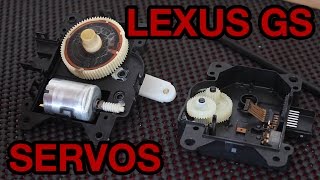
Typical fix: Replace the faulty servo motor. 🎬 Watch this guide on how to repair and clean servos. This requires accessing it from within the dashboard, typically by removing the lower dash panels and the driver's knee airbag assembly. In some cases, a servo re-initialization using Techstream may temporarily resolve the issue.
Est. part cost: $150-$250
Rare But Worth Checking
- A/C Amplifier (ECU) Malfunction: While rare, the HVAC control module itself can fail. TSB L-SB-0019-20 mentions that for some 2017-2019 models, a software update (flash reprogram) for the A/C amplifier should be performed as part of the diagnosis. If a new servo motor doesn't fix the issue, this could be the cause.
- Wiring Harness or Connector Issue: An open or short in the wiring to the servo motor, or a loose connector, could also trigger this code. This is much less common than motor failure but should be checked while the area is disassembled. A DIY guide on Reddit notes it's difficult to unplug the connector while the servo is installed, so checking the connection is part of the replacement process.
Diagnosis Steps
- Connect a bi-directional scan tool (like Toyota Techstream) to the OBD-II port.
- Read codes from the Air Conditioning module. Confirm B1453 is present and not just in history.
- Monitor the live data for the 'Driver Side Cool Air Mix Servo'. Observe the 'Target Pulse' and 'Actual Pulse' values while commanding the temperature from full cold to full hot.
- If the 'Actual Pulse' does not match the 'Target Pulse' or does not move, the servo motor or its circuit is faulty. A large discrepancy (e.g., target of 152 vs actual of 254) confirms the error.
- Listen for clicking noises from the driver's side lower dashboard while changing temperature settings, which indicates a mechanically failed/stuck servo motor.
- Before replacement, attempt to run the 'INITIALIZE SERVOMOTOR' utility in Techstream. In some rare cases, this software recalibration can resolve the fault.
- If the fault persists, gain access to the servo motor connector (it has a blue connector) to test for power, ground, and signal from the A/C amplifier to rule out a wiring issue.
- If tests confirm the motor is receiving commands but not responding correctly, the servo motor has failed and needs replacement. A small ratchet with a Phillips bit is considered essential for removing the hidden screws.
Parts You'll Likely Need
- Damper Servo Sub-Assembly (Driver Side Cool Air Mix)
(OEM #87106-30610)— This is the specific servo motor that fails and causes the B1453 code. It is the primary point of failure. Note: Some OEM parts suppliers list this part as discontinued, but it is still available through various channels.
Trusted brands: Lexus (OEM), Denso (Aftermarket, often the OEM supplier)
OEM price range: $150-$250
Aftermarket price range: $100-$180
Related Codes That Often Appear With This One
- B1454 — This is the corresponding code for the 'Passenger Side Air Outlet Damper COOL Control Servo Motor Circuit'. These servos are of the same design and often fail around the same time.
- B1441, B1446, B1455, etc. — These are codes for other HVAC servo motors within the same system. It is very common for multiple servo motors to fail and set codes simultaneously, as they are a known weak point across the entire vehicle line-up.
Technical Service Bulletins (TSBs) & Recalls
- L-SB-0001-21 Rev: 'HVAC Servo Motor Malfunction'. Lists B1453 and provides diagnostic/repair guidance for 2015-2017 RC 350 models, among others.
- L-SB-0019-20: 'HVAC Servo Motor Malfunction'. A similar TSB covering 2017-2019 RC 350 models, also listing B1453 and suggesting a potential A/C amplifier reprogram.
- Customer Support Program 20LE01 (ZLE): Not a TSB, but an official Lexus program extending warranty coverage for this exact failure on 2015-2017 RC 350s due to 'internal electrical malfunction'.
Platform-Specific Known Issues
- Lexus issued Technical Service Bulletin L-SB-0001-21 Rev, which covers the 2015-2017 RC 350, and L-SB-0019-20, which covers 2017-2019 models, for widespread HVAC servo motor malfunctions. These bulletins list B1453 as a known fault code and provide diagnostic steps.
- A Customer Support Program (20LE01 / ZLE) was initiated by Lexus in January 2021, extending warranty coverage for this specific issue on approximately 328,700 vehicles, including the 2015-2017 RC 350. The program covers the cost of repair for a confirmed internal electrical malfunction of the A/C servo motors.
Mechanic-Grade Diagnostic Values
- Techstream Live Data: 'Cool A/M Servo (D)' Target vs. Actual Pulse — expected: The 'Target Pulse' and 'Actual Pulse' values should be nearly identical as the temperature is changed.. Failure: A large discrepancy between the target and actual pulse values (e.g., target of 152 vs. actual of 254) indicates a fault in the servo motor or its circuit.
- Servo Motor Bench Test — expected: Applying 12V and ground to the two gold tabs at the base of the motor should cause it to spin. Reversing the polarity should cause it to spin in the opposite direction.. Failure: If the motor does not spin in one or both directions, it is internally faulty.
Scan Tool Commands That Help
- Toyota Techstream: Servo Motor Initialization — This utility forces the A/C amplifier to relearn the end-stop positions of all servo motors. It should be performed after replacing a servo, disconnecting the battery, or as a first diagnostic step, as it can sometimes temporarily resolve a stuck motor.
- Toyota Techstream: Active Test — Allows a technician to command a specific servo motor (e.g., 'Cool A/M Servo (D)') to move to a desired position while observing its 'Actual Pulse' in the live data list. This directly confirms if a specific servo is non-responsive before disassembly.
- Toyota Techstream: Flash Reprogram (A/C Amplifier) — As per TSB L-SB-0019-20 (for 2017-2019 models), if DTCs are present, the A/C amplifier may need to be reprogrammed with an updated calibration file to resolve control logic issues before replacing parts.
- Toyota Techstream: AC damper servo operation check tool — This is a specific tool downloaded to the Techstream desktop, mentioned in TSB L-SB-0001-21 Rev1. It runs an 8-14 minute cleaning cycle on the servos. This is intended to be used after a flash reprogram and before part replacement to see if the issue can be resolved by cleaning the internal contacts.
Wiring & Ground Locations
- Driver Side Cool Air Servo Motor Connector — Located in the driver's side footwell, attached to the left side of the central HVAC unit. It is one of a cluster of three servo motors.. This is the specific servo motor for code B1453. It is identified by its BLUE electrical connector, distinguishing it from the adjacent servos with red and brown connectors.
- A/C Amplifier (HVAC ECU) — Located behind the center of the dashboard, above the transmission tunnel.. This is the control unit that sends commands to the servo motor and receives position feedback. All wiring for the servo originates here. TSBs indicate it may require a software update.
Real Owner Repair Stories
- Reddit user on r/LexusIS (Lexus IS (3rd Gen, platform-mate)) — DTC B1453 was present, indicating a servo motor error.
❌ Tried (didn't work) The user did not report trying other fixes first; they went straight to replacement.
✅ What actually fixed it The user successfully replaced the servo motor (part # 87106-30610). A critical tip provided was to manually align the flat part of the damper's protruding shaft with a white mark on the A/C control box housing *before* installing the new servo. After installation, a servo re-initialization was performed using Techstream to complete the repair. - ClubLexus user 'SoloGrunt' (2015 Lexus RC350) — Driver side blows warm air while the passenger side is cold. On-board diagnostics showed code '53' (correlating to B1453).
❌ Tried (didn't work) The user's goal was to avoid replacement cost.
✅ What actually fixed it The user removed the faulty servo motor (location 6, brown connector in their guide, but blue is more commonly cited for B1453), opened the servo casing, cleaned the internal copper contact points and traces with a pencil eraser and isopropyl alcohol, re-lubricated the gears, and reinstalled it. This restored function without needing a new part.
Model Year Variations Within This Range
- 2017-2019: TSB L-SB-0019-20 applies specifically to these later model years and recommends checking if the A/C Amplifier needs a software flash reprogram as a diagnostic step before replacing hardware.
- 2015-2017: These earlier models are covered by TSB L-SB-0001-21 Rev. This bulletin also mentions a flash reprogram, but focuses more on a 'servo cleaning process' using a special Techstream tool after the update.
Helpful Videos

The information in this article is provided for general reference and educational purposes only. Vehicle specifications, procedures, and part compatibility can vary by production date, trim level, and region. Always consult your vehicle's factory service manual and verify part numbers before purchasing or performing repairs. Safety-critical components such as airbags, seat belts, and braking systems should be installed by a qualified professional.
- Lexus RC 350:
- 🧭 Diagnostic Flowchart
- 🎬 Helpful Videos
- What's Unique About the 2015-2019 Lexus RC 350
- Symptoms You May Notice
- Most Likely Causes
- Rare But Worth Checking
- Diagnosis Steps
- Parts You'll Likely Need
- Related Codes That Often Appear With This One
- Technical Service Bulletins (TSBs) & Recalls
- Platform-Specific Known Issues
- Mechanic-Grade Diagnostic Values
- Scan Tool Commands That Help
- Wiring & Ground Locations
- Real Owner Repair Stories
- Model Year Variations Within This Range
- 🎟️ Get 5% Off