

B1455 on 2016-2019 Lexus IS 300: Driver's Foot/Defrost Damper Servo Fixes
Code B1455 on a 2016-2019 Lexus IS 300 means the servo motor that directs air to the driver's footwell and defroster vents has failed. This is a very common issue acknowledged by Lexus in TSB L-SB-0001-21. The fix is to replace the faulty servo motor, but the repair is extremely labor-intensive and expensive, often requiring full dashboard removal. A Customer Support Program (20LE01) was issued, but its primary coverage has expired.
- B1455 is a very specific and common code for a failed Driver's Foot/Defrost servo motor on 2016-2019 Lexus IS 300s and related models.
- The failure is officially acknowledged by Lexus through TSBs and a now-mostly-expired Customer Support Program (20LE01).
- Symptoms include incorrect airflow, clicking from the dash, and the HVAC system not remembering its last settings on startup.
- The repair involves replacing part #87106-30500, but the job is exceptionally labor-intensive (8-17+ hours) and expensive ($1900-$3900+), as it typically requires removing the entire dashboard.
- While the vehicle is drivable, a non-functional defroster poses a safety risk in certain weather conditions.
What's Unique About the 2016-2019 Lexus IS 300
The third-generation Lexus IS, along with its platform mates like the GS and RC, is known for premature failures of these HVAC servo motors due to an internal electrical malfunction. The issue is so common that Lexus issued multiple Technical Service Bulletins (TSBs) and a Customer Support Program (20LE01) to address it. The failure is typically internal to the servo motor itself rather than a wiring or control module problem. The primary challenge is not diagnosis, but the extreme labor involved in accessing and replacing the part, which is buried deep within the dashboard assembly, often requiring its complete removal.
Diagnostic Flowchart
Tap your situation to follow the diagnostic path that matches what you're seeing on this vehicle.
Symptoms You May Notice
- Air blows from the wrong vents (e.g., stuck on floor when dash is selected).
- Inability to switch airflow to the defroster or footwell vents on the driver's side.
- Clicking, grinding, or buzzing noises from behind the dashboard, especially during startup or when changing HVAC modes. 🎬 Watch: How to identify and fix that dashboard clicking noise.
- Climate control system defaults to 'Auto' mode on every startup and doesn't remember the last setting.
- A noticeable delay (up to a minute) before the HVAC controls become responsive after starting the car.
- Replacing the wrong servo motor. The HVAC unit has multiple servos. B1455 is specifically for the Driver Side Foot/Defrost servo.
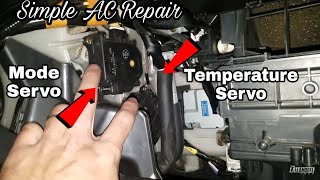
- Confusing the part's location. Although it is a 'driver side' code, some forum users report the servo is physically located on the passenger side of the central HVAC unit 🎬 See how to access and replace the temperature and mode servos., requiring access from the passenger footwell. This confusion arises because the servo controls the driver-side airflow, but its physical placement is on the opposite side of the HVAC box.
Most Likely Causes
- Failed Driver's Foot/Defrost Servo Motor 🔴 High Probability Lexus acknowledged a high rate of internal electrical failure in these specific servo motors via TSB L-SB-0001-21 and Customer Support Program 20LE01. It is a well-documented pattern failure on this platform due to the design of the motor's internal contacts.
How to confirm: Use a diagnostic scan tool like Toyota's Techstream to perform an active test, commanding the servo to move. If it makes noise, doesn't move, or its position feedback on the scanner doesn't change, the motor has failed. In Techstream, a discrepancy between the 'target pulse' and 'actual pulse' for the 'A/O Damper FOOT/DEF Pos(D)' is a definitive indicator of failure.
Typical fix: Replace the faulty servo motor. Due to the high labor cost, it is often recommended to replace other accessible servo motors at the same time as a preventative measure. After replacement, the servos must be re-initialized, which can be done with Techstream or by disconnecting the battery for over 30 minutes.
Est. part cost: $175-$200
Rare But Worth Checking
- Wiring Harness or Connector Issue: While less common than outright servo failure, a damaged wire or loose connection between the A/C Amplifier and the servo motor can cause an open or short in the circuit, triggering the code. This should be checked before condemning the servo, especially if there is no noise from the servo motor.
- Faulty A/C Amplifier: In very rare cases, the control module itself (the A/C Amplifier) can fail and be unable to properly command or read the position of the servo motor. TSB L-SB-0019-20 for 2017-2019 models suggests that reprogramming the A/C amplifier could be a fix, indicating a potential software glitch.
- Mechanical Obstruction: It is possible, though unlikely, for the damper door or its linkage to become physically stuck, preventing the servo from moving and causing the code to set.
Diagnosis Steps
- Connect a professional scan tool (like Toyota Techstream) capable of reading Lexus-specific body codes to confirm B1455 is active or in history.
- Listen carefully for clicking or grinding noises from the lower dashboard area when the vehicle is started or when changing HVAC modes between Floor, Vent, and Defrost.
- Using the scan tool's active test feature, command the 'Driver Side Air Outlet Damper FOOT/DEF Control Servo Motor' to move through its range.
- Observe the live data on the scan tool. Specifically, watch the 'A/O Damper FOOT/DEF Pos(D)' parameter to see if the 'actual pulse' matches the 'target pulse' as it's commanded to move.
- If the servo makes noise but doesn't move, or if the position feedback doesn't change, the servo motor has most likely failed.
- If there is no noise and no movement, access the servo motor connector. For this specific servo, this may require removing the passenger side glove box and lower panels.
- Check the wiring connector at the servo for power and ground with a multimeter when it is being commanded to move.
- If power and ground are present, the servo motor (part #87106-30500) is faulty. If they are not present, inspect the wiring harness back to the A/C Amplifier for damage.
Parts You'll Likely Need
- Air Conditioner Radiator Damper Servo Sub Assembly, No. 1
(OEM #87106-30500)— This is the specific servo motor identified in TSBs and forum discussions as the cause for code B1455. It is also cross-referenced as a related part to other failing servos in the same system.
Trusted brands: Lexus (Genuine OEM), Denso
OEM price range: $175-$200
Aftermarket price range: $100-$150
Related Codes That Often Appear With This One
- B1453 — This code is for the Driver Side Air Outlet Damper COOL Control Servo. These servos are part of the same assembly and prone to the same failures, often failing around the same time.
- B1454 — This is for the Passenger Side Air Outlet Damper COOL Control Servo. It is listed in the same TSBs and indicates a pattern of failure across the HVAC servo family.
- B1441 — For the Passenger Side Lower Air Mix servo, this is another common code that appears with B1455, as noted in Lexus TSBs.
- B1443 — For the main Air Outlet Damper Control Servo, this is also listed in the same TSBs and can occur simultaneously.
Technical Service Bulletins (TSBs) & Recalls
- L-SB-0001-21 Rev - HVAC Servo Motor Malfunction
- L-SB-0001-21 - HVAC Servo Motor Malfunction
- L-SB-0019-20 - HVAC Servo Motor Malfunction
Platform-Specific Known Issues
- Lexus issued Technical Service Bulletin L-SB-0001-21 (and its revision) which specifically identifies code B1455 and provides diagnostic and repair procedures for this common failure on 2016-2017 IS models.
- Lexus also had a Customer Support Program (20LE01) that extended warranty coverage for this specific issue. Primary coverage (regardless of mileage) ended on January 12, 2022. Secondary coverage lasts for 7 years or 125,000 miles from the vehicle's date of first use, whichever comes first. Owners should check with a Lexus dealer with their VIN to see if any coverage still applies, though most 2016-2019 models are likely outside the coverage window now.
Mechanic-Grade Diagnostic Values
- Techstream Live Data: 'A/O Damper FOOT/DEF Pos(D)' Target Pulse (LHD Vehicle) — expected: FACE: 146-156 pulse, B/L: 138 pulse, FOOT: 113-138 pulse, FOOT/DEF: 96 pulse, DEF: 86 pulse.. Failure: The 'actual pulse' value read from the sensor does not match the 'target pulse' value when commanded to change modes, or the value is stuck.
Scan Tool Commands That Help
- Toyota Techstream: Data List > A/O Damper FOOT/DEF Pos(D) — This is the primary diagnostic step to confirm the failure. It allows you to compare the computer's commanded position ('target pulse') with the servo's actual reported position ('actual pulse') in real-time.
- Toyota Techstream: Utility > Servo Motor Initialization — This function should be performed after replacing a servo motor to teach the A/C Amplifier the new motor's position limits. It can also be attempted before replacement to see if it temporarily restores function.
- AC Damper Operation Check Tool: Servo Cleaning Process — According to TSB L-SB-0001-21, this procedure is used after flash reprogramming the A/C amplifier to cycle and clean the servo motor contacts. It requires the vehicle to be in 'Power Supply Mode'.
Wiring & Ground Locations
- A/C Amplifier — Located behind the passenger side glove box. Access requires removing the glove box assembly and lower trim panels.. The A/C Amplifier is the control module for all HVAC servo motors. The wiring harness for the B1455 servo motor connects directly to this unit. Any diagnostic wiring checks (for power, ground, or signal) will originate or terminate at the amplifier's connectors.
Real Owner Repair Stories
- ClubLexus Forum user Kasuhari (2016 Lexus IS200T) — Climate control would not remember its previous setting after the car was off for 30 minutes and would default to 'Auto' mode. Scan tool showed code B1455.
❌ Tried (didn't work) The user was initially confused by the dealer providing a part for the passenger side (87106-30500) for a driver-side code.
✅ What actually fixed it The confirmed fix is replacing the servo motor, but the user was quoted over $3,000 for 13+ hours of labor by the dealer, highlighting the extreme cost and difficulty of the repair. - LexusOwnersClub.co.uk Forum user Randomizer (2015 Lexus IS 300h with 121,000 km) — The only noticeable symptom was the HVAC control panel being unresponsive for about a minute after starting the car, which the owner thought was a normal feature. The B1455 code was discovered during routine yearly maintenance.
✅ What actually fixed it The user was advised by a mechanic that the servo needed replacement, but the story's value is in highlighting the very subtle 'slow to boot' symptom that can be the only clue to this fault code. - Reddit r/LexusIS user (Lexus 3rd Gen IS (3IS)) — DTC B1453 (a similar servo motor code).
❌ Tried (didn't work) Attempting the job without a small ratchet wrench with a Phillips bit is not recommended.
✅ What actually fixed it For a similar servo in the same location, the user confirmed a successful DIY replacement. Key tips include: accessing from the passenger side for LHD cars, using a small ratchet wrench for the hidden screws, removing the screws holding the servo to its bracket (not the bracket to the HVAC box), unplugging the connector *after* unbolting the servo, and aligning the new servo's shaft with a white mark on the HVAC housing before installation.
OEM Part Supersession History
87106-30500→87106-30500 (manufacturing variations exist)— Internal manufacturing updates or different production runs.
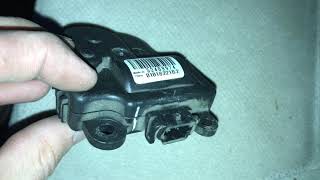
Heads up: A replacement OEM part may have different text printed on the casing (e.g., '12V 04C 8420' instead of '12V 08T 8420'). This is normal, as the official part number is not printed on the servo body itself. As long as the part is sourced using the OEM number 87106-30500, it is the correct component.
Model Year Variations Within This Range
- 2017-2019: For these model years, Lexus issued TSB L-SB-0019-20, which instructs technicians to first flash reprogram the A/C Amplifier as a potential fix for code B1455. This differs from earlier procedures that focused primarily on component replacement, indicating a known software issue in the later part of the generation.
Helpful Videos

Used OEM Parts in Stock
New Aftermarket Parts Available

The information in this article is provided for general reference and educational purposes only. Vehicle specifications, procedures, and part compatibility can vary by production date, trim level, and region. Always consult your vehicle's factory service manual and verify part numbers before purchasing or performing repairs. Safety-critical components such as airbags, seat belts, and braking systems should be installed by a qualified professional.
- Lexus IS 300:
- 🧭 Diagnostic Flowchart
- 🎬 Helpful Videos
- 🛍️ Shop This Part
- What's Unique About the 2016-2019 Lexus IS 300
- Symptoms You May Notice
- Most Likely Causes
- Rare But Worth Checking
- Diagnosis Steps
- Parts You'll Likely Need
- Related Codes That Often Appear With This One
- Technical Service Bulletins (TSBs) & Recalls
- Platform-Specific Known Issues
- Mechanic-Grade Diagnostic Values
- Scan Tool Commands That Help
- Wiring & Ground Locations
- Real Owner Repair Stories
- OEM Part Supersession History
- Model Year Variations Within This Range
- 🎟️ Get 5% Off