

OBD-II Code B1497: HVAC Bus Communication Malfunction
The Ultimate 2026 Guide to Diagnosing and Fixing B1497
- Code B1497 on Toyota and Lexus vehicles indicates a lost communication link—lasting longer than 10 seconds—between the A/C Amplifier and one or more dashboard servo motors.
- A failed servo motor is the most common culprit, costing between $190 and $650 to replace, but a $5 blown fuse or corroded bus connector triggers the exact same code.
- Never replace the $600 A/C Amplifier without first using a bi-directional scan tool to command individual servos and an oscilloscope to verify the LIN bus waveform.
- Driving with B1497 is mechanically safe, but a stuck mode door disables the windshield defroster, creating a critical visibility hazard in cold or humid weather.
What Does B1497 Mean?

B1497 is a manufacturer-specific body control module code primarily used by Toyota and Lexus. It signifies that the A/C Amplifier (the main climate control computer) has lost communication with one or more dashboard servo motors. These motors control airflow direction, dual-zone temperature blending, and fresh air intake.
Technical definition: For Toyota/Lexus, B1497 is defined as 'BUS IC Communication Malfunction'. The HVAC control module stores this code when it detects an open circuit, short, or data error on the Local Interconnect Network (LIN) bus for more than 10 seconds.
Can I Drive With B1497?
Yes, But With Caution. You can drive, but your climate control will not work correctly. The primary safety risk is an inoperative defroster, which severely impairs visibility in cold or humid conditions. Repair this issue immediately before driving in weather that requires windshield defrosting.
Common Causes

- Failed HVAC Servo Motor (Very Common) — An internal failure in one of the small electric blend or mode door motors. These motors operate constantly, causing plastic gears to strip or internal circuits to short.
- Damaged Wiring or Corroded Connector (Common) — Frayed wiring or corroded connectors interrupt the communication signal. On models like the Toyota Sienna, corrosion on the wiring harness's built-in communication driver IC causes total bus failure.
- Blown Fuse or Electrical Short (Less Common) — A blown fuse cutting power to the A/C amplifier or servo circuit. This usually indicates an underlying short circuit elsewhere in the HVAC harness.
- Failed A/C Amplifier (HVAC Control Module) (Less Common) — Internal failure of the main climate control computer. This occurs most frequently after electrical surges, such as improper jump-starting. 🎬 Watch: A quick 30-minute fix for common Toyota A/C problems
- Software/Initialization Glitch (Rare) — The A/C amplifier loses servo position memory after a battery disconnect. Running a 'Servomotor Initialization' via a scan tool often resolves this without parts replacement.
Symptoms

- Inability to Change Airflow Direction — Air is stuck coming out of one set of vents (e.g., only the dash vents) and will not switch to the floor or defroster.
- Inability to Adjust Temperature — The temperature is stuck on full hot or full cold for one or both sides of the vehicle because the air mix servo is unresponsive.
- Clicking or Grinding Noises from the Dashboard — Clicking or grinding noises emit from behind the dash as a faulty servo motor with stripped gears attempts to move.
- HVAC Communication Fault Code Stored (scan-tool only — no driver-felt sign) — The B1497 code is present when checked with a compatible OBD-II scanner.
Diagnostic Flowchart

Tap your situation to follow the diagnostic path that matches what you're seeing on this code.
Common Fixes & Costs
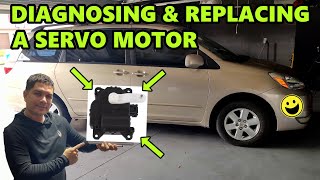
- Replace a Failed HVAC Servo Motor
— Parts: $40-$150, Labor: $150-$500, ~1.5 hr book time
(Intermediate)
Toyota Sienna (2011-2020): OEM 87106-08060 (Air Mix), 87106-08050 (Mode) (Alt: Denso AE063800-0172, Dorman 604-906)
Toyota Camry (2012-2017): OEM 87106-07120 (Air Mix), 87106-07140 (Mode) (Alt: Four Seasons 73329, Dorman 604-953) - Replace a Corroded Wiring Harness Connector — Parts: $25-$100, Labor: $200-$600, ~2.5 hr book time (Intermediate)
- Replace the A/C Amplifier Assembly
— Parts: $200-$600, Labor: $100-$250, ~1.0 hr book time
(Intermediate)
Toyota Sienna (2011-2020): OEM 88650-08060 (Alt: N/A)
Toyota Prius (2010-2015): OEM 88650-47171 (Alt: N/A) - Repair a Damaged Wire or Poor Ground — Parts: $5-$20, Labor: $150-$400, ~2.0 hr book time (Professional)
DIY vs Professional
- Replace a Failed HVAC Servo Motor 🟢 Beginner
Tools: Socket set, screwdrivers, trim removal tools, flashlight. - Replace the A/C Amplifier Assembly 🟢 Beginner
Tools: Basic hand tools, trim removal tools, bi-directional scanner. - Repair a Damaged Wire or Poor Ground 🟢 Beginner
Tools: Multimeter, wire strippers, soldering iron, heat shrink tubing, wiring diagrams.
Used vs. New Parts: Buying Guide
When a used part is worth it: Buy a used A/C Amplifier from a reputable salvage yard if the part number is an exact match. Always buy new servo motors due to the high labor cost of dashboard disassembly.
Donor-vehicle mileage cap: roughly under 100000 miles for the part to have meaningful remaining life.
Donor quality checklist:
- Verify the part number on the used A/C Amplifier is identical to the original part.
- Purchase from sellers with a minimum 30-day return policy.
Decision logic:
- If The failed part is the A/C Amplifier and a used exact-match part is available for <50% of the new price. → Buy used. Most Toyotas require no programming for this module.
- If The failed part is a servo motor. → Buy a new OEM or reputable aftermarket part. The labor required to access it makes used parts too risky.
Warranty tradeoff: Used parts typically have a 30-90 day warranty. New aftermarket parts offer 1-year to limited lifetime warranties. New OEM parts carry the manufacturer's 12-month warranty.
Worst-case if a used part fails: 500. If a used servo motor fails, you pay the full 2-4 hour labor cost again for the repeat installation.
What Happens If You Wait — Timeline
- 0-1 month: Code B1497 is set. Symptoms are intermittent. Temperature is slow to respond, or airflow hesitates before switching. A faint clicking noise begins. (MPG impact: 0%% · Added cost: $0)
- 1-3 months: The fault becomes permanent. Airflow is stuck in one position, or temperature is stuck on full hot/cold. Clicking noises stop as the motor fails completely. (MPG impact: 0%% · Added cost: $0)
- 3-6 months: Critical loss of the defroster function makes the vehicle unsafe to drive in cold or humid weather due to impaired visibility. (MPG impact: 0%% · Added cost: $0)
- 6+ months: If the root cause is a wiring short, insulation on adjacent wires melts, spreading the electrical failure to other body control systems. (MPG impact: 0%% · Added cost: $200 - $800)
Cost of Not Fixing It
- Immediate: Loss of climate control, including A/C and heating, leading to significant discomfort. (Added cost: 0)
- First cold or humid day: Inability to use the defroster, severely impairing visibility and creating a critical safety hazard. (Added cost: 0)
- Long-term (6+ months): If the cause is a wiring short, the problem spreads, melting adjacent wires in the harness and damaging other body control modules. (Added cost: 200 - 800)
Diagnosis Steps
- Read and Document All Codes
Use an OBD-II scanner capable of reading Body Control Module (BCM) codes. Note B1497 and any secondary codes (e.g., B1441). Clear the codes, cycle the A/C, and see which return immediately to confirm a hard fault.
Tools: OBD-II Scanner (with BCM/HVAC capability) (Beginner) - Check All Related Fuses
Locate the fuse box using your owner's manual. Find all fuses related to 'A/C', 'HVAC', or 'Heater'. Use a multimeter to test for continuity. Replace blown fuses, which indicate a deeper electrical short.
Tools: Owner's Manual, Fuse Puller, Multimeter (Beginner) - Perform an Active Test
Use a bi-directional scan tool to command each HVAC servo motor individually. Listen for the motor and feel for airflow changes. The unresponsive motor is the likely fault source.
Tools: Bi-Directional Scan Tool (Intermediate) - Perform a Servo Motor Initialization
Use a scan tool to run the 'AC Servomotor Initialization' utility. This forces the A/C amplifier to relearn servo positions and instantly clears communication faults caused by software glitches or battery disconnects.
Tools: Bi-Directional Scan Tool (Intermediate) - Visually Inspect the Suspect Servo and Connector
Access the unresponsive servo motor identified in Step 3. Inspect the motor and electrical connector for damage, corrosion, or loose wires. On Toyota Siennas, inspect the harness's built-in bus connector.
Tools: Basic Hand Tools, Trim Removal Tools (Intermediate) - Test the Servo Motor Circuit
Unplug the suspect servo. Use a multimeter to check for 11-14V at the B+ pin and continuity to ground (below 1 Ω) at the BUS G pin. Missing power or ground indicates a wiring fault, not a bad servo.
Tools: Multimeter, Wiring Diagram (Advanced) - Check LIN Bus Voltage
Test the LIN bus wire at the A/C Amplifier. With the key ON, it reads near battery voltage (12V) at rest and toggles lower when communicating. A voltage stuck low indicates a short or open bus.
Tools: Multimeter, Wiring Diagram (Advanced) - Check the Communication Bus Waveform
Back-probe the BUS and BUS G terminals at the A/C amplifier with an oscilloscope. You should see a square wave pulse (0V to 12V). A flat line indicates a shorted wire, bad bus connector, or failed A/C amplifier.
Tools: Oscilloscope, Wiring Diagram (Professional) - Isolate the Faulty Component
If the oscilloscope shows a flat line, disconnect servos one by one. If the waveform returns after unplugging a specific motor, that motor has an internal short. If it remains flat, the harness or A/C amplifier is faulty.
Tools: Oscilloscope, Hand Tools (Professional)
When This Code Triggers (Freeze-Frame Conditions)
- Ignition Status: ON (The ignition switch must be in the 'ON' position for the A/C amplifier to monitor the communication bus.)
- System Voltage: 11-14V (The A/C amplifier and servo motors require normal battery voltage to operate. The LIN bus idle voltage rests near battery voltage.)
- Malfunction Time: >10 seconds (The A/C amplifier waits for a continuous communication failure for 10 seconds before logging the B1497 code.)
Related Codes
- B1498 — Indicates a communication failure with the A/C inverter on hybrids. Seeing both codes strongly suggests a wiring or A/C amplifier issue affecting multiple bus lines.
- B1441, B1442, B1443 — Specific servo motor circuit codes. If present with B1497, the fault is isolated to that individual servo motor or its dedicated wiring.
- B1468 — Indicates a fault in a room temperature sensor circuit. B1497 is a bus failure, while B1468 is a single sensor failure.
Climate & Environmental Factors
- High Humidity / Coastal Regions: Elevated humidity and salt air significantly accelerate corrosion on wiring connectors, ground points, and internal servo motor components.
- Cold Climates / Road Salt: Moisture carrying road salt enters the cabin's fresh air intake, corroding under-dash components and degrading the electrical system over time.
How to Talk to a Mechanic About This Code
Say this: "I have a B1497 code and my HVAC system isn't working correctly. I authorize one hour of diagnostic time to perform an active test and identify the specific point of failure—whether it's a servo, the wiring, or the A/C amplifier—before any parts are replaced."
This directs the shop to perform a proper diagnosis rather than just swapping common parts, setting a clear initial budget and preventing expensive misdiagnosis.
Avoid saying:
- 'My A/C is broken, can you fix it?'
- 'Just replace the broken motor.'
- 'Do whatever you think is best.'
Questions to ask before authorizing the repair:
- Did you perform an active test with a scan tool to see which specific components are not responding?
- If a servo is bad, did you test for power, ground, and signal at its connector to rule out a wiring issue?
- If all servos are offline, how did you test the main communication bus and the A/C amplifier?
Where to Take It: Dealer vs Independent vs Chain
- Dealer:
Best for: Vehicles under warranty, Complex electrical issues where previous attempts at an independent shop have failed
Downsides: Highest labor rates and parts costs., Less willing to attempt a wiring repair instead of a full harness replacement. (Typical cost: +50% vs. baseline) - Independent Shop:
Excellent fit, IF you vet the shop. Look for a Toyota/Lexus specialist with bi-directional scan tools and oscilloscope experience.
Best for: Out-of-warranty vehicles where cost is a factor.
Downsides: Must find a shop with strong electrical and diagnostic skills, not just a general mechanic. (Typical cost: +0% vs. baseline) - Chain Shop:
AVOID. This is a complex electrical diagnostic job. The likelihood of a correct first-time diagnosis is very low.
Best for: Simple, unrelated jobs like oil changes or tires.
Downsides: Least likely to have the advanced diagnostic tools needed for a complex communication bus fault. (Typical cost: -10% vs. baseline)
When to Walk Away From the Repair
If the total estimated repair cost exceeds 40-50% of the car's current private-party market value, seriously consider not fixing it.
- Car worth $5000, fix is $2200: Walk away. The repair cost is too high relative to the car's value.
- Car worth $15000, fix is $800: Fix it. This is a reasonable cost to restore a critical safety feature on a valuable vehicle.
What Scan Tool You Need for This Code
Minimum: A scanner that can read manufacturer-specific Body Control Module ('B' codes) and perform bi-directional 'active tests'.
A cheap engine-only code reader will not see the B1497 code. Without bi-directional control to command individual servos, you cannot isolate the fault and will likely replace the wrong parts.
Budget: BlueDriver Pro (~$100) — Reads and clears B-codes from the HVAC module. It lacks bi-directional 'active test' capability, making it insufficient for a full diagnosis.
Mid-range: XTOOL D7 / Launch CReader Elite for Toyota (~$350-450) — Offers full bi-directional control to command each servo motor individually. Performs the 'Servomotor Initialization' procedure required after a repair.
Professional: Autel MaxiCOM MK808BT / MK900-BT (~$500-800) — Provides OEM-level diagnostics, full bi-directional control, initialization functions, and easy access to component locations critical for tracing wiring faults.
Rent vs buy: Auto parts store loaner tools are basic code readers and lack bi-directional capability. Buying a midrange tool is a better investment than paying $75+ for a one-week rental.
How to Clear the Code After You Fix It
- Use a compatible OBD-II scan tool to clear codes from the HVAC/Body Control Module.
- Cycle the ignition off and then on again.
- Operate all climate controls (temperature, mode, fan speed) to verify the repair.
Drive cycle (~5 minutes): A specific drive cycle is not required. Clearing the code with a scan tool and performing a short test drive while operating all HVAC functions confirms the fix.
Readiness monitors affected: None
Watch out for:
- Disconnecting the battery does not reliably clear the code from the A/C amplifier's memory.
- The code returns immediately if the root cause (e.g., bad wire, faulty part) is not fixed.
Will This Fail Emissions / State Inspection?
No — by itself this code doesn't fail OBD inspection (but it can keep readiness monitors from setting, which causes a separate fail).
- California: This is a 'B' (Body) code and does not trigger a failure in a California smog check, which targets 'P' (Powertrain) codes.
- Texas: Texas fails vehicles if the MIL (Check Engine Light) is commanded on. B1497 does not illuminate the MIL, so it passes.
Most Commonly Affected Vehicles
- Toyota Sienna (2011-2020) — Extremely common. Often caused by corrosion in the unique 'bus connector' containing a communication IC. Misdiagnosis is frequent.
- Toyota Prius (2010-2015) — Commonly experiences failures of the A/C amplifier or the wiring harness leading to the servo motors.
- Toyota Camry (2012-2017) — Frequently points to a failure in the servo motor power circuit. Blown fuses are a common root cause.
- Toyota 4Runner (2010-2023) — A known issue with dedicated Toyota diagnostic procedures targeting the LIN bus.
- Lexus IS 250/350 (2006-2015) — Frequently sees this code due to individual servo motor failures. TSB L-SB-0001-21 instructs technicians to diagnose the communication bus.
- Toyota Land Cruiser (2008-2021) — Failures of the rear HVAC unit servo motors trigger this communication code.
- Ford Explorer (2020-2022) — On Ford models, B1497 is defined as 'Decklid Punch-Out Sensor Battery Short' and is completely unrelated to the HVAC system.
- Hyundai/Kia Various Models (2020-2024) — Logs B1497 for an HVAC communication bus error, requiring similar diagnosis of servos and wiring.
Manufacturer-Specific Notes
- Toyota/Lexus: Diagnosis requires a scan tool to perform active tests on individual servos and run the 'Servomotor Initialization' utility after repairs.
- Ford/Lincoln/Mercury: B1497 is defined as 'Decklid Punch-Out Sensor Battery Short' or relates to a lighting system fault, completely unrelated to HVAC.
Real Owner Stories
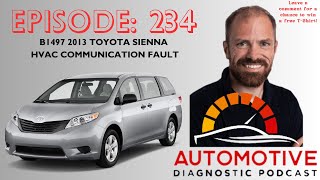
2013 Toyota Sienna with persistent B1497 after multiple parts replaced
Airflow was stuck on the defrost vents. A shop replaced the mode door actuator and the A/C amplifier with new OEM parts, but the B1497 code remained.
What they tried:
- Shop replaced the mode door actuator.
- Shop replaced the A/C amplifier.
- A specialist performed an active test, confirming the mode door and passenger blend door servos were unresponsive.
Outcome: The specialist discovered a unique 'bus connector' in the wiring harness containing a communication IC had failed. Replacing the specific harness section resolved the fault.
Lesson: On Toyota Siennas, the fault is often in a special 'bus connector' within the harness. Blindly replacing servos leads to expensive misdiagnosis.
2007 Toyota Camry with B1497 that defied parts-swapping
A DIY owner experienced non-functional HVAC controls and attempted to fix it by replacing the most common culprits.
What they tried:
- Replaced the HVAC servo wiring harness.
- Replaced the A/C amplifier module.
- The B1497 code immediately returned after clearing.
Outcome: An electrical specialist found the root cause was a blown fuse and a short circuit in a different, related wiring harness. Repairing the short and replacing the fuse fixed the problem.
Lesson: A persistent communication code that doesn't resolve after replacing major components is often caused by a foundational electrical issue like a blown fuse or a short to ground.
How to Prevent This Code From Triggering
- Apply dielectric grease to vulnerable connectors (During any under-dash repair) — Dielectric grease seals electrical connectors from moisture and salt, preventing the corrosion that causes communication failures.
- Clean the cabin air filter regularly (Every 12,000-15,000 miles) — A clogged filter restricts airflow, forcing servo motors to work harder and accelerating wear.
- Address water leaks into the cabin immediately (As needed) — Water leaking from a bad windshield seal drips onto under-dash electronics, leading directly to corrosion and short circuits.
Frequently Asked Questions
Can I fix a B1497 code myself?
Yes, if the cause is a blown fuse or a software glitch requiring a scan tool initialization. Replacing a servo motor is a viable DIY fix if you are comfortable removing dashboard panels. Diagnosing wiring or module faults requires professional tools like an oscilloscope.
Why won't my defroster work with code B1497?
The defroster relies on a 'mode door' inside the dashboard to direct air to the windshield. If the servo motor controlling that door fails or loses communication, the system cannot clear the glass, creating a severe safety hazard.
The shop replaced a motor and the A/C amplifier, but the code is still there. What now?
This is a classic B1497 misdiagnosis. The problem is almost certainly a short in the wiring harness, a corroded bus connector, or a blown fuse. A technician must methodically test the entire circuit for power, ground, and data signal integrity.
What is the most common mistake when diagnosing B1497?
Parts swapping without confirming the diagnosis is the biggest error. Technicians often replace the servo and amplifier when the actual fault is a simple wiring short. Using a scan tool's active test and testing the specific non-responsive circuit prevents this.
What is an 'A/C Amplifier'?
It is the specific term Toyota and Lexus use for the HVAC control module. This computer processes commands from the climate control panel and operates the motors and sensors to manage cabin temperature.
Is it expensive to fix code B1497?
Costs range from $5 for a fuse to over $800 for complex wiring repairs or a new A/C amplifier. Replacing a single servo motor typically costs between $190 and $650, mostly due to the labor required to access the dashboard.
What does servo motor initialization do?
It is a scan tool function that commands the A/C amplifier to move each HVAC door to its endpoint limits, relearning their positions. This is required after replacing a servo or battery and often clears communication glitches instantly.
Key Takeaways
- Code B1497 on Toyota and Lexus vehicles indicates a lost communication link—lasting longer than 10 seconds—between the A/C Amplifier and one or more dashboard servo motors.
- A failed servo motor is the most common culprit, costing between $190 and $650 to replace, but a $5 blown fuse or corroded bus connector triggers the exact same code.
- Never replace the $600 A/C Amplifier without first using a bi-directional scan tool to command individual servos and an oscilloscope to verify the LIN bus waveform.
- Driving with B1497 is mechanically safe, but a stuck mode door disables the windshield defroster, creating a critical visibility hazard in cold or humid weather.
Helpful Videos
Shop the Parts Behind B1497
Below are the parts most often responsible for code B1497, ranked by how frequently each one is the actual culprit (per the diagnosis above). Tap any to see what we have for your vehicle.



The information in this article is provided for general reference and educational purposes only. Vehicle specifications, procedures, and part compatibility can vary by production date, trim level, and region. Always consult your vehicle's factory service manual and verify part numbers before purchasing or performing repairs. Safety-critical components such as airbags, seat belts, and braking systems should be installed by a qualified professional.
- 🧭 Diagnostic Flowchart
- 🎬 Helpful Videos
- 🛍️ Shop This Part
- What Does B1497 Mean?
- Can I Drive With B1497?
- Common Causes
- Symptoms
- Common Fixes & Costs
- DIY vs Professional
- Used vs. New Parts: Buying Guide
- What Happens If You Wait — Timeline
- Cost of Not Fixing It
- Diagnosis Steps
- When This Code Triggers (Freeze-Frame Conditions)
- Related Codes
- Climate & Environmental Factors
- How to Talk to a Mechanic About This Code
- Where to Take It: Dealer vs Independent vs Chain
- When to Walk Away From the Repair
- What Scan Tool You Need for This Code
- How to Clear the Code After You Fix It
- Will This Fail Emissions / State Inspection?
- Most Commonly Affected Vehicles
- Manufacturer-Specific Notes
- Real Owner Stories
- 2013 Toyota Sienna with persistent B1497 after multiple parts replaced
- 2007 Toyota Camry with B1497 that defied parts-swapping
- How to Prevent This Code From Triggering
- Frequently Asked Questions
- Can I fix a B1497 code myself?
- Why won't my defroster work with code B1497?
- The shop replaced a motor and the A/C amplifier, but the code is still there. What now?
- What is the most common mistake when diagnosing B1497?
- What is an 'A/C Amplifier'?
- Is it expensive to fix code B1497?
- What does servo motor initialization do?
- Key Takeaways
- 🎟️ Get 5% Off