

OBD-II Code B1511: Comprehensive Diagnostic and Repair Guide
Manufacturer-specific definitions (GM, Hyundai/Kia, Ford), exact failure points, and pro-level fixes.
- Verify your manufacturer's specific definition for B1511, as it indicates a driver's door handle failure on GM vehicles and a critical seat belt buckle fault on Hyundai/Kia models.
- Treat B1511 on Hyundai or Kia vehicles as an immediate safety hazard, because it disables the driver's airbag and seatbelt pretensioner.
- Fix GM door handle issues by replacing the $25 exterior switch pad or repairing broken wires in the door jamb before authorizing a $500 latch assembly replacement.
- Use an advanced OBD-II scanner capable of reading Body Control Module (BCM) and Supplemental Restraint System (SRS) codes, as $20 generic engine readers cannot detect B1511.
- Test the switch continuity and harness voltage with a multimeter to pinpoint the exact failure before replacing expensive control modules.
What Does B1511 Mean?
Code B1511 depends entirely on the vehicle manufacturer. For General Motors (GM), the Body Control Module (BCM) detects an electrical failure in the driver's exterior door handle circuit. For Hyundai and Kia, the Supplemental Restraint System Control Module (SRSCM) detects an open or short in the driver's seat belt buckle switch circuit. For Ford, it indicates seat position sensor or audio system circuit faults. The control module is failing to receive the correct electrical signal from the specific component.
Technical definition: The SAE/ISO definition is manufacturer-specific. GM: 'Driver Door Handle Circuit Failure'. Hyundai/Kia: 'Buckle Switch Driver open or short to Battery'. Ford: 'Driver Seat Position Sensor Circuit Failure'.
Can I Drive With B1511?
Yes, But With Caution. GM vehicles are safe to drive, though the broken exterior door handle is a major inconvenience. Hyundai/Kia vehicles face a moderate safety risk; the driver's airbag and seatbelt pretensioner will not deploy in a collision. Repair Hyundai/Kia vehicles immediately.
Common Causes
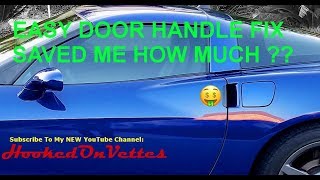
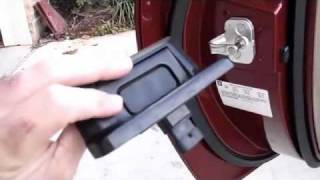
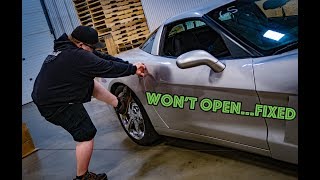
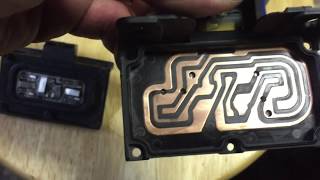
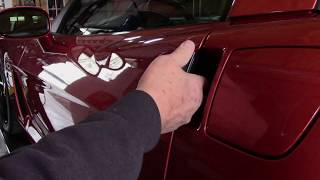
- Faulty Driver Door Handle Switch/Pad (GM) (Very Common) — The electronic switch or rubber pad inside the exterior door handle wears out 🎬 Watch: How to fix a C6 Corvette exterior door handle. from repeated use or corrodes from water exposure.
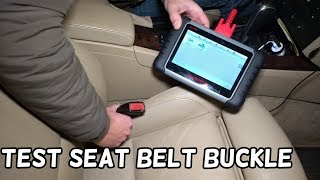
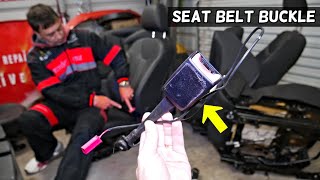
- Faulty Driver's Seat Belt Buckle (Hyundai/Kia) (Very Common) — The internal switch inside the driver's seat belt buckle fails, sending an incorrect resistance signal 🎬 See this walkthrough for fixing Hyundai/Kia seat belt buckle codes. to the airbag control module.
- Broken Wires in Door or Seat Harness (Common) — Wiring harnesses in the door jamb (GM) or under the driver's seat (Hyundai/Kia) break or chafe from constant movement, causing open or short circuits.
- Corroded or Loose Connector (Common) — Moisture or vibration loosens or corrodes the electrical connector at the door handle or seat belt buckle, blocking the signal.
- Water Intrusion (GM) (Less Common) — Failed door handle gaskets allow water inside, shorting the switch or connector.
- Low Battery Voltage (Less Common) — Weak batteries cause the BCM to behave erratically and set false codes, misinterpreting a healthy door handle signal.
- Faulty Control Module (BCM or SRSCM) (Rare) — The control module itself fails. Consider this only after ruling out all switches, wires, and connectors.
Symptoms
- Driver's door won't open from the outside (GM) — Pulling or pressing the exterior door handle does nothing. You must use the key fob or enter through another door.
- Airbag Warning Light is On (Hyundai/Kia) — The dashboard airbag warning light illuminates permanently, indicating a disabled supplemental restraint system.
- Intermittent door handle operation (GM) — The handle requires multiple presses or only works in specific weather conditions.
- Window indexes but door won't unlatch (GM) — The window drops slightly to clear the weatherstripping, but the electronic latch mechanism fails to release.
Diagnostic Flowchart
Tap your situation to follow the diagnostic path that matches what you're seeing on this code.
Common Fixes & Costs
- Replace Exterior Door Handle Switch/Pad (GM) — Parts: $16-$50, Labor: $100-$200, ~0.8 hr book time (DIY)
- Replace Driver's Seat Belt Buckle (Hyundai/Kia) — Parts: $75-$250, Labor: $100-$250, ~1.2 hr book time (Intermediate)
- Repair Broken Wires in Harness — Parts: $5-$20, Labor: $150-$300, ~1.5 hr book time (Intermediate)
- Clean or Replace Electrical Connector — Parts: $0-$30, Labor: $75-$150, ~0.5 hr book time (DIY)
Used vs. New Parts: Buying Guide
When a used part is worth it: Never buy a used Hyundai/Kia seat belt buckle; it is a critical safety component. Buy new aftermarket or OEM GM door handle switches, as used ones fail quickly and new ones cost under $30.
Donor-vehicle mileage cap: roughly under 20000 miles for the part to have meaningful remaining life.
Donor quality checklist:
- Verify the donor vehicle lacks flood or electrical fire damage.
- Match part numbers exactly.
- Never buy used safety components (buckles, airbags) from uncertified sellers.
Decision logic:
- If The part is a GM door handle switch/pad → Buy new. The $25 cost outweighs the short lifespan of a used part.
- If The part is a Hyundai/Kia seat belt buckle → Buy new OEM only. Never compromise on safety components.
- If The part is a wiring harness connector pigtail → A used pigtail from a reputable recycler is acceptable if new is unavailable.
Warranty tradeoff: Used parts offer 30-90 day warranties. New aftermarket parts offer 1-year to lifetime warranties. New OEM parts carry 12-month warranties.
Worst-case if a used part fails: $150-$300. A failed used part requires paying diagnostic and labor fees twice.
What Happens If You Wait — Timeline
- 0-1 month: Fault is intermittent. GM door handle fails occasionally; Hyundai/Kia airbag light flickers. Code stores as 'History'. (MPG impact: 0%% · Added cost: $0)
- 1-3 months: Fault becomes permanent. GM handle dies completely; Hyundai/Kia airbag light stays solid. Code becomes 'Active'. (MPG impact: 0%% · Added cost: $50-$150 (Failed state safety inspection fees).)
- 3-12 months: Chafed wires short against other circuits, causing unrelated electrical failures (power windows/locks) and complicating diagnosis. (MPG impact: 0%% · Added cost: $300-$600 (Complex wiring diagnosis labor).)
- 12+ months: A short to power overloads the driver circuit in the BCM or SRSCM, requiring module replacement. Hyundai/Kia drivers face severe injury if an accident occurs. (MPG impact: 0%% · Added cost: $800-$2000+ (Module replacement and programming).)
Cost of Not Fixing It
- Immediate: Hyundai/Kia driver's airbag and pretensioner are disabled (severe safety risk). GM driver's door won't open from the outside (major inconvenience). (Added cost: Potential injury/death (Hyundai/Kia). Lockout inconvenience (GM).)
- 1-6 months: Ignored chafing wires short against other circuits, damaging the BCM. Vehicle fails state safety inspections. (Added cost: $500-$1500 (BCM replacement and inspection failure fees).)
- 6+ months: Continued flexing deteriorates the wire break point, requiring complex harness replacement rather than a simple splice. (Added cost: $300-$600 (Complex wiring repair).)
Diagnosis Steps
- Verify Code and Manufacturer Definition
Use a Body/SRS capable scanner to confirm B1511. Verify the exact definition for your vehicle (GM: Door Handle, Hyundai: Buckle Switch).
Tools: OBD-II Scanner (Body/SRS Capable) (Beginner) - Perform a 'Wiggle Test'
For GM, wiggle the rubber wiring boot in the door hinge while trying the handle. For Hyundai/Kia, wiggle the harness under the driver's seat while watching the airbag light. Intermittent function confirms a broken wire.
Tools: Hands (No tools required) (Beginner) - Scan Tool Live Data Analysis
Access BCM/SRSCM live data. GM: Monitor 'Driver Door Handle Switch' PID; it must toggle when pressed. Hyundai/Kia: Monitor 'Driver Buckle Switch' PID; it must change to 'Buckled' when fastened. Static data confirms a switch or circuit fault.
Tools: Advanced OBD-II Scanner (Intermediate) - Inspect Component and Connector
Visually inspect the GM handle pad for cracks or the Hyundai buckle for debris. Disconnect the electrical connector and check for green corrosion or pushed-out pins.
Tools: Trim Removal Tools, Flashlight (Intermediate) - Test for Reference Voltage
With the key on, use a multimeter to check for voltage (typically 5V or 12V) at the harness connector plugging into the switch. No voltage points to upstream wiring or a bad module.
Tools: Multimeter, Vehicle-Specific Wiring Diagram (Intermediate) - Advanced Signal Analysis
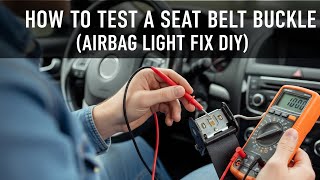
Test the disconnected switch. GM two-wire switches should show infinite resistance normally, and near-zero (≈0–5 Ω) when pressed. Hyundai resistor-based switches vary (e.g., ~400Ω unbuckled, ~1000Ω buckled). Incorrect readings dictate replacement.
Tools: Multimeter, Service Manual (Advanced) - Check for Shorts to Ground or Power
Test the signal wire for shorts. With component and module disconnected, check continuity between the signal wire and ground. Then check for voltage on the signal wire with the key on. Any reading indicates a harness short.
Tools: Multimeter, Wiring Diagram (Advanced) - Inspect Fuses
Locate and inspect fuses for the BCM, door locks, or SRS. A blown fuse causes this code, though it usually indicates a deeper short circuit.
Tools: Owner's Manual, Fuse Puller (Beginner)
When This Code Triggers (Freeze-Frame Conditions)
- System Voltage: 11.5V - 14.5V (The module logs a fault the instant an out-of-spec voltage or resistance is detected on the circuit.)
- Ignition Status: ON / RUN (The code sets when the ignition is on and modules perform active self-checks.)
- Component State Change: Active/Pressed (GM) or Buckled/Unbuckled (Hyundai/Kia) (The fault registers when the driver presses the handle or fastens the belt, and the module receives no electrical response.)
- Fault Counter: 1 or more (Modules log the fault after detecting the anomaly multiple consecutive times to filter out transient glitches.)
Related Codes
- B1512 — Indicates an 'Open' circuit (GM) or 'Short to GND' (Hyundai). Seeing B1511 and B1512 together confirms a broken wire or completely dead switch.
- B1513 — Indicates a 'Short to Battery'. The signal wire is receiving 12V improperly, usually caused by a chafed wire touching a power wire in the harness.
- B3130 — A general GM code for 'Driver Door Lock/Unlock Circuit Malfunction'. If paired with B1511, start by testing the handle switch before replacing the lock actuator.
- B1193 — A Ford code ('Event Threshold Exceeded') stored in the Restraints Control Module. If seen with B1511, it indicates a complex SRS issue requiring professional diagnosis.
Climate & Environmental Factors
- High Humidity / Rain: Accelerates corrosion on electrical connectors and switch contacts, causing GM door handle failures.
- Cold Weather: Makes GM rubber handle pads brittle and stiffens wire insulation, increasing the chance of wires breaking when flexed.
- Salt Belt Regions: Airborne salt significantly increases corrosion rates on exposed door terminals.
How to Talk to a Mechanic About This Code
Say this: "For GM: "I have a B1511 code and my driver's door handle isn't working. Please diagnose the door handle switch and the door jamb wiring before quoting a latch assembly." For Hyundai/Kia: "I have an airbag light and a B1511 code for the driver's seat belt buckle switch. Please use an SRS scanner to confirm the buckle circuit fault before quoting repairs.""
This proves you understand the manufacturer-specific definition. For GM, it prevents an immediate quote for an expensive door latch assembly. For Hyundai/Kia, it confirms you know it is a safety system issue requiring SRS verification.
Avoid saying:
- "My door won't open." (Too vague, invites a wide-ranging diagnostic fee).
- "Just fix the code."
- "I read online it's the switch, just replace it." (Authorizing repair without diagnosis makes you liable if it fails).
Questions to ask before authorizing the repair:
- For GM: Did you test the switch continuity and perform a wiggle test on the door jamb wiring?
- For Hyundai/Kia: Did the SRSCM live data show the buckle switch status failing to change?
- Are you using an OEM or aftermarket replacement part?
- What is your warranty on parts and labor?
Where to Take It: Dealer vs Independent vs Chain
- Dealer:
Recommended for Hyundai/Kia due to airbag system liability. Expensive but reliable for GM if you demand OEM parts.
Best for: Hyundai/Kia vehicles, as dealers carry the highest liability and training for Supplemental Restraint System (SRS) faults., Vehicles under warranty., Complex wiring issues requiring proprietary diagnostic tools.
Downsides: Highest labor rates (1.5-2x independent shops)., Often replaces entire assemblies (full door handle) rather than individual components (switch pad). (Typical cost: +50% vs. baseline) - Independent Shop:
Best fit for GM door handle issues at a reputable electrical shop. For Hyundai/Kia, only use ASE-certified shops explicitly specializing in SRS/airbags.
Best for: GM vehicles, specifically shops specializing in auto electrical diagnostics., Out-of-warranty vehicles., Labor-intensive broken wire repairs.
Downsides: Experience with body electrical or SRS systems varies widely., May lack manufacturer-specific scan tools for deep module diagnosis. (Typical cost: +0% vs. baseline) - Chain Shop:
AVOID. Chain shops lack the diagnostic expertise for B1511 and frequently refuse SRS-related work.
Best for: Unrelated routine maintenance (oil, tires).
Downsides: Technicians lack specialized training for Body Control or SRS diagnostics., High risk of misdiagnosis on manufacturer-specific codes. (Typical cost: -10% vs. baseline)
When to Walk Away From the Repair
If the estimated repair cost exceeds 40-50% of the car's current private-party value, consider selling as-is or trading it in.
- Car worth $22000, fix is $450: Fix it. A $450 repair on a 2008 Corvette is well below the threshold and restores daily functionality.
- Car worth $5500, fix is $400: Fix it. A $400 repair on a 2013 Hyundai Elantra is essential. An active airbag light makes the car unsafe and unsellable to private parties.
- Car worth $2000, fix is $900: Walk away. A $900 module or complex wiring repair on a $2,000 vehicle exceeds the threshold.
What Scan Tool You Need for This Code
Minimum: A scanner capable of reading and clearing Body Control Module (BCM) and Supplemental Restraint System (SRS) codes. Basic engine-only readers WILL NOT work.
Generic $20 OBD-II readers only communicate with the Engine Control Module (ECM). B1511 is stored in the BCM (GM) or SRSCM (Hyundai/Kia). You need module access to view the code, read live data, and clear the fault.
Budget: BlueDriver Pro Scan Tool (~$100) — Connects via Bluetooth. Reads/clears BCM and SRS codes, views live switch status data, and generates repair reports.
Mid-range: Foxwell NT630 Plus / Autel MaxiLink ML629 (~$130-200) — Handheld units accessing Engine, ABS, Transmission, and SRS. Reads/clears B1511 and streams live data for the buckle or handle switch.
Professional: Autel MaxiCOM MK808S / Foxwell NT716 (~$400-600) — Full-tablet scanners with all-system access and bidirectional controls. Activates components directly to test BCM functionality.
Rent vs buy: Auto parts store loaner tools typically CANNOT read BCM/SRS codes. You must buy or borrow a capable scanner. The BlueDriver is the most cost-effective investment for this specific code.
How to Clear the Code After You Fix It
- Reconnect the negative battery terminal.
- Use a BCM/SRS capable OBD-II scan tool to clear the code.
- Cycle the ignition off, then on, and verify the warning light remains off.
Drive cycle (~5 minutes): Complex drive cycles are unnecessary. After clearing, press the GM door handle or buckle the Hyundai/Kia seatbelt several times with the ignition on. If the code stays clear, the repair is successful.
Readiness monitors affected: None. Emissions readiness monitors are unaffected by Body or SRS codes.
Watch out for:
- Using a basic engine scanner that cannot communicate with the BCM/SRSCM.
- Disconnecting the battery fails to clear SRS codes stored in non-volatile memory.
- The code returns instantly if the broken wire or faulty switch wasn't actually fixed.
Will This Fail Emissions / State Inspection?
No — by itself this code doesn't fail OBD inspection (but it can keep readiness monitors from setting, which causes a separate fail).
- California: An airbag light will NOT fail the smog check, but signifies a critical safety defect.
- New York: Current DMV documentation states an airbag light is an advisory and not cause for rejection, though policies vary by station.
- Texas: The airbag light is NOT checked during the safety inspection and will not cause a failure.
- Virginia: An illuminated airbag light is an automatic safety inspection failure.
Most Commonly Affected Vehicles
- Chevrolet Corvette (C6) (2005-2013) — Extremely common failure of the electronic door handle pads and door jamb wiring.
- Cadillac XLR (2004-2009) — Shares the C6 Corvette platform and suffers identical door handle and wiring failures.
- Hyundai Elantra, Sonata, Tucson, Santa Fe (2004-2015) — B1511 indicates a critical 'Buckle Switch Driver' fault, disabling the airbag.
- Kia Optima, Sorento, Sportage, Forte (2005-2015) — B1511 points to the driver's seat belt buckle switch circuit, compromising crash safety.
- Chevrolet HHR (2006-2011) — Known for wires breaking inside the flexible door hinge boot.
- Pontiac Solstice (2006-2010) — Experiences frequent failures in the door handle switch and harness.
- Saturn Sky (2007-2010) — Shares the Solstice platform and identical door handle circuit problems.
- Ford Crown Victoria, Ranger (1998-2011) — B1511 indicates 'Driver Seat Position Sensor Circuit Failure', affecting airbag deployment logic.
Manufacturer-Specific Notes
- Hyundai / Kia: B1511 means 'Buckle Switch Driver open or short to Battery'. It disables the driver's airbag and pretensioner. The issue is the buckle switch, not the door handle.
- General Motors: The code points to the driver's door handle pad or door jamb wiring. Low battery voltage from a failing alternator can also trigger this code falsely.
- Ford: Indicates 'Driver Seat Position Sensor Circuit Failure', affecting seat memory and airbag logic. On newer models, it points to an 'Automobile Audio Bus (A2B) Master Node' failure.
- Suzuki: Indicates 'Malfunction Indication Light Open' or a 'Temperature Control Actuator' fault. It is unrelated to doors or airbags.
Real Owner Stories
2008 Chevrolet Corvette (C6) at 75,000 miles
Driver's exterior door handle died. Key fob and interior release worked perfectly.
What they tried:
- Checked BCM fuses (all good).
- Replaced 5-year-old battery to rule out low voltage.
- Performed a wiggle test on door jamb wiring with no result.
Outcome: Replaced the exterior door handle switch pad (OEM P/N 22775873) for $25. The handle worked immediately, and the B1511 code was cleared permanently.
Lesson: On C6 Corvettes, the door handle pad is the primary failure point. It is a cheap, easy DIY fix that should be attempted before diagnosing complex wiring.
2013 Hyundai Elantra at 110,000 miles
Airbag warning light stayed on. A parts store scanned B1511 but incorrectly defined it as a door handle issue.
What they tried:
- Researched 'Hyundai B1511 airbag light' and found it relates to the seat belt buckle.
- Wiggled wiring under the driver's seat, causing the airbag light to flicker.
Outcome: Replaced the driver's side seat belt buckle assembly with an OEM part. Cleared the code with an SRS scanner, and the light stayed off.
Lesson: Never trust generic code definitions. Hyundai B1511 is a seat belt buckle fault. An intermittent light during a wiggle test confirms a wiring or component fault, not a bad module.
2007 Saturn Sky with intermittent B1511
Driver's door handle worked intermittently in cold/wet weather.
What they tried:
- Replaced exterior door handle switch (problem returned).
- Cleaned and greased the connector (temporary fix).
Outcome: An auto electrician opened the door jamb wiring loom and found two chafed wires making intermittent contact. Repaired the wires with butt connectors and heat-shrink tubing, permanently resolving the issue.
Lesson: If a new part fails to fix an intermittent issue, the root cause is wiring. The door jamb harness is a high-flex area and a frequent failure point.
How to Prevent This Code From Triggering
- Apply Dielectric Grease to Connectors (Anytime a connector is disconnected.) — Seals electrical contacts from moisture and salt, preventing the corrosion that causes high resistance and B1511 codes.
- Inspect Door Jamb Harness (Every 2-3 years.) — Ensures the rubber boot is secure and wires aren't pinched. Reinforcing with Tesa tape adds abrasion resistance to this high-flex area.
- Clean Seat Belt Buckles (Annually.) — Vacuuming and blowing compressed air into the buckle clears debris that interferes with the internal switch operation.
Frequently Asked Questions
Why did my airbag light come on with a B1511 code?
On Hyundai and Kia vehicles, B1511 indicates a fault with the driver's seat belt buckle sensor. This sensor is a critical component of the airbag system.
Can I get locked out of my car with a B1511 code?
Yes, on GM vehicles. If the exterior handle switch fails and your key fob battery dies, you must use the hidden manual emergency key.
Is replacing the door handle switch a DIY job?
Yes, for most GM vehicles. On a C6 Corvette, the switch pad is easily accessible after removing the door panel. The part costs under $30.
I replaced the switch/buckle, but the code came back. What now?
The problem is almost certainly in the wiring. Inspect the bundle of wires running through the rubber boot in the door jamb (GM) or under the seat (Hyundai/Kia). These wires flex and break over time.
What is a common misdiagnosis for a B1511 code?
Technicians often misdiagnose a Hyundai seat belt buckle as a door handle issue due to generic code readers. On GM vehicles, shops frequently replace the expensive door latch actuator when only the $25 handle switch failed.
My scanner can't find code B1511, but I have the symptoms. Why?
B1511 is a Body (B) or Supplemental Restraint System (SRS) code. Basic $20 OBD-II scanners only read Powertrain (P) codes. You need an advanced scanner to communicate with the BCM or SRSCM.
What's the difference between a B1511 and P1511 code?
The first letter dictates the system: 'B' is for Body (locks, airbags), and 'P' is for Powertrain (engine, transmission). A P1511 code relates to engine idle control, which is entirely unrelated to the B1511 body code.
Key Takeaways
- Verify your manufacturer's specific definition for B1511, as it indicates a driver's door handle failure on GM vehicles and a critical seat belt buckle fault on Hyundai/Kia models.
- Treat B1511 on Hyundai or Kia vehicles as an immediate safety hazard, because it disables the driver's airbag and seatbelt pretensioner.
- Fix GM door handle issues by replacing the $25 exterior switch pad or repairing broken wires in the door jamb before authorizing a $500 latch assembly replacement.
- Use an advanced OBD-II scanner capable of reading Body Control Module (BCM) and Supplemental Restraint System (SRS) codes, as $20 generic engine readers cannot detect B1511.
- Test the switch continuity and harness voltage with a multimeter to pinpoint the exact failure before replacing expensive control modules.
Helpful Videos
Shop the Parts Behind B1511
Below are the parts most often responsible for code B1511, ranked by how frequently each one is the actual culprit (per the diagnosis above). Tap any to see what we have for your vehicle.



The information in this article is provided for general reference and educational purposes only. Vehicle specifications, procedures, and part compatibility can vary by production date, trim level, and region. Always consult your vehicle's factory service manual and verify part numbers before purchasing or performing repairs. Safety-critical components such as airbags, seat belts, and braking systems should be installed by a qualified professional.
- 🧭 Diagnostic Flowchart
- 🎬 Helpful Videos
- 🛍️ Shop This Part
- What Does B1511 Mean?
- Can I Drive With B1511?
- Common Causes
- Symptoms
- Common Fixes & Costs
- Used vs. New Parts: Buying Guide
- What Happens If You Wait — Timeline
- Cost of Not Fixing It
- Diagnosis Steps
- When This Code Triggers (Freeze-Frame Conditions)
- Related Codes
- Climate & Environmental Factors
- How to Talk to a Mechanic About This Code
- Where to Take It: Dealer vs Independent vs Chain
- When to Walk Away From the Repair
- What Scan Tool You Need for This Code
- How to Clear the Code After You Fix It
- Will This Fail Emissions / State Inspection?
- Most Commonly Affected Vehicles
- Manufacturer-Specific Notes
- Real Owner Stories
- 2008 Chevrolet Corvette (C6) at 75,000 miles
- 2013 Hyundai Elantra at 110,000 miles
- 2007 Saturn Sky with intermittent B1511
- How to Prevent This Code From Triggering
- Frequently Asked Questions
- Why did my airbag light come on with a B1511 code?
- Can I get locked out of my car with a B1511 code?
- Is replacing the door handle switch a DIY job?
- I replaced the switch/buckle, but the code came back. What now?
- What is a common misdiagnosis for a B1511 code?
- My scanner can't find code B1511, but I have the symptoms. Why?
- What's the difference between a B1511 and P1511 code?
- Key Takeaways
- 🎟️ Get 5% Off